

Live Video Mind-Body Program for Patients With Knee Osteoarthritis, Comorbid Depression, and Obesity: Development and Feasibility Pilot Study
Open accessPublished version of a preprint
The DOI matches its Crossref record; 112 of the 112 references it cites were found in a registry or an index.
Abstract
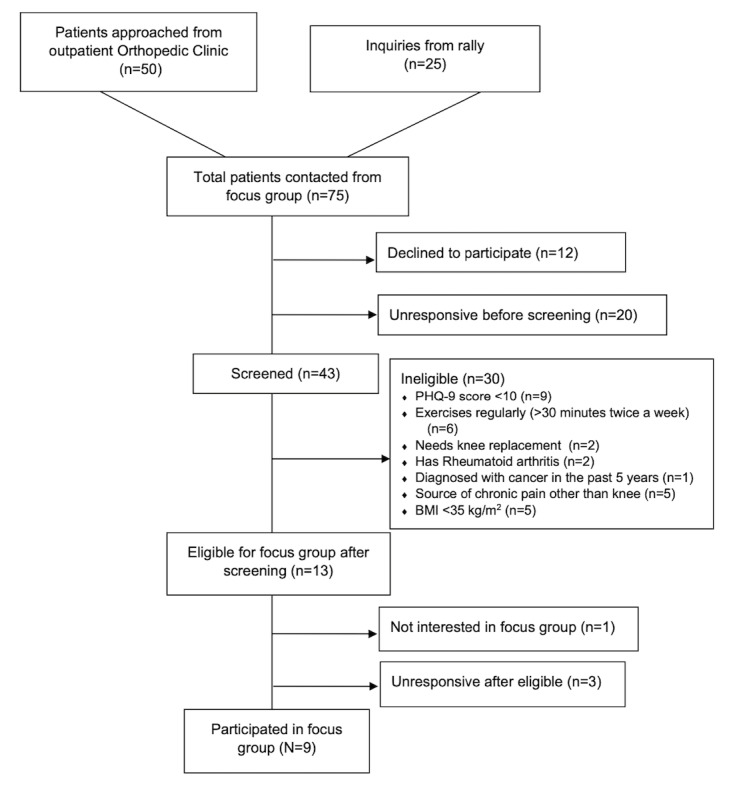
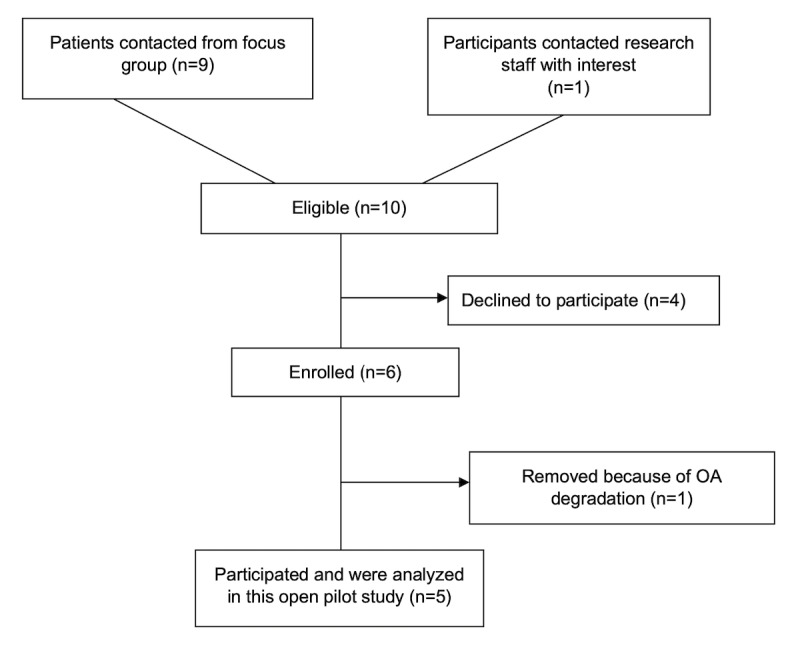
Background: Knee osteoarthritis (KOA) is the most common joint disorder in the United States and a leading cause of disability. Depression and obesity are highly comorbid with KOA and accelerate knee degeneration and disability through biopsychosocial mechanisms. Mind-body physical activity programs can engage biological, mechanical, and psychological mechanisms to improve outcomes in KOA, but such programs are not currently available. Objective: This mixed methods study aims to adapt a mind-body activity program for the unique needs of patients with KOA, depression, and obesity (GetActive-OA) delivered via live video. Methods: Participants were adults (aged ≥45 years) from rural Kentucky with obesity (BMI≥30 kg/m2), idiopathic KOA with mild to moderate radiographic changes, and elevated depressive symptoms (9-item Patient Health Questionnaire ≥10) recruited from 2 orthopedic centers. In phase 1, we developed GetActive-OA and the study protocol using qualitative focus group feedback from the study population (N=9; 2 focus groups, 90 minutes) and multidisciplinary expertise from clinical psychologists and orthopedic researchers. In phase 2, we explored the initial feasibility, credibility, and acceptability of GetActive-OA, live video delivery, and study procedures via an open pilot with exit interviews (N=5; 1 group). This research was guided by National Institutes of Health (NIH) model stage IA. Results: Phase 1 qualitative analyses revealed nuanced information about challenges with coping and increasing activity, high interest in a mind-body activity program, program participation facilitators (flexibility with technology) and barriers (amotivation and forgetfulness), and perceived challenges with data collection procedures (blood and urine samples and homework). Phase 2 quantitative analyses showed that GetActive-OA met most a priori feasibility markers: acceptability (80%), expectancy (100%), credibility (100%), clinician adherence (90%), homework adherence (80%), questionnaire data collection (100%), program satisfaction (100%), and safety (100%). Adherence to ActiGraph wear (80% baseline, 20% posttest) and collection of blood samples (60%) were low. Participation in GetActive-OA was associated with signals of improvements in general coping (Cohen d=2.41), pain catastrophizing (Cohen d=1.24), depression (Cohen d=0.88), anxiety (Cohen d=0.78), self-efficacy (Cohen d=0.73), pain (Cohen d=0.39), and KOA symptoms (Cohen d=0.36). Qualitative exit interviews confirmed quantitative findings and provided valuable information to optimize the program and protocol. Conclusions: Patients with KOA, depression, and obesity from rural Kentucky were interested in a live video mind-body activity program. GetActive-OA shows promise; however, the program and protocol require further NIH stage I refinement before formal efficacy testing (NIH model stage II). International Registered Report Identifier (IRRID): RR2-10.1016/j.conctc.2021.100720
Overview
The claims and statistics of this paper haven’t been checked yet.
Free: it reads the open-access text and checks the first 5 claims that cite a source we can check. Create a free account to check every claim.
Integrity signals
Registry
Cites
Statistics
Figures
Verification
Claims the paper makes
The claims and statistics of this paper haven’t been checked yet.
Free: it reads the open-access text and checks the first 5 claims that cite a source we can check. Create a free account to check every claim.
Claims other papers make about this one
Each is checked against this paper’s own text: does it say what the citing paper says it does?
The cited source says what the claim attributes to it.
In the citing paper
“The prespecified thresholds (criteria for success), as outlined in Table 2 for the feasibility, are based on established benchmarks of previous feasibility trials [47,48] and our previous experience in recruiting pediatric patients with concussion from an ED [49].”
Self-check
Percentages, sums and reported differences re-computed from the paper’s own numbers.
The self-check needs the paper’s full text.
Citations
Cites
The PHQ-9: Validity of a brief depression severity measure
Kroenke, K., Spitzer, R. L., & Williams, J. B. W. (2001) · Journal of General Internal Medicine · doi:10.1046/j.1525-1497.2001.016009606.x · Cited by 44,910
Radiological Assessment of Osteo-Arthrosis
Kellgren, J. H., & Lawrence, J. S. (1957) · Annals of the Rheumatic Diseases · doi:10.1136/ard.16.4.494 · Cited by 12,422 · cited 1×
“The inclusion criteria were as follows: (1) obesity (BMI ≥30 kg/m(2)), (2) idiopathic KOA [49] with mild to moderate radiographic changes (Kellgren or Lawrence grade 2 or 3 [50]) or Knee Injury and Osteoarthritis Outcome Scores (KOOSs) consistent with KOA [51], (3) elevated depressive symptoms with a 9-item Patient He…”
BackgroundSpitzer, R. L. (1999) · JAMA · doi:10.1001/jama.282.18.1737 · Cited by 9,802 · cited 1×
“The inclusion criteria were as follows: (1) obesity (BMI ≥30 kg/m(2)), (2) idiopathic KOA [49] with mild to moderate radiographic changes (Kellgren or Lawrence grade 2 or 3 [50]) or Knee Injury and Osteoarthritis Outcome Scores (KOOSs) consistent with KOA [51], (3) elevated depressive symptoms with a 9-item Patient He…”
BackgroundMolecular Mechanisms of Depression: Perspectives on New Treatment Strategies
Lang, U. E., & Borgwardt, S. (2013) · Cellular Physiology and Biochemistry · doi:10.1159/000350094 · Cited by 8,475
The Pain Catastrophizing Scale: Development and validation.
Sullivan, M. J. L., Bishop, S. R., & Pivik, J. (1995) · Psychological Assessment · doi:10.1037//1040-3590.7.4.524 · Cited by 8,227 · cited 6×
“In addition, mind-body programs, which incorporate a range of complementary practices (eg, meditation, relaxation, breathing, and body movement) [33], can decrease depression, obesity, and pain in osteoarthritis (OA) [34-36], which are additional barriers to engagement in activity in this population.”
BackgroundMethodInfluentialAltman, R., Asch, E., Bloch, D., Bole, G., Borenstein, D., Brandt, K., Christy, W., Cooke, T. D., Greenwald, R., Hochberg, M., et al. (1986) · Arthritis & Rheumatism · doi:10.1002/art.1780290816 · Cited by 6,777 · cited 1×
“The inclusion criteria were as follows: (1) obesity (BMI ≥30 kg/m(2)), (2) idiopathic KOA [49] with mild to moderate radiographic changes (Kellgren or Lawrence grade 2 or 3 [50]) or Knee Injury and Osteoarthritis Outcome Scores (KOOSs) consistent with KOA [51], (3) elevated depressive symptoms with a 9-item Patient He…”
BackgroundFarrar, J. T., Young, J. P., LaMoreaux, L., Werth, J. L., & Poole, M. R. (2001) · Pain · doi:10.1016/s0304-3959(01)00349-9 · Cited by 5,808
Fear-avoidance and its consequences in chronic musculoskeletal pain: a state of the art.
Vlaeyen, J. W. S., & Linton, S. J. (2000) · Pain · doi:10.1016/s0304-3959(99)00242-0 · Cited by 4,931 · cited 2×
“Participants learn that inflammation is the biological tie among the 3 conditions and physical activity is a modifiable factor that can decrease inflammation, improve the biology and function of the knee, and decrease both depression and obesity [7-9,16,38-40,65-67].”
BackgroundA Meta-Analysis of Cytokines in Major Depression
Dowlati, Y., Herrmann, N., Swardfager, W., Liu, H., Sham, L., Reim, E. K., & Lanctôt, K. L. (2010) · Biological Psychiatry · doi:10.1016/j.biopsych.2009.09.033 · Cited by 4,729 · cited 2×
“Participants learn that inflammation is the biological tie among the 3 conditions and physical activity is a modifiable factor that can decrease inflammation, improve the biology and function of the knee, and decrease both depression and obesity [7-9,16,38-40,65-67].”
BackgroundDesign and analysis of pilot studies: recommendations for good practice
Lancaster, G. A., Dodd, S., & Williamson, P. R. (2004) · Journal of Evaluation in Clinical Practice · doi:10.1111/j..2002.384.doc.x · Cited by 2,572 · cited 2×
“The phase 2 quantitative results offer preliminary evidence that GetActive-OA is sensitive to population-specific needs and that the measures are sensitive to changes in key outcomes [98,99].”
BackgroundMethod
Research works printed but not linked: 2
- Marks R Knee osteoarthritis psychological complications: an important overlooked disease correlate Nov Tech Arthritis Bone Res 2017 08 02 1 4 555568
- Cohen J Statistical Power Analysis for the Behavioral Sciences 2nd Edition 1988 Hillside, NJ Lawrence Erlbaum Associates
Cited by
Ledoux, A.-A., Zemek, R., Cairncross, M., Silverberg, N., Sicard, V., Barrowman, N., Goldfield, G., Gray, C., Harris, A. D., Jaworska, N., et al. (2024) · JMIR Research Protocols · doi:10.2196/57226 · Cited by 15
“The prespecified thresholds (criteria for success), as outlined in Table 2 for the feasibility, are based on established benchmarks of previous feasibility trials [47,48] and our previous experience in recruiting pediatric patients with concussion from an ED [49].”
Background(2024) · doi:10.2196/preprints.57226 · Cited by 14
Mace, R. A., Law, M. E., Cohen, J. E., Ritchie, C. S., Okereke, O. I., Hoeppner, B. B., Brewer, J. A., Bartels, S. J., Vranceanu, A., & My Healthy Brain Team (2024) · JMIR Research Protocols · doi:10.2196/64149 · Cited by 6
Self-citationZhang, Y., Zhang, B., Li, W., Yang, Z., & Bai, M. (2023) · PubMed Central · Cited by 4
Becker, M. E., Levey, N., Yeh, G. Y., Giacino, J. T., Iverson, G. L., Silverberg, N. D., Parker, R. A., McKinnon, E., Siravo, C., Shah, P., et al. (2024) · JMIR Formative Research · doi:10.2196/64540 · Cited by 5
“We used proportions and descriptive statistics to calculate preliminary a priori feasibility benchmarks (Table 2), consistent with Greenberg et al [25], Mace et al [27], and Vranceanu et al [17].”
Self-citationPresciutti, A., Rochon, E. A., Alvarez-Frank, N. A., Daily, J., Silverman, E., Motta, M., Vranceanu, A., & Hwang, D. Y. (2025) · Neurocritical Care · doi:10.1007/s12028-025-02387-x · Cited by 2
Self-citationJacobs, C. A., Ortiz, S. F., MOON Shoulder Group, Baumgarten, K. M., Bishop, J. Y., Bollier, M. J., Bravman, J. T., Brophy, R. H., Cvetanovich, G. L., Feeley, B. T., et al. (2023) · The American Journal of Sports Medicine · doi:10.1177/03635465231188975 · Cited by 2
“Other studies have used automated text messaging to deliver PROM questionnaires with a similar number of items to patient populations ranging from those with anterior cruciate ligament injuries to knee osteoarthritis.(7,22) Future work is needed to determine if the combination of validated short forms with SMS text me…”
MethodSelf-citationCampos, L., Moniz, A., Donato, H., Nunes, B., & Cruz, E. B. (2025) · JBI Evidence Synthesis · doi:10.11124/jbies-24-00396 · Cited by 1
Sicard, V., Cairncross, M., Zemek, R. L., Silverberg, N. D., Goldfield, G. S., Reed, N. P., Saab, B. J., Smith, A., & Ledoux, A. (2026) · JMIR Rehabilitation and Assistive Technologies · doi:10.2196/84623 · Cited by 2
“The prespecified feasibility targets for progressing to a definitive trial were informed by established benchmarks from previous feasibility trials [57,58] and our experience recruiting pediatric concussion patients from the ED [59].”
Lezcano, M., Landuzzi, M. G., Pasini, M., Laezza, L., & Vacondio, M. (2026) · Journal of Technology in Behavioral Science · doi:10.1007/s41347-026-00670-y · Cited by 2
Miao, C., Ning, W., Li, B., & Yan, B. (2024) · Research Square · doi:10.21203/rs.3.rs-3811025/v1
Miao, C., Ning, W., Li, B., & Yan, B. (2025) · Research Square · doi:10.21203/rs.3.rs-3811025/v2
Sicard, V., Cairncross, M., Zemek, R. L., Silverberg, N. D., Goldfield, G. S., Reed, N. P., Saab, B. J., Smith, A., & Ledoux, A. (2025) · doi:10.2196/preprints.84623
Lentz, T. A., Porter, L. S., McGarvey, L., Rhodes, C., Rocos, B., Gremore, T. M., Reinke, E. K., Eucker, S. A., Green, C. L., Poehlein, E., et al. (2025) · JMIR Research Protocols · doi:10.2196/77236
Fouad, R., Fattah, N. K. A. E., & Sorour, D. M. (2026) · International Journal of Orthopaedic and Trauma Nursing · doi:10.1016/j.ijotn.2026.101281
Doorley, J. D., Triplett, A. N., Post, E. G., Antonio, L., Clark, E., Clark, M., Vincent, H. K., Bartley, J. D., Donaldson, A. T., & Finnoff, J. T. (2026) · Research Square · doi:10.21203/rs.3.rs-10501945/v1
Self-citation
Metadata
- Authors
- Mace, R. A., Greenberg, J., Lemaster, N., Duarte, B., Penn, T., Kanaya, M., Doorley, J. D., Burris, J. L., Jacobs, C. A., & Vranceanu, A.-M.
- Affiliations
- Harvard University (US)
- University of Kentucky (US)
- Massachusetts General Hospital (US)
- Corresponding author
- Jacobs, Cale A
- ORCID
- Venue
- JMIR Formative Research
- Publisher
- JMIR Publications Inc.
- Published
- 2022-04-27
- Volume
- 6
- Issue
- 4
- Pages
- e34654
- ISSN
- 2561-326X (ISSN-L)
- PMC
- PMC9096632
- OpenAlex
- W4224997229
- Cited by
- 15
- References
- 112
- Citations by year
- 2026: 4 · 2025: 5 · 2024: 4 · 2023: 2
- FWCI
- 1.65
- Type
- journal article
- Language
- en
- Open access
- gold
- doi.org
- Licence
- cc-by
- Locations
- JMIR Formative Research (publishedVersion, cc-by)
- PubMed Central (publishedVersion, cc-by)
- PubMed (publishedVersion)
- DOAJ (DOAJ: Directory of Open Access Journals) (submittedVersion)
- Funders
- National Institutes of Health (UL1TR001998)
- National Center for Advancing Translational Sciences
- National Center for Complementary and Integrative Health (K23AT010653, R34AT010370)
- Topics
- Health Sciences › Health Professions › Physical Therapy, Sports Therapy and Rehabilitation › Musculoskeletal pain and rehabilitation
- Health Sciences › Medicine › Public Health, Environmental and Occupational Health › Physical Activity and Health
- Social Sciences › Psychology › Clinical Psychology › Mindfulness and Compassion Interventions
- Keywords
- knee osteoarthritis, depression, obesity, feasibility, acceptability, coping, pain catastrophizing, self-efficacy, anxiety, physical activity adherence, wearable activity trackers, comorbidities, program development, biopsychosocial model, orthopedic patients, patient-reported outcomes
About these checks
Registry, retraction, Cites and statistics results are computed, not judged, with one exception: a printed reference that no index lists is read once by a model before it counts as a citation error. Claims are extracted by a model and kept only when their quote appears verbatim in the text; each cited source is then checked, with a model’s help, for whether it says what the claim relies on. Those verdicts can be wrong — read the claim’s quote and the cited source before relying on one.
Statistics and arithmetic are recomputed, not judged.
Confidence bands are shown only for fields calibrated on our annotated test set. None is calibrated yet, so no band is shown.
What counts as a claim ›How we measure confidence ›How we check this ›
Are you an author, or do you see a problem with this page? Request a review
Data sources
Bibliographic data: Semantic Scholar, OpenAlex, Crossref.
Contains information from the Semantic Scholar Academic Graph Datasets, made available under the ODC Attribution License (ODC-BY 1.0).
Semantic Scholar’s data is described in: Kinney, R., et al. (2023). The Semantic Scholar Open Data Platform. arXiv:2301.10140.
