

Single-Session Interventions Embedded Within Tumblr: Acceptability, Feasibility, and Utility Study
Open accessPublished version of a preprint
The DOI matches its Crossref record; 65 of the 65 references it cites were found in a registry or an index.
Abstract
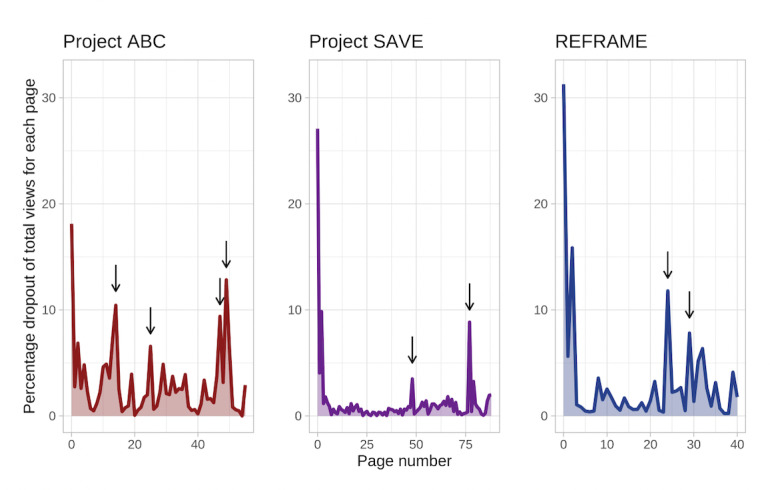
Background: Existing mental health treatments are insufficient for addressing mental health needs at scale, particularly for teenagers, who now seek mental health information and support on the web. Single-session interventions (SSIs) may be particularly well suited for dissemination as embedded web-based support options that are easily accessible on popular social platforms. Objective: We aimed to evaluate the acceptability and effectiveness of three SSIs, each with a duration of 5 to 8 minutes (Project Action Brings Change, Project Stop Adolescent Violence Everywhere, and REFRAME)—embedded as Koko minicourses on Tumblr—to improve three key mental health outcomes: hopelessness, self-hate, and the desire to stop self-harm behavior. Methods: We used quantitative data (ie, star ratings and SSI completion rates) to evaluate acceptability and short-term utility of all 3 SSIs. Paired 2-tailed t tests were used to assess changes in hopelessness, self-hate, and the desire to stop future self-harm from before to after the SSI. Where demographic information was available, the analyses were restricted to teenagers (13-19 years). Examples of positive and negative qualitative user feedback (ie, written text responses) were provided for each program. Results: The SSIs were completed 6179 times between March 2021 and February 2022. All 3 SSIs generated high star ratings (>4 out of 5 stars), with high completion rates (approximately 25%-57%) relative to real-world completion rates among other digital self-help interventions. Paired 2-tailed t tests detected significant pre-post reductions in hopelessness for those who completed Project Action Brings Change (P<.001, Cohen dz=−0.81, 95% CI −0.85 to −0.77) and REFRAME (P<.001, Cohen dz=−0.88, 95% CI −0.96 to −0.80). Self-hate significantly decreased (P<.001, Cohen dz=−0.67, 95% CI −0.74 to −0.60), and the desire to stop self-harm significantly increased (P<.001, Cohen dz=0.40, 95% CI 0.33 to 0.47]) from before to after the completion of Project Stop Adolescent Violence Everywhere. The results remained consistent across sensitivity analyses and after correcting for multiple tests. Examples of positive and negative qualitative user feedback point toward future directions for SSI research. Conclusions: Very brief SSIs, when embedded within popular social platforms, are one promising and acceptable method for providing free, scalable, and potentially helpful mental health support on the web. Considering the unique barriers to mental health treatment access that many teenagers face, this approach may be especially useful for teenagers without access to other mental health supports.
Overview
The claims and statistics of this paper haven’t been checked yet.
Free: it reads the open-access text and checks the first 5 claims that cite a source we can check. Create a free account to check every claim.
Integrity signals
Registry
Cites
Statistics
Figures


Verification
Claims the paper makes
The claims and statistics of this paper haven’t been checked yet.
Free: it reads the open-access text and checks the first 5 claims that cite a source we can check. Create a free account to check every claim.
Claims other papers make about this one
Each is checked against this paper’s own text: does it say what the citing paper says it does?
The cited source says what the claim attributes to it.
In the citing paper
“For example, single-session interventions integrated into popular social media platforms demonstrate potential in addressing acute mental health needs, such as self-harm [29].”
From Social Media Use in Adolescents: Bans, Benefits, and Emotion Regulation Behaviors (2024) · cites this paper as [29]
The cited source says what the claim attributes to it.
In the citing paper
“There have also been calls to employ more widely used technologies, such as text messaging (Willcox et al., 2019), messaging apps (Fitzpatrick et al., 2017), and social media (Dobias et al., 2022), so that interventions fit easily into users' daily routines and are more scalable.”
From A text messaging intervention to support the mental health of young adults: User engagement and feedback from a field trial of an intervention prototype (2023) · cites this paper as Dobias et al., 2022
Self-check
Percentages, sums and reported differences re-computed from the paper’s own numbers.
The self-check needs the paper’s full text.
Citations
Cites
Controlling the False Discovery Rate: A Practical and Powerful Approach to Multiple Testing
Benjamini, Y., & Hochberg, Y. (1995) · Journal of the Royal Statistical Society Series B: Statistical Methodology · doi:10.1111/j.2517-6161.1995.tb02031.x · Cited by 109,482 · cited 1×
“We applied a false discovery rate correction to all 4 P values to reduce the likelihood of false positives [45].”
MethodDiscovering statistics using R
(2012) · Choice Reviews Online · doi:10.5860/choice.50-2114 · Cited by 2,534
The functions of deliberate self-injury: a review of the evidence
Klonsky, E. D. (2007) · Clinical Psychology Review · doi:10.1016/j.cpr.2006.08.002 · Cited by 1,979 · cited 1×
“Project SAVE was designed to reduce the use of self-harm behaviors to cope with high emotional distress, especially in the context of self-hatred or desires to punish oneself [33].”
BackgroundThe impact of guidance on Internet-based mental health interventions — A systematic review
Baumeister, H., Reichler, L., Munzinger, M., & Lin, J. (2014) · Internet Interventions · doi:10.1016/j.invent.2014.08.003 · Cited by 1,037 · cited 1×
“Low real-world completion rates for self-help digital interventions, especially relative to guided digital supports [26,48,49], are unsurprising; unguided supports require substantial emotional and mental bandwidth (eg, energy, sustained attention, and motivation) to find and engage with an unguided mental health supp…”
BackgroundBarriers to mental health treatment: results from the National Comorbidity Survey Replication
Mojtabai, R., Olfson, M., Sampson, N. A., Jin, R., Druss, B., Wang, P. S., Wells, K. B., Pincus, H. A., & Kessler, R. C. (2011) · Psychological Medicine · doi:10.1017/s0033291710002291 · Cited by 951 · cited 1×
“Existing mental health treatments have long been inaccessible due to well-established structural (eg, cost, transportation, and time) and individual (eg, stigma and distrust of providers) barriers [1-3].”
BackgroundMcRae, K., & Gross, J. J. (2020) · Emotion · doi:10.1037/emo0000703 · Cited by 949
Weisz, J. R., Kuppens, S., Ng, M. Y., Eckshtain, D., Ugueto, A. M., Vaughn-Coaxum, R., Jensen-Doss, A., Hawley, K. M., Krumholz Marchette, L. S., Chu, B. C., et al. (2017) · American Psychologist · doi:10.1037/a0040360 · Cited by 862 · cited 3×
“Black, Hispanic, and Asian youths consistently access mental health treatment at lower rates than their non-Hispanic White peers [55,56], yet up to 90% of youths in mental health clinical trials are White [57,58].”
BackgroundInfluentialConstructing Confidence Sets Using Rank Statistics
Bauer, D. F. (1972) · Journal of the American Statistical Association · doi:10.1080/01621459.1972.10481279 · Cited by 848 · cited 1×
“For outcomes where difference scores were not normally distributed, we completed an additional sensitivity analysis using the nonparametric Wilcoxon signed-rank test to evaluate within-group changes from before to after the intervention [44].”
MethodTorous, J., Nicholas, J., Larsen, M. E., Firth, J., & Christensen, H. (2018) · Evidence Based Mental Health · doi:10.1136/eb-2018-102891 · Cited by 790 · cited 2×
“Once disseminated in the real world, digital interventions often encounter issues with user engagement (ie, low uptake and low completion) [26-28].”
BackgroundFleming, T., Bavin, L., Lucassen, M., Stasiak, K., Hopkins, S., & Merry, S. (2018) · Journal of Medical Internet Research · doi:10.2196/jmir.9275 · Cited by 670 · cited 1×
“Once disseminated in the real world, digital interventions often encounter issues with user engagement (ie, low uptake and low completion) [26-28].”
Background
Cited by
Schleider, J. L., Zapata, J. P., Rapoport, A., Wescott, A., Ghosh, A., Kaveladze, B., Szkody, E. M., & Ahuvia, I. L. (2025) · Annual Review of Clinical Psychology · doi:10.1146/annurev-clinpsy-081423-025033 · Cited by 169
Self-citationSchleider, J. L., & Beidas, R. S. (2022) · Frontiers in Health Services · doi:10.3389/frhs.2022.997406 · Cited by 65
Self-citationSmith, A. C., Ahuvia, I. L., Ito, S., & Schleider, J. L. (2023) · International Journal of Eating Disorders · doi:10.1002/eat.23976 · Cited by 69
Self-citationShroff, A., Roulston, C. A., Fassler, J., Dierschke, N. A., Todd, J. S. P., Ríos-Herrera, Á., Plastino, K. A., & Schleider, J. L. (2023) · JMIR Mental Health · doi:10.2196/43062 · Cited by 61
“Similar to other web-based SSI evaluations [10,15,52], the youths in this project showed an SSI completion rate of 49.6%.”
InfluentialSelf-citationRealizing the untapped promise of single‐session interventions for eating disorders
Schleider, J. L., Smith, A. C., & Ahuvia, I. L. (2023) · International Journal of Eating Disorders · doi:10.1002/eat.23920 · Cited by 59
Self-citationSocial Media Use in Adolescents: Bans, Benefits, and Emotion Regulation Behaviors
McAlister, K. L., Beatty, C. C., Smith-Caswell, J. E., Yourell, J. L., & Huberty, J. L. (2024) · JMIR Mental Health · doi:10.2196/64626 · Cited by 47
“For example, single-session interventions integrated into popular social media platforms demonstrate potential in addressing acute mental health needs, such as self-harm [29].”
BackgroundMixed-Methods Examination of Adolescent-Reported Barriers to Accessing Mental Health ServicesPreprint
Ringle, V. A. M., Sung, J. Y., Roulston, C. A., & Schleider, J. L. (2023) · PsyArXiv (OSF Preprints) · doi:10.1016/j.jadohealth.2023.08.034 · Cited by 59
Self-citationKruzan, K. P., Fitzsimmons‐Craft, E. E., Dobias, M., Schleider, J. L., & Pratap, A. (2022) · Procedia Computer Science · doi:10.1016/j.procs.2022.09.081 · Cited by 49
Self-citationHo, T. Q. A., Le, L. K.-D., Engel, L., Le, N., Melvin, G., Le, H. N. D., & Mihalopoulos, C. (2025) · European Child & Adolescent Psychiatry · doi:10.1007/s00787-024-02386-x · Cited by 38
“Mental illness symptoms (e.g., hopelessness, low energy) [45, 46, 91], insufficient understanding of mental health and available services [23, 43, 46, 47, 54, 58, 59, 64, 76–78, Trust or concern about the program and privacy Eighteen studies (29”
InfluentialPublic health measures related to the transmissibility of suicide
Pirkis, J., Bantjes, J. R., Gould, M. S., Niederkrotenthaler, T., Robinson, J., Sinyor, M., Ueda, M., & Hawton, K. (2024) · The Lancet Public Health · doi:10.1016/s2468-2667(24)00153-1 · Cited by 44
Kornfield, R., Stamatis, C. A., Bhattacharjee, A., Pang, B., Nguyen, T., Williams, J. J., Kumar, H., Popowski, S., Beltzer, M., Karr, C. J., et al. (2023) · Internet Interventions · doi:10.1016/j.invent.2023.100667 · Cited by 33
“, 2017), and social media (Dobias et al., 2022), so that interventions fit easily into users' daily routines and are more scalable.”
BackgroundCohen, K. A., Dobias, M., Morris, R. R., & Schleider, J. L. (2022) · PsyArXiv (OSF Preprints) · doi:10.1016/j.jbct.2022.12.001 · Cited by 38
Self-citationHankin, B. L., & Griffith, J. M. (2023) · Clinical Child and Family Psychology Review · doi:10.1007/s10567-023-00437-4 · Cited by 38
“SSI proponents and researchers take care to note that these interventions are meant to motivate and supplement, not replace, comprehensive evidence-based therapies (Dobias et al., 2022; Schleider et al., 2022).”
BackgroundHamilton, J. L., Torous, J. B., Szlyk, H. S., Biernesser, C. L., Kruzan, K. P., Jensen, M. R., Reyes‐Portillo, J. A., Primack, B. A., Zelazny, J. M., & Weigle, P. E. (2024) · Current Treatment Options in Psychiatry · doi:10.1007/s40501-024-00315-y · Cited by 35
“Media industry/researchers: Partnerships are critical to create promising preventative interventions built within existing social media platforms [48].”
BackgroundSuicide prevention: reflections on progress over the past decade
Hawton, K. E., & Pirkis, J. (2024) · The Lancet Psychiatry · doi:10.1016/s2215-0366(24)00105-6 · Cited by 22
Evaluating change in body image concerns following a single session digital intervention
Nemesure, M. D., Park, C., Morris, R. R., Chan, W. W., Fitzsimmons‐Craft, E. E., Rackoff, G. N., Fowler, L. A., Taylor, C. B., & Jacobson, N. C. (2022) · Body Image · doi:10.1016/j.bodyim.2022.11.007 · Cited by 19
Self-citationDeveloping a Mobile App for Young Adults with Nonsuicidal Self-Injury: A Prototype Feedback Study
Kruzan, K. P., Reddy, M. C., Washburn, J. J., & Mohr, D. C. (2022) · International Journal of Environmental Research and Public Health · doi:10.3390/ijerph192316163 · Cited by 18
“For example, a 30 min online intervention for adolescents who self-harm (Project Stop Adolescent Violence Everywhere) showed preliminary support for reductions in NSSI-related targets (self-hate and desire to stop selfinjury) through an randomized controlled trial (RCT) [34], and later in an implementation through the…”
BackgroundSusman, E. S., Chen, S., Kring, A. M., & Harvey, A. G. (2024) · Behaviour Research and Therapy · doi:10.1016/j.brat.2024.104498 · Cited by 16
“…in youth (0.29 [0.06, 0.53]; Schleider & Weisz, 2017), SCT required approximately the same resource investment and slightly more time investment including home practice, than some single-session self-guided interventions (SCT: 12 – 15 min vs. as low as 5 – 8 min in Dobias et al. [2022]).”
BackgroundInfluentialKruzan, K. P., Whitlock, J. L., Chapman, J., Bhandari, A., & Bazarova, N. N. (2023) · JMIR Formative Research · doi:10.2196/41546 · Cited by 14
Ghosh, A., Cohen, K. A., Jans, L. K., Busch, C. A., McDanal, R., Yang, Y., Cooper, K. M., & Schleider, J. L. (2023) · JMIR Mental Health · doi:10.2196/48926 · Cited by 19
“Across multiple trials, both youths and young adults, who report limited access to traditional mental health services owing to a variety of structural-and stigma-related barriers [27], rated SSIs as highly acceptable [26,28,29].”
BackgroundSelf-citationQuayle, E., Larkin, A., Schwannauer, M., Varese, F., Cartwright, K. L., Chitsabesan, P., Green, V., Radford, G., Richards, C., Shafi, S., et al. (2024) · BMC Psychiatry · doi:10.1186/s12888-024-05605-6 · Cited by 14
“Existing feasibility, acceptability, and efficacy studies of DHIs indicate that they are acceptable across genders [37], can impact behavior as well as mood [38], and are safe for vulnerable YP [39].”
BackgroundSteinberg, J. S., Fitzpatrick, O. M., Khurana, S., Kim, M. Y., Mair, P., Schleider, J. L., Hatzenbuehler, M. L., & Weisz, J. R. (2024) · Journal of Clinical Child & Adolescent Psychology · doi:10.1080/15374416.2024.2384026 · Cited by 20
Self-citationDigital Single-Session Interventions for Child and Adolescent Mental Health
Ghosh, A., McDanal, R., & Schleider, J. L. (2023) · Advances in Psychiatry and Behavioral Health · doi:10.1016/j.ypsc.2023.03.016 · Cited by 13
Self-citationDigital Single-Session Interventions for Youth Mental Health
Jans, L. K., Sotomayor, I., & Schleider, J. L. (2024) · CBT: science into practice · doi:10.1007/978-3-031-60746-2_13 · Cited by 11
Self-citationIntegrating Single-Session Interventions into Existing Care Systems
Cohen, K. A., Smith, A. C., & Schleider, J. L. (2024) · Advances in Psychiatry and Behavioral Health · doi:10.1016/j.ypsc.2024.04.006 · Cited by 9
Self-citationHatoum, A. H., Coutts‐Bain, D., Hunnisett, N., Baffsky, R., O’Dea, B., & Torok, M. H. (2025) · EClinicalMedicine · doi:10.1016/j.eclinm.2025.103601 · Cited by 9
Self-Hatred: The Unaddressed Symptom of Borderline Personality Disorder
Wilner, J. G., Ronzio, B., Gillen, C., & Aguirre, B. A. (2024) · Journal of Personality Disorders · doi:10.1521/pedi.2024.38.2.157 · Cited by 6
A crowdsourced megastudy of 12 digital single-session interventions for depression in US adults
Kaveladze, B. T., Voelkel, J. G., Stagnaro, M. N., Huang, M., Smock, A., Sullivan, E., Xu, Y., McCall, M. P., Zapata, J. P., Ahmed, S. I., et al. (2026) · Nature Human Behaviour · doi:10.1038/s41562-026-02415-6 · Cited by 11
“In many cases, these deployments reached people who were unlikely to have received an evidence-based intervention otherwise 13 .”
Self-citationKornfield, R., Popowski, S. A., Tack, E., Svoboda, J., Herrera, M. A., Nguyen, T., Knapp, A. A., Mohr, D. C., & Meyerhoff, J. (2025) · JMIR Formative Research · doi:10.2196/68950 · Cited by 9
“Some DMHIs have been designed with scalability in mind, such as by delivering interventions in online spaces where adolescents seek mental health information and through communication channels that are already highly used by young people, such as messaging apps, texting, and social media [36-38].”
Dallison, S., Munir, S., Chubb, E., Padley, H. J., Fung, H. M., Desrochers, D. M., & Loades, M. E. (2025) · BMC Medical Research Methodology · doi:10.1186/s12874-025-02636-9 · Cited by 7
“Ten studies [23–27, 29, 34–37] included the exact text narrative that they used on social media adverts.”
Maity, A., Wang, A. W., Dreier, M. J., Wallace, V., Orchard, F., Schleider, J. L., Loades, M. E., & Hamilton, J. L. (2023) · Clinical Child Psychology and Psychiatry · doi:10.1177/13591045231205475 · Cited by 8
“…they require substantial mental and emotional effort during times of distress (Fleming et al., 2018), SSIs could be a potentially promising solution as they have been intentionally designed to lower time and effort demands, which may improve user engagement with interventions (Dobias et al., 2022).”
BackgroundSelf-citationLoades, M. E., Perry, G., & Marshall, N. (2025) · JMIR Mental Health · doi:10.2196/72077 · Cited by 9
“A briefer version of an SSI embedded in Tumblr has been found to be feasible and acceptable in the United States [64] Alternatively, it may be that some participants discontinued because they had received what they wanted from the SSI, a pattern which has been found in a subgroup of adolescents…”
Kaveladze, B. T., Ghosh, A., Funkhouser, C. J., Schueller, S. M., & Schleider, J. L. (2025) · Clinical Psychological Science · doi:10.1177/21677026251358836 · Cited by 5
“In naturalistic contexts (i.e., outside of trials in which participants are compensated), people are less likely to drop out of shorter SSIs and might be more willing to begin them (Cohen & Schleider, 2022; Dobias et al., 2022).”
Self-citationCooper, C., Sala, L. L., Patlamazoglou, L., Patrick, P., Sabo, A., Rajaram, G., & Robinson, J. (2026) · Computers in Human Behavior Reports · doi:10.1016/j.chbr.2026.101067 · Cited by 6
Schleider, J. L., & Morris, R. R. (2026) · Child and Adolescent Mental Health · doi:10.1111/camh.70105 · Cited by 4
Self-citationSzkody, E. M., Chang, Y., & Schleider, J. L. (2023) · Journal of Clinical Child & Adolescent Psychology · doi:10.1080/15374416.2023.2272935 · Cited by 4
“Previous studies have found digital SSIs to be effective and acceptable for use in reducing hopelessness, depression, and anxiety among teens recruited through social media (e.g., Dobias et al., 2022; Schleider & Weisz, 2017).”
Self-citationKaveladze, B. T., Shkel, J., Le, S., Marcotte, V., Rushton, K., Nguyen, T., & Schueller, S. M. (2024) · Internet Interventions · doi:10.1016/j.invent.2024.100774 · Cited by 3
Depression and depressive disorders
Griffith, J. M., McCormick, K. C., & Hankin, B. L. (2023) · Elsevier eBooks · doi:10.1016/b978-0-323-96023-6.00037-3 · Cited by 4
Smith, A. C., Ahuvia, I. L., Zapata, J. P., Cohen, K. A., Graham, A. K., & Schleider, J. L. (2025) · Behaviour Research and Therapy · doi:10.1016/j.brat.2025.104809 · Cited by 6
Self-citationAn open pilot trial of digital single-session interventions for healthcare workers and trainees
Sotomayor, I., Szkody, E. M., Schleider, J. L., & Pati, S. (2025) · Journal of Workplace Behavioral Health · doi:10.1080/15555240.2025.2587074 · Cited by 2
“Compensating HCWs for participation limits the generalizability of findings in real-world settings, as demonstrated in research documenting disparate rates of SSI completion when compensation is removed (Cohen & Schleider, 2022; Dobias et al., 2022).”
Self-citationAmaro, C. M., Silver, S., Patel, P., Collins, M. K. R., Canter, K. S., Fooks‐Parker, S., Amylon, M. D., Hudson, S. V., Schleider, J. L., Alderfer, M. A., et al. (2026) · Pediatric Blood & Cancer · doi:10.1002/1545-5017.70192 · Cited by 2
“These recommendations mirror dissemination settings of existing digital SSIs [ 36, 37 ].”
Self-citationJones, G. M., Castro‐Ramirez, F., Al‐Suwaidi, M., McGuire, T. C., & Herrmann, F. M. (2023) · JMIR Formative Research · doi:10.2196/53268 · Cited by 1
Lapadat, L., Wilson, S., Zhu, L. Y., & Racine, S. E. (2025) · Journal of Eating Disorders · doi:10.1186/s40337-025-01333-8 · Cited by 1
“Though promising, a present limitation to the development of SSIs is a lack of research on the acceptability of these interventions to their target populations [18].”
Alsaqqa, H. H. (2025) · Journal of Multidisciplinary Healthcare · doi:10.2147/jmdh.s544368 · Cited by 1
Hatoum, A. H., Wong, Q. J. J., Hunt, Z., O’Dea, B., Josifovski, N., Gan, D. Z., & Torok, M. H. (2026) · BMJ Open · doi:10.1136/bmjopen-2025-112453 · Cited by 1
Quayle, E., Schwannauer, M., Varese, F., & Bucci, S. (2026) · Victims & Offenders · doi:10.1080/15564886.2025.2540969 · Cited by 1
Petz, K. D., Toner, E. R., Rucker, M., Leventhal, E. L., Livermon, S., Davidson, B., Boukhechba, M., Barnes, L. E., & Teachman, B. A. (2025) · Cognitive Therapy and Research · doi:10.1007/s10608-025-10623-z · Cited by 2
“However, other studies suggest that participants are more likely to drop out of interventions when a written response is requested, suggesting less engagement with the intervention and potentially less benefit from it (Dobias et al., 2022).”
Sotomayor, I., Chang, Y.-W., Szkody, E. M., Fox, K. R., & Schleider, J. L. (2026) · Journal of Clinical Child & Adolescent Psychology · doi:10.1080/15374416.2025.2585451 · Cited by 2
Self-citationGhosh, A., Cohen, K. A., Jans, L. K., Busch, C. A., McDanal, R., Yang, Y., Cooper, K. M., & Schleider, J. L. (2023) · doi:10.31234/osf.io/km7wt · Cited by 1
Self-citationSocial Media Use in Adolescents: Bans, Benefits, and Emotion Regulation Behaviors (Preprint)Preprint
McAlister, K. L., Beatty, C. C., Smith, J. E., Yourell, J., & Huberty, J. (2024) · doi:10.2196/preprints.64626
Gorkin, A., Szkody, E. M., & Schleider, J. L. (2025) · PsyArXiv (OSF Preprints) · doi:10.31234/osf.io/2ngyk_v2
Self-citationLadis, I., & Teachman, B. A. (2026) · Behaviour Research and Therapy · doi:10.1016/j.brat.2026.105007
An online single-session intervention for intrusive thoughts in young adults: Preliminary findings
Serody, M. R., Beatty, C. C., Szkody, E. M., Schleider, J. L., & Mohanty, A. (2026) · Journal of Anxiety Disorders · doi:10.1016/j.janxdis.2026.103196
Self-citationSleep Interventions and the Prevention of Pediatric Anxiety: A Systematic Review
Kidwell, K. M., Vrabec, A., & Tully, L. K. (2026) · Current Psychiatry Reports · doi:10.1007/s11920-026-01701-4
“Single Session Interventions have been intentionally and successfully implemented for a range of problems including anxiety [52, 53], depression [52], restrictive eating [52], alcohol use [54], non-suicidal self-injury [55, 56], empathy [57], and pain [58]”
Ghosh, A., Kaveladze, B. T., & Schleider, J. L. (2026) · Clinical Psychological Science · doi:10.1177/21677026261470339 · Cited by 2
Self-citationBeyond effectiveness: orienting youth mental health research towards population impact
Loades, M. E., Weisz, J. R., & Beidas, R. S. (2026) · Frontiers in Child and Adolescent Psychiatry · doi:10.3389/frcha.2026.1952905
Zapata, J. P., Gorkin, A., Bergstrom, T., Kangavary, A., Sotomayor, I., & Szkody, E. M. (2026) · Journal of Community Psychology · doi:10.1002/jcop.70156
Metadata
- Authors
- Dobias, M. L., Morris, R. R., & Schleider, J. L.
- Affiliations
- Stony Brook University (US)
- Corresponding author
- Dobias, Mallory L
- Venue
- JMIR Formative Research
- Publisher
- JMIR Publications Inc.
- Published
- 2022-07-25
- Volume
- 6
- Issue
- 7
- Pages
- e39004
- ISSN
- 2561-326X (ISSN-L)
- PMC
- PMC9361144
- OpenAlex
- W4287377589
- Cited by
- 56
- References
- 64
- Citations by year
- 2026: 12 · 2025: 12 · 2024: 13 · 2023: 14 · 2022: 5
- FWCI
- 9.69
- Type
- journal article
- Language
- en
- Open access
- gold
- doi.org
- Licence
- cc-by
- Locations
- JMIR Formative Research (publishedVersion, cc-by)
- PubMed Central (publishedVersion, cc-by)
- PubMed (publishedVersion)
- DOAJ (DOAJ: Directory of Open Access Journals) (submittedVersion)
- Funders
- National Science Foundation (2141710)
- Psi Chi
- Klingenstein Third Generation Foundation
- University of Denver
- Stony Brook University
- National Institutes of Health (1r43mh128075-01, DP5OD028123)
- National Institute of Mental Health ([R43MH128075])
- Topics
- Social Sciences › Psychology › Applied Psychology › Digital Mental Health Interventions
- Social Sciences › Sociology and Political Science › Impact of Technology on Adolescents
- Health Sciences › Medicine › Psychiatry and Mental health › Mental Health Treatment and Access
- Keywords
- single-session intervention, Tumblr, adolescents, hopelessness, self-hatred, self-harm, ReFrame, digital mental health, acceptability, feasibility, user feedback, self-help intervention, suicide prevention
About these checks
Registry, retraction, Cites and statistics results are computed, not judged, with one exception: a printed reference that no index lists is read once by a model before it counts as a citation error. Claims are extracted by a model and kept only when their quote appears verbatim in the text; each cited source is then checked, with a model’s help, for whether it says what the claim relies on. Those verdicts can be wrong — read the claim’s quote and the cited source before relying on one.
Statistics and arithmetic are recomputed, not judged.
Confidence bands are shown only for fields calibrated on our annotated test set. None is calibrated yet, so no band is shown.
What counts as a claim ›How we measure confidence ›How we check this ›
Are you an author, or do you see a problem with this page? Request a review
Data sources
Bibliographic data: Semantic Scholar, OpenAlex, Crossref.
Contains information from the Semantic Scholar Academic Graph Datasets, made available under the ODC Attribution License (ODC-BY 1.0).
Semantic Scholar’s data is described in: Kinney, R., et al. (2023). The Semantic Scholar Open Data Platform. arXiv:2301.10140.
