

The DOI matches its Crossref record; 4 of the 4 references it cites were found in a registry or an index.
Efficacy, Usability, and Acceptability of a Chatbot for Promoting COVID-19 Vaccination in Unvaccinated or Booster-Hesitant Young Adults: Pre-Post Pilot Study
Abstract
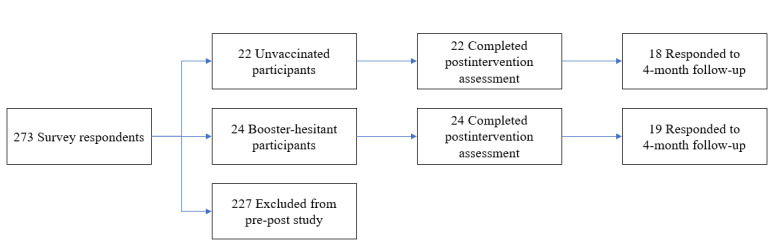
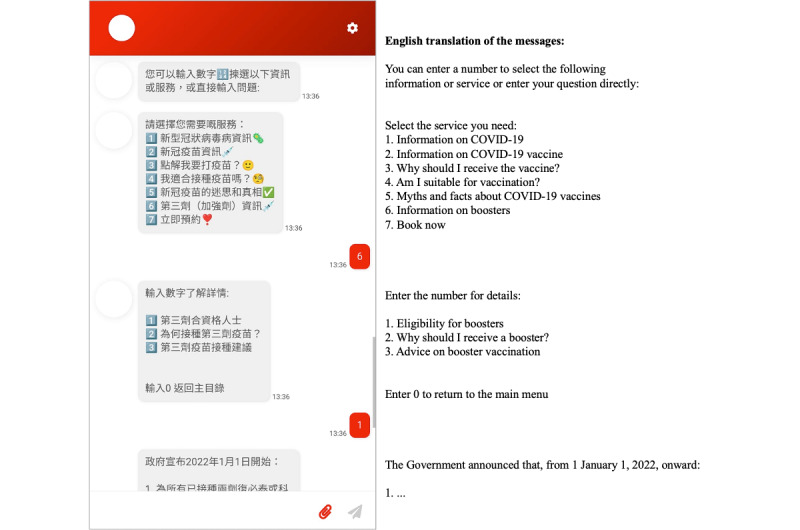
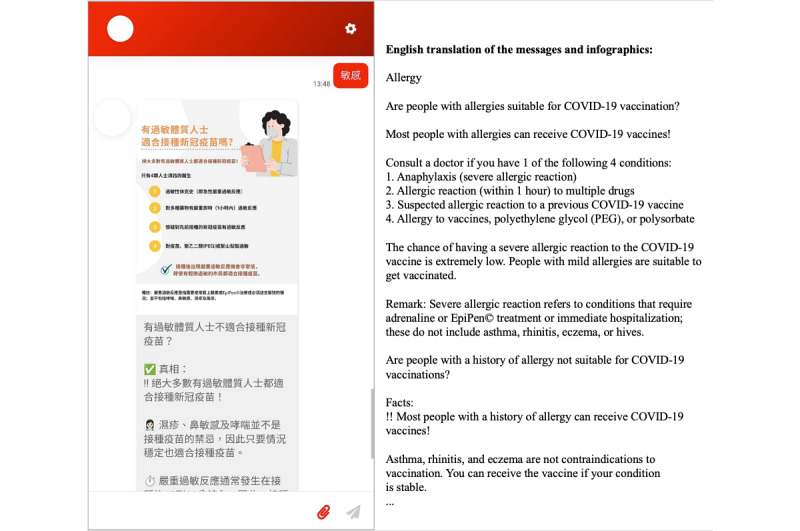
Background: COVID-19 vaccines are highly effective in preventing severe disease and death but are underused. Interventions to address COVID-19 vaccine hesitancy are paramount to reducing the burden of COVID-19. Objective: We aimed to evaluate the preliminary efficacy, usability, and acceptability of a chatbot for promoting COVID-19 vaccination and examine the factors associated with COVID-19 vaccine hesitancy. Methods: In November 2021, we conducted a pre-post pilot study to evaluate “Vac Chat, Fact Check,” a web-based chatbot for promoting COVID-19 vaccination. We conducted a web-based survey (N=290) on COVID-19 vaccination at a university in Hong Kong. A subset of 46 participants who were either unvaccinated (n=22) or were vaccinated but hesitant to receive boosters (n=24) were selected and given access to the chatbot for a 7-day trial period. The chatbot provided information about COVID-19 vaccination (eg, efficacy and common side effects), debunked common myths about the vaccine, and included a decision aid for selecting vaccine platforms (inactivated and mRNA vaccines). The main efficacy outcome was changes in the COVID-19 Vaccine Hesitancy Scale (VHS) score (range 9-45) from preintervention (web-based survey) to postintervention (immediately posttrial). Other efficacy outcomes included changes in intention to vaccinate or receive boosters and willingness to encourage others to vaccinate on a scale from 1 (not at all) to 5 (very). Usability was assessed by the System Usability Scale (range 0-100). Linear regression was used to examine the factors associated with COVID-19 VHS scores in all survey respondents. Results: The mean (SD) age of all survey respondents was 21.4 (6.3) years, and 61% (177/290) of respondents were female. Higher eHealth literacy (B=–0.26; P<.001) and perceived danger of COVID-19 (B=–0.17; P=.009) were associated with lower COVID-19 vaccine hesitancy, adjusting for age, sex, chronic disease status, previous flu vaccination, and perceived susceptibility to COVID-19. The main efficacy outcome of COVID-19 VHS score significantly decreased from 28.6 (preintervention) to 24.5 (postintervention), with a mean difference of –4.2 (P<.001) and an effect size (Cohen d) of 0.94. The intention to vaccinate increased from 3.0 to 3.9 (P<.001) in unvaccinated participants, whereas the intention to receive boosters increased from 1.9 to 2.8 (P<.001) in booster-hesitant participants. Willingness to encourage others to vaccinate increased from 2.7 to 3.0 (P=.04). At postintervention, the median (IQR) System Usability Scale score was 72.5 (65-77.5), whereas the median (IQR) recommendation score was 7 (6-8) on a scale from 0 to 10. In a post hoc 4-month follow-up, 82% (18/22) of initially unvaccinated participants reported having received the COVID-19 vaccine, whereas 29% (7/24) of booster-hesitant participants received boosters. Conclusions: This pilot study provided initial evidence to support the efficacy, usability, and acceptability of a chatbot for promoting COVID-19 vaccination in young adults who were unvaccinated or booster-hesitant.
Overview
The claims and statistics of this paper haven’t been checked yet.
Run the check — free, no account needed. It reads the open-access text and checks the sources it cites.
Integrity signals
Registry
Cites
Statistics
Figures
Verification
Claims the paper makes
The claims and statistics of this paper haven’t been checked yet.
Run the check — free, no account needed. It reads the open-access text and checks the sources it cites.
Claims other papers make about this one
Each is checked against this paper’s own text: does it say what the citing paper says it does?
The cited source says what the claim attributes to it.
In the citing paper
“These findings are in between similar studies that found both shorter (Anmella et al., 2023) and longer (Luk et al., 2022) user engagement with other chatbot-delivered interventions.”
From A chatbot-delivered intervention for optimizing social media use and reducing perceived isolation among rural-living LGBTQ+ youth: Development, acceptability, usability, satisfaction, and utility (2023) · cites this paper as Luk et al., 2022
Self-check
Percentages, sums and reported differences re-computed from the paper’s own numbers.
The self-check needs the paper’s full text.
Citations
Cites
Vaccine hesitancy: Definition, scope and determinants
MacDonald, N. E. (2015) · Vaccine · doi:10.1016/j.vaccine.2015.04.036 · Cited by 5,573
A global survey of potential acceptance of a COVID-19 vaccine
Lazarus, J. V., Ratzan, S. C., Palayew, A., Gostin, L. O., Larson, H. J., Rabin, K., Kimball, S., & El-Mohandes, A. (2021) · Nature Medicine · doi:10.1038/s41591-020-1124-9 · Cited by 2,904
eHEALS: The eHealth Literacy Scale
Norman, C. D., & Skinner, H. A. (2006) · Journal of Medical Internet Research · doi:10.2196/jmir.8.4.e27 · Cited by 2,680
Measuring the impact of COVID-19 vaccine misinformation on vaccination intent in the UK and USA
Loomba, S., de Figueiredo, A., Piatek, S. J., de Graaf, K., & Larson, H. J. (2021) · Nature Human Behaviour · doi:10.1038/s41562-021-01056-1 · Cited by 1,800
Research works printed but not linked: 27
- 10.3390/vaccines9111286 · DOI
- 10.3390/vaccines9111358 · DOI
- 10.1016/j.lanepe.2022.100317 · DOI
- 10.1016/j.vaccine.2021.02.005 · DOI
- 10.1016/j.eclinm.2021.101113 · DOI
- 10.1001/jama.2022.2404 · DOI
- 10.1098/rsos.201199 · DOI · Paper page
- 10.5455/aim.2020.28.241-247 · DOI
- 10.1093/jamia/ocac014 · DOI
- 10.1056/CAT.20.0230 · DOI
- 10.2196/27283 · DOI
- 10.1016/j.vaccine.2021.05.036 · DOI
- 10.2196/24577 · DOI
- Amith, M, 2019, Stud Health Technol Inform, 257, 17
- 10.1016/S2468-2667(21)00096-7 · DOI
- 10.1016/j.vaccine.2017.12.043 · DOI
- 10.1016/j.vaccine.2015.04.037 · DOI
- 10.1136/bmj.314.7080.572 · DOI · Paper page
- 10.1136/bmj.g7327 · DOI
- Brooke, J, 2013, J Usability Stud, 8, 29
- 10.2196/10831 · DOI
- Cohen, J, 1988, Statistical Power Analysis for the Behavioral Sciences
- Bangor, A, 2009, J Usability Stud, 4, 114
- 10.1111/hex.12297 · DOI
- 10.1037/xap0000400 · DOI
- 10.1101/2021.05.26.21257854 · DOI
- 10.2196/25042 · DOI
Cited by
Sorted by citations
Roles, Users, Benefits, and Limitations of Chatbots in Health Care: Rapid Review (Preprint)
Laymouna, M., Ma, Y., Lessard, D., Schuster, T., Engler, K., & Lebouché, B. (2024) · doi:10.2196/preprints.56930 · Cited by 302
Escobar-Viera, C. G., Porta, G., Coulter, R. W. S., Martina, J., Goldbach, J., & Rollman, B. L. (2023) · Internet Interventions · doi:10.1016/j.invent.2023.100668 · Cited by 34
Metadata
- Authors
- Luk, T. T., Lui, J. H. T., & Wang, M. P.
- Venue
- Journal of Medical Internet Research
- Publisher
- JMIR Publications Inc.
- Published
- 2022-10-04
- Volume
- 24
- Issue
- 10
- Pages
- e39063
- ISSN
- 1438-8871
- PMC
- PMC9534274
- Cited by
- 43
- References
- 4
- Language
- en
About these checks
Registry, retraction, Cites and statistics results are computed, not judged, with one exception: a printed reference that no index lists is read once by a model before it counts as a citation error. Claims are extracted by a model and kept only when their quote appears verbatim in the text; each cited source is then checked, with a model’s help, for whether it says what the claim relies on. Those verdicts can be wrong — read the claim’s quote and the cited source before relying on one.
Statistics and arithmetic are recomputed, not judged.
Confidence bands are shown only for fields calibrated on our annotated test set. None is calibrated yet, so no band is shown.
What counts as a claim ›How we measure confidence ›How we check this ›
Are you an author, or do you see a problem with this page? Request a review
