

Persuading Patients Using Rhetoric to Improve Artificial Intelligence Adoption: Experimental Study
Open accessPublished version of a preprint
The DOI matches its Crossref record; 69 of the 69 references it cites were found in a registry or an index.
Abstract
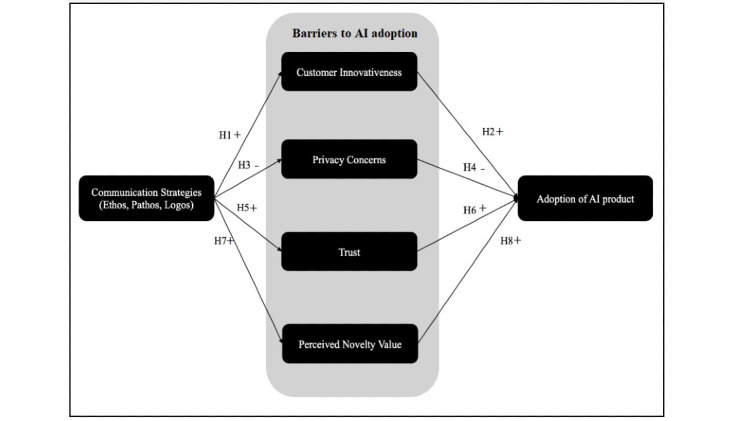
Background: Artificial intelligence (AI) can transform health care processes with its increasing ability to translate complex structured and unstructured data into actionable clinical decisions. Although it has been established that AI is much more efficient than a clinician, the adoption rate has been slower in health care. Prior studies have pointed out that the lack of trust in AI, privacy concerns, degrees of customer innovativeness, and perceived novelty value influence AI adoption. With the promotion of AI products to patients, the role of rhetoric in influencing these factors has received scant attention. Objective: The main objective of this study was to examine whether communication strategies (ethos, pathos, and logos) are more successful in overcoming factors that hinder AI product adoption among patients. Methods: We conducted experiments in which we manipulated the communication strategy (ethos, pathos, and logos) in promotional ads for an AI product. We collected responses from 150 participants using Amazon Mechanical Turk. Participants were randomly exposed to a specific rhetoric-based advertisement during the experiments. Results: Our results indicate that using communication strategies to promote an AI product affects users’ trust, customer innovativeness, and perceived novelty value, leading to improved product adoption. Pathos-laden promotions improve AI product adoption by nudging users’ trust (n=52; β=.532; P<.001) and perceived novelty value of the product (n=52; β=.517; P=.001). Similarly, ethos-laden promotions improve AI product adoption by nudging customer innovativeness (n=50; β=.465; P<.001). In addition, logos-laden promotions improve AI product adoption by alleviating trust issues (n=48; β=.657; P<.001). Conclusions: Promoting AI products to patients using rhetoric-based advertisements can help overcome factors that hinder AI adoption by assuaging user concerns about using a new AI agent in their care process.
Overview
The claims and statistics of this paper haven’t been checked yet.
Free: it reads the open-access text and checks the first 5 claims that cite a source we can check. Create a free account to check every claim.
Integrity signals
Registry
Cites
Statistics
Figures
Verification
Claims the paper makes
The claims and statistics of this paper haven’t been checked yet.
Free: it reads the open-access text and checks the first 5 claims that cite a source we can check. Create a free account to check every claim.
Claims other papers make about this one
Each is checked against this paper’s own text: does it say what the citing paper says it does?
The source backs part of the claim, not all of it — or backs it for a different population, condition or comparison.
In the citing paper
“Risk perception plays a crucial role in decision-making, including the adoption of novel technologies like ChatGPT [65-68].”
From Assessing Health Students' Attitudes and Usage of ChatGPT in Jordan: Validation Study (2023) · cites this paper as [68]
Experimental — accuracy not yet measured
Self-check
Percentages, sums and reported differences re-computed from the paper’s own numbers.
The self-check needs the paper’s full text.
Citations
Cites
Podsakoff, P. M., MacKenzie, S. B., Lee, J.-Y., & Podsakoff, N. P. (2003) · Journal of Applied Psychology · doi:10.1037/0021-9010.88.5.879 · Cited by 82,194 · cited 1×
“We then conducted single-factor test by Harmon [60,61] to rule out common method bias.”
Perceived usefulness, perceived ease of use, and user acceptance of information technology
Davis, F. D. (1989) · MIS Quarterly · doi:10.2307/249008 · Cited by 68,483 · cited 2×
“[34] The perceived usefulness of a novel product also drives its increased adoption [16,35].”
User Acceptance of Information Technology: Toward A Unified View1
Venkatesh, V., Morris, M. G., Davis, G. B., & Davis, F. D. (2003) · MIS Quarterly · doi:10.2307/30036540 · Cited by 45,035
Preacher, K. J., & Hayes, A. F. (2008) · Behavior Research Methods · doi:10.3758/brm.40.3.879 · Cited by 34,117 · cited 2×
“The significance levels for the effects were computed in SmartPLS using 1000 bootstrap samples [61].”
A Theoretical Extension of the Technology Acceptance Model: Four Longitudinal Field Studies
Venkatesh, V., & Davis, F. D. (2000) · Management Science · doi:10.1287/mnsc.46.2.186.11926 · Cited by 23,066 · cited 2×
“[34] The perceived usefulness of a novel product also drives its increased adoption [16,35].”
Structural equation models with unobservable variables and measurement error: Algebra and statistics
Fornell, C., & Larcker, D. F. (1981) · Journal of Marketing Research · doi:10.1177/002224378101800313 · Cited by 13,287
An integrative model of organizational trust
Mayer, R. C., Davis, J. H., & Schoorman, F. D. (1995) · The Academy of Management Review · doi:10.2307/258792 · Cited by 10,736
High-performance medicine: the convergence of human and artificial intelligence
Topol, E. J. (2019) · Nature Medicine · doi:10.1038/s41591-018-0300-7 · Cited by 10,450 · cited 1×
“Prior studies note that AI systems will not replace human clinicians on a large scale, but rather will augment their efforts to care for patients [21].”
Amazon's Mechanical Turk: A New Source of Inexpensive, Yet High-Quality, Data?
Buhrmester, M., Kwang, T., & Gosling, S. D. (2011) · Perspectives on Psychological Science · doi:10.1177/1745691610393980 · Cited by 9,996
Trust in Automation: Designing for Appropriate Reliance
Lee, J. D., & See, K. A. (2004) · Human Factors: The Journal of the Human Factors and Ergonomics Society · doi:10.1518/hfes.46.1.50_30392 · Cited by 6,605 · cited 1×
“Trust is the cornerstone of effective AI user interactions, such that it affects how much users rely on AI [26].”
Research works printed but not linked: 5
- Russell, SJ, 2002, Artificial Intelligence: A Modern Approach. 2nd edition
- 1926, Art of Rhetoric. Volume 2
- 10.5465/amr.2004.14497653 · doi:10.5465/amr.2004.14497653 · Paper page
- Adeleke, IT, 2011, Niger J Med, 20, 228
- WangWSiauKTrusting artificial intelligence in healthcareProceedings of the 24th Americas Conference on Information Systems2018AMCIS '18August 16-18, 2018New Orleans, LA, USA
Cited by
Walker, H. L., Ghani, S., Kuemmerli, C., Nebiker, C. A., Müller, B. P., Raptis, D. A., & Staubli, S. M. (2023) · Journal of Medical Internet Research · doi:10.2196/47479 · Cited by 363
Assessing Health Students' Attitudes and Usage of ChatGPT in Jordan: Validation Study
Sallam, M., Salim, N. A., Barakat, M., Al-Mahzoum, K., Al-Tammemi, A. B., Malaeb, D., Hallit, R., & Hallit, S. (2023) · JMIR Medical Education · doi:10.2196/48254 · Cited by 234
“Risk perception plays a crucial role in decision-making, including the adoption of novel technologies like ChatGPT [65-68].”
Putting ChatGPT’s Medical Advice to the (Turing) Test: Survey Study
Nov, O., Singh, N., & Mann, D. (2023) · JMIR Medical Education · doi:10.2196/46939 · Cited by 198
“Second, there was no specialized prompting of ChatGPT (eg, to be empathetic), which can help responses sound more human and could potentially increase patients’ willingness to accept AI chatbot–generated responses [30].”
BackgroundIkram, A., Mehmood, H., Arshad, M. T., Rasheed, A., Noreen, S., & Gnedeka, K. T. (2024) · CyTA - Journal of Food · doi:10.1080/19476337.2024.2393287 · Cited by 130
“It highlights the economic and market-driven reasons driving traceability and its possible consequences on sustainability (Sebastian et al., 2023).”
Rony, M. K. K., Parvin, M. R., Wahiduzzaman, M., Debnath, M., Bala, S. D., & Kayesh, I. (2024) · SAGE Open Nursing · doi:10.1177/23779608241245220 · Cited by 133
“…to recent studies, the global AI adoption rate in healthcare has surged, with a substantial increase in the implementation of AI-driven solutions for tasks such as image analysis, predictive analytics, and personalized medicine (Alowais et al., 2023; Kumar et al., 2023b; Sebastian et al., 2023).”
BackgroundChoudhury, A., & Shamszare, H. (2024) · JMIR Human Factors · doi:10.2196/55399 · Cited by 103
Zhang, M., Scandiffio, J., Younus, S., Jeyakumar, T., Karsan, I., Charow, R., Salhia, M., & Wiljer, D. (2023) · JMIR Formative Research · doi:10.2196/47847 · Cited by 67
Sebastian, G. (2023) · doi:10.2139/ssrn.4454761 · Cited by 56
“These concerns have been addressed in various research papers discussing the usage of LLM-based chatbots, such as those by Hariri (2023), Sebastian (2023), and Cao et al. (2023).”
Self-citationChoudhury, A., Elkefi, S., & Tounsi, A. (2024) · PLoS ONE · doi:10.1371/journal.pone.0296151 · Cited by 73
Choudhury, A., Volmer, L., Martin, F. J., Fijten, R., Wee, L., Dekker, A. L. A. J., & van Soest, J. (2024) · JMIR AI · doi:10.2196/60847 · Cited by 44
Liu, F., Chang, X., Zhu, Q., Huang, Y., Li, Y., & Wang, H. (2024) · BMC Medical Education · doi:10.1186/s12909-024-06232-1 · Cited by 35
“Risk perception is often included as an additional variable in the TAM model, affecting students’ attitudes toward and usage of new technology [24, 30–32].”
BackgroundTechnology Usability for People Living With Dementia: Concept Analysis
Chien, S., Zaslavsky, O., & Berridge, C. W. (2024) · JMIR Aging · doi:10.2196/51987 · Cited by 36
“Furthermore, Sebastian et al [80] have raised a question about the potential of rhetoric in enhancing the adoption of AI; their study results suggest that the adoption of strategic communication techniques (ethos, pathos, and logos) can significantly impact people’s willingness to accept AI…”
BackgroundPersist or Abandon? Exploring Chinese Users’ Continuance Intentions Toward AI Painting Tools
Xu, J., Ren, X., Huang, Y., Wu, R., & Pan, Y. (2024) · IEEE Access · doi:10.1109/access.2024.3424946 · Cited by 30
“However, there is an interesting finding in this study indicating that PI (H5b) and PN (H6b) do not have a significant direct effect on CI, a result that is inconsistent with the findings of Bawack et al. [75] and Sebastian et al. [80].”
BackgroundResultAlqurashi, H., Mohammed, R., AlGhanmi, A. S., & Alanazi, F. (2023) · JMIR Formative Research · doi:10.2196/47065 · Cited by 17
“In addition, further research on the cybersecurity challenges of working from home during the COVID-19 pandemic, as discussed by Sebastian in a descriptive study [37], and persuasive strategies to improve artificial intelligence adoption in health care, as proposed by Sebastian et al [38], would provide valuable insig…”
Lorenzo-Luaces, L., Wasil, A., Kacmarek, C. N., & DeRubeis, R. (2024) · JMIR Formative Research · doi:10.2196/49780 · Cited by 13
Fischer, A.-K., & Mühlbacher, A. C. (2023) · JMIR Research Protocols · doi:10.2196/46056 · Cited by 17
“Furthermore, research on rhetoric to improve the adoption of digital technologies such as AI shows the importance of communicative strategies [69].”
BackgroundArtificial intelligence in nephrology: predicting CKD progression and personalizing treatment
Yuan, S., Guo, L., & Xu, F. (2025) · International Urology and Nephrology · doi:10.1007/s11255-025-04878-4 · Cited by 20
Khavandi, S., Zaghloul, F., Higham, A., Lim, E., de Pennington, N., & Celi, L. A. (2023) · JMIR Research Protocols · doi:10.2196/49374 · Cited by 19
“For example, health care professionals willingly accepted the technology into their practice if it was aligned with professional values, was easy to use, trusted, and improved job performance [28,29].”
BackgroundCalvaresi, D., Carli, R., Tiribelli, S., Buzcu, B., Aydoğan, R., Vincenzo, A. D., Mualla, Y., Schumacher, M., & Calbimonte, J.-P. (2024) · Computers in Human Behavior Reports · doi:10.1016/j.chbr.2024.100577 · Cited by 12
Sari, P. K., Handayani, P. W., & Hidayanto, A. N. (2023) · JMIR Formative Research · doi:10.2196/49439 · Cited by 15
“Current technology adopting artificial intelligence might bring new security risks XSL • FO RenderX to health care systems [35].”
BackgroundPOTDAI: A Tool to Evaluate the Perceived Operational Trust Degree in Artificial Intelligence Systems
Martín-Moncunill, D., García-Laredo, E., & Nieves, J. C. (2024) · IEEE Access · doi:10.1109/access.2024.3454061 · Cited by 10
“Even simpler assessment tools, such as those used by Guo [19], Schreibelmayr et al. [37], and Sebastian et al. [31], were considered.”
BackgroundMethodInfluentialVaidhyam, S., & Huang, K. (2023) · JMIR Human Factors · doi:10.2196/47982 · Cited by 14
“Considering the broader picture, although there was an increase in the use of health technology during the COVID-19 pandemic, some studies have shown that people’s awareness of cybersecurity and data privacy also played an important role in adoption [58,59].”
BackgroundYoung, N. P., Ridgeway, J. L., Haddad, T. C., Harper, S. B., Philpot, L. M., Christopherson, L. A., McColley, S., Phillips, S. A., Brown, J. K., Zimmerman, K. S., et al. (2023) · JMIR Formative Research · doi:10.2196/48372 · Cited by 8
“Using effective rhetoric to promote the adoption of artificial intelligence–based tools is important and may also help improve the engagement of tools such as the MICP in its current design [40].”
Shi, H., Huang, J., Jin, Y., & Han, M. (2026) · Journal of Medical Internet Research · doi:10.2196/80581 · Cited by 10
“Medium-feasibility BCTs, including strategies such as social comparison to address privacy concerns [55], require deliberate planning and resources.”
An App to Support Fathers’ Mental Health and Well-Being: User-Centered Development Study
Liverpool, S., Eisenstadt, M., Smith, A. M., & Kozhevnikova, S. V. (2023) · JMIR Formative Research · doi:10.2196/47968 · Cited by 8
Naqbi, H. A., Bahroun, Z., & Ahmed, V. (2025) · Sustainability · doi:10.3390/su17219914 · Cited by 10
Sawesi, S., Sabbineni, H., Shagamreddy, R. R., & Rashrash, B. (2026) · Journal of Multidisciplinary Healthcare · doi:10.2147/jmdh.s581251 · Cited by 9
“49 Kneese et al document how intimacy and privacy expectations shift during extended chatbot interactions, widening the gap between user assumptions and actual data governance.”
Generative AI Health Assistants in Modern Healthcare: Drivers and Barriers to Adoption
Al-Lataifeh, Z., Harris, M. A., Smith, J., & Chin, A. G. (2025) · Information Systems Frontiers · doi:10.1007/s10796-025-10681-4 · Cited by 7
“When users mistrust accuracy, efficiency, and precision of AIHAS, it may reduce their willingness to use the recommendations provided (Sebastian et al., 2023 ).”
Tremoulet, P. D., Lobo, A. F., Simmons, C. A., Baliga, G. R., & Brady, M. (2024) · JMIR Human Factors · doi:10.2196/51612 · Cited by 3
“Future work on technologies to support DSPs should be informed by the framework developed by Venkatesh et al [76] for understanding user acceptance of IT and might also consider the strategies outlined by Sebastian et al [77] for increasing user acceptance of novel technologies.”
Nagdev, K., & Rajesh, A. (2024) · Technology Mind and Behavior · doi:10.1037/tmb0000132 · Cited by 8
Shinn, E. H., Garden, A. S., Peterson, S. K., Leupi, D. J., Chen, M., Blau, R., Becerra, L. L., Rafeedi, T., Ramírez, J., Rodriquez, D., et al. (2023) · JMIR Cancer · doi:10.2196/47359 · Cited by 2
“Since personalized risk information is generally not sufficient in itself to increase exercise adherence per se [67], further user-centered testing would be needed to assess preferred modes of sensor feedback (eg, within an app or coupled with virtual coaching) [68].”
BackgroundFijital İnovasyon: Sistematik Bir İnceleme
BALKAR, O. E. (2024) · Özgür Yayınları eBooks · doi:10.58830/ozgur.pub608 · Cited by 2
Modern Trends in Food Production: The Role of AI in Smart Food Factories
Shehzad, K., Munir, A., & Ali, U. (2025) · Global Journal of Emerging AI and Computing · doi:10.70445/gjeac.1.2.2025.1-30 · Cited by 16
Artificial intelligence in patient education: a bibliometric analysis
Guo, Y., Guo, Q., Liu, C., Chen, F., Ma, J., Zhang, H., Lv, Y., Yang, T., & Sun, Y. (2025) · International Journal of Surgery · doi:10.1097/js9.0000000000004075 · Cited by 2
Adoption and use factors of artificial intelligence and big data by citizens
Holgado, P. S., & Calderón, C. A. (2024) · Communication & Society · doi:10.15581/003.37.2.227-246 · Cited by 7
“…which is especially appreciated in health issues (Dhagarra et al. , 2020; Abdullah & Fakieh, 2020; Gerke et al. , 2020; Lee & Yoon, 2021; Sebastian et al. , 2023), finance (Mhlanga, 2020; Mandala et al. , 2022; Hentzen et al. , 2022), and governance (Saura et al. , 2022; Medaglia et al.…”
BackgroundHennrich, J., Doctor, E., Körner, M.-F., Lederman, R., & Eymann, T. (2025) · Journal of Medical Internet Research · doi:10.2196/63668 · Cited by 6
“To educate physicians and to increase trust in AI applications, targeted marketing campaigns with customized messages should be set up [38].”
Zimbile, F., Beek, T. F., David, S., & Crutzen, R. (2023) · JMIR Formative Research · doi:10.2196/49009 · Cited by 2
“In this context, it is very interesting for future research to examine the possibilities of integrating artificial intelligence–based support into the WSTPs. Promotional strategies aimed at promoting public acceptance of artificial intelligence in health care processes seem to be effective [35].”
BackgroundŞenyapar, H. N. D. (2025) · Balkan Journal of Electrical and Computer Engineering · doi:10.17694/bajece.1712706 · Cited by 2
Waldkirch, O., George, A., Ow, T. T., Sebastian, S. R., & Sebastian, G. (2026) · Discover Artificial Intelligence · doi:10.1007/s44163-026-01075-9 · Cited by 1
“Such factors include the novelty of AI technology, lack of trust in AI, and privacy concerns [28, 70].”
Self-citationThe Impact of AI Chatbots like ChatGPT on Sarbanes-Oxley (SOX) CompliancePreprint
Akhtar, F. (2023) · SSRN Electronic Journal · doi:10.2139/ssrn.4589571 · Cited by 1
Unraveling the Nexus: AI and Chatbot’s like Chatgpt Impact on CybersecurityPreprint
Sebastian, G. (2024) · SSRN Electronic Journal · doi:10.2139/ssrn.4786611
Self-citationWaldkirch, O., George, A., Ow, T. T., Sebastian, S. R., & Sebastian, G. (2025) · doi:10.2196/preprints.78382
Self-citationAnalyzing Persuasive Appeals in Tv Advertisements Using Ai Techniques
Abed, M. T., Abbas, A. K., & Lazem, H. G. H. (2025) · IEEE International Conference on Computing and Machine Intelligence (ICMI) · doi:10.1109/icmi65310.2025.11141217
“Sebastian et al. [12] applied the techniques of rhetorical persuasion to the problem of AI adoption, suggesting that persuasion techniques can be studied systematically with the help of AI models.”
Credibility Assessment of Human–Generative AI Interaction
Zhao, Y., Song, S., & Jing, Y. (2025) · Cambridge University Press eBooks · doi:10.1017/9781009587877.005
Modelling the Antecedents of Perceived Trust in AI-Based Records and Information Management Systems
Shonhe, L. (2026) · Mousaion South African Journal of Information Studies · doi:10.25159/2663-659x/21085
Guenier, A. W., & Mao, Y. (2026) · doi:10.2196/preprints.96062
Human Cognition, Bias, and AI Decision Making
Pattnaik, S., Panigrahi, S. S., Sahoo, A., & Kumari, S. (2026) · Advances in computational intelligence and robotics book series · doi:10.4018/979-8-3373-9109-0.ch003
Metadata
- Authors
- Sebastian, G., George, A., & Jackson Jr, G.
- Affiliations
- Georgia Institute of Technology (US)
- Georgia State University (US)
- Corresponding author
- George, Amrita
- Venue
- Journal of Medical Internet Research
- Publisher
- JMIR Publications Inc.
- Published
- 2023-03-13
- Volume
- 25
- Pages
- e41430
- ISSN
- 1438-8871 (ISSN-L)
- PMC
- PMC10131865
- OpenAlex
- W4317826997
- Cited by
- 48
- References
- 69
- Citations by year
- 2026: 7 · 2025: 10 · 2024: 16 · 2023: 15
- FWCI
- 10.75
- Type
- journal article
- Language
- en
- Open access
- gold
- doi.org
- Licence
- cc-by
- Locations
- Journal of Medical Internet Research (publishedVersion, cc-by)
- PubMed Central (publishedVersion, cc-by)
- PubMed (publishedVersion)
- DOAJ (DOAJ: Directory of Open Access Journals) (submittedVersion, cc-by-sa)
- Topics
- Health Sciences › Health Professions › Health Information Management › Health, Technology, Consumer Behavior
- Health Sciences › Medicine › Health Informatics › Artificial Intelligence in Healthcare and Education
- Social Sciences › Decision Sciences › Information Systems and Management › Technology Adoption and User Behaviour
- Keywords
- artificial intelligence adoption, rhetoric, rhetorical appeals, persuasion, health care AI, trust in AI, consumer innovativeness, advertising communication strategy, patient acceptance, privacy concerns
- MeSH terms
- Artificial Intelligence, Communication, Humans, Patients, Privacy, Trust
About these checks
Registry, retraction, Cites and statistics results are computed, not judged, with one exception: a printed reference that no index lists is read once by a model before it counts as a citation error. Claims are extracted by a model and kept only when their quote appears verbatim in the text; each cited source is then checked, with a model’s help, for whether it says what the claim relies on. Those verdicts can be wrong — read the claim’s quote and the cited source before relying on one.
Statistics and arithmetic are recomputed, not judged.
Confidence bands are shown only for fields calibrated on our annotated test set. None is calibrated yet, so no band is shown.
What counts as a claim ›How we measure confidence ›How we check this ›
Are you an author, or do you see a problem with this page? Request a review
Data sources
Bibliographic data: Semantic Scholar, OpenAlex, Crossref.
Contains information from the Semantic Scholar Academic Graph Datasets, made available under the ODC Attribution License (ODC-BY 1.0).
Semantic Scholar’s data is described in: Kinney, R., et al. (2023). The Semantic Scholar Open Data Platform. arXiv:2301.10140.
