

The DOI matches its Crossref record; 69 of the 69 references it cites were found in a registry or an index.
Persuading Patients Using Rhetoric to Improve Artificial Intelligence Adoption: Experimental Study
Open accessPublished version of a preprint
Abstract
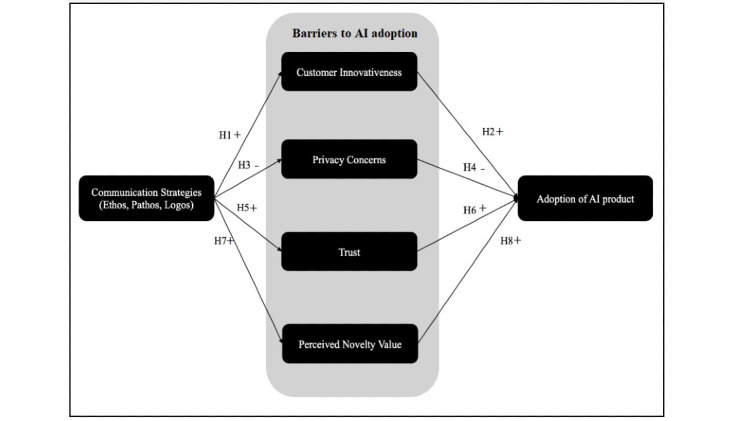
Background: Artificial intelligence (AI) can transform health care processes with its increasing ability to translate complex structured and unstructured data into actionable clinical decisions. Although it has been established that AI is much more efficient than a clinician, the adoption rate has been slower in health care. Prior studies have pointed out that the lack of trust in AI, privacy concerns, degrees of customer innovativeness, and perceived novelty value influence AI adoption. With the promotion of AI products to patients, the role of rhetoric in influencing these factors has received scant attention. Objective: The main objective of this study was to examine whether communication strategies (ethos, pathos, and logos) are more successful in overcoming factors that hinder AI product adoption among patients. Methods: We conducted experiments in which we manipulated the communication strategy (ethos, pathos, and logos) in promotional ads for an AI product. We collected responses from 150 participants using Amazon Mechanical Turk. Participants were randomly exposed to a specific rhetoric-based advertisement during the experiments. Results: Our results indicate that using communication strategies to promote an AI product affects users’ trust, customer innovativeness, and perceived novelty value, leading to improved product adoption. Pathos-laden promotions improve AI product adoption by nudging users’ trust (n=52; β=.532; P<.001) and perceived novelty value of the product (n=52; β=.517; P=.001). Similarly, ethos-laden promotions improve AI product adoption by nudging customer innovativeness (n=50; β=.465; P<.001). In addition, logos-laden promotions improve AI product adoption by alleviating trust issues (n=48; β=.657; P<.001). Conclusions: Promoting AI products to patients using rhetoric-based advertisements can help overcome factors that hinder AI adoption by assuaging user concerns about using a new AI agent in their care process.
Overview
The claims and statistics of this paper haven’t been checked yet.
Free: it reads the open-access text and checks the first 5 claims that cite a source we can check. Create a free account to check every claim.
Integrity signals
Registry
Cites
Statistics
Figures
Verification
Claims the paper makes
The claims and statistics of this paper haven’t been checked yet.
Free: it reads the open-access text and checks the first 5 claims that cite a source we can check. Create a free account to check every claim.
Claims other papers make about this one
Each is checked against this paper’s own text: does it say what the citing paper says it does?
The source backs part of the claim, not all of it — or backs it for a different population, condition or comparison.
In the citing paper
“Risk perception plays a crucial role in decision-making, including the adoption of novel technologies like ChatGPT [65-68].”
From Assessing Health Students' Attitudes and Usage of ChatGPT in Jordan: Validation Study (2023) · cites this paper as [68]
Experimental — accuracy not yet measured
Self-check
Percentages, sums and reported differences re-computed from the paper’s own numbers.
The self-check needs the paper’s full text.
Citations
Cites
Podsakoff, P. M., MacKenzie, S. B., Lee, J.-Y., & Podsakoff, N. P. (2003) · Journal of Applied Psychology · doi:10.1037/0021-9010.88.5.879 · Cited by 82,194 · cited 1×
“We then conducted single-factor test by Harmon [60,61] to rule out common method bias.”
Perceived usefulness, perceived ease of use, and user acceptance of information technology
Davis, F. D. (1989) · MIS Quarterly · doi:10.2307/249008 · Cited by 68,483 · cited 2×
“[34] The perceived usefulness of a novel product also drives its increased adoption [16,35].”
User Acceptance of Information Technology: Toward A Unified View1
Venkatesh, V., Morris, M. G., Davis, G. B., & Davis, F. D. (2003) · MIS Quarterly · doi:10.2307/30036540 · Cited by 45,035
Preacher, K. J., & Hayes, A. F. (2008) · Behavior Research Methods · doi:10.3758/brm.40.3.879 · Cited by 34,117 · cited 2×
“The significance levels for the effects were computed in SmartPLS using 1000 bootstrap samples [61].”
A Theoretical Extension of the Technology Acceptance Model: Four Longitudinal Field Studies
Venkatesh, V., & Davis, F. D. (2000) · Management Science · doi:10.1287/mnsc.46.2.186.11926 · Cited by 23,066 · cited 2×
“[34] The perceived usefulness of a novel product also drives its increased adoption [16,35].”
Structural equation models with unobservable variables and measurement error: Algebra and statistics
Fornell, C., & Larcker, D. F. (1981) · Journal of Marketing Research · doi:10.1177/002224378101800313 · Cited by 13,287
An integrative model of organizational trust
Mayer, R. C., Davis, J. H., & Schoorman, F. D. (1995) · The Academy of Management Review · doi:10.2307/258792 · Cited by 10,736
High-performance medicine: the convergence of human and artificial intelligence
Topol, E. J. (2019) · Nature Medicine · doi:10.1038/s41591-018-0300-7 · Cited by 10,450 · cited 1×
“Prior studies note that AI systems will not replace human clinicians on a large scale, but rather will augment their efforts to care for patients [21].”
Amazon's Mechanical Turk: A New Source of Inexpensive, Yet High-Quality, Data?
Buhrmester, M., Kwang, T., & Gosling, S. D. (2011) · Perspectives on Psychological Science · doi:10.1177/1745691610393980 · Cited by 9,996
Trust in Automation: Designing for Appropriate Reliance
Lee, J. D., & See, K. A. (2004) · Human Factors: The Journal of the Human Factors and Ergonomics Society · doi:10.1518/hfes.46.1.50_30392 · Cited by 6,605 · cited 1×
“Trust is the cornerstone of effective AI user interactions, such that it affects how much users rely on AI [26].”
Modern Methods for Business Research
(1998) · doi:10.4324/9781410604385 · Cited by 6,534
Partial least squares structural equation modeling
Sarstedt, M., Ringle, C. M., & Hair, J. F. (2017) · Handbook of Market Research · doi:10.1007/978-3-319-05542-8_15-1 · Cited by 3,285 · cited 1×
“We chose PLS because it permits the modeling of latent variables and the simultaneous assessment of the measurement and structural models, while placing minimal demands on sample size and distributional assumptions [58,59].”
The practical implementation of artificial intelligence technologies in medicine
He, J., Baxter, S. L., Xu, J., Xu, J., Zhou, X., & Zhang, K. (2019) · Nature Medicine · doi:10.1038/s41591-018-0307-0 · Cited by 2,246 · cited 1×
“Consumer research shows that people are likely to adhere to their existing routines, characterized by risk aversion and a general preference to buy familiar products [30].”
Value-based Adoption of Mobile Internet: An empirical investigation
Kim, H.-W., Chan, H. C., & Gupta, S. (2007) · Decision Support Systems · doi:10.1016/j.dss.2005.05.009 · Cited by 2,084 · cited 1×
“In addition, the TAM has been extended to derive the Value-based Adoption Model [6] to study the influence of benefits, such as usefulness and enjoyment, and sacrifices (such as technicality and perceived fee) on the perceived value of technology adoption.”
Resistance to Medical Artificial Intelligence
Longoni, C., Bonezzi, A., & Morewedge, C. K. (2019) · Journal of Consumer Research · doi:10.1093/jcr/ucz013 · Cited by 2,015 · cited 1×
“For example, many patients trust a surgeon more than a robotic surgical system, despite these systems being as efficient as a surgeon [15].”
Innovativeness, Novelty Seeking, and Consumer Creativity
Hirschman, E. C. (1980) · Journal of Consumer Research · doi:10.1086/208816 · Cited by 1,713 · cited 3×
“The conceptualization of innovativeness by Hirschman [34] focuses on consumer desires to obtain information about innovations that aid in the adoption or use of novel products and technology.”
Yielding to Temptation: Self‐Control Failure, Impulsive Purchasing, and Consumer Behavior
Baumeister, R. F. (2002) · Journal of Consumer Research · doi:10.1086/338209 · Cited by 1,612 · cited 2×
“Prior research points to the presence of antecedent hindering factors to AI adoption, such as privacy concerns, lack of trust (especially related to the accuracy, efficiency, and precision of AI), different degrees of consumer innovativeness, and lack of perceived novelty value [7,9].”
Measuring consumer innovativeness
Goldsmith, R. E., & Hofacker, C. F. (1991) · Journal of the Academy of Marketing Science · doi:10.1007/bf02726497 · Cited by 1,457
The literature review of technology adoption models and theories for the novelty technology
Lai, P. (2017) · Journal of Information Systems and Technology Management · doi:10.4301/s1807-17752017000100002 · Cited by 1,062 · cited 2×
“The novelty of the content or novelty value of a new technology will positively influence (1) its perceived ease of use and (2) its perceived usefulness [49,50].”
Sun, T. Q., & Medaglia, R. (2019) · Government Information Quarterly · doi:10.1016/j.giq.2018.09.008 · Cited by 948 · cited 2×
“AI research has examined the key challenges and hindrances to AI adoption and how these challenges can be overcome [24].”
Pelau, C., Dabija, D.-C., & Ene, I. (2021) · Computers in Human Behavior · doi:10.1016/j.chb.2021.106855 · Cited by 889 · cited 1×
“We adapted scales from the literature to measure trust [51,52], novelty value [51,53], customer innovativeness [54], privacy concerns [55], and AI adoption [56] (Table S3 in Multimedia Appendix 1).”
Artificial Intelligence and Human Trust in Healthcare: Focus on Clinicians
Asan, O., Bayrak, A. E., & Choudhury, A. (2020) · Journal of Medical Internet Research · doi:10.2196/15154 · Cited by 825 · cited 3×
“We found that prior studies summarize the enablers and inhibitors in AI adoption from consumer and practitioner perspectives (Table S1 in Multimedia Appendix 1 [7-11,”
A Rhetorical Theory of Diffusion
Green, S. E. (2004) · The Academy of Management Review · doi:10.2307/20159076 · Cited by 684 · cited 5×
“A sequence of justifications starting with pathos and logos produces pragmatic legitimacy, whereas ethos would generate moral legitimacy [18].”
InfluentialMcLean, G., & Wilson, A. (2019) · Computers in Human Behavior · doi:10.1016/j.chb.2019.07.002 · Cited by 662 · cited 1×
“The novelty of the content or novelty value of a new technology will positively influence (1) its perceived ease of use and (2) its perceived usefulness [49,50].”
Sohn, K., & Kwon, O. (2020) · Telematics and Informatics · doi:10.1016/j.tele.2019.101324 · Cited by 646 · cited 1×
“Prior research on technology innovation has used the Technology Acceptance Model (TAM), Theory of Planned Behavior, and Unified Theory of Acceptance and Use of Technology to examine AI adoption and use [3].”
(2020) · Springer eBooks · doi:10.1007/978-3-319-05542-8 · Cited by 634
Amazon's Mechanical Turk: A new source of inexpensive, yet high-quality, data?: (527772014-223)
Buhrmester, M., Kwang, T., & Gosling, S. (2011) · PsycEXTRA Dataset · doi:10.1037/e527772014-223 · Cited by 534
Lassar, W. M., Manolis, C., & Lassar, S. S. (2005) · International Journal of Bank Marketing · doi:10.1108/02652320510584403 · Cited by 477 · cited 1×
“Consumer innovativeness plays a critical role in AI adoption and can be influenced by marketing campaigns from the organization [31], especially in the case of the adoption of medical technologies [32,33].”
Efficacy of co-creation and mastering on perceived value and satisfaction in tourists' consumption
Prebensen, N. K., & Xie, J. (2017) · Tourism Management · doi:10.1016/j.tourman.2016.12.001 · Cited by 457 · cited 1×
“We adapted scales from the literature to measure trust [51,52], novelty value [51,53], customer innovativeness [54], privacy concerns [55], and AI adoption [56] (Table S3 in Multimedia Appendix 1).”
The effect of online privacy policy on consumer privacy concern and trust
Wu, K.-W., Huang, S. Y., Yen, D. C., & Popova, I. (2012) · Computers in Human Behavior · doi:10.1016/j.chb.2011.12.008 · Cited by 428 · cited 1×
“Finally, when advertisements use logos communication strategy, it can provide evidence of adherence to privacy policies (ie, notice, enforcement, access, security, or choice) that can alleviate privacy concerns [46].”
Cubric, M. (2020) · Technology in Society · doi:10.1016/j.techsoc.2020.101257 · Cited by 416
Juaneda-Ayensa, E., Mosquera, A., & Sierra Murillo, Y. (2016) · Frontiers in Psychology · doi:10.3389/fpsyg.2016.01117 · Cited by 393 · cited 2×
“Studies found that when customer innovativeness is high, users are more likely to accept the innovative technology [42].”
Wu, K., Zhao, Y., Zhu, Q., Tan, X., & Zheng, H. (2011) · International Journal of Information Management · doi:10.1016/j.ijinfomgt.2011.03.004 · Cited by 389 · cited 2×
“Prior research observed trust as an important antecedent of technology acceptance [48] and behavioral intention to use AI products [14].”
Mobile health technology adoption across generations: Narrowing the digital divide
Fox, G., & Connolly, R. (2018) · Information Systems Journal · doi:10.1111/isj.12179 · Cited by 344 · cited 1×
“Similarly, older users could be more apprehensive about privacy risks, thereby leading to less adoption among them [64,65].”
Cho, J.-H., Chan, K., & Adali, S. (2015) · ACM Computing Surveys · doi:10.1145/2815595 · Cited by 342 · cited 1×
“Trust, a psychological construct that encompasses an emotional and a logical aspect [47], can influence a user’s perception of using an AI product.”
Ethos,logos,pathos: Strategies of persuasion in social/environmental reports
Higgins, C., & Walker, R. (2012) · Accounting Forum · doi:10.1016/j.accfor.2012.02.003 · Cited by 328
Consumer trust and perceived risk for voice-controlled artificial intelligence: The case of Siri
Hasan, R., Shams, R., & Rahman, M. (2021) · Journal of Business Research · doi:10.1016/j.jbusres.2020.12.012 · Cited by 314 · cited 1×
“We adapted scales from the literature to measure trust [51,52], novelty value [51,53], customer innovativeness [54], privacy concerns [55], and AI adoption [56] (Table S3 in Multimedia Appendix 1).”
Antecedents and consequences of e-learning acceptance
Cheng, Y.-M. (2011) · Information Systems Journal · doi:10.1111/j.1365-2575.2010.00356.x · Cited by 276 · cited 1×
“Sharing the positive effects of e-learning, including performance expectancy and social influence, has helped spark customer innovativeness and interest in offerings that lead to increased adoption [43,44].”
(2021) · doi:10.2196/25856 · Cited by 268
Artificial Intelligence and Internet of Things Based Healthcare 4.0 Monitoring System
Kishor, A., & Chakraborty, C. (2022) · Wireless Personal Communications · doi:10.1007/s11277-021-08708-5 · Cited by 226 · cited 1×
“The adoption of AI products in health care has the potential to transform the health care industry, with medical AI forecasted to exceed a market size of ≥ US $30 billion by 2025 [2].”
Beyond the technology adoption: Technology readiness effects on post-adoption behavior
Son, M., & Han, K. (2011) · Journal of Business Research · doi:10.1016/j.jbusres.2011.06.019 · Cited by 203 · cited 4×
“Research on technology adoption and communication strategies suggests that managers of technology-based products could use communication strategies that promote the use of their technologies [10].”
InfluentialPeer-to-Peer Contact Tracing: Development of a Privacy-Preserving Smartphone App
Yasaka, T. M., Lehrich, B. M., & Sahyouni, R. (2020) · JMIR mHealth and uHealth · doi:10.2196/18936 · Cited by 202 · cited 1×
“Consumer innovativeness plays a critical role in AI adoption and can be influenced by marketing campaigns from the organization [31], especially in the case of the adoption of medical technologies [32,33].”
Mobile users’ information privacy concerns and the role of app permission requests
Degirmenci, K. (2019) · International Journal of Information Management · doi:10.1016/j.ijinfomgt.2019.05.010 · Cited by 194 · cited 3×
“Prior privacy concerns, computer anxiety, perceived control, and app permission concerns can affect a user’s privacy concerns when using an AI product [45].”
InfluentialMeyer-Waarden, L., & Cloarec, J. (2022) · Technovation · doi:10.1016/j.technovation.2021.102348 · Cited by 192 · cited 7×
“Studies have established that consumer innovativeness influences the behavioral intention to use AI products [14] and consumers’ adoption intention for wearable health care technology [8].”
InfluentialMiles, A., & Mezzich, J. (2011) · The International Journal of Person Centered Medicine · doi:10.5750/ijpcm.v1i2.61 · Cited by 183
Mental models and expectation violations in conversational AI interactions
Grimes, G. M., Schuetzler, R. M., & Giboney, J. S. (2021) · Decision Support Systems · doi:10.1016/j.dss.2021.113515 · Cited by 179 · cited 1×
“In the current rush toward using AI for aiding businesses in a variety of tasks [62] and with AI increasingly becoming integrated in many aspects of human life [63], we believe that communication strategies can help users transcend any perceived risks inherent to using AI products.”
Drolet, A., Williams, P., & Lau-Gesk, L. (2007) · Marketing Letters · doi:10.1007/s11002-007-9016-z · Cited by 176
Visvikis, D., Cheze Le Rest, C., Jaouen, V., & Hatt, M. (2019) · European Journal of Nuclear Medicine and Molecular Imaging · doi:10.1007/s00259-019-04373-w · Cited by 168 · cited 1×
“However, in the present context of medical imaging, a more specific definition may be more appropriate: “a system’s ability to correctly interpret external data, to learn from such data, and to use what was learned to achieve specific goals and tasks through flexible adaptation” [23].”
Examining Consumers’ Adoption of Wearable Healthcare Technology: The Role of Health Attributes
Cheung, M. L., Chau, K. Y., Lam, M. H. S., Tse, G., Ho, K. Y., Flint, S. W., Broom, D. R., Tso, E. K. H., & Lee, K. Y. (2019) · International Journal of Environmental Research and Public Health · doi:10.3390/ijerph16132257 · Cited by 166 · cited 6×
“Studies have established that consumer innovativeness influences the behavioral intention to use AI products [14] and consumers’ adoption intention for wearable health care technology [8].”
InfluentialIndividuals’ Attitudes Towards Electronic Health Records: A Privacy Calculus Perspective
Dinev, T., Albano, V., Xu, H., D’Atri, A., & Hart, P. (2015) · Annals of information systems · doi:10.1007/978-3-319-23294-2_2 · Cited by 156 · cited 1×
“We adapted scales from the literature to measure trust [51,52], novelty value [51,53], customer innovativeness [54], privacy concerns [55], and AI adoption [56] (Table S3 in Multimedia Appendix 1).”
Patient Perceptions of a Personal Health Record: A Test of the Diffusion of Innovation Model
Emani, S., Yamin, C. K., Peters, E. M., Karson, A. S., Lipsitz, S. R., Wald, J. S., Williams, D. H., & Bates, D. W. (2012) · Journal of Medical Internet Research · doi:10.2196/jmir.2278 · Cited by 142 · cited 1×
“Consumer innovativeness plays a critical role in AI adoption and can be influenced by marketing campaigns from the organization [31], especially in the case of the adoption of medical technologies [32,33].”
Hsieh, P.-J. (2015) · International Journal of Medical Informatics · doi:10.1016/j.ijmedinf.2015.03.004 · Cited by 140 · cited 1×
“…and Use of Technology has been widely used to explain intentions for technology use in various fields, including intelligent health care systems [4,5], whereas the TAM discusses the impact of perceived usefulness and ease of use on the behavioral intention to use and the actual use of…”
Hundleby, J. D., & Nunnally, J. C. (1968) · American Educational Research Journal · doi:10.2307/1161962 · Cited by 137
The Art of Rhetoric in Alexandria
Smith, R. W. (1974) · Springer eBooks · doi:10.1007/978-94-015-0905-3 · Cited by 83
The adoption of hyped technologies: a qualitative study
Hedman, J., & Gimpel, G. (2010) · Information Technology and Management · doi:10.1007/s10799-010-0075-0 · Cited by 75 · cited 2×
“Consumer research shows that people usually adhere to their existing routines, characterized by risk aversion [9], and that novelty value, along with emotional and social values, significantly influences the adoption of new technologies [17].”
Thompson, S., Whitaker, J., Kohli, R., & Jones, C. H. (2020) · MIS Quarterly · doi:10.25300/misq/2020/15085 · Cited by 67 · cited 2×
“…by several personal factors, such as education, past experiences, user biases, and emotions, as well as properties of the AI system, including controllability, model complexity, embedded biases, and reliability (ie, whether AI technology can perform a task predictably and consistently) [28].”
Acceptance and Use of E-Learning Based on Cloud Computing: The Role of Consumer Innovativeness
Nguyen, T. D., Nguyen, T. M., Pham, Q.-T., & Misra, S. (2014) · Lecture notes in computer science · doi:10.1007/978-3-319-09156-3_12 · Cited by 64 · cited 1×
“Sharing the positive effects of e-learning, including performance expectancy and social influence, has helped spark customer innovativeness and interest in offerings that lead to increased adoption [43,44].”
Engaging Generation Y to Co-Create Through Mobile Technology
Zhang, T. C., Lu, C., & Kizildag, M. (2017) · International Journal of Electronic Commerce · doi:10.1080/10864415.2016.1355639 · Cited by 51 · cited 1×
“We adapted scales from the literature to measure trust [51,52], novelty value [51,53], customer innovativeness [54], privacy concerns [55], and AI adoption [56] (Table S3 in Multimedia Appendix 1).”
Garvey, M. D., Samuel, J., & Pelaez, A. (2021) · Decision Support Systems · doi:10.1016/j.dss.2021.113497 · Cited by 41 · cited 1×
“In the current rush toward using AI for aiding businesses in a variety of tasks [62] and with AI increasingly becoming integrated in many aspects of human life [63], we believe that communication strategies can help users transcend any perceived risks inherent to using AI products.”
Public engagement with health data governance: the role of visuality
Sleigh, J., & Vayena, E. (2021) · Humanities and Social Sciences Communications · doi:10.1057/s41599-021-00826-6 · Cited by 36 · cited 1×
“For example, rhetorical modes of logos (rational) and pathos (emotional) were used to change the UK’s societal attitudes toward sharing health data [19].”
Lee, K., Khan, S. A., & Mirchandani, D. A. (2012) · Journal of Business Research · doi:10.1016/j.jbusres.2012.05.024 · Cited by 33 · cited 1×
“The need to be unique is nudged when the advertisement demonstrates a unique opportunity, thereby positively influencing consumer innovativeness [41].”
EHR: a Sensing Technology Readiness Model for Lifestyle Changes
Chen, Y., Le, D., Yumak, Z., & Pu, P. (2017) · Mobile Networks and Applications · doi:10.1007/s11036-017-0871-4 · Cited by 23 · cited 1×
“…and Use of Technology has been widely used to explain intentions for technology use in various fields, including intelligent health care systems [4,5], whereas the TAM discusses the impact of perceived usefulness and ease of use on the behavioral intention to use and the actual use of technology.”
Communicating Radiation Risk: The Power of Planned, Persuasive Messaging
Wieder, J. S. (2018) · Health Physics · doi:10.1097/hp.0000000000000998 · Cited by 23 · cited 4×
“Addressing this research gap would be a substantial contribution, because communications have been found to be persuasive in health care outreach programs [11].”
InfluentialHutchesson, M., Collins, C. E., Morgan, P. J., & Callister, R. (2013) · Journal of Medical Internet Research · doi:10.2196/jmir.2540 · Cited by 18 · cited 1×
“An endorsement by a trusted figure improves consumer confidence in the product, thereby increasing adoption [38].”
Adeleke, I. T., Adekanye, A. O., Adefemi, A. K., Onawola, K. A., Okuku, A. G., Sheshi, E. U., James-Adeniran, J. A., Francis, M., Elegbe, T. R. O., Ayeni, A., et al. (2011) · PubMed · Cited by 12
Measuring Mobile Telecom Service Innovativeness Among Youth
Jasrai, L. (2014) · Paradigm A Management Research Journal · doi:10.1177/0971890714540369 · Cited by 9 · cited 3×
“When someone similar to us endorses a product with a happy emotion, it improves innate consumer innovativeness [40]. consumer’s innovativeness can be nudged by their passion to be unique [36].”
A Tactical Framework for Market Penetration with a Multidimensional Organization
Bigley, J. (2018) · Research in Economics and Management · doi:10.22158/rem.v4n1p1 · Cited by 8
The Art of Rhetoric in Alexandria
Smith, R. W. (1975) · Springer eBooks · doi:10.1007/978-94-010-1705-3 · Cited by 7
Rothenberger, L. G. (2014) · European Journal for Person Centered Healthcare · doi:10.5750/ejpch.v2i1.698 · Cited by 3
Research works printed but not linked: 5
- Russell, SJ, 2002, Artificial Intelligence: A Modern Approach. 2nd edition
- 1926, Art of Rhetoric. Volume 2
- 10.5465/amr.2004.14497653 · doi:10.5465/amr.2004.14497653 · Paper page
- Adeleke, IT, 2011, Niger J Med, 20, 228
- WangWSiauKTrusting artificial intelligence in healthcareProceedings of the 24th Americas Conference on Information Systems2018AMCIS '18August 16-18, 2018New Orleans, LA, USA
Cited by
Walker, H. L., Ghani, S., Kuemmerli, C., Nebiker, C. A., Müller, B. P., Raptis, D. A., & Staubli, S. M. (2023) · Journal of Medical Internet Research · doi:10.2196/47479 · Cited by 363
Assessing Health Students' Attitudes and Usage of ChatGPT in Jordan: Validation Study
Sallam, M., Salim, N. A., Barakat, M., Al-Mahzoum, K., Al-Tammemi, A. B., Malaeb, D., Hallit, R., & Hallit, S. (2023) · JMIR Medical Education · doi:10.2196/48254 · Cited by 234
“Risk perception plays a crucial role in decision-making, including the adoption of novel technologies like ChatGPT [65-68].”
Putting ChatGPT’s Medical Advice to the (Turing) Test: Survey Study
Nov, O., Singh, N., & Mann, D. (2023) · JMIR Medical Education · doi:10.2196/46939 · Cited by 198
“Second, there was no specialized prompting of ChatGPT (eg, to be empathetic), which can help responses sound more human and could potentially increase patients’ willingness to accept AI chatbot–generated responses [30].”
BackgroundIkram, A., Mehmood, H., Arshad, M. T., Rasheed, A., Noreen, S., & Gnedeka, K. T. (2024) · CyTA - Journal of Food · doi:10.1080/19476337.2024.2393287 · Cited by 118
“It highlights the economic and market-driven reasons driving traceability and its possible consequences on sustainability (Sebastian et al., 2023).”
Rony, M. K. K., Parvin, M. R., Wahiduzzaman, M., Debnath, M., Bala, S. D., & Kayesh, I. (2024) · SAGE Open Nursing · doi:10.1177/23779608241245220 · Cited by 133
“…to recent studies, the global AI adoption rate in healthcare has surged, with a substantial increase in the implementation of AI-driven solutions for tasks such as image analysis, predictive analytics, and personalized medicine (Alowais et al., 2023; Kumar et al., 2023b; Sebastian et al., 2023).”
Background
Metadata
- Authors
- Sebastian, G., George, A., & Jackson Jr, G.
- Affiliations
- Georgia Institute of Technology (US)
- Georgia State University (US)
- Corresponding author
- George, Amrita
- Venue
- Journal of Medical Internet Research
- Publisher
- JMIR Publications Inc.
- Published
- 2023-03-13
- Volume
- 25
- Pages
- e41430
- ISSN
- 1438-8871 (ISSN-L)
- PMC
- PMC10131865
- OpenAlex
- W4317826997
- Cited by
- 48
- References
- 69
- Citations by year
- 2026: 7 · 2025: 10 · 2024: 16 · 2023: 15
- FWCI
- 10.75
- Type
- journal article
- Language
- en
- Open access
- gold
- doi.org
- Licence
- cc-by
- Locations
- Journal of Medical Internet Research (publishedVersion, cc-by)
- PubMed Central (publishedVersion, cc-by)
- PubMed (publishedVersion)
- DOAJ (DOAJ: Directory of Open Access Journals) (submittedVersion, cc-by-sa)
- Topics
- Health Sciences › Health Professions › Health Information Management › Health, Technology, Consumer Behavior
- Health Sciences › Medicine › Health Informatics › Artificial Intelligence in Healthcare and Education
- Social Sciences › Decision Sciences › Information Systems and Management › Technology Adoption and User Behaviour
- Keywords
- artificial intelligence adoption, rhetoric, rhetorical appeals, persuasion, health care AI, trust in AI, consumer innovativeness, advertising communication strategy, patient acceptance, privacy concerns
- MeSH terms
- Artificial Intelligence, Communication, Humans, Patients, Privacy, Trust
About these checks
Registry, retraction, Cites and statistics results are computed, not judged, with one exception: a printed reference that no index lists is read once by a model before it counts as a citation error. Claims are extracted by a model and kept only when their quote appears verbatim in the text; each cited source is then checked, with a model’s help, for whether it says what the claim relies on. Those verdicts can be wrong — read the claim’s quote and the cited source before relying on one.
Statistics and arithmetic are recomputed, not judged.
Confidence bands are shown only for fields calibrated on our annotated test set. None is calibrated yet, so no band is shown.
What counts as a claim ›How we measure confidence ›How we check this ›
Are you an author, or do you see a problem with this page? Request a review
Data sources
Bibliographic data: Semantic Scholar, OpenAlex, Crossref.
Contains information from the Semantic Scholar Academic Graph Datasets, made available under the ODC Attribution License (ODC-BY 1.0).
Semantic Scholar’s data is described in: Kinney, R., et al. (2023). The Semantic Scholar Open Data Platform. arXiv:2301.10140.
