

Strengths, Weaknesses, Opportunities, and Threats Analysis of the Use of Digital Health Technologies in Primary Health Care in the Sub-Saharan African Region: Qualitative Study
Open accessPublished version of a preprint
The DOI matches its Crossref record; 27 of the 27 references it cites were found in a registry or an index; 1 of the 29 sources its claims cite were checked for support.
Abstract
Background: Digital health technologies (DHTs) have become increasingly commonplace as a means of delivering primary care. While DHTs have been postulated to reduce inequalities, increase access, and strengthen health systems, how the implementation of DHTs has been realized in the sub-Saharan Africa (SSA) health care environment remains inadequately explored. Objective: This study aims to capture the multidisciplinary experiences of primary care professionals using DHTs to explore the strengths and weaknesses, as well as opportunities and threats, regarding the implementation and use of DHTs in SSA primary care settings. Methods: A combination of qualitative approaches was adopted (ie, focus groups and semistructured interviews). Participants were recruited through the African Forum for Primary Care and researchers’ contact networks using convenience sampling and included if having experience with digital technologies in primary health care in SSA. Focus and interviews were conducted, respectively, in November 2021 and January-March 2022. Topic guides were used to cover relevant topics in the interviews, using the strengths, weaknesses, opportunities, and threats framework. Transcripts were compiled verbatim and systematically reviewed by 2 independent reviewers using framework analysis to identify emerging themes. The COREQ (Consolidated Criteria for Reporting Qualitative Research) checklist was used to ensure the study met the recommended standards of qualitative data reporting. Results: A total of 33 participants participated in the study (n=13 and n=23 in the interviews and in focus groups, respectively; n=3 participants participated in both). The strengths of using DHTs ranged from improving access to care, supporting the continuity of care, and increasing care satisfaction and trust to greater collaboration, enabling safer decision-making, and hastening progress toward universal health coverage. Weaknesses included poor digital literacy, health inequalities, lack of human resources, inadequate training, lack of basic infrastructure and equipment, and poor coordination when implementing DHTs. DHTs were perceived as an opportunity to improve patient digital literacy, increase equity, promote more patient-centric design in upcoming DHTs, streamline expenditure, and provide a means to learn international best practices. Threats identified include the lack of buy-in from both patients and providers, insufficient human resources and local capacity, inadequate governmental support, overly restrictive regulations, and a lack of focus on cybersecurity and data protection. Conclusions: The research highlights the complex challenges of implementing DHTs in the SSA context as a fast-moving health delivery modality, as well as the need for multistakeholder involvement. Future research should explore the nuances of these findings across different technologies and settings in the SSA region and implications on health and health care equity, capitalizing on mixed-methods research, including the use of real-world quantitative data to understand patient health needs. The promise of digital health will only be realized when informed by studies that incorporate patient perspective at every stage of the research cycle.
Overview
CoChat Summary
TL;DR
This qualitative SWOT study captures multidisciplinary primary care professional and expert perspectives on digital health technologies (DHTs) in sub-Saharan African primary health care, identifying benefits such as access and continuity alongside weaknesses like poor digital literacy and infrastructure gaps. It concludes that realizing digital health’s promise requires multistakeholder involvement, regulation, and patient-centered research.
Key findings
- A total of 33 participants took part (n=13 interviews, n=23 focus groups; n=3 participated in both), representing a variety of roles and 16 countries; roles included physicians (n=9, 27%), nonclinical professionals in academia/industry/international NGOs (n=4 each, 12%), nurses or nurse clinicians (n=2, 6%), nonclinical government professionals (n=1, 3%), and other clinical professionals (n=1, 3%).
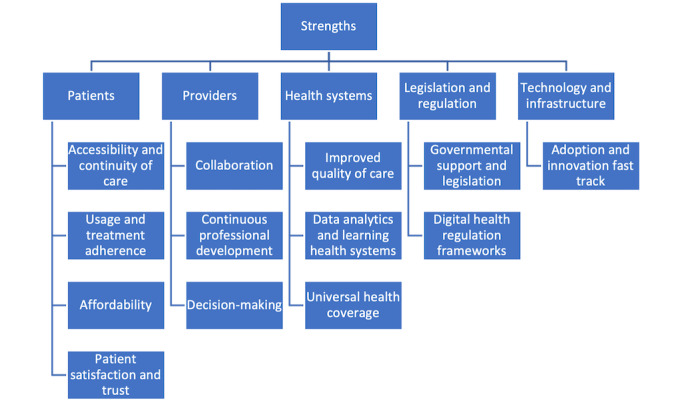
- Strengths included improved access to care, continuity of care, use and treatment adherence, affordability, patient satisfaction and trust; provider collaboration, continuous professional development, and decision-making; health system quality, learning health systems, and progress toward universal health coverage; governmental support and regulation; and fast-tracked adoption and innovation.
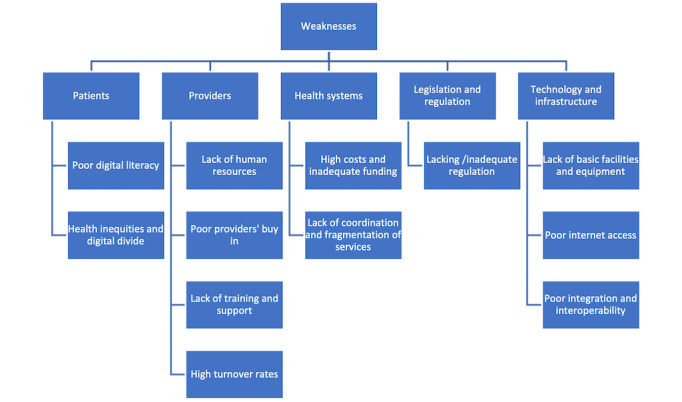
- Weaknesses included poor digital literacy, health inequalities and the digital divide; lack of human resources, poor provider buy-in, lack of training and support, and high turnover; high costs and inadequate funding, lack of coordination and fragmentation; lack or inadequate regulation; and lack of basic facilities/equipment, poor internet access, and poor integration/interoperability.
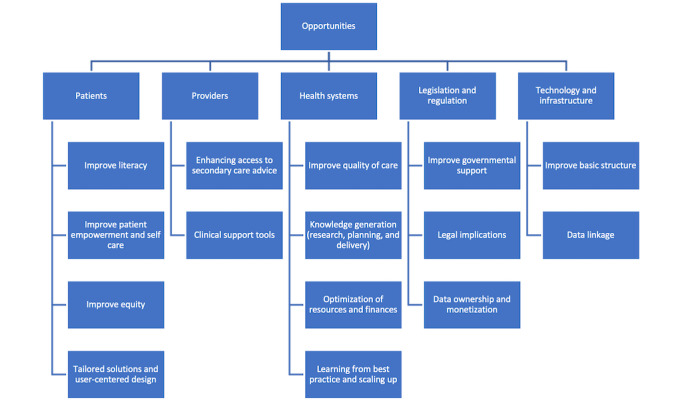
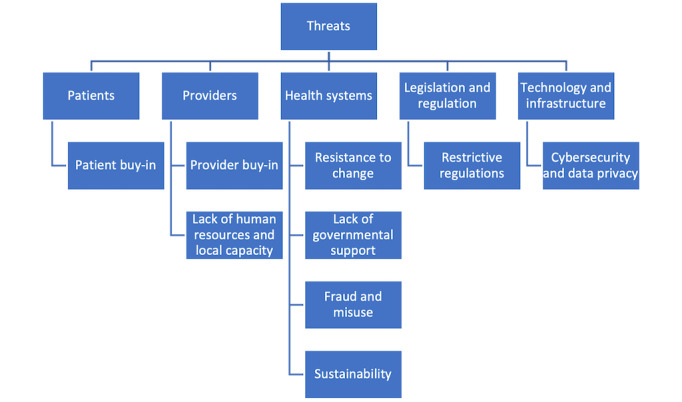
- Opportunities included improving patient digital literacy, empowerment and self-care, equity, and user-centered design; provider access to secondary care advice and clinical support tools; system quality improvement, knowledge generation, resource optimization, and learning from best practice; and improved government support, data ownership/monetization, infrastructure, and data linkage. Threats included patient and provider buy-in, lack of human resources and local capacity, resistance to change, lack of governmental support, fraud and misuse, sustainability, restrictive regulations, and cybersecurity/data privacy concerns.
Methods
- A qualitative study combining web-based focus groups (November 2021; 1 hour; Zoom) and semistructured interviews (January-March 2022; Microsoft Teams), using topic guides based on the strengths, weaknesses, opportunities, and threats (SWOT) framework.
- Participants were recruited through the African Forum for Primary Care and researchers’ contact networks using convenience sampling; inclusion criteria were primary care professionals (clinical and nonclinical) with experience using digital technologies in primary health care in sub-Saharan Africa. There were 6 focus groups and 13 interviews, with 33 unique participants (3 participated in both).
- Transcripts were compiled verbatim and systematically reviewed by 2 independent reviewers using framework analysis with deductive and inductive coding; the COREQ checklist was used, and data saturation was reached.
Limitations
- Stated: the study considered a broad spectrum of heterogeneous DHTs, requiring careful interpretation and potentially limiting transferability to other settings; self-selection may have biased findings toward participants with more experience/knowledge or more positive views of DHTs; and web-based focus groups/interviews may have excluded potential participants with limited network connectivity, electricity, or access to video conferencing platforms.
- Evident from the text: participants were primary care professionals and experts rather than patients or caregivers, and the paper states future research should capture patient and caregiver experiences; participants did not provide consent for further contact, so feedback on findings could not be obtained.
- Evident from the text: focus group participants who did not complete the Zoom survey (n=8, 24%) were categorized as “unknown,” limiting role-specific interpretation for that subset.
Model-written summary. Check it against the paper before relying on it.
Integrity signals
Registry
Cites
Statistics
Figures
Verification
Claims the paper makes
1 Valid · 0 Not valid · 19 Not checked · 103 Own results and interpretations
The cited sources support only part of this claim — read each source’s verdict below.
In the paper
“According to previous literature, in the SSA region, digital health deployment has been constrained by some challenges, including suboptimal coordination of pilot projects [11], lack of awareness and knowledge about digital health, and poor infrastructures (eg, unstable power supply, poor internet connectivity, limited distribution of digital devices, and lack of interoperability of the numerous”
§ Strengths, Weaknesses, Opportunities, and Threats Analysis of the Use of Digital Health Technologies in Primary Health Care in the Sub-Saharan African Region: Qualitative Study > Introduction
What the sources say
- Partly supportedcites [8] Olu O Muneene D Bataringaya JE Nahimana MR Ba H Turgeon Y Karamagi HC Dovlo D How can digital health technologies contribute to sustainable attainment of universal health coverage in Africa? A perspective Front Public Health 2019 7 341 10.3389/fpubh.2019.00341 31803706 31803706 PMC6873775 sourceExperimental — accuracy not yet measured
The Abstract and the 'Digital Health: Evolution, Applications, Benefits, and Challenges in Africa' section of Olu et al. (2019) state that digital health deployment in Africa is constrained by poor infrastructure such as unstable power supply, poor (unstable and expensive) internet connectivity and lack of interoperability of the numerous digital health systems, so those elements are supported. However, 'limited distribution of digital devices' is not among the source's stated constraints: our copy reports mobile phone and internet penetration in Africa at 74% and 21.8%, 'lower than the global average but sufficient for scale up of DH on the continent,' and lists unavailability of maintenance capacities and technologies not adapted to rural African contexts instead. The source also frames the constraint for 'Africa' (the AFRO region) rather than specifically sub-Saharan Africa. (LLM, conf=0.78)
- Not matchedcites [11] mHealth: use of appropriate digital technologies for public health: report by the director-general World Health Organization 2018 2023-05-18 https://apps.who.int/gb/ebwha/pdf_files/WHA71/A71_20-en.pdf
Its entry has no title and year that we can search by.
plainstates a cause- Asserted: passes — The authors put it forward as true.
- Checkable: passes — It can be checked against evidence.
- Load-bearing: passes — The paper’s conclusions depend on it.
- Based: passes — The paper gives a reason why it holds.
- Partly supported
A result the paper reports from its own data — it cites no other source for it, so there is none to check. The quote shows it is in the paper.
In the paper
“At the patient level, the main weaknesses reported were poor digital literacy and the potential of DHTs to entrench existing inequities and exacerbate the digital divide (Figure 2).”
§ Strengths, Weaknesses, Opportunities, and Threats Analysis of the Use of Digital Health Technologies in Primary Health Care in the Sub-Saharan African Region: Qualitative Study > Results > Weaknesses
plain- Asserted: passes — The authors put it forward as true.
- Checkable: passes — It can be checked against evidence.
- Load-bearing: unclear — It is unclear whether the paper’s conclusions depend on it.
- Based: passes — The paper gives a reason why it holds.
A result the paper reports from its own data — it cites no other source for it, so there is none to check. The quote shows it is in the paper.
In the paper
“In what concerns legislation and regulation, participants noted positive developments in governmental support, policies, guidelines, and frameworks.”
§ Strengths, Weaknesses, Opportunities, and Threats Analysis of the Use of Digital Health Technologies in Primary Health Care in the Sub-Saharan African Region: Qualitative Study > Results > Strengths
plain- Asserted: passes — The authors put it forward as true.
- Checkable: passes — It can be checked against evidence.
- Load-bearing: unclear — It is unclear whether the paper’s conclusions depend on it.
- Based: passes — The paper gives a reason why it holds.
A result the paper states — it cites no source for it, so there is none to check. The quote shows it is in the paper.
In the paper
“From a health system perspective, using DHTs improved care quality, supported learning health systems, and contributed to further universal health coverage.”
§ Strengths, Weaknesses, Opportunities, and Threats Analysis of the Use of Digital Health Technologies in Primary Health Care in the Sub-Saharan African Region: Qualitative Study > Discussion > Key Findings
plainstates a cause- Asserted: passes — The authors put it forward as true.
- Checkable: passes — It can be checked against evidence.
- Load-bearing: passes — The paper’s conclusions depend on it.
- Based: passes — The paper gives a reason why it holds.
A result the paper states — it cites no source for it, so there is none to check. The quote shows it is in the paper.
In the paper
“It was also noted that improved accessibility increases usage and adherence.”
§ Strengths, Weaknesses, Opportunities, and Threats Analysis of the Use of Digital Health Technologies in Primary Health Care in the Sub-Saharan African Region: Qualitative Study > Results > Strengths
plainstates a cause- Asserted: passes — The authors put it forward as true.
- Checkable: passes — It can be checked against evidence.
- Load-bearing: unclear — It is unclear whether the paper’s conclusions depend on it.
- Based: passes — The paper gives a reason why it holds.
55 more claims
Create a free account to see all 123 claims and to verify the 22 references still open.
- Probably not a substantial claim. 46
- It may state two separate claims as one. 35
Citations
Cites
Tong, A., Sainsbury, P., & Craig, J. (2007) · International Journal for Quality in Health Care · doi:10.1093/intqhc/mzm042 · Cited by 42,509
The methodology of Focus Groups: the importance of interaction between research participants
Kitzinger, J. (1994) · Sociology of Health & Illness · doi:10.1111/1467-9566.ep11347023 · Cited by 3,870 · cited 1×
“Focus groups are a qualitative method designed to capture both individual perspectives and group dynamics [12,13], and there is an established methodology for conducting them via videoconference [14].”
Focus group methodology: a review
Wilkinson, S. (1998) · International Journal of Social Research Methodology · doi:10.1080/13645579.1998.10846874 · Cited by 861
Ansoff, H. I. (1980) · Strategic Management Journal · doi:10.1002/smj.4250010204 · Cited by 729
Transforming Public Organizations with Strategic Management and Strategic Leadership
Nutt, P. C., & Backoff, R. W. (1993) · Journal of Management · doi:10.1177/014920639301900206 · Cited by 230
Mbunge, E., Batani, J., Gaobotse, G., & Muchemwa, B. (2022) · Global Health Journal · doi:10.1016/j.glohj.2022.03.001 · Cited by 205
Olu, O., Muneene, D., Bataringaya, J. E., Nahimana, M.-R., Ba, H., Turgeon, Y., Karamagi, H. C., & Dovlo, D. (2019) · Frontiers in Public Health · doi:10.3389/fpubh.2019.00341 · Cited by 179
Manyazewal, T., Woldeamanuel, Y., Blumberg, H. M., Fekadu, A., & Marconi, V. C. (2021) · npj Digital Medicine · doi:10.1038/s41746-021-00487-4 · Cited by 177
Social inequalities, regional disparities and health inequity in North African countries
Boutayeb, A., & Helmert, U. (2011) · International Journal for Equity in Health · doi:10.1186/1475-9276-10-23 · Cited by 130
Strengthening Health Systems Using Innovative Digital Health Technologies in Africa
Ibeneme, S., Karamagi, H., Muneene, D., Goswami, K., Chisaka, N., & Okeibunor, J. (2022) · Frontiers in Digital Health · doi:10.3389/fdgth.2022.854339 · Cited by 93
Research works printed but not linked: 4
- Digital technologies: shaping the future of primary health care World Health Organization 2018 2022-12-06 https://www.who.int/docs/default-source/primary-health-care-conference/digital-technologies.pdf?sfvrsn
- Abrams K Gaiser TJ Blank G Fielding N Lee RM The SAGE Handbook of Online Research Methods 2017 London, UK SAGE Publications
- Fontana A Frey J Denzin NK Lincoln YS Handbook of Qualitative Research 1994 Thousand Oaks, CA Sage Publications
- Ritchie J Spencer L Huberman AM Miles MB Qualitative data analysis for applied policy research The Qualitative Researcher's Companion 1994 London, UK Routledge
Cited by
We need to talk about ‘bad’ resilience
Saulnier, D. D., & Topp, S. M. (2024) · BMJ Global Health · doi:10.1136/bmjgh-2023-014041 · Cited by 40
Ochieng, S., Hariharan, N., Abuya, T., Okondo, C., Ndwiga, C., Warren, C., Wickramanayake, A., & Rajasekharan, S. (2024) · BMC Pregnancy and Childbirth · doi:10.1186/s12884-024-06373-7 · Cited by 35
Nairn, B., Tsakanikas, V., Gordon, B., Karapintzou, E., Kaski, D. N., Fotiadis, D. I., & Bamiou, D. (2025) · JMIR Rehabilitation and Assistive Technologies · doi:10.2196/69589 · Cited by 26
Sekandi, J. N., Buregyeya, E., Zalwango, S. K., Nakkonde, D., Kaggwa, P., Quach, T. H. T., Asiimwe, D., Atuyambe, L. M., & Dobbin, K. K. (2025) · JMIR mhealth and uhealth · doi:10.2196/57991 · Cited by 21
Segun-Omosehin, O., Omiye, J. A., Elalfy, A., Sheriff, S. M., Kuti, F., Omole, O., Ogunyankin, K. O., Idemili-Aronu, N., Olawepo, J. O., Ezeanolue, E. E., et al. (2025) · npj Cardiovascular Health · doi:10.1038/s44325-025-00055-9 · Cited by 17
Metadata
- Authors
- O'Brien, N., Li, E., Chaibva, C. N., Gomez Bravo, R., Kovacevic, L., Kwame Ayisi-Boateng, N., Lounsbury, O., Nwabufo, N. F. F., Senkyire, E. K., Serafini, A., Surafel Abay, E., van de Vijver, S., Wanjala, M., Wangari, M.-C., Moosa, S., & Neves, A. L.
- Affiliations
- Imperial College London (GB)
- National University of Science and Technology (ZW)
- Johns Hopkins Children's Center (US)
- Adventist University Cosendai (CM)
- Liverpool School of Tropical Medicine (GB)
- University of Modena and Reggio Emilia (IT)
- OLVG (NL)
- University of the Witwatersrand (ZA)
- ORCID
- Venue
- Journal of Medical Internet Research
- Publisher
- JMIR Publications Inc.
- Published
- 2023-09-07
- Volume
- 25
- Pages
- e45224
- ISSN
- 1438-8871 (ISSN-L)
- PMC
- PMC10514769
- OpenAlex
- W4385147517
- Cited by
- 57
- References
- 27
- Citations by year
- 2026: 22 · 2025: 20 · 2024: 13 · 2023: 2
- FWCI
- 10.37
- Type
- journal article
- Language
- en
- Open access
- gold
- doi.org
- Licence
- cc-by
- Locations
- Journal of Medical Internet Research (publishedVersion, cc-by)
- Oxford University Research Archive (ORA) (University of Oxford) (publishedVersion, cc-by)
- PubMed Central (publishedVersion, cc-by)
- PubMed (publishedVersion)
- LSTM Online Archive (Liverpool School of Tropical Medicine) (acceptedVersion)
- DOAJ (DOAJ: Directory of Open Access Journals) (submittedVersion)
- Spiral (Imperial College London) (submittedVersion, cc-by)
- Funders
- UK Research and Innovation
- National Institute for Health and Care Research (NIHR-INF-0735)
- Imperial College London
- Topics
- Health Sciences › Medicine › Public Health, Environmental and Occupational Health › Telemedicine and Telehealth Implementation
- Health Sciences › Health Professions › General Health Professions › Mobile Health and mHealth Applications
- Health Sciences › Medicine › Public Health, Environmental and Occupational Health › Healthcare Systems and Practices
- Keywords
- digital health technologies, primary care, sub-Saharan Africa, SWOT analysis, digital literacy, health disparities, universal health coverage, continuity of care, health workforce capacity, health policy and regulation, implementation barriers, patient-centered design, multi-stakeholder collaboration, health system strengthening, digital divide
- MeSH terms
- Digital Technology, Humans, Primary Health Care, Technology, Focus Groups, Qualitative Research
About these checks
Registry, retraction, Cites and statistics results are computed, not judged, with one exception: a printed reference that no index lists is read once by a model before it counts as a citation error. Claims are extracted by a model and kept only when their quote appears verbatim in the text; each cited source is then checked, with a model’s help, for whether it says what the claim relies on. Those verdicts can be wrong — read the claim’s quote and the cited source before relying on one.
The claim verdicts this report counts are experimental: their accuracy is not yet measured.
A language model drew the claims from the paper on 2026-11-26, under version 3 of the claim definition (model deepseek-v4.1-flash, prompt extract-v3).
A second model labelled each claim on 2026-11-26 (model jev-1.13-20260917, definition revision gold-guideline-v0.2).
Cited sources are checked with a language model’s help (qwen3.8-omni-flash).
Statistics and arithmetic are recomputed, not judged.
Confidence bands are shown only for fields calibrated on our annotated test set. None is calibrated yet, so no band is shown.
What counts as a claim ›How we measure confidence ›How we check this ›
Are you an author, or do you see a problem with this page? Request a review
Data sources
Bibliographic data: Semantic Scholar, OpenAlex, Crossref.
Contains information from the Semantic Scholar Academic Graph Datasets, made available under the ODC Attribution License (ODC-BY 1.0).
Semantic Scholar’s data is described in: Kinney, R., et al. (2023). The Semantic Scholar Open Data Platform. arXiv:2301.10140.
