

Virtual Patients Using Large Language Models: Scalable, Contextualized Simulation of Clinician-Patient Dialogue With Feedback
Open accessPublished version of a preprint
The DOI matches its Crossref record; 66 of the 66 references it cites were found in a registry or an index.
Abstract
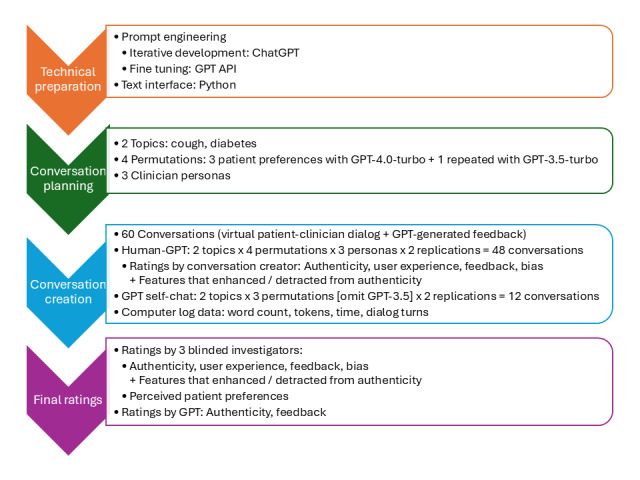
Background: Virtual patients (VPs) are computer screen–based simulations of patient-clinician encounters. VP use is limited by cost and low scalability. Objective: We aimed to show that VPs powered by large language models (LLMs) can generate authentic dialogues, accurately represent patient preferences, and provide personalized feedback on clinical performance. We also explored using LLMs to rate the quality of dialogues and feedback. Methods: We conducted an intrinsic evaluation study rating 60 VP-clinician conversations. We used carefully engineered prompts to direct OpenAI’s generative pretrained transformer (GPT) to emulate a patient and provide feedback. Using 2 outpatient medicine topics (chronic cough diagnosis and diabetes management), each with permutations representing different patient preferences, we created 60 conversations (dialogues plus feedback): 48 with a human clinician and 12 “self-chat” dialogues with GPT role-playing both the VP and clinician. Primary outcomes were dialogue authenticity and feedback quality, rated using novel instruments for which we conducted a validation study collecting evidence of content, internal structure (reproducibility), relations with other variables, and response process. Each conversation was rated by 3 physicians and by GPT. Secondary outcomes included user experience, bias, patient preferences represented in the dialogues, and conversation features that influenced authenticity. Results: The average cost per conversation was US $0.51 for GPT-4.0-Turbo and US $0.02 for GPT-3.5-Turbo. Mean (SD) conversation ratings, maximum 6, were overall dialogue authenticity 4.7 (0.7), overall user experience 4.9 (0.7), and average feedback quality 4.7 (0.6). For dialogues created using GPT-4.0-Turbo, physician ratings of patient preferences aligned with intended preferences in 20 to 47 of 48 dialogues (42%-98%). Subgroup comparisons revealed higher ratings for dialogues using GPT-4.0-Turbo versus GPT-3.5-Turbo and for human-generated versus self-chat dialogues. Feedback ratings were similar for human-generated versus GPT-generated ratings, whereas authenticity ratings were lower. We did not perceive bias in any conversation. Dialogue features that detracted from authenticity included that GPT was verbose or used atypical vocabulary (93/180, 51.7% of conversations), was overly agreeable (n=56, 31%), repeated the question as part of the response (n=47, 26%), was easily convinced by clinician suggestions (n=35, 19%), or was not disaffected by poor clinician performance (n=32, 18%). For feedback, detractors included excessively positive feedback (n=42, 23%), failure to mention important weaknesses or strengths (n=41, 23%), or factual inaccuracies (n=39, 22%). Regarding validation of dialogue and feedback scores, items were meticulously developed (content evidence), and we confirmed expected relations with other variables (higher ratings for advanced LLMs and human-generated dialogues). Reproducibility was suboptimal, due largely to variation in LLM performance rather than rater idiosyncrasies. Conclusions: LLM-powered VPs can simulate patient-clinician dialogues, demonstrably represent patient preferences, and provide personalized performance feedback. This approach is scalable, globally accessible, and inexpensive. LLM-generated ratings of feedback quality are similar to human ratings.
Overview
The claims and statistics of this paper haven’t been checked yet.
Free: it reads the open-access text and checks the first 5 claims that cite a source we can check. Create a free account to check every claim.
Integrity signals
Registry
Cites
Statistics
Figures
Verification
Claims the paper makes
The claims and statistics of this paper haven’t been checked yet.
Free: it reads the open-access text and checks the first 5 claims that cite a source we can check. Create a free account to check every claim.
Claims other papers make about this one
Each is checked against this paper’s own text: does it say what the citing paper says it does?
The source backs part of the claim, not all of it — or backs it for a different population, condition or comparison.
In the citing paper
“LLM-generated simulations demonstrate clinically relevant psychiatric exchanges [23-25] and generate automated feedback aligned with expert judgment [26], offering a cost-efficient and scalable alternative to real patients for clinical training.”
From Enhancing Psychiatry Training Using an Agentic AI Simulated Consultation Tool: Prospective Cohort Study (2026) · cites this paper as [23]
Experimental — accuracy not yet measuredThe cited source says what the claim attributes to it.
In the citing paper
“Prior studies have demonstrated the technical feasibility of text-based VSPs and AI-assisted automated scoring systems.”
In the citing paper
“These findings, echoed by Cook et al [23], who observed that LLM-powered virtual patients generated personalized, high-quality performance feedback rated comparably to human evaluators, substantiate the potential of AI-assisted formative assessment in clinical education.”
From Enhancing Psychiatry Training Using an Agentic AI Simulated Consultation Tool: Prospective Cohort Study (2026) · cites this paper as [23]
Self-check
Percentages, sums and reported differences re-computed from the paper’s own numbers.
The self-check needs the paper’s full text.
Citations
Cites
The Measurement of Observer Agreement for Categorical Data
Landis, J. R., & Koch, G. G. (1977) · Biometrics · doi:10.2307/2529310 · Cited by 81,148 · cited 1×
“To appraise rating reproducibility, we estimated variance components and calculated a single-rating intraclass correlation coefficient (ICC), which was interpreted using criteria from Landis and Koch [66] (ie, 0-0.2=slight; 0.21-0.4=fair; 0.41-0.6=moderate; and 0.61-0.8=substantial).”
InfluentialThe FAIR Guiding Principles for scientific data management and stewardship
Wilkinson, M. D., Dumontier, M., Aalbersberg, I. J., Appleton, G., Axton, M., Baak, A., Blomberg, N., Boiten, J.-W., da Silva Santos, L. B., Bourne, P. E., et al. (2016) · Scientific Data · doi:10.1038/sdata.2016.18 · Cited by 18,423 · cited 1×
“LLMs represent a disruptive technology [31], offering an unprecedented opportunity to transform VP production and use, enabling scalable, accessible (ie, inexpensive and low expertise), interoperable, and reusable [32] simulations of patient-clinician encounters.”
An overview of clinical decision support systems: Benefits, risks, and strategies for success
Sutton, R. T., Pincock, D., Baumgart, D. C., Sadowski, D. C., Fedorak, R. N., & Kroeker, K. I. (2020) · npj Digital Medicine · doi:10.1038/s41746-020-0221-y · Cited by 3,019 · cited 1×
“VPs—computer screen–based simulations of patient-clinician encounters [7]—have demonstrated efficacy in teaching, assessing, and studying clinical reasoning [8] and could also support validation of decision-support tools before clinical implementation [9,10].”
The Experience of Presence: Factor Analytic Insights
Schubert, T., Friedmann, F., & Regenbrecht, H. (2001) · Presence: Teleoperators and Virtual Environments · doi:10.1162/105474601300343603 · Cited by 2,303 · cited 1×
“We added a third empirically derived framework for evaluating “presence” in virtual reality (ie, realness, involvement, and spatial “physical” presence) [54,55].”
Current Concepts in Validity and Reliability for Psychometric Instruments: Theory and Application
Cook, D. A., & Beckman, T. J. (2006) · The American Journal of Medicine · doi:10.1016/j.amjmed.2005.10.036 · Cited by 1,745 · cited 1×
“For the 3 novel instruments, we conducted a validation study collecting validity evidence from 4 of 5 potential sources [39,40]: content (ie, grounding of the instruments in theory and prior empirical work); internal structure (ie, rating reproducibility); relations with other variables (ie,…”
Self-citationFeedback in Clinical Medical Education
Ende, J. (1983) · JAMA: The Journal of the American Medical Association · doi:10.1001/jama.1983.03340060055026 · Cited by 1,329 · cited 1×
“Providing performance feedback to clinicians is also essential in clinical skill development [23], yet it is commonly of low quality or simply absent [24-27].”
Liu, C.-W., Lowe, R., Serban, I., Noseworthy, M., Charlin, L., & Pineau, J. (2016) · Proceedings of the 2016 Conference on Empirical Methods in Natural Language Processing · doi:10.18653/v1/d16-1230 · Cited by 1,228
Language (Technology) is Power: A Critical Survey of “Bias” in NLP
Blodgett, S. L., Barocas, S., Daumé III, H., & Wallach, H. (2020) · Proceedings of the 58th Annual Meeting of the Association for Computational Linguistics · doi:10.18653/v1/2020.acl-main.485 · Cited by 1,050 · cited 1×
“Bias—“skew that produces a type of harm toward different social groups” [62]—is a well-known risk in AI generally and natural language generation specifically [62-65].”
A three-talk model for shared decision making: multistage consultation process
Elwyn, G., Durand, M. A., Song, J., Aarts, J., Barr, P. J., Berger, Z., Cochran, N., Frosch, D., Galasiński, D., Gulbrandsen, P., et al. (2017) · BMJ · doi:10.1136/bmj.j4891 · Cited by 1,018
What every teacher needs to know about clinical reasoning
Eva, K. W. (2005) · Medical Education · doi:10.1111/j.1365-2929.2004.01972.x · Cited by 930 · cited 1×
“As we seek to prevent errors in clinical practice [1,2] and promote high-value care [3,4], we need to better understand clinical reasoning and how to support its development and application [2,5].”
Research works printed but not linked: 3
- Tong, Y, 2014, The standards for educational and psychological testing, 11
- Roller, S, arXiv, 2006.12442 · arXiv
- Adiwardana, D, arXiv
Cited by
Zeng, J., Qi, W., Shen, S., Liu, X., Li, S., Wang, B., Dong, C., Zhu, X., Shi, Y., Lou, X., et al. (2025) · Journal of Medical Internet Research · doi:10.2196/79091 · Cited by 76
“Among studies using ChatGPT, only 2 mentioned setting the “temperature” hyperparameter [49,51], with one of them exploring whether the temperature affects LLM-based virtual patients’performance.”
InfluentialA large language model digital patient system enhances ophthalmology history taking skills
Luo, M.-J., Bi, S., Pang, J., Liu, L., Tsui, C.-K., Lai, Y., Chen, W., Yang, Y., Xu, K., Zhao, L., et al. (2025) · npj Digital Medicine · doi:10.1038/s41746-025-01841-6 · Cited by 39
Gin, B. C., LaForge, K., Burk-Rafel, J., & Boscardin, C. K. (2025) · Academic Medicine · doi:10.1097/acm.0000000000006117 · Cited by 36
Li, D., & Lutfi, S. L. (2025) · JMIR Medical Informatics · doi:10.2196/79039 · Cited by 45
The feasibility of using generative artificial intelligence for history taking in virtual patients
Yi, Y., & Kim, K.-J. (2025) · BMC Research Notes · doi:10.1186/s13104-025-07157-8 · Cited by 28
“In particular, further studies are warranted to inform the effective use of prompts and behavioral components of the chatbot that optimizes its performance across various clinical contexts [8, 9, 10].”
Elhilali, A., Ngo, A. S.-H., Reichenpfader, D., & Denecke, K. (2025) · JMIR Medical Education · doi:10.2196/81271 · Cited by 34
“Similarly, Cook et al [16] compared 2 models (GPT-4.”
InfluentialJacobs, C., Johnson, H., Tan, N., Brownlie, K., Joiner, R., & Thompson, T. (2025) · JMIR Medical Education · doi:10.2196/70766 · Cited by 20
“AI platforms offer an opportunity to simulate such scenarios with high fidelity while ensuring accessibility and scalability, thus addressing key gaps in current educational approaches [14-16].”
Liu, Y., Shi, C., Wu, L., Lin, X., Chen, X., Zhu, Y., Tan, H., & Zhang, W. (2025) · JMIR Medical Education · doi:10.2196/73419 · Cited by 28
Haider, S. A., Prabha, S., Gomez-Cabello, C. A., Borna, S., Genovese, A., Trabilsy, M., Collaço, B. G., Wood, N. G., Bagaria, S. P., Tao, C., et al. (2025) · Sensors · doi:10.3390/s25144305 · Cited by 31
“In recent years, simulation has taken on a new dimension with the emergence of large language models (LLMs), which can generate synthetic clinical data, most notably, artificial patient–physician conversations [15–17].”
Large Language Model-Based Virtual Patient Simulations in Medical and Nursing Education: A Review
Jo, Y.-W., Lee, M., & Yang, H.-J. (2025) · Applied Sciences · doi:10.3390/app152211917 · Cited by 22
Kewalramani, D., Jawa, R. S., Martin, C. A., Gosain, A., Wan, D. C., Varghese, T. K., Boland, G. M., Dream, S. Y., Sifri, Z. C., Mollen, K. P., et al. (2025) · Surgery · doi:10.1016/j.surg.2025.109849 · Cited by 24
Sheth, U., Lo, M., McCarthy, J., Baath, N., Last, N., Guo, E., Monteiro, S., & Sibbald, M. (2025) · International Medical Education · doi:10.3390/ime4040039 · Cited by 11
“Foundational work in nursing has been conducted, and the beginnings of work in undergraduate medical education have as well [10,35–37 ,”
InfluentialBorg, A., Schiött, J., Ivegren, W., Gentline, C., Huss, V., Hugelius, A., Jobs, B., Ruiz, M., Edelbring, S., Georg, C., et al. (2026) · JMIR Medical Education · doi:10.2196/90368 · Cited by 17
“Recent advances in large language models (LLMs) enable automated analysis of student-VP interactions, providing scalable feedback on medical history taking and diagnostic reasoning [16,17].”
Zouakia, Z., Logak, E., Szymczak, A., Jaïs, J., Burgun, A., & Tsopra, R. (2026) · JMIR Medical Education · doi:10.2196/82116 · Cited by 11
Jeon, H. G., & Jeong, H. W. (2026) · Clinical Simulation in Nursing · doi:10.1016/j.ecns.2026.101912 · Cited by 5
AI-simulated clinical consultations: Assessing the potential of ChatGPT to support medical training
Saggar, A., Dimitrova, V., Sarikaya, D., Hogg, D., & Darling, J. C. (2026) · Archives of Disease in Childhood · doi:10.1136/archdischild-2025-329846 · Cited by 4
“19 24 However, many works restrict assessment of agents to rigid measures like diagnostic correctness 15–17 or the ability to recall role-specific information.”
Dymm, B., & Khalid, A. (2025) · Seminars in Neurology · doi:10.1055/a-2713-6622 · Cited by 6
“Importantly, AI provides data insights to inform, not replace, human judgment in nal administrative and selection decisions.”
Controlled Yet Natural: A Hybrid BDI-LLM Conversational Agent for Child Helpline Training
Owayyed, M. A., Denga, A., & Brinkman, W. (2025) · ACM International Conference on Intelligent Virtual Agents (IVA) · doi:10.1145/3717511.3747075 · Cited by 4
“For example, LLMs could be used to generate feedback based on trainees’ interactions, enabling deeper skill acquisition [9, 13, 52].”
Müller, Y., Lemberg, H., Gellert, P. R., & Zoellick, J. C. (2026) · JMIR Medical Education · doi:10.2196/88092 · Cited by 6
Managing Clinical Uncertainty: Formalizing Management Reasoning in Emergency Care Delivery
Haimovich, A. D., Janke, A. T., Kocher, K. E., Mangus, C. W., Parsons, A. S., McCoy, L. G., Taylor, R. A., Rodman, A. M., & Pusic, M. V. (2025) · Annals of Emergency Medicine · doi:10.1016/j.annemergmed.2025.09.007 · Cited by 6
Virtual Patients for Communication Skills Training: A Mixed Methods Evaluation
Jadoon, M., Naushad, K., Aman, F., Khan, Y., Durrani, M., & Ali, S. (2025) · Cureus · doi:10.7759/cureus.91005 · Cited by 7
“One such innovation is the use of virtual patients, computer-generated simulations that replicate real-life clinical encounters [6].”
Wang, Q., Chen, Z., Zhang, H., Zhou, Y., Du, C., Hu, W., Lv, X., Xie, T., & Zheng, H. (2025) · Scientific Reports · doi:10.1038/s41598-025-18759-4 · Cited by 4
“The result showed that the quality of LLMs-generated ratings of feedback is similar to human physicians, but it still has detractors like lower authenticity, verbose vocabulary and failure to mention important weaknesses or strengths 10 .”
Xin, W., Yi, H., Song, J., Tian, Z., Chen, H., & Tan, S. (2025) · Asian Journal of Psychiatry · doi:10.1016/j.ajp.2025.104707 · Cited by 4
Sun, N., Zhou, X., Yang, Z., Zhou, Y., Ma, R., & Wang, Z. (2026) · Frontiers in Public Health · doi:10.3389/fpubh.2026.1768518 · Cited by 5
“They are not restricted by time or physical space, can be simultaneously accessed by multiple users, and can be reused repeatedly—making them more cost-effective and practical than human SPs (17).”
Artificial Intelligence in Medical Education and Assessment: The next step in the IT Revolution
Shaban, S. F., & Magzoub, M. E. (2025) · F1000Research · doi:10.12688/f1000research.173611.1 · Cited by 4
Figueroa, R. A., Bernales, M., Hoeboer, C. M., & Olff, M. (2026) · European Journal of Psychotraumatology · doi:10.1080/20008066.2026.2616976 · Cited by 2
“…language interactions that are accountable to context, and to provide personalized feedback on support provision performance, it is now possible to build virtual people affected by distressing events with unprecedented capacities to por-tray realistic individuals (Cook, 2025; Cook et al., 2025).”
Liu, Y., Zhu, Y., Zhang, W., Lu, X., Wu, L., Yue, M., Xia, O., & Shi, C. (2026) · JMIR Medical Education · doi:10.2196/89367 · Cited by 3
“With advancements in digital technologies, particularly revolutionary breakthroughs in large language models (LLMs), LLM-driven virtual patients (VPs) are viewed as a potential innovative solution to resource shortages [8-10].”
Large Language Model-Based Virtual Patients for Simulated Clinical Learning: A Scoping Review
Gandhi, B., Morjaria, L., Illamperuma, I., Nadesan, P., Arora, A., & Sibbald, M. (2026) · AI in Medicine · doi:10.3390/aimed1010007 · Cited by 6
Current and Future View on Artificial Intelligence in Cardiothoracic Surgery
Engelhardt, S., Kostiuchik, G., Bezák, B., Chacko, J., Daeter, E. J., Fallouh, H. B., Grieshaber, P., Hussein, N., Meyer, A., Quattroni, P., et al. (2026) · European Journal of Cardio-Thoracic Surgery · doi:10.1093/ejcts/ezag112 · Cited by 2
Gao, X., Feng, J., Duan, L., Wang, L. M., Xu, H., Sun, X., & Huang, X. (2026) · Medical Teacher · doi:10.1080/0142159x.2026.2681965 · Cited by 2
Rueda, A., Al-Shamali, H. F., Cote, Z., Roy, N., Janssen-Aguilar, R., Joseph, J., Teferra, B. G., Kamaleddin, M. A., Burback, L., Winkler, O., et al. (2026) · JMIR Medical Education · doi:10.2196/88580 · Cited by 1
“These findings, echoed by Cook et al [23], who observed that LLM-powered virtual patients generated personalized, high-quality performance feedback rated comparably to human evaluators, substantiate the potential of AI-assisted formative assessment in clinical education.”
Generative AI: A Disruptor to Health Professions Learner Assessment
Morjaria, L., Gandhi, B., Burns, L., & Sibbald, M. (2025) · Cureus · doi:10.7759/cureus.96034 · Cited by 2
“GenAI is similarly able to revolutionize case-based learning; a central component of most health professions curricula, learners stand to benefit from cases developed with GenAI and its ability to act as a virtual patient and provide customized, real-time feedback for students [34].”
From Bytes to Bedside: Exploring the Impact of AI on Medicine and Education
Winkel, A. F., Myrick, O., Smith, M., & Triola, M. M. (2025) · Clinical Obstetrics & Gynecology · doi:10.1097/grf.0000000000000982 · Cited by 1
Konrad, R., Pfadenhauer, T., Eckenweber, L., Banahovschi, A., Braun, C., Reuter, T., Popp, S., Engelen, C., Baierl, L., Soy, M., et al. (2026) · Frontiers in Disaster and Emergency Medicine · doi:10.3389/femer.2026.1756349 · Cited by 1
Zhao, L., Han, Q., Li, P., Dai, H., & Ju, X. (2026) · BMC Medical Education · doi:10.1186/s12909-026-08947-9 · Cited by 2
“…align with emerging evidence that learners embrace AI tools when they perceive them as efficient, accessible, and aligned with academic needs [20], demonstrating high perceived usefulness and adequate perceived ease of use—TAM’s foundational constructs for predicting technology acceptance [21].”
Evaluating real-time voice AI–based virtual patients for authentic communication training
Hu, W., Zuo, Y., Wan, Q., Zhou, J., Yuan, L., & Wang, S. (2026) · Medical Teacher · doi:10.1080/0142159x.2026.2645021 · Cited by 2
“VPs have emerged as a scalable alternative, offering standardized, on-demand opportunities for practice [10,11].”
Khan, A. S., Hasan, S. H., & Ismail, F. N. A. (2026) · Advances in Medical Education and Practice · doi:10.2147/amep.s578857 · Cited by 2
“19,20 Research shows that these systems have the ability to ask guided reflection questions, role-play difficult conversations before providing feedback, and summarize performance logs.”
An Interactive LLM-Based Simulator for Dementia-Related Activities of Daily Living
Gangaraju, K., Wung, S.-F., Berner, K., Wang, J., & Yuan, F. (2026) · IEEE/ACM Conference on Connected Health: Applications, Systems and Engineering Technologies · doi:10.1109/chase69719.2026.00024 · Cited by 1
“[5 ] evaluates an LLM-driven virtual patient for clinician–patient dialogue practice with feedback, comparing it against fixed-response chatbots and human standardized patient encounters.”
Espinosa-Hernández, S., Rodríguez-Pérez, M. E., & Ramírez-Flores, C. J. (2026) · Journal of Microbiology and Biology Education · doi:10.1128/jmbe.00344-25 · Cited by 1
Sözlü, U., Günay, S. M., & Özkazanç, G. (2026) · BMC Sports Science Medicine and Rehabilitation · doi:10.1186/s13102-026-01812-8 · Cited by 1
“Additionally, they can transform image-based inputs into verbal explanations, enabling interactions resembling clinician–patient communication and improving accessibility for both healthcare professionals and the general public [13, 14].”
Ye, Y., Tao, H., Huang, S., Zou, M., Chen, Y., Shen, P., Hao, M., & Liu, C. (2026) · Frontiers in Medicine · doi:10.3389/fmed.2026.1904001 · Cited by 1
MedPI: Evaluating AI Systems in Medical Patient-facing InteractionsPreprint
Fajardo, D., Proniakin, O., Gruber, V., & Marinescu, R. V. (2026) · medRxiv · doi:10.64898/2025.12.24.25342982 · Cited by 4
“Prior work on automatic evaluation of patient-doctor conversations [9–11] has explored both LLM-driven patient simulation and the use of LLMs as evaluators.”
Daniels, B., Zhang, W., Nguyen, H., & Duong, D. (2026) · medRxiv · doi:10.64898/2026.03.02.26347479 · Cited by 1
Song, J. W., Kim, M., Hong, C., Kim, Y. S., Cho, J., Kim, J. H., Myung, J., Choi, A., Yoon, H., Lee, S. G. W., et al. (2026) · medRxiv · doi:10.64898/2026.02.21.26346803
AI-Driven Virtual Patient Simulations for Communication Training in Medical Students: A Pilot StudyPreprint
Zambrano-Serrano, B., Cueto-Galán, R., Escamilla, A., Ramirez-Rodríguez, M. D. R., Sanchez-Corrales, N., & Fontalba-Navas, A. (2025) · Research Square · doi:10.21203/rs.3.rs-7270436/v1
Training LLM with Human Feedback
Rezaei, H., Beheshti, A., & Rabhi, F. (2025) · Springer eBooks · doi:10.1007/978-981-95-3658-0_53 · Cited by 2
Botero, V. B., Yadav, V. K., Ouyang, J., Abbas, A., & Worthington, M. (2026) · Journal of Medical Internet Research · doi:10.2196/89066
“Emerging empirical evidence supports this utility: randomized trials show that LLM-based simulations achieve high dialogue authenticity ratings and reduce trainee anxiety compared with live observation, providing an accessible environment for skill development [15-19].”
Smart Virtual Patients for TCM: Combining Knowledge Graphs and Language Models
Li, D., & Lutfi, S. L. (2025) · International Conference on Information Technology and Digital Applications (ICITDA) · doi:10.1109/icitda68167.2025.11332301
Yu, Z., Wei, J., Dong, F., Luo, H., Zhang, Z., Fan, J., Ding, H., An, H., Xie, W., & Lu, Y. (2026) · Intelligent Medicine · doi:10.1016/j.imed.2025.12.009
Medina, D., Lavín, C., Leviante, R., Alzolay-Sepúlveda, J., Torres, F. M., Araya, T. A., Reyes, R. V., & Reyes, J. (2026) · doi:10.2196/preprints.91444
Application of large language models in medical interview training: a study with medical students
Hryszko, J., Michałek, A., & Roman, A. (2026) · BMC Medical Education · doi:10.1186/s12909-026-08819-2 · Cited by 2
“Following Cook et al. [16], we define effective communication in medical interviews as the ability to conduct structured information gathering (the intake interview), elicit comprehensive history of present illness (HPI), and facilitate shared decision-making between physician and patient.”
InfluentialGao, X., Feng, J., Duan, L. F., Wang, L., Xu, H., Sun, X., & Huang, X. (2026) · doi:10.2196/preprints.94401
Yang, J., Yang, S., Shao, Z., Chen, T., Shen, H., Zhou, P., Xia, B., Lei, X., Wang, L., Xue, D., et al. (2026) · Burns & Trauma · doi:10.1093/burnst/tkag026 · Cited by 3
“These flaws amplify in high-stakes ECCM settings: false positives risk alert fatigue, while false negatives may delay recognition of clinical deterioration, potentially resulting in patient death [ 137, 138].”
InfluentialPsychoDial: A framework for building a suicide risk dialogue dataset in human-AI conversations
Chen, X., Li, Q., Jiang, Y., Liu, M., Yang, L., Jing, X., Wei, Z., & Cao, L. (2026) · Information Processing & Management · doi:10.1016/j.ipm.2026.104787 · Cited by 1
Artificial Intelligence–driven Avatar Simulation for Preanesthesia Assessment Training
Barra, F. L., Rodella, G., Leuci, L., Costa, A., Santini, A., Vaschetto, R., Cecconi, M., & Carenzo, L. (2026) · Anesthesiology · doi:10.1097/aln.0000000000006031
Miao, W., & Yuen, M. (2026) · Journal of Creativity in Mental Health · doi:10.1080/15401383.2026.2666304
Glinkowski, W., Jacennik, B., Jankowska, K., Cedro, T., Wilk, S., & Doniec, R. (2026) · Applied Sciences · doi:10.3390/app16104858 · Cited by 1
BaHammam, F. A. (2026) · JMIR Formative Research · doi:10.2196/91021 · Cited by 1
“Feasibility was evaluated using the Dialogue Authenticity Scale to assess the quality of standardized virtual patient responses during interactions with students and the realism of the overall dialogue in the simulation-based training session [20].”
InfluentialJanke, A. T., Wu, D., Stubblefield, W. B., Westafer, L. M., Schmitzberger, F., Rodman, A. M., Kocher, K. E., & Haimovich, A. D. (2026) · doi:10.2196/preprints.103522
Haut, K. G., Hasan, M., Carroll, T., Epstein, R. M., Sen, T., & Hoque, M. E. (2026) · JMIR Medical Education · doi:10.2196/93034
“Studies by Elhilali et al [25] and Cook et al [27] demonstrate that LLM-driven patient simulations can generate realistic dialogue and are perceived as usable, but they do not assess whether such systems improve clinician communication skills.”
Nguyen, T., Dang, T., Nguyen, D., & Vo, C. (2026) · International Conference on Information and Education Technology (ICIET) · doi:10.1109/iciet69664.2026.11561634
“These two components also show the differences between our system and the existing ones in [2, 4, 5], leading to the significant contribution of our work to education technologies.”
Lim, S.-W., Noh, J. H., Seo, M. S., & 이정 (2026) · Korean Association for Qualitative Research · doi:10.48000/kaqrkr.2026.11.31
Su, D., & Ling, J. (2026) · Lecture notes in computer science · doi:10.1007/978-3-032-29842-3_34
Liu, Y., Zhu, Y., Shi, C., Lu, X., Wu, L., Yue, M., Hong, X., Xia, O., & Zhang, W. (2026) · JMIR Medical Education · doi:10.2196/101425 · Cited by 1
Takhdat, K., Fadely, A. E., Mohamed, E., Ouaamr, A., & Adib, A. R. E. (2026) · Medical Science Educator · doi:10.1007/s40670-026-02804-6 · Cited by 1
Albaladejo‐González, M., Ruipérez‐Valiente, J. A., Barno, E., Mármol, F. G., & Reich, J. (2026) · Behaviour and Information Technology · doi:10.1080/0144929x.2026.2699273
A Doctor Dialogue Model Based on Vector Quantisation
Chen, X. (2026) · Cognitive Models and Artificial Intelligence Conference (AICCONF) · doi:10.1109/aicconf69182.2026.11600627
Imani, M. H., & Imani, A. H. (2026) · doi:10.2196/preprints.107535
Digital Standardized Patients: Conceptual Framework for Generative AI–Empowered Medical Education
Jia, C., & Qi, L. (2026) · JMIR Medical Education · doi:10.2196/91050 · Cited by 1
Artificial intelligence generated virtual patients in health professions education: a scoping review
Fang, E., Boon, Y., Ho, J. Y., Tey, N., & Low, M. (2026) · BMC Medical Education · doi:10.1186/s12909-026-10028-w · Cited by 2
“…patients’ geographical and cultural backgrounds [64, 95, 101], patients’ preferences (e.g. preference for testing or patient financial concerns) [37], patients’ trust in clinicians [106], and patient personalities [59, 66, 75], which aligned with realistic variation and challenge in authentic…”
InfluentialA primer on artificial intelligence for palliative care educators
Simoni, J., & Simoni, D. A. (2026) · Palliative Care and Social Practice · doi:10.1177/26323524261474075 · Cited by 1
Zhang, J., Zhu, Y., Lin, D., Yang, X., Yu, S., Liu, X., Wu, N., & Zhao, M. (2026) · Research Square · doi:10.21203/rs.3.rs-10452795/v1
Thompson, S., Southwood, R., Brooks, K., Palmer, R., Smith, K., Shin, D., & Lavender, D. L. (2026) · American Journal of Pharmaceutical Education · doi:10.1016/j.ajpe.2026.102068
Yin, Q., Feng, T., Dou, J.-Q., Li, Y., Liu, D., Song, D., Pan, A., Yu, M., Sun, Y., Li, T., et al. (2026) · doi:10.2196/preprints.109817
Gandhi, B., Sheth, U., McCarthy, J., & Sibbald, M. (2026) · International Medical Education · doi:10.3390/ime5030085
“Comparable work has also shown that VPs may support history-taking and diagnostic tasks when the simulation is deliberately designed around those objectives [8,9,16].”
Aloraini, A. (2026) · SeGAH ... IEEE ... International Conference on Serious Games and Applications for Health/IEEE International Conference on Serious Games and Applications for Health · doi:10.1109/segah69272.2026.11653318
“[7], [8].”
Cohen, H., Smith, B., Day, N., Jacobs, C., & Reid, D. (2026) · Education for Primary Care · doi:10.1080/14739879.2026.2714838
Hashimoto, N., & Iwatani, K. (2026) · Applied Sciences · doi:10.3390/app16178591
Oppositional Simulation as a Method for Expert Witness Skill Acquisition
Cohen, C., & Cohen, J. (2026) · Proceedings of the Human Factors and Ergonomics Society Annual Meeting · doi:10.1177/10711813261485917
Elucidating the transformative role of large language models in advancing anesthesiology education
Zhu, Y., Xie, D., Liang, R., Yang, J.-J., Du, X.-Y., & Zhou, C.-M. (2026) · Journal of International Medical Research · doi:10.1177/03000605261483195
“21 Compared with traditional teaching resource development that relies on individual faculty expertise, LLM-generated resources offer advantages in standardization across institutions, real-time updating to re fl ect the latest clinical guidelines, and customization for different learner levels…”
Li, D., Lutfi, S. L., Ahmad, A., & Mulki, H. (2026) · doi:10.2196/preprints.111051
Drouot, C., & Percivalle, A. (2026) · Education Sciences · doi:10.3390/educsci16091505
Xu, Y., Liu, X., & Zhao, Y. (2026) · International Conference on Educational Digitalization and Computer Science in the Guangdong-Hong Kong-Macao Greater Bay Area · doi:10.1145/3828183.3828398
“Cook et al. [12] developed a virtual patient (VP) system based on LLMs, using care-fully designed prompts to simulate clinician-patient dialogues and provide personalized feedback, verifying that LLM-powered VPs are scalable, low-cost, and capable of generating authentic clinical dialogues—this…”
Kelleher, M. E., Zhou, C. Y., Weber, D., Overla, S., Bowen, J., Generoso, J. R., Zheng, W., Santen, S. A., & Turner, L. (2026) · Diagnosis · doi:10.1515/dx-2026-0069
“When appropriately supported with well-designed architecture, AI enables students to engage in diagnostic and management reasoning through dynamic, adaptive scenarios that can also be repeated and customized [17, 18].”
Soares, V. V., PASSOS, F. F. D. C., Shansis, F., & Herbert, J. S. (2026) · Academic Psychiatry · doi:10.1007/s40596-026-02422-9
Ismail, N. A. S., Azman, A. H. A., Zafira, A., Faiz, M. F. A., Shaharir, S. S., Mustafar, R., Shamsuddin, C. M., Ma’arof, D. Z., & Sahran, S. (2026) · Frontiers in Medicine · doi:10.3389/fmed.2026.1895321
Lee, C.-T., & Chen, C. (2026) · Nurse Education Today · doi:10.1016/j.nedt.2026.107448
Choi, Y.-M., Hur, S., & Kim, S.-H. (2026) · Journal of Digital Contents Society · doi:10.9728/dcs.2026.27.9.2573
Shawon, M. T. R., Irbaz, M. S., Elyazori, H. R. A., Resapu, K. R., Lin, Y., Cardenas, V. F., Eklou, K. P., Alemi, F., & Lybarger, K. (2026) · JMIR AI · doi:10.2196/100772 · Cited by 1
“Recent systems have integrated LLMs to enhance expressiveness and flexibility [37], constructed structured knowledge bases from clinical notes to support medical intake tasks [38], and embedded risk-aware feedback mechanisms [34].”
InfluentialChen, A., Jin, S., Wang, C., Swartz, H. A., Wu, T., Kraut, R. E., & Zhu, H. (2026) · JMIR Mental Health · doi:10.2196/95389 · Cited by 1
“Rapid advances in LLMs and chatbot technologies means that chatbot-based virtual patients might be a useful and scalable addition to counselor training [19, 53, 113].”
Zhang, J., Zhu, Y., Lin, D., Yang, X., Yu, S., Liu, X., Wu, N., & Zhao, M. (2026) · Research Square · doi:10.21203/rs.3.rs-11023382/v1
Gbekie, C., Peet, B. M., Whelan, M. G., Simmons, G. B., Pacella, D. P., Nwigwe, V., & Rosario, A. (2026) · Research Square · doi:10.21203/rs.3.rs-11120355/v1
Artificial Intelligence in Surgical Education
Schmidt, J. C., Asaad, M., Gosman, A. A., & Nguyen, V. T. (2026) · Clinics in Plastic Surgery · doi:10.1016/j.cps.2026.09.001
Bostraeten, P. V., Mertens, L., Jaeken, J., Bossen, J. K. J., Toelen, J., Bekkering, G. E., Delvaux, N., & Aertgeerts, B. (2026) · JMIR Formative Research · doi:10.2196/102449
Metadata
- Authors
- Cook, D. A., Overgaard, J., Pankratz, V. S., Del Fiol, G., & Aakre, C. A.
- Affiliations
- Mayo Clinic (US)
- University of New Mexico (US)
- Corresponding author
- Cook, David A
- Venue
- Journal of Medical Internet Research
- Publisher
- JMIR Publications Inc.
- Published
- 2025-04-04
- Volume
- 27
- Pages
- e68486
- ISSN
- 1438-8871 (ISSN-L)
- PMC
- PMC12008702
- OpenAlex
- W4406327404
- Cited by
- 96
- References
- 65
- Citations by year
- 2026: 72 · 2025: 24
- FWCI
- 23.11
- Type
- journal article
- Language
- en
- Open access
- gold
- doi.org
- Licence
- cc-by
- Locations
- Journal of Medical Internet Research (publishedVersion, cc-by)
- PubMed Central (publishedVersion, cc-by)
- PubMed (publishedVersion)
- DOAJ (DOAJ: Directory of Open Access Journals) (submittedVersion, cc-by-sa)
- Funders
- Edinburgh Napier University
- Gentofte Hospital
- Topics
- Health Sciences › Medicine › Health Informatics › Artificial Intelligence in Healthcare and Education
- Social Sciences › Education › Simulation-Based Education in Healthcare
- Social Sciences › Education › Innovations in Medical Education
- Keywords
- virtual patients, large language models, GPT, personalized feedback, patient preferences, GPT-3.5-turbo, diabetes management, simulation scalability, user experience, prompt engineering
- MeSH terms
- Large Language Models, Communication, Diabetes Mellitus, Feedback, Humans, Language, Physician-Patient Relations, User-Computer Interface, Patient Simulation, Patient Preference
About these checks
Registry, retraction, Cites and statistics results are computed, not judged, with one exception: a printed reference that no index lists is read once by a model before it counts as a citation error. Claims are extracted by a model and kept only when their quote appears verbatim in the text; each cited source is then checked, with a model’s help, for whether it says what the claim relies on. Those verdicts can be wrong — read the claim’s quote and the cited source before relying on one.
Statistics and arithmetic are recomputed, not judged.
Confidence bands are shown only for fields calibrated on our annotated test set. None is calibrated yet, so no band is shown.
What counts as a claim ›How we measure confidence ›How we check this ›
Are you an author, or do you see a problem with this page? Request a review
Data sources
Bibliographic data: Semantic Scholar, OpenAlex, Crossref.
Contains information from the Semantic Scholar Academic Graph Datasets, made available under the ODC Attribution License (ODC-BY 1.0).
Semantic Scholar’s data is described in: Kinney, R., et al. (2023). The Semantic Scholar Open Data Platform. arXiv:2301.10140.
