

The DOI matches its Crossref record; 23 of the 23 references it cites were found in a registry or an index.
eHealth Trends in Europe 2005-2007: A Population-Based Survey
Open accessAbstract
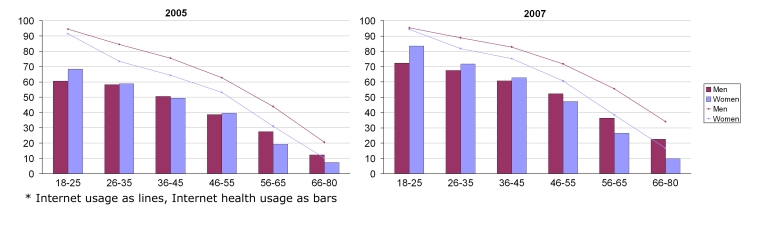
BACKGROUND: In the last decade, the number of Internet users worldwide has dramatically increased. People are using the Internet for various health-related purposes. It is important to monitor such use as it may have an impact on the individual's health and behavior, patient-practitioner roles, and on general health care provision. OBJECTIVES: This study investigates trends and patterns of European health-related Internet use over a period of 18 months. The main study objective was to estimate the change in the proportion of the population using the Internet for health purposes, and the importance of the Internet as a source of health information compared to more traditional sources. METHODS: The survey data were collected through computer-assisted telephone interviews. A representative sample (N = 14,956) from seven European countries has been used: Denmark, Germany, Greece, Latvia, Norway, Poland, and Portugal. The European eHealth Consumer Trends Survey was first conducted in October-November 2005 and repeated in April-May 2007. In addition to providing background information, respondents were asked to rate the importance of various sources of health information. They were also queried as to the frequency of different online activities related to health and illness and the effects of such use on their disposition. RESULTS: The percentage of the population that has used the Internet for health purposes increased from an estimated 42.3% (95% CI [Confidence Interval] 41.3 - 43.3) in 2005 to an estimated 52.2% (95% CI 51.3 - 53.2) in 2007. Significant growth in the use of the Internet for health purposes was found in all the seven countries. Young women are the most active Internet health users. The importance of the Internet as a source of health information has increased. In 2007, the Internet was perceived as an important source of health information by an estimated 46.8% (95% CI 45.7 - 47.9) of the population, a significant increase of 6.5 % (95% CI 4.9 - 8.1) from 2005. The importance of all the traditional health information channels has either decreased or remained the same. An estimated 22.7% (95% CI 21.7 - 23.6) are using it for more interactive services than just reading health information. CONCLUSION: The Internet is increasingly being used as a source of health information by the European population, and its perceived importance is rising. Use of the Internet for health purposes is growing in all age groups and for both men and women, with especially strong growth among young women. We see that experienced Internet health users are also using the Internet as an active communication channel, both for reaching health professionals and for communicating with peers.
Overview
The claims and statistics of this paper haven’t been checked yet.
Run the check — free, no account needed. It reads the open-access text and checks the sources it cites.
Integrity signals
Registry
Cites
Statistics
Figures
Verification
Claims the paper makes
The claims and statistics of this paper haven’t been checked yet.
Run the check — free, no account needed. It reads the open-access text and checks the sources it cites.
Claims other papers make about this one
Each is checked against this paper’s own text: does it say what the citing paper says it does?
The cited source says what the claim attributes to it.
In the citing paper
“It is also noteworthy that young women (ie, women in childbearing age) are the ones who use Internet most frequently when it comes to acquiring health-related information [29].”
From Mamma mia: A feasibility study of a web-based intervention to reduce the risk of postpartum depression and enhance subjective well-being (2013) · cites this paper as [29]
Self-check
Percentages, sums and reported differences re-computed from the paper’s own numbers.
The self-check needs the paper’s full text.
Citations
Cites
Hesse, B. W., Nelson, D. E., Kreps, G. L., Croyle, R. T., Arora, N. K., Rimer, B. K., & Viswanath, K. (2005) · Archives of Internal Medicine · doi:10.1001/archinte.165.22.2618 · Cited by 1,523
Use of the Internet and E-mail for Health Care Information: Results From a National Survey
Baker, L., Wagner, T. H., Singer, S., & Bundorf, M. K. (2003) · JAMA · doi:10.1001/jama.289.18.2400 · Cited by 1,129
European citizens' use of E-health services: A study of seven countries
Andreassen, H. K., Bujnowska-Fedak, M. M., Chronaki, C. E., Dumitru, R. C., Pudule, I., Santana, S., Voss, H., & Wynn, R. (2007) · BMC Public Health · doi:10.1186/1471-2458-7-53 · Cited by 676
Self-citationHelp seeking behavior and the Internet: A national survey
Ybarra, M. L., & Suman, M. (2006) · International Journal of Medical Informatics · doi:10.1016/j.ijmedinf.2005.07.029 · Cited by 466
E-health: transforming the physician/patient relationship
Ball, M. J., & Lillis, J. (2001) · International Journal of Medical Informatics · doi:10.1016/s1386-5056(00)00130-1 · Cited by 406
Personal Health Records: Evaluation of Functionality and Utility
Kim, M. I. (2002) · Journal of the American Medical Informatics Association · doi:10.1197/jamia.m0978 · Cited by 251
Eysenbach, G., & Kohler, C. (2003) · PubMed · Cited by 231
Beckjord, E. B., Rutten, L. J. F., Squiers, L., Arora, N. K., Volckmann, L. N., Moser, R. P., & Hesse, B. W. (2007) · Journal of Medical Internet Research · doi:10.2196/jmir.9.3.e20 · Cited by 157
Brooks, R. G., & Menachemi, N. (2006) · Journal of Medical Internet Research · doi:10.2196/jmir.8.1.e2 · Cited by 145
Research works printed but not linked: 7
- Eysenbach, G, 2003, AMIA Annu Symp Proc, 225
- Bovi, AM, 2003, Am J Bioeth, 3, W-IF2
- Ball, Marion J, 2007, J Healthc Inf Manag, 21, 76
- Houston, Thomas K, 2004, Am J Manag Care, 10, 601
- Santana, S, 2006, Cunningham P, Cunningham M, editors. Exploiting the Knowledge Economy: Issues, Applications and Case Studies. Volume 3, 1021
- Katz, Steven J, 2004, Am J Manag Care, 10, 593
- Sadan, B, 2002, Stud Health Technol Inform, 90, 514
Cited by
Sorted by citations
Items 401–449 of 449
Sicherheit bei der Arzneimitteltherapie
Kolbe, S., Neubauer, P., & Schröder, J. (2013) · Prävention und Gesundheitsförderung · doi:10.1007/s11553-012-0365-y
Abouzahra, M., Guenter, D., & Tan, J. (2015) · International Conference on Information Systems
Selbsthilfe im Onlineforum bei lokal begrenztem Prostatakarzinom
Psychosomatische, K. F. (2010)
Natural Language Question and Answer System on Semantic Health Website
Handayani, D. O. D., & Kartiwi, M. (2015) · International Journal on Perceptive and Cognitive Computing · doi:10.31436/ijpcc.v1i1.12
Are European immunisation programmes recession proof?
O’Flanagan, D., Lévy-Bruhl, D., & Salmaso, S. (2011) · Eurosurveillance · doi:10.2807/ese.16.17.19855-en
Lahti, L. (2016) · Aaltodoc (Aalto University)
Roşu, S. M., & Drăgoi, G. (2014) · IGI Global eBooks · doi:10.4018/978-1-4666-7230-7.ch025
Motivations for Contributing to Health- Related Articles on Wikipedia: An Interview Study
Eysenbach, G., Laurent, M. R., Heilman, J., & van de Belt, T. H. (2014)
Rockmann, R., Weeger, A., & Gewald, H. (2015)
Организации прямых продаж как неформальные провайдеры здравоохранения в России
Krasheninnikova, Y. A., & Makarova, O. Y. (2016) · Journal of Economic Sociology · doi:10.17323/1726-3247-2016-5-77-102
Health 2.0 : Überblick über Gestaltungsdimensionen von Gesundheitsportalen bzw. Online-Communities
Görlitz, R. A., Seip, B., Rashid, A., & Zacharias, V. (2010)
Media and Health Information Literacy among Senior Citizens in Iceland
Pálsdóttir, Á. (2017) · Revista Română de Biblioteconomie și Știința Informării = Romanian Journal of Library and Information Science · doi:10.26660/rrbsi.2017.13.3.59
Forstnerič, S., Fijačko, N., Pajnkihar, M., & Štiglic, G. (2018) · Pielegniarstwo XXI wieku / Nursing in the 21st Century · doi:10.2478/pielxxiw-2018-0001
Abouzahra, M. (2017) · MacSphere (McMaster University) · doi:10.71548/19724
La salud 2.0 y el marketing social
Cerdá, J. C. M. (2019) · Horizonte Sanitario · doi:10.19136/hs.a18n2.3253
Design Challenges for Social Interactions at Factory Floor
Immonen, M., Alavesa, P., & Mylonopoulou, V. (2019) · International Conference on Virtual Worlds and Games for Serious Applications (VS-Games) · doi:10.1109/vs-games.2019.8864601
Islertas, Z. (2020) · Gesundheit und Gesellschaft · doi:10.1007/978-3-658-30909-1_11
An Appraisal of e-Health Information Literacy of Students
Sohal, G. S., Sharda, P., Chandwani, S., & Singh, N. (2021) · Zenodo (CERN European Organization for Nuclear Research) · doi:10.5281/zenodo.5889658
Smith, C. A., Yu, D., Maestre, J. F., Backonja, U., Boyd, A. D., Buis, L. R., Chaudhry, B. M., Huh, J., Hussain, S. A., Jones, L. M., et al. (2020) · doi:10.2196/preprints.19980
McCall, M. P., Hineline, M. T., Anton, M. T., Highlander, A., & Jones, D. J. (2022) · doi:10.2196/preprints.37455
Fakhar, A. (2013) · IGI Global eBooks · doi:10.4018/978-1-4666-4979-8.ch044
(2014) · Revue du Rhumatisme · doi:10.1016/s1169-8330(14)70075-4
Heras-Alonso, A. D. L., Seoane‐Mato, D., Guerra, M., & Villa, C. C. M. (2022) · doi:10.2196/preprints.42352
Desikan, P., Sathyanarayana, A., & Srivastava, J. (2016) · Springer eBooks · doi:10.1007/978-1-4614-7163-9_82-1
Desikan, P., Sathyanarayana, A., & Srivastava, J. (2014) · Springer eBooks · doi:10.1007/978-1-4614-6170-8_82
Doshmangir, L., Jabbari, H., Arab‐Zozani, M., Naghavi‐Behzad, M., Abedi, Z., & Mostafavi, H. (2022) · Hospital Practice · doi:10.1080/21548331.2022.2134679
Trastornos de la conducta alimentaria: su divulgación
Guardiola-Wanden-Berghe, R. (2022) · Hospital a Domicilio · doi:10.22585/hospdomic.v6i4.179
Priatna, A. N. (2022) · Bureaucracy Journal Indonesia Journal of Law and Social-Political Governance · doi:10.53363/bureau.v2i1.111
Shafik, A. M. (2023) · The Egyptian Orthopaedic Journal · doi:10.4103/eoj.eoj_52_22
Posicionamiento y calidad en Webs vinculadas a la psicología de la obesidad.
Facultad de ciencias de la salud de Universidad Isabel, I., Arroyo-Fernández, A., Fernández, M. A. B., de Madrid, D. D. P. D. L. F. C. B. D. L. U. E., Verdugo, M. P. M., Díaz, M. D. C., (IDIVAL), I. D. I. S. V., Lladó‐Jordan, G., & (IDIVAL, I. D. I. S. V. (2023) · Revista de PSICOLOGÍA DE LA SALUD · doi:10.21134/pssa.v12i1.103
Heras-Alonso, A. D. L., Seoane‐Mato, D., Guerra, M., & Villa, C. C. M. (2023) · Reumatología Clínica · doi:10.1016/j.reuma.2023.09.002
Heras-Alonso, A. D. L., Seoane‐Mato, D., Guerra, M., & Villa, C. C. M. (2024) · Reumatología Clínica (English Edition) · doi:10.1016/j.reumae.2023.09.006
Strøm, J., Pedersen, P. B., Nielsen, S. N., Kjærgaard-Andersen, A. M., & Kayser, L. (2024) · doi:10.2196/preprints.65902
Determinants of Online Medical Decisions for Older Parents: A Discrete Choice Experiment
Fan, B., Song, W., Zhang, W., & Evans, R. D. (2024) · SAGE Open · doi:10.1177/21582440241293115
Effektive Kommunikation mit Internetpatienten
Jäger, S. (2015) · Forum · doi:10.1007/s12312-015-1284-6
Desikan, P., Sathyanarayana, A., & Srivastava, J. (2018) · Springer eBooks · doi:10.1007/978-1-4939-7131-2_82
Georgsson, S., & Carlsson, T. (2022) · Figshare · doi:10.6084/m9.figshare.19766486
Georgsson, S., & Carlsson, T. (2022) · Figshare · doi:10.6084/m9.figshare.19766483
Georgsson, S., & Carlsson, T. (2022) · Figshare · doi:10.6084/m9.figshare.19766489
Georgsson, S., & Carlsson, T. (2022) · Figshare · doi:10.6084/m9.figshare.19766492
CPS303/CSY 401 - Senibina Komputer Februari 1999
Ppskom, P. P. S. K. (1999) · Universiti Sains Malaysia Institutional Repository (Universiti Sains Malaysia)
Algedik, P., & Kocaman, O. (2026) · Cyprus Turkish Journal of Psychiatry and Psychology · doi:10.35365/ctjpp.26.1.11
Kasperska, K., Skrzypczak, T., & Gać, P. (2026) · doi:10.2196/preprints.101399
Mohammadi, M. (2026) · INQUIRY The Journal of Health Care Organization Provision and Financing · doi:10.1177/00469580261429017
Kasperska, K., Skrzypczak, T., & Gać, P. (2026) · JMIR Formative Research · doi:10.2196/101399
Teleradiologia jako narzędzie do bardziej efektywnego wykorzystania infrastruktury ochrony zdrowia
Karlińska, M., & Rudowski, R. (2012) · RePEc: Research Papers in Economics
Metadata
- Authors
- Kummervold, P. E., Chronaki, C. E., Lausen, B., Prokosch, H.-U., Rasmussen, J., Santana, S., Staniszewski, A., & Wangberg, S. C.
- Affiliations
- University Hospital of North Norway (NO)
- Foundation for Research and Technology Hellas (GR)
- Friedrich-Alexander-Universität Erlangen-Nürnberg (DE)
- MedCom (DE)
- University of Aveiro (PT)
- Wroclaw Medical University (PL)
- Corresponding author
- Kummervold, Per Egil
- ORCID
- Venue
- Journal of Medical Internet Research
- Publisher
- JMIR Publications Inc.
- Published
- 2008-11-17
- Volume
- 10
- Issue
- 4
- Pages
- e42
- ISSN
- 1438-8871 (ISSN-L)
- PMC
- PMC2629359
- OpenAlex
- W2130026454
- Cited by
- 449
- References
- 23
- Citations by year
- 2026: 6 · 2025: 2 · 2024: 11 · 2023: 10 · 2022: 19 · 2021: 18 · 2020: 22 · 2019: 22 · 2018: 19 · 2017: 21 · 2016: 37 · 2015: 41 · 2014: 44 · 2013: 50 · 2012: 42
- FWCI
- 53.99
- Type
- journal article
- Language
- en
- Open access
- gold
- doi.org
- Licence
- cc-by
- Locations
- Journal of Medical Internet Research (publishedVersion, cc-by)
- Europe PMC (PubMed Central) (publishedVersion, cc-by)
- PubMed Central (publishedVersion, cc-by)
- PubMed (publishedVersion)
- DOAJ (DOAJ: Directory of Open Access Journals) (submittedVersion, cc-by-sa)
- Open Access at Essex (University of Essex) (submittedVersion)
- Topics
- Health Sciences › Health Professions › General Health Professions › Health Literacy and Information Accessibility
- Health Sciences › Health Professions › Health Information Management › Health, Technology, Consumer Behavior
- Physical Sciences › Computer Science › Information Systems › Information Retrieval and Search Behavior
- Keywords
- e-health, health-related internet use, online health information, health information sources, virtual care, patient-practitioner relationship, health behavior, young women, Europe, cross-national comparison, health care delivery, patient empowerment, health literacy, health promotion, health policy
- MeSH terms
- Attitude to Computers, Automation, Computer Literacy, Data Collection, Europe, Health Education, Humans, Information Services, Interviews as Topic, Patient Education as Topic, Surveys and Questionnaires, Telemedicine, Internet, Electronic Mail, Consumer Health Information
About these checks
Registry, retraction, Cites and statistics results are computed, not judged, with one exception: a printed reference that no index lists is read once by a model before it counts as a citation error. Claims are extracted by a model and kept only when their quote appears verbatim in the text; each cited source is then checked, with a model’s help, for whether it says what the claim relies on. Those verdicts can be wrong — read the claim’s quote and the cited source before relying on one.
Statistics and arithmetic are recomputed, not judged.
Confidence bands are shown only for fields calibrated on our annotated test set. None is calibrated yet, so no band is shown.
What counts as a claim ›How we measure confidence ›How we check this ›
Are you an author, or do you see a problem with this page? Request a review
