

The DOI matches its Crossref record; 62 of the 62 references it cites were found in a registry or an index.
The Smartphone in Medicine: A Review of Current and Potential Use Among Physicians and Students
Open accessAbstract
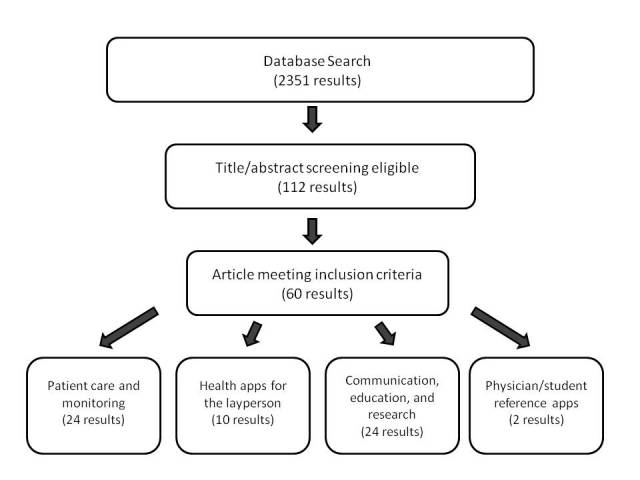
BACKGROUND: Advancements in technology have always had major impacts in medicine. The smartphone is one of the most ubiquitous and dynamic trends in communication, in which one's mobile phone can also be used for communicating via email, performing Internet searches, and using specific applications. The smartphone is one of the fastest growing sectors in the technology industry, and its impact in medicine has already been significant. OBJECTIVE: To provide a comprehensive and up-to-date summary of the role of the smartphone in medicine by highlighting the ways in which it can enhance continuing medical education, patient care, and communication. We also examine the evidence base for this technology. METHODS: We conducted a review of all published uses of the smartphone that could be applicable to the field of medicine and medical education with the exclusion of only surgical-related uses. RESULTS: In the 60 studies that were identified, we found many uses for the smartphone in medicine; however, we also found that very few high-quality studies exist to help us understand how best to use this technology. CONCLUSIONS: While the smartphone's role in medicine and education appears promising and exciting, more high-quality studies are needed to better understand the role it will have in this field. We recommend popular smartphone applications for physicians that are lacking in evidence and discuss future studies to support their use.
Overview
The claims and statistics of this paper haven’t been checked yet.
Run the check — free, no account needed. It reads the open-access text and checks the sources it cites.
Integrity signals
Registry
Cites
Statistics
Figures
Verification
Claims the paper makes
The claims and statistics of this paper haven’t been checked yet.
Run the check — free, no account needed. It reads the open-access text and checks the sources it cites.
Claims other papers make about this one
Each is checked against this paper’s own text: does it say what the citing paper says it does?
In the citing paper
“There also appears to be little adequate exploration of how individuals actually use their mobile phones and integrate health apps in their day-to-day routines using longitudinal case study-based approaches [47,48].”
From Understanding Usage of a Hybrid Website and Smartphone App for Weight Management: A Mixed-Methods Study (2014) · cites this paper as [48]
Self-check
Percentages, sums and reported differences re-computed from the paper’s own numbers.
The self-check needs the paper’s full text.
Citations
Cites
Boulos, M. N. K., Wheeler, S., Tavares, C., & Jones, R. B. (2011) · BioMedical Engineering OnLine · doi:10.1186/1475-925x-10-24 · Cited by 1,123
2010 Alzheimer's disease facts and figures
Alzheimer's Association (2010) · Alzheimer s & Dementia · doi:10.1016/j.jalz.2010.01.009 · Cited by 703
Mobile Phone Based Clinical Microscopy for Global Health Applications
Breslauer, D. N., Maamari, R. N., Switz, N. A., Lam, W. A., & Fletcher, D. A. (2009) · PLoS ONE · doi:10.1371/journal.pone.0006320 · Cited by 694
e-Health technologies show promise in developing countries
Blaya, J. A., Fraser, H. S. F., & Holt, B. (2010) · Health Affairs · doi:10.1377/hlthaff.2009.0894 · Cited by 581
Smartphone App Use Among Medical Providers in ACGME Training Programs
Franko, O. I., & Tirrell, T. F. (2011) · Journal of Medical Systems · doi:10.1007/s10916-011-9798-7 · Cited by 531
Lensfree microscopy on a cellphone
Tseng, D. K., Mudanyali, O., Oztoprak, C., Isikman, S. O., Şencan, İ., Yaglidere, O., & Özcan, A. (2010) · Lab on a Chip · doi:10.1039/c003477k · Cited by 480
Oresko, J., Jin, Z., Cheng, J., Huang, S., Sun, Y., Duschl, H., & Cheng, A. C. (2010) · IEEE Transactions on Information Technology in Biomedicine · doi:10.1109/titb.2010.2047865 · Cited by 455
iPhone Apps for Smoking Cessation
Abroms, L. C., Padmanabhan, N., Thaweethai, L., & Phillips, T. (2011) · American Journal of Preventive Medicine · doi:10.1016/j.amepre.2010.10.032 · Cited by 365
Cost-effective and compact wide-field fluorescent imaging on a cell-phone
Zhu, H., Yaglidere, O., Su, T., Tseng, D. K., & Özcan, A. (2010) · Lab on a Chip · doi:10.1039/c0lc00358a · Cited by 330
Apnea medassist: Real-time sleep apnea monitor using single-lead ECG
Bsoul, M., Minn, H., & Tamil, L. (2011) · IEEE Transactions on Information Technology in Biomedicine · doi:10.1109/titb.2010.2087386 · Cited by 297
Research works printed but not linked: 5
- Kiser, K, 2011, Minn Med, 94, 22
- 2010, Harv Womens Health Watch, 18, 2
- Ly, K, 2011, Community Pract, 84, 16
- 2011, ED Manag, 23, 28
- Chen, J, 2010, Electron J Health Inform, 5
Cited by
Sorted by citations
Mobile devices and apps for health care professionals: uses and benefits.
Ventola, C. L. (2014) · PubMed Central · doi:10.57945/manara.23966214 · Cited by 847
Mobile medical and health apps: state of the art, concerns, regulatory control and certification
Kamel Boulos, M. N., Brewer, A. C., Karimkhani, C., Buller, D. B., & Dellavalle, R. P. (2014) · Online Journal of Public Health Informatics · doi:10.5210/ojphi.v5i3.4814 · Cited by 659
Howells, A., Ivtzan, I., & Eiroa-Orosa, F. J. (2016) · Journal of Happiness Studies · doi:10.1007/s10902-014-9589-1 · Cited by 407
Use of Medical Mobile Applications Among Hospital Pharmacists in Malaysia
Ming, L. C., Hameed, M. A., Lee, D. D., Apidi, N. A., Lai, P. S. M., Hadi, M. A., Al‐Worafi, Y. M., & Khan, T. M. (2016) · Therapeutic Innovation & Regulatory Science · doi:10.1177/2168479015624732 · Cited by 412
Zangheri, M., Cevenini, L., Anfossi, L., Baggiani, C., Simoni, P., Di Nardo, F., & Roda, A. (2015) · Biosensors and Bioelectronics · doi:10.1016/j.bios.2014.08.048 · Cited by 373
Metadata
- Authors
- Ozdalga, E., Ozdalga, A., & Ahuja, N.
- Affiliations
- Stanford Medicine (US)
- Corresponding author
- Ozdalga, Errol
- Venue
- Journal of Medical Internet Research
- Publisher
- JMIR Publications Inc.
- Published
- 2012-09-27
- Volume
- 14
- Issue
- 5
- Pages
- e128
- ISSN
- 1438-8871 (ISSN-L)
- PMC
- PMC3510747
- OpenAlex
- W2107694226
- Cited by
- 654
- References
- 62
- Citations by year
- 2026: 8 · 2025: 9 · 2024: 33 · 2023: 21 · 2022: 33 · 2021: 39 · 2020: 61 · 2019: 69 · 2018: 70 · 2017: 84 · 2016: 66 · 2015: 73 · 2014: 52 · 2013: 36
- FWCI
- 7.72
- Type
- journal article
- Language
- en
- Open access
- gold
- doi.org
- Licence
- cc-by
- Locations
- Journal of Medical Internet Research (publishedVersion, cc-by)
- Europe PMC (PubMed Central) (publishedVersion, cc-by)
- PubMed Central (publishedVersion, cc-by)
- PubMed (publishedVersion)
- DOAJ (DOAJ: Directory of Open Access Journals) (submittedVersion, cc-by-sa)
- Topics
- Health Sciences › Health Professions › General Health Professions › Mobile Health and mHealth Applications
- Physical Sciences › Computer Science › Information Systems › Mobile Learning in Education
- Social Sciences › Health › Social Media in Health Education
- Keywords
- smartphones, mobile health, physicians, medical students, continuing medical education, patient care, physician-patient communication, mobile application, evidence base
- MeSH terms
- Delivery of Health Care, Humans, Physicians, Students, Medical, Cell Phone
About these checks
Registry, retraction, Cites and statistics results are computed, not judged, with one exception: a printed reference that no index lists is read once by a model before it counts as a citation error. Claims are extracted by a model and kept only when their quote appears verbatim in the text; each cited source is then checked, with a model’s help, for whether it says what the claim relies on. Those verdicts can be wrong — read the claim’s quote and the cited source before relying on one.
Statistics and arithmetic are recomputed, not judged.
Confidence bands are shown only for fields calibrated on our annotated test set. None is calibrated yet, so no band is shown.
What counts as a claim ›How we measure confidence ›How we check this ›
Are you an author, or do you see a problem with this page? Request a review
