

The DOI matches its Crossref record; 53 of the 53 references it cites were found in a registry or an index.
A Low-Intensity Mobile Health Intervention With and Without Health Counseling for Persons With Type 2 Diabetes, Part 1: Baseline and Short-Term Results From a Randomized Controlled Trial in the Norwegian Part of RENEWING HEALTH
Open accessAbstract
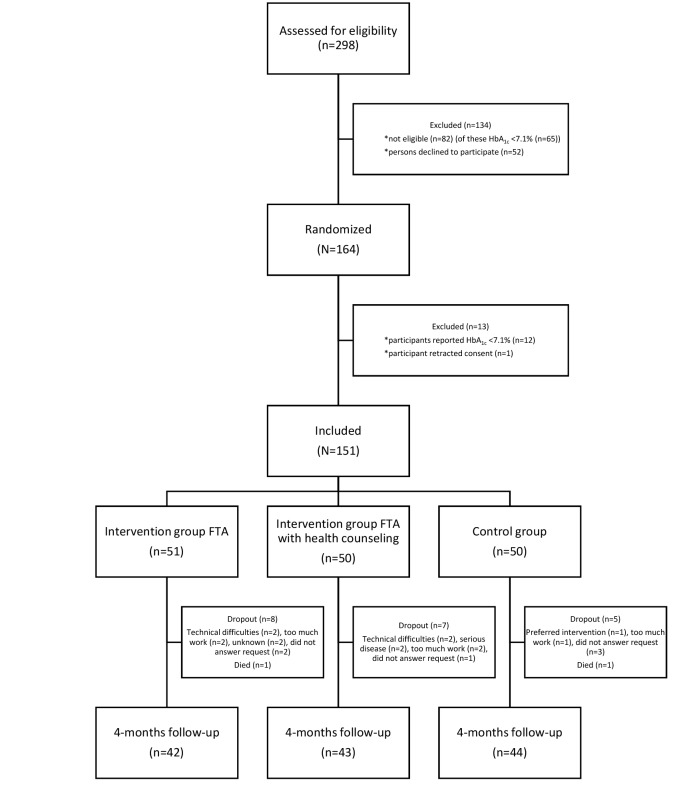
BACKGROUND: Self-management support for people with type 2 diabetes is essential in diabetes care. Thus, mobile health technology with or without low-intensity theory-based health counseling could become an important tool for promoting self-management. OBJECTIVES: The aim was to evaluate whether the introduction of technology-supported self-management using the Few Touch Application (FTA) diabetes diary with or without health counseling improved glycated hemoglobin (HbA1c) levels, self-management, behavioral change, and health-related quality of life, and to describe the sociodemographic, clinical, and lifestyle characteristics of the participants after 4 months. METHODS: A 3-armed randomized controlled trial was conducted in Norway during 2011-2013. In the 2 intervention groups, participants were given a mobile phone for 1 year, which provided access to the FTA diary, a self-help tool that recorded 5 elements: blood glucose, food habits, physical activity, personal goal setting, and a look-up system for diabetes information. One of the intervention groups was also offered theory-based health counseling with a specialist diabetes nurse by telephone for 4 months from baseline. Both intervention groups and the control group were provided usual care according to the national guidelines. Adults with type 2 diabetes and HbA1c ≥7.1% were included (N=151). There were 3 assessment points: baseline, 4 months, and 1 year. We report the short-term findings after 4 months. HbA1c was the primary outcome and the secondary outcomes were self-management (Health Education Impact Questionnaire, heiQ), behavioral change (diet and physical activity), and health-related quality of life (SF-36 questionnaire). The data were analyzed using univariate methods (ANOVA), multivariate linear, and logistic regression. RESULTS: Data were analyzed from 124 individuals (attrition rate was 18%). The groups were well balanced at baseline. There were no differences in HbA1c between groups after 4 months, but there was a decline in all groups. There were changes in self-management measured using the health service navigation item in the heiQ, with improvements in the FTA group compared to the control group (P=.01) and in the FTA with health counseling group compared with both other groups (P=.04). This may indicate an improvement in the ability of patients to communicate health needs to their health care providers. Furthermore, the FTA group reported higher scores for skill and technique acquisition at relieving symptoms compared to the control group (P=.02). There were no significant changes in any of the domains of the SF-36. CONCLUSIONS: The primary outcome, HbA1c, did not differ between groups after 4 months. Both of the intervention groups had significantly better scores than the control group for health service navigation and the FTA group also exhibited improved skill and technique acquisition.
Overview
The claims and statistics of this paper haven’t been checked yet.
Run the check — free, no account needed. It reads the open-access text and checks the sources it cites.
Integrity signals
Registry
Cites
Statistics
Figures
Verification
Claims the paper makes
The claims and statistics of this paper haven’t been checked yet.
Run the check — free, no account needed. It reads the open-access text and checks the sources it cites.
Self-check
Percentages, sums and reported differences re-computed from the paper’s own numbers.
The self-check needs the paper’s full text.
Citations
Cites
The CES-D Scale: A Self-Report Depression Scale for Research in the General Population
Radloff, L. S. (1977) · Applied Psychological Measurement · doi:10.1177/014662167700100306 · Cited by 53,267
(1992) · PubMed · Cited by 33,716
The MOS 36-ltem Short-Form Health Survey (SF-36): I. Conceptual Framework and Item Selection
Ware, J. E., & Sherbourne, C. D. (1992) · Medical Care · doi:10.1097/00005650-199206000-00002 · Cited by 30,033
CONSORT 2010 Statement: updated guidelines for reporting parallel group randomised trials
the CONSORT Group, Schulz, K. F., Altman, D. G., & Moher, D. (2010) · BMC Medicine · doi:10.1186/1741-7015-8-18 · Cited by 13,371
(2000) · PubMed · Cited by 13,173
Obesity : Preventing and managing the global epidemic
Akram, D. S., Astrup, A. V., Atinmo, T., Boissin, J.-L., Bray, G. A., Carroll, K. N., Chitson, P., Chen, C., Dietz, W. H., Hill, J. O., et al. (2000) · Research at the University of Copenhagen (University of Copenhagen) · Cited by 12,945
Developing and evaluating complex interventions: the new Medical Research Council guidance
Craig, P., Dieppe, P., Macintyre, S., Michie, S., Nazareth, I., & Petticrew, M. (2008) · BMJ · doi:10.1136/bmj.a1655 · Cited by 10,995
SUS: A 'Quick and Dirty' Usability Scale
(1996) · Usability Evaluation In Industry · doi:10.1201/9781498710411-35 · Cited by 8,989
In search of how people change: Applications to addictive behaviors.
Prochaska, J. O., DiClemente, C. C., & Norcross, J. C. (1992) · American Psychologist · doi:10.1037/0003-066x.47.9.1102 · Cited by 8,596
Cosentino, F., Grant, P. J., Aboyans, V., Bailey, C. J., Ceriello, A., Delgado, V., Federici, M., Filippatos, G., Grobbee, D. E., Hansen, T. B., et al. (2020) · European Heart Journal · doi:10.1093/eurheartj/ehz486 · Cited by 4,763
Usability Evaluation In Industry
(1996) · CRC Press eBooks · doi:10.1201/9781498710411 · Cited by 4,445
Inzucchi, S. E., Bergenstal, R. M., Buse, J. B., Diamant, M., Ferrannini, E., Nauck, M., Peters, A. L., Tsapas, A., Wender, R., & Matthews, D. R. (2012) · Diabetologia · doi:10.1007/s00125-012-2534-0 · Cited by 3,919
Effect of a multifactorial intervention on mortality in type 2 diabetes
Gæde, P., Lund-Andersen, H., Parving, H.-H., & Pedersen, O. (2008) · New England Journal of Medicine · doi:10.1056/nejmoa0706245 · Cited by 3,465 · cited 1×
“People with type 2 diabetes have an increased risk of cardiovascular morbidity and mortality, but the multifactorial risk can be reduced by changes in diet, exercise, and education often combined with antihypertensives, statins, and oral glucose-lowering agents or insulin-lowering drugs [1-3].”
Management of Hyperglycemia in Type 2 Diabetes: A Patient-Centered Approach
Inzucchi, S. E., Bergenstal, R. M., Buse, J. B., Diamant, M., Ferrannini, E., Nauck, M., Peters, A. L., Tsapas, A., Wender, R., & Matthews, D. R. (2012) · Diabetes Care · doi:10.2337/dc12-0413 · Cited by 3,207
Cardiovascular effects of intensive lifestyle intervention in type 2 diabetes
The Look AHEAD Research Group (2013) · New England Journal of Medicine · doi:10.1056/nejmoa1212914 · Cited by 2,908 · cited 1×
“Intensive long-term interventions related to lifestyle and obesity in patients with type 2 diabetes have achieved some effects on weight loss and improved glycemic control, but these were not enduring [10].”
Authors Task Force Members, Rydén, L., Grant, P. J., Anker, S. D., Berne, C., Cosentino, F., Danchin, N., Deaton, C., Escaned, J., Hammes, H., et al. (2013) · European Heart Journal · doi:10.1093/eurheartj/eht108 · Cited by 1,994
Eysenbach, G., & CONSORT-EHEALTH Group (2011) · Journal of Medical Internet Research · doi:10.2196/jmir.1923 · Cited by 1,863
Improving the reporting of pragmatic trials: An extension of the CONSORT statement
Zwarenstein, M., Treweek, S., Gagnier, J. J., Altman, D. G., Tunis, S., Haynes, B., Oxman, A. D., Moher, D., & groups, F. T. C. A. P. T. I. H. (. (2008) · BMJ · doi:10.1136/bmj.a2390 · Cited by 1,813
Design and analysis of stepped wedge cluster randomized trials.
Hussey, M. A., & Hughes, J. (2007) · Contemporary Clinical Trials · doi:10.1016/j.cct.2006.05.007 · Cited by 1,297
The Hawthorne effect: A reconsideration of the methodological artifact.
Adair, J. G. (1984) · Journal of Applied Psychology · doi:10.1037/0021-9010.69.2.334 · Cited by 1,095 · cited 1×
“They may also have received special attention from their general practitioners because “their patients” were included in a lifestyle intervention with modern technology [45].”
National Standards for Diabetes Self-Management Education and Support
Haas, L. B., Maryniuk, M. D., Beck, J. K., Cox, C. E., Duker, P. N., Edwards, L. J., Fisher, E. B., Hanson, L., Kent, D., Kolb, L. E., et al. (2012) · Diabetes Care · doi:10.2337/dc12-1707 · Cited by 686
Rydén, L., Grant, P. J., Anker, S. D., Berne, C., Cosentino, F., Danchin, N., Deaton, C., Escaned, J., Hammes, H., Huikuri, H., et al. (2014) · Revista Española de Cardiología (English Edition) · doi:10.1016/j.rec.2013.10.013 · Cited by 609
Osborne, R. H., Elsworth, G. R., & Whitfield, K. (2007) · Patient Education and Counseling · doi:10.1016/j.pec.2006.12.002 · Cited by 556
Griffin, S. J., Borch-Johnsen, K., Davies, M. J., Khunti, K., Rutten, G. E., Sandbæk, A., Sharp, S. J., Simmons, R. K., van den Donk, M., Wareham, N. J., et al. (2011) · The Lancet · doi:10.1016/s0140-6736(11)60698-3 · Cited by 462
A MODEL FOR ASSESSMENT OF TELEMEDICINE APPLICATIONS: MAST
Kidholm, K., Ekeland, A. G., Jensen, L. K., Rasmussen, J., Pedersen, C. D., Bowes, A. M., Flottorp, S. A., & Bech, M. (2012) · International Journal of Technology Assessment in Health Care · doi:10.1017/s0266462311000638 · Cited by 416
The Diabetes Empowerment Scale-Short Form (DES-SF)
Anderson, R. M., Fitzgerald, J. T., Gruppen, L. D., Funnell, M. M., & Oh, M. S. (2003) · Diabetes Care · doi:10.2337/diacare.26.5.1641-a · Cited by 388
Computer-based diabetes self-management interventions for adults with type 2 diabetes mellitus
Pal, K., Eastwood, S. V., Michie, S., Farmer, A. J., Barnard, M. L., Peacock, R., Wood, B., Inniss, J. D., & Murray, E. (2013) · Cochrane Database of Systematic Reviews · doi:10.1002/14651858.cd008776.pub2 · Cited by 344
Kerr, E. A., Heisler, M., Krein, S. L., Kabeto, M., Langa, K. M., Weir, D., & Piette, J. D. (2007) · Journal of General Internal Medicine · doi:10.1007/s11606-007-0313-2 · Cited by 330
Patients' preferences within randomised trials: systematic review and patient level meta-analysis
Preference Collaborative Review Group (2008) · BMJ · doi:10.1136/bmj.a1864 · Cited by 302
National Standards for Diabetes Self-Management Education and Support
Haas, L., Maryniuk, M., Beck, J., Cox, C. E., Duker, P., Edwards, L., Fisher, E. B., Hanson, L., Kent, D., Kolb, L., et al. (2014) · Diabetes Care · doi:10.2337/dc14-s144 · Cited by 264
Telemedicine Application in the Care of Diabetes Patients: Systematic Review and Meta-Analysis
Marcolino, M. S., Maia, J. X., Alkmim, M. B. M., Boersma, E., & Ribeiro, A. L. (2013) · PLoS ONE · doi:10.1371/journal.pone.0079246 · Cited by 215 · cited 3×
“Some interventions combine self-monitoring with professional support, which is based primarily on the monitoring of results by health care providers, with subsequent counseling and advice [18-22].”
Kurtze, N., Rangul, V., Hustvedt, B.-E., & Flanders, W. D. (2007) · European Journal of Epidemiology · doi:10.1007/s10654-007-9110-9 · Cited by 212
Mobile Phone-Based Self-Management Tools for Type 2 Diabetes: The Few Touch Application
Arsand, E., Tatara, N., ostengen, G., & Hartvigsen, G. (2010) · Journal of Diabetes Science and Technology · doi:10.1177/193229681000400213 · Cited by 188 · cited 2×
“The FTA is a self-management tool that comprises 5 main elements accessible to the user: (1) the blood glucose data management system, (2) food habits data management system, (3) physical activity data management system, (4) personal goal-setting system, and (5) general diabetes information look-up system [24].”
Self-citationBlood glucose self-monitoring in type 2 diabetes: a randomised controlled trial
Farmer, A. A., Wade, A. N., French, D., Simon, J., Yudkin, P. L., Gray, A., Craven, A., Goyder, L., Holman, R. R., Mant, D., et al. (2009) · Health Technology Assessment · doi:10.3310/hta13150 · Cited by 178
Evaluation of a mobile phone telemonitoring system for glycaemic control in patients with diabetes
Istepanian, R. S., Zitouni, K., Harry, D., Moutosammy, N., Sungoor, A., Tang, B., & Earle, K. A. (2009) · Journal of Telemedicine and Telecare · doi:10.1258/jtt.2009.003006 · Cited by 177
King, M., Nazareth, I., Lampe, F. C., Bower, P., Chandler, M., Morou, M., Sibbald, B., & Lai, R. (2005) · Health Technology Assessment · doi:10.3310/hta9350 · Cited by 164
Stages of Change for Healthy Eating in Diabetes
Vallis, M., Ruggiero, L., Greene, G. W., Jones, H., Zinman, B., Rossi, S. R., Edwards, L., Rossi, J. S., & Prochaska, J. O. (2003) · Diabetes Care · doi:10.2337/diacare.26.5.1468 · Cited by 163
Marrero, D. G., Ard, J., Delamater, A. M., Peragallo-Dittko, V., Mayer-Davis, E. J., Nwankwo, R., & Fisher, E. B. (2013) · Diabetes Care · doi:10.2337/dc12-2305 · Cited by 159
Patients' preferences and randomised trials
Silverman, W. A., & Altman, D. G. (1996) · The Lancet · doi:10.1016/s0140-6736(96)90347-5 · Cited by 157
Impact of body mass index on prevalence of multimorbidity in primary care: cohort study
Booth, H. P., Prevost, A. T., & Gulliford, M. C. (2013) · Family Practice · doi:10.1093/fampra/cmt061 · Cited by 150
Nolte, S., Elsworth, G. R., Sinclair, A. J., & Osborne, R. H. (2006) · Patient Education and Counseling · doi:10.1016/j.pec.2006.08.016 · Cited by 133
Trief, P. M., Teresi, J. A., Eimicke, J. P., Shea, S., & Weinstock, R. S. (2008) · Age and Ageing · doi:10.1093/ageing/afn299 · Cited by 109
Bradley, C. (1993) · Diabetes Care · doi:10.2337/diacare.16.2.509 · Cited by 107
Benefits of Modest Weight Loss on the Management of Type 2 Diabetes Mellitus
Lau, D. C. W., & Teoh, H. (2013) · Canadian Journal of Diabetes · doi:10.1016/j.jcjd.2013.03.023 · Cited by 98
Bower, P., King, M., Nazareth, I., Lampe, F. C., & Sibbald, B. (2005) · Social Science & Medicine · doi:10.1016/j.socscimed.2004.12.010 · Cited by 88
Cassimatis, M., & Kavanagh, D. J. (2012) · Journal of Telemedicine and Telecare · doi:10.1258/jtt.2012.gth105 · Cited by 73
The Obesity Paradox in Diabetes
Carnethon, M. R., Rasmussen‐Torvik, L. J., & Palaniappan, L. P. (2014) · Current Cardiology Reports · doi:10.1007/s11886-013-0446-3 · Cited by 65
Ribu, L., Holmen, H., Torbjørnsen, A., Wahl, A. K., Grøttland, A., Småstuen, M. C., Elind, E., Bergmo, T. S., Breivik, E., & Årsand, E. (2013) · JMIR Research Protocols · doi:10.2196/resprot.2768 · Cited by 45
Self-citationCastelnuovo, G., Manzoni, G. M., Cuzziol, P., Cesa, G. L., Corti, S., Tuzzi, C., Villa, V., Liuzzi, A., Petroni, M. L., & Molinari, E. (2011) · Clinical Practice and Epidemiology in Mental Health · doi:10.2174/1745017901107010044 · Cited by 43
Lifestyle characteristics among participants in a Norwegian colorectal cancer screening trial
Larsen, I. K., Grotmol, T., Almendingen, K., & Hoff, G. S. (2005) · European Journal of Cancer Prevention · doi:10.1097/01.cej.0000186636.27496.bb · Cited by 39
Psychosocial correlates of stages of change in physical activity in an adult community sample
Lorentzen, C., Ommundsen, Y., & Holme, I. (2007) · European Journal of Sport Science · doi:10.1080/17461390701456122 · Cited by 27
McNamara, R., Robling, M., Hood, K., Bennert, K., Channon, S., Cohen, D., Crowne, E., Hambly, H., Hawthorne, K., Longo, M., et al. (2010) · BMC Health Services Research · doi:10.1186/1472-6963-10-36 · Cited by 22
The Obesity Paradox and Diabetes
Franz, M. J. (2013) · Diabetes Spectrum · doi:10.2337/diaspect.26.3.145 · Cited by 9
Research works printed but not linked: 2
- Rollnick, S, 2008, Motivational Interviewing in Health Care: Helping Patients Change Behavior (Applications of Motivational Interviewing)
- 2000, World Health Organ Tech Rep Ser, 894, i
Cited by
Sorted by citations
Meyerowitz-Katz, G., Ravi, S., Arnolda, L., Feng, X., Maberly, G., & Astell-Burt, T. (2020) · Journal of Medical Internet Research · doi:10.2196/20283 · Cited by 561
Holmen, H., Torbjørnsen, A., Wahl, A. K., Jenum, A. K., Småstuen, M. C., Årsand, E., & Ribu, L. (2014) · JMIR mHealth and uHealth · doi:10.2196/mhealth.3882 · Cited by 294
Self-citationWu, Y., Yao, X., Vespasiani, G., Nicolucci, A., Dong, Y., Kwong, J., Li, L., Sun, X., Tian, H., & Li, S. (2017) · JMIR mHealth and uHealth · doi:10.2196/mhealth.6522 · Cited by 283
Villinger, K., Wahl, D. R., Boeing, H., Schupp, H. T., & Renner, B. (2019) · Obesity Reviews · doi:10.1111/obr.12903 · Cited by 310
Bonoto, B. C., de Araújo, V. E., Godói, I. P., de Lemos, L. L. P., Godman, B., Bennie, M., Diniz, L. M., & Junior, A. A. G. (2017) · JMIR mhealth and uhealth · doi:10.2196/mhealth.6309 · Cited by 294
Metadata
- Authors
- Torbjørnsen, A., Jenum, A. K., Småstuen, M. C., Årsand, E., Holmen, H., Wahl, A. K., & Ribu, L.
- Affiliations
- OsloMet – Oslo Metropolitan University (NO)
- University Hospital of North Norway (NO)
- University of Oslo (NO)
- Corresponding author
- Torbjørnsen, Astrid
- Venue
- JMIR mHealth and uHealth
- Publisher
- JMIR Publications Inc.
- Published
- 2014-12-11
- Volume
- 2
- Issue
- 4
- Pages
- e52
- ISSN
- 2291-5222 (ISSN-L)
- PMC
- PMC4275473
- OpenAlex
- W2160865185
- Cited by
- 117
- References
- 53
- Citations by year
- 2026: 3 · 2025: 4 · 2024: 7 · 2023: 4 · 2022: 11 · 2021: 18 · 2020: 11 · 2019: 14 · 2018: 15 · 2017: 14 · 2016: 8 · 2015: 7 · 2014: 1
- FWCI
- 18.11
- Type
- journal article
- Language
- en
- Open access
- gold
- doi.org
- Licence
- cc-by
- Locations
- JMIR mhealth and uhealth (publishedVersion, cc-by)
- Europe PMC (PubMed Central) (publishedVersion, cc-by)
- PubMed Central (publishedVersion, cc-by)
- PubMed (publishedVersion)
- DOAJ (DOAJ: Directory of Open Access Journals) (submittedVersion, cc-by-sa)
- NORA - Norwegian Open Research Archives (submittedVersion, other-oa)
- NORA - Norwegian Open Research Archives (submittedVersion, cc-by)
- Funders
- Høgskolen i Oslo og Akershus
- Norges Forskningsråd
- Diabetesforbundet
- Akershus Universitetssykehus
- Topics
- Health Sciences › Health Professions › General Health Professions › Mobile Health and mHealth Applications
- Health Sciences › Medicine › Endocrinology, Diabetes and Metabolism › Diabetes Management and Education
- Health Sciences › Medicine › Endocrinology, Diabetes and Metabolism › Diabetes Management and Research
- Keywords
- type 2 diabetes, mobile health, diabetes self-management, health counseling, HbA1c, telephone counseling, health-related quality of life, dietary behavior, physical activity, health system navigation, self-management support, HbA1c reduction, behavior change, goal setting, dietary habits, patient-provider communication
About these checks
Registry, retraction, Cites and statistics results are computed, not judged, with one exception: a printed reference that no index lists is read once by a model before it counts as a citation error. Claims are extracted by a model and kept only when their quote appears verbatim in the text; each cited source is then checked, with a model’s help, for whether it says what the claim relies on. Those verdicts can be wrong — read the claim’s quote and the cited source before relying on one.
Statistics and arithmetic are recomputed, not judged.
Confidence bands are shown only for fields calibrated on our annotated test set. None is calibrated yet, so no band is shown.
What counts as a claim ›How we measure confidence ›How we check this ›
Are you an author, or do you see a problem with this page? Request a review
