

The DOI matches its Crossref record; 1 of the 1 references it cites were found in a registry or an index.
An mHealth App and System Architecture for Respiratory Disease Management: Design Principles, Tool Development, and Pilot Usability Study (Preprint)
Open accessPreprint — published as 10.2196/73584 · Paper page
Abstract
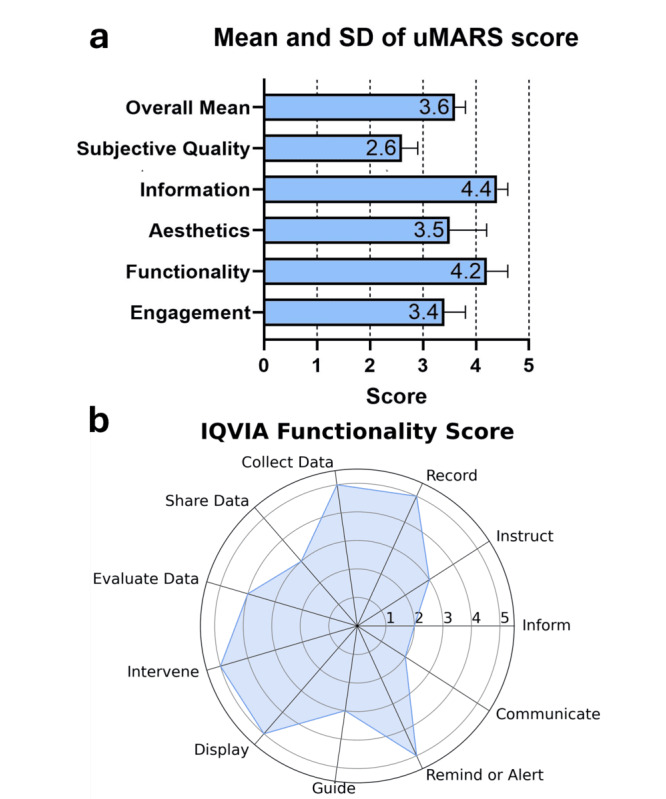
BACKGROUND: Mobile health (mHealth) apps are software interfaces that enable users to access and manage wearable technology through smartphones and tablet devices for health improvement purposes. However, many respiratory disease mHealth apps lack transparent development documentation, compromising user confidence in their quality, functionality, and usability. OBJECTIVE: This study aimed to develop and evaluate AIrway, a companion mHealth app designed to interface with an in-house wearable device for monitoring airway symptoms following established mHealth development and reporting standards. METHODS: The development cycle of AIrway comprised 2 study phases. In phase 1, AIrway, a native Android app, was developed following academic and industrial standards (Android material design and Morville’s design principles) and privacy regulations (Personal Information Protection and Electronic Documents Act). Core functionalities included location-based environmental monitoring, a clinical diary with action plans, Bluetooth connectivity, and real-time data storage. In phase 2, the usability of AIrway was evaluated by software app developers using standardized assessment tools, namely, the User Version of the Mobile Application Rating Scale survey and the IQVIA questionnaire. RESULTS: AIrway successfully fulfilled 7 of 8 development criteria on usability, privacy, security, appropriateness, transparency, safety, and technical support, with only the technology aspects requiring refinement. Accessibility assessments confirmed that AIrway’s content and interface were comprehensible to the general population (grade 9-10 reading level). Technical testing demonstrated reliable Bluetooth data transmission for up to 10 minutes without interruption. User evaluation scores for the User Version of the Mobile Application Rating Scale (3.6/5.0) and IQVIA (8/11) were comparable to those of similar mHealth apps on the market. CONCLUSIONS: By adhering to established mHealth app design principles, AIrway achieved the necessary accessibility standards and wireless communication capabilities for wearable device integration. Future development will focus on expanding cross-platform compatibility and conducting usability evaluation with intended patient populations to validate its clinical effectiveness and support ongoing improvements.
Overview
The claims and statistics of this paper haven’t been checked yet.
Run the check — free, no account needed. It reads the open-access text and checks the sources it cites.
Integrity signals
Registry
Cites
Statistics
Figures
Verification
Claims the paper makes
The claims and statistics of this paper haven’t been checked yet.
Run the check — free, no account needed. It reads the open-access text and checks the sources it cites.
Self-check
Percentages, sums and reported differences re-computed from the paper’s own numbers.
The self-check needs the paper’s full text.
Citations
Cites
The making of accessible Android applications: an empirical study on the state of the practice
Di Gregorio, M., Di Nucci, D., Palomba, F., & Vitiello, G. (2022) · Empirical Software Engineering · doi:10.1007/s10664-022-10182-x · Cited by 25
Research works printed but not linked: 66
- 10.2196/22591 · DOI
- 10.1038/s41746-019-0206-x · DOI · Paper page
- 10.1109/icassp.2018.8461394 · DOI
- 10.1145/3517014 · DOI
- 10.1145/2750858.2805826 · DOI
- 10.2196/39789 · DOI
- 10.1109/tbme.2008.2008165 · DOI
- 10.1109/tbme.2012.2207896 · DOI
- 10.1002/aisy.202100284 · DOI
- 10.3390/app9071505 · DOI
- 10.1038/s41746-024-01417-w · DOI
- 10.1038/s41746-022-00691-w · DOI
- 10.1038/s41528-024-00355-7 · DOI
- 10.1109/taslp.2016.2516647 · DOI
- 10.3390/s21165589 · DOI · Paper page
- 10.1016/j.cmpbup.2021.100012 · DOI · Paper page
- 10.1109/lifetech48969.2020.1570618580 · DOI
- 10.1109/jbhi.2023.3264999 · DOI
- 10.2196/12700 · DOI · Paper page
- 10.2196/49982 · DOI
- 10.32388/t0uxhu · DOI
- 10.1136/bmjopen-2020-046803 · DOI
- 10.2196/10956 · DOI
- 10.1093/jama/9780195176339.003.0022 · DOI
- 10.2196/13057 · DOI
- 10.1201/9781032622538-2 · DOI
- 10.1111/opn.12181 · DOI
- 10.1093/med/9780199383863.003.0011 · DOI
- 10.2196/12983 · DOI
- 10.1007/springerreference_9944 · DOI
- 10.1155/2007/612974 · DOI
- 10.4187/respcare.03795 · DOI
- 10.1111/jocn.15790 · DOI
- 10.1034/j.1399-3003.1999.14d29.x · DOI · Paper page
- 10.1183/13993003.00853-2015 · DOI
- 10.1183/09031936.00102509 · DOI
- 10.1097/00063198-200203000-00001 · DOI
- 10.1038/npjpcrm.2016.83 · DOI
- 10.11622/smedj.201517 · DOI
- 10.1016/b978-1-4377-7842-7.00035-0 · DOI
- 10.1016/j.envpol.2020.116329 · DOI
- 10.1016/b978-0-443-23816-1.00016-1 · DOI
- 10.1016/j.jaci.2007.09.029 · DOI · Paper page
- 10.21236/ada006655 · DOI · Paper page
- 10.4135/9781452229669.n3027 · DOI
- 10.4108/icst.pervasivehealth2009.5949 · DOI
- 10.1016/j.envres.2022.114489 · DOI
- 10.1081/jas-54631 · DOI
- 10.4037/ajcc1998.7.3.200 · DOI
- 10.1109/cts48763.2019.8973333 · DOI
- 10.1109/upcon47278.2019.8980238 · DOI
- 10.1145/3410670.3410860 · DOI
- 10.1109/cecit53797.2021.00220 · DOI
- 10.1016/b978-0-12-804721-7.00006-0 · DOI
- 10.3390/s17122898 · DOI · Paper page
- 10.1007/978-1-4842-9452-9_4 · DOI
- 10.2196/mhealth.5849 · DOI · Paper page
- 10.5664/jcsm.7396 · DOI
- 10.4135/9781452229669.n1317 · DOI
- 10.4135/9781452229669.n1473 · DOI
- 10.1057/9781137388773_2 · DOI
- 10.1016/j.rmed.2022.106947 · DOI
- 10.2196/30674 · DOI
- 10.14722/usec.2014.23006 · DOI
- 10.2196/mental.9445 · DOI · Paper page
- 10.2196/12103 · DOI
Metadata
- Authors
- Chao, A., Martignetti, L., Groh, R., Kist, A. M., & Li-Jessen, N. Y.
- Affiliations
- McGill University (CA)
- Friedrich-Alexander-Universität Erlangen-Nürnberg (DE)
- Venue
- JMIR Formative Research
- Publisher
- JMIR Publications Inc.
- Published
- 2025-03-07
- Volume
- 9
- Pages
- e73584-e73584
- ISSN
- 2561-326X (ISSN-L)
- PMC
- PMC12612645
- OpenAlex
- W4412518588
- Cited by
- 0
- References
- 1
- FWCI
- 0.00
- Type
- journal article
- Language
- en
- Open access
- gold
- doi.org
- Licence
- cc-by
- Locations
- JMIR Formative Research (publishedVersion, cc-by)
- Europe PMC (PubMed Central) (publishedVersion, cc-by)
- PubMed (publishedVersion)
- DOAJ (DOAJ: Directory of Open Access Journals) (submittedVersion, cc-by-sa)
- Funders
- National Institutes of Health (1r01dc021461-01a1)
- Topics
- Health Sciences › Health Professions › General Health Professions › Mobile Health and mHealth Applications
- Social Sciences › Psychology › Applied Psychology › Digital Mental Health Interventions
- Physical Sciences › Computer Science › Human-Computer Interaction › Usability and User Interface Design
- Keywords
- mobile health apps, respiratory disease management, airway symptoms, app usability, Android app development, Bluetooth connectivity, clinical diary, privacy and security, accessibility, respiratory tract
- MeSH terms
- Wearable Electronic Devices, Adult, Female, Humans, Male, Middle Aged, Pilot Projects, Surveys and Questionnaires, Respiratory Tract Diseases, Telemedicine, Disease Management, Mobile Applications
About these checks
Registry, retraction, Cites and statistics results are computed, not judged, with one exception: a printed reference that no index lists is read once by a model before it counts as a citation error. Claims are extracted by a model and kept only when their quote appears verbatim in the text; each cited source is then checked, with a model’s help, for whether it says what the claim relies on. Those verdicts can be wrong — read the claim’s quote and the cited source before relying on one.
Statistics and arithmetic are recomputed, not judged.
Confidence bands are shown only for fields calibrated on our annotated test set. None is calibrated yet, so no band is shown.
What counts as a claim ›How we measure confidence ›How we check this ›
Are you an author, or do you see a problem with this page? Request a review
