

ANTIMICROBIAL AND ANTIOXIDANT ACTIVITIES OF SELECTED PLANTS USED BY POPULATIONS FROM JURUENA VALLEY, LEGAL AMAZON, BRAZIL
Open accessThe DOI matches its Crossref record; 58 of the 60 references it cites were found in a registry or an index.
Abstract
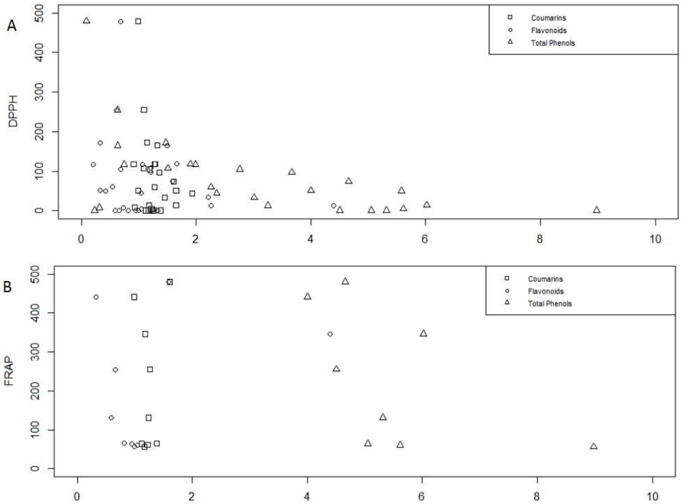
Objective: The purpose of this study was to evaluate selected Brazilian plants from Juruena valley region of Mato Grosso, for their in vitro antimicrobial and antioxidant activities.Methods: The powder obtained from different parts of the twenty-six (26) plants were macerated in hydroethanolic solution to obtain the extracts. The hydroethanolic extracts were tested for their in vitro antimicrobial activity by determining the MIC using broth microdilution. The 2, 2-diphenyl-1-picrylhydrazyl (DPPH) radical, ferric reducing antioxidant power (FRAP) and nitric oxide (NO) methods were used for the determination of antioxidant activities. Correlation between classes of secondary metabolites and antioxidant activity was assessed.Results: Phanera glabra extract (HEPg) showed broad antibacterial spectrum, presenting the best activity against Klebsiella pneumoniae. Hevea microphylla extract (HEHm) presented a narrow spectrum of antibacterial activity with strong effect against Shigella flexneri. The only plant with broad spectrum antifungal activity was Bertholletia excelsa (HEBe), with moderate activity against strains of Aspergillus and Candida. The following extracts were prominent regarding their activities in the DPPH and FRAP assays-HEBe, Cariniana rubra (HECr) and in the FRAP assay alone, Cedrela odorata (HECo) and HEPg. None of the extracts was active in the NO assay. A significant association was observed between DPPH activity and the total phenolic contents.Conclusion: Our results justified the use of some of the investigated plants in the Brazilian ethnomedicine. The antibacterial activities of these plants are bacteriostatic in nature. These findings support that a number of investigated plants could be a valuable source of new antioxidant and antimicrobial compounds that can potentially deliver novel mechanisms of actions.However, further studies are required.
Overview
The claims and statistics of this paper haven’t been checked yet.
Free: it reads the open-access text and checks the first 5 claims that cite a source we can check. Create a free account to check every claim.
Integrity signals
Registry
Cites
Statistics
Figures
Verification
Claims the paper makes
The claims and statistics of this paper haven’t been checked yet.
Free: it reads the open-access text and checks the first 5 claims that cite a source we can check. Create a free account to check every claim.
Claims other papers make about this one
Each is checked against this paper’s own text: does it say what the citing paper says it does?
The source backs part of the claim, not all of it — or backs it for a different population, condition or comparison.
In the citing paper
“Cytotoxic | Whole plant | Hydroetha nolic | Effect against brine shrimp lethality assay (BSLA) | LC 50 : 0.076 mg/mL CC 50 : 0.011 mg/mL | Has strong significant cytotoxic activity”
From Eleusine Indica for Food and Medicine (2021) · cites this paper as Silva et al. (2017)
Experimental — accuracy not yet measured
Self-check
Percentages, sums and reported differences re-computed from the paper’s own numbers.
The self-check needs the paper’s full text.
Citations
Cites
The re-emergence of natural products for drug discovery in the genomics era
Harvey, A. L., Edrada-Ebel, R., & Quinn, R. J. (2015) · Nature Reviews Drug Discovery · doi:10.1038/nrd4510 · Cited by 2,572 · cited 3×
“The ethnobotanical survey data was obtained via the application of a semi-structured questionnaire, containing the descriptors: infection, antibiotic, pneumonia, bronchitis, gastritis, diarrhoea, vaginal discharge, syphilis, impetigo, conjunctivitis, venereal disease, gonorrhoea, boils, inflammation, fever, wound, wou…”
BackgroundMethodPark, B. J., Wannemuehler, K. A., Marston, B. J., Govender, N., Pappas, P. G., & Chiller, T. M. (2009) · AIDS · doi:10.1097/qad.0b013e328322ffac · Cited by 2,014
Nitric Oxide Scavenging by Curcuminoids
Sreejayan, & Rao, M. N. A. (1997) · Journal of Pharmacy and Pharmacology · doi:10.1111/j.2042-7158.1997.tb06761.x · Cited by 1,135
Vatansever, F., de Melo, W. C. M. A., Avci, P., Vecchio, D., Sadasivam, M., Gupta, A., Chandran, R., Karimi, M., Parizotto, N. A., Yin, R., et al. (2013) · FEMS Microbiology Reviews · doi:10.1111/1574-6976.12026 · Cited by 1,127 · cited 4×
“Reactive oxygen species (ROS) are generated as part of the organism metabolism and normal physiological processes and there are endogenous antioxidant systems that help in cushioning the deleterious effects that go with their excessive levels [7].”
BackgroundMethodInfluentialHoletz, F. B., Pessini, G. L., Sanches, N. R., Cortez, D. A. G., Nakamura, C. V., & Dias Filho, B. P. (2002) · Memórias do Instituto Oswaldo Cruz · doi:10.1590/s0074-02762002000700017 · Cited by 948 · cited 1×
“Besides, the use of the hydroethanolic solution in the preparation of plants extracts is widespread in Brazil, as can be seen in many studies by [1, 13, 17-18, 24, 34].”
BackgroundAssessment of antioxidant capacity in vitro and in vivo
Niki, E. (2010) · Free Radical Biology and Medicine · doi:10.1016/j.freeradbiomed.2010.04.016 · Cited by 873 · cited 2×
“Based on our recent ethnopharmacological surveys of medicinal plants from the state of Mato Grosso, Brazil [1-13] and literature review [14], we carried out screening of selected plants for their antibacterial, antioxidative and antiradical activities.”
BackgroundMethodAlothman, M., Bhat, R., & Karim, A. A. (2009) · Food Chemistry · doi:10.1016/j.foodchem.2008.12.005 · Cited by 853 · cited 1×
“Moreover, literature findings are controversial as to the existence of an association between antioxidant activity and flavonoid or coumarin content in plant extracts [74-77].”
BackgroundPulmonary aspergillosis: a clinical review
Kousha, M., Tadi, R., & Soubani, A. O. (2011) · European Respiratory Review · doi:10.1183/09059180.00001011 · Cited by 752 · cited 1×
“niger are two of the most common causes of bronchopulmonary aspergillosis, which is currently one of the infections with the highest mortality rates, with the rate as high as 50-90 %, even after the administration of antifungal therapy, in immunocompromised patients [48, 49].”
BackgroundAntioxidant activity, phenol and flavonoid contents of 13 citrus species peels and tissues.
Ghasemi, K., Ghasemi, Y., & Ebrahimzadeh, M. A. (2009) · PubMed · Cited by 734
Kuse, E.-R., Chetchotisakd, P., da Cunha, C. A., Ruhnke, M., Barrios, C., Raghunadharao, D., Sekhon, J. S., Freire, A., Ramasubramanian, V., Demeyer, I., et al. (2007) · The Lancet · doi:10.1016/s0140-6736(07)60605-9 · Cited by 692 · cited 1×
“glabrata has reduced sensitivity to most conventional antifungal drugs and is associated with skin, mucosal and systemic infections [44].”
Background
Research works printed but not linked: 14
- O'Neill J. The Review on Antimicrobial Resistance. Tackling a global health crisis: initial steps; 2015.
- Amorim ELC, Nascimento JE, Monteiro JM, Sobrinho TJSP, Araújo T, Albuquerque UP. A simple and accurate procedure for the determination of tannin and flavonoid levels and some applications in ethnobotany and ethnopharmacology. Func Ecosyst Commun 2008;2:88-94.
- Gobbo-neto L, Lopes NP. Plantas medicinais: fatores de influência no conteúdo de metabólitos secundários. Quím Nova 2007;30:374-81.
- Souza LBG, Figueiredo BB. Prevalência de infecções nosocomiais provocadas por Staphylococcus aureus resistente à meticilina (MRSA), no hospital universitário regional de maringa. Rev Bras Anal Clin 2008;40:31-4.
- Andrade DFR. Microbiota fúngica no ar em unidades de terapia intensiva and centros cirúrgicos. Rev Pre Infece Saúde 2015;1:74-81.
- Idu M, Oshomoh EO, Ovuakporie-Uvo PO. Phytochemistry and antimicrobial properties of Chlorophora excelsa, Cedrela odorata and Tectona grandis Topcls. J Herb Med 2013;2:248-53.
- Buratto AP, Carpes ST, Vecchia PD, Loss EMS, Appelt P. Determinação da atividade antioxidante e antimicrobiana em Castanha-do-Pará (Bertholletia excelsa). Rev Brasi Pesq Alim 2011;2:60-5.
- Lima DCA. Estudo comparativo da atividade antioxidant de plantas medicinais da Caatinga utilizadas como antinflamatórias, Master's thesis, Universidade Federal de Pernambuco; 2011.
- Rashed K. Hepatoprotective effect from Cedrela odorata and phytochemical profile. J Pharm Cosmet Sci 2013;3:45-52.
- Fernandes RS. Frutas, sementes and amêndoas silvestres alimentícias na comunidade indígena tunuí cachoeira, Ph. D thesis, Universidade Federal de Lavras; 2012.
- Sousa CMM, Silva HRS, Vieira-Jr GM. Fenóis totais and atividade antioxidant de cinco plantas medicinais. Quim Nova 2007;30:351-5.
- Spagolla LC, Santos MM, Aguiar LML. Extração alcoólica de fenólicos and flavonóides totais de mirtilo "Rabbiteye" (Vaccinium ashei) e sua atividade antioxidante. Rev Ciênc Farm Básica Appl 2009;2:59-64.
- Oliveira GLS, Júnior ALG, Oliveira FRAM. Avaliação da capacidade antioxidant in vitro and in vivo do extrato etanólico da Copernicia prunifera (Mill.) HE Moore. Rev Cienc Farm Basica Appl 2014;2:293-300.
- Infante J, Selani MM, Toledo NMV, Silveira-Diniz MF, Alencar SM, Spoto MHF. Atividade antioxidant de resíduos. Alim Nutr Braz J Food Nutr 2013;24:87-91.
Cited by
Pereira, L. O. M., Vilegas, W., Tangerina, M. M. P., Arunachalam, K., Balogun, S. O., Orlandi-Mattos, P. E., Colodel, É. M., & Martins, D. T. D. O. (2018) · Journal of Ethnopharmacology · doi:10.1016/j.jep.2018.02.038 · Cited by 44
Self-citationTaroq, A., Kamari, F. E., Aouam, I., Atki, Y. E., Lyoussi, B., & Abdellaoui, A. (2018) · Asian Journal of Pharmaceutical and Clinical Research · doi:10.22159/ajpcr.2018.v11i12.29747 · Cited by 17
Hardiyanti, R., Marpaung, L., Adnyana, I. K., & Simanjuntak, P. (2018) · Asian Journal of Pharmaceutical and Clinical Research · doi:10.22159/ajpcr.2018.v11i12.29725 · Cited by 15
“and ferric reducing antioxidant power [15,16].”
Antibacterial potential of extracts from different Brazilian bamboo species
Anselmo‐Moreira, F., Gagliano, J., Sala‐Carvalho, W. R., Grombone‐Guaratini, M. T., & Furlan, C. M. (2021) · Revista Brasileira de Botânica · doi:10.1007/s40415-020-00683-8 · Cited by 12
Gomides, N. A. M. T. P., Neto, G. G., Martins, M. P., Kato, L., & Severino, V. G. P. (2022) · Boletin Latinoamericano y del Caribe de plantas Medicinales y Aromaticas · doi:10.37360/blacpma.22.21.6.42 · Cited by 13
Wiraswati, H. L., Pradini, G. W., Fauziah, N., Laelalugina, A., Arimdayu, A. R., Supandi, S., Kodir, R. A., Kurnia, D., Berbudi, A., Achadiyani, A., et al. (2024) · Discover Applied Sciences · doi:10.1007/s42452-024-05824-2 · Cited by 12
Eleusine Indica for Food and Medicine
Zakri, Z. H. M., Suleiman, M., Ng, S. Y., Ngaini, Z., Maili, S., & Salim, F. (2021) · Journal of Agrobiotechnology · doi:10.37231/jab.2021.12.2.260 · Cited by 10
“Silva et al. (2017) Aerial Ethanol Acetone Effect against BSLA LC50: Ethanol: 16.857 ppm Acetone: 9.828 ppm Have demonstrated strong to moderate cytotoxic potential LC50 value of extracts to brine shrimps indicates the presence of cytotoxic compounds in the plant.”
BackgroundInfluentialde Paula, C. C., Martins, D. T. D. O., Arunachalam, K., Balogun, S. O., Borges, Q. I., Picone, M. G., de Barros, W. M., & Prado, R. M. D. S. (2018) · Pharmacognosy Journal · doi:10.5530/pj.2018.6s.28 · Cited by 9
Self-citationEngelbrecht, L. M. W., Ribeiro, R. V., Yoshida, N., Gonçalves, V. S., Pavan, E., Martins, D. T. D. O., & dos Santos, É. L. (2021) · Chemistry & Biodiversity · doi:10.1002/cbdv.202001068 · Cited by 7
“All tests were carried out in triplicate.[65]”
Self-citationdos Santos, É. L., Santana, A. C., Micheletti, A. C., Freire, T. V., Guterres, Z. R., & Yoshida, N. (2023) · Arabian Journal of Chemistry · doi:10.1016/j.arabjc.2023.105133 · Cited by 6
Antimicrobial activity of amazon medicinal plants
Júnior, P. R. P. D. S., Santos, G. S., Prado, L. D. S., Peters, L. P., & Carvalho, C. M. (2023) · Acta Scientiarum Biological Sciences · doi:10.4025/actascibiolsci.v45i1.68565 · Cited by 5
“…described for Brasilnut tree are related to the presence of secondary metabolites such as triterpenes, saponins, steroids, tocopherols, phenolic acids, flavonoids and derivatives, sequiterpenes, norisoprenoids, fatty acid derivatives, coumarins, xanthones and depsides (Silva et al., 2017).”
BackgroundInfluentialBeyene, R., Biru, T. G., & Dekebo, A. (2024) · International Journal of Secondary Metabolite · doi:10.21448/ijsm.1375324 · Cited by 4
Bararunyeretse, P., Niyokwizera, J. C., Gateretse, E., & Hitimana, M. (2024) · Pharmacology & Pharmacy · doi:10.4236/pp.2024.155011 · Cited by 4
AKTIVITAS ANTIOKSIDAN DAN KANDUNGAN KUERSETIN EKSTRAK DAUN DAN BATANG MELATI KOSTA
Wacana, U. K. S., Melanie, M., Salenussa, M. W., Wacana, U. K. S., Lestario, L. N., & Wacana, U. K. S. (2023) · Jurnal Pangan dan Agroindustri · doi:10.21776/ub.jpa.2023.011.02.6 · Cited by 4
Antimicrobial potential of extracts from leaves and culms of an Amazonian native bamboo
Solá, G. S., Costa, M. R. N., da Silva, T. A., Costa, M. R. L., de Souza, R. R., Peters, L. P., Carvalho, C. M., & da Silva, B. K. D. A. (2023) · Brazilian Journal of Biology · doi:10.1590/1519-6984.277199 · Cited by 3
ANTIMICROBIAL ACTIVITY OF SOME THAI AROMATIC PLANTS AGAINST ORAL PATHOGENS INDUCING HALITOSIS
Yasin, P., Wanachantararuk, P., Jidaphatinoi, J., & Dumri, K. (2019) · Asian Journal of Pharmaceutical and Clinical Research · doi:10.22159/ajpcr.2018.v12i1.28404 · Cited by 3
Maciel, A. B., Jácome, E. R. D. Q., da Silva, N., Fernandes, R. D. M. N., Cardoso, C. A. L., & Scapin, E. (2025) · Chemistry & Biodiversity · doi:10.1002/cbdv.202403256 · Cited by 2
Nguyen, T. V., & Nguyen, H. T. (2019) · Asian Journal of Pharmaceutical and Clinical Research · doi:10.22159/ajpcr.2019.v12i4.32290 · Cited by 2
Pratiwi, R. S., Pratimasari, D., & Setiawan, I. (2024) · Cendekia Journal of Pharmacy · doi:10.31596/cjp.v8i3.319 · Cited by 1
Antimicrobial Potential of Three Native Plant Species From the Brazilian Amazon: A Review
de Lara, N. O. T., Polonio, J. C., & Golias, H. C. (2025) · Chemistry & Biodiversity · doi:10.1002/cbdv.202501911 · Cited by 1
Umaarasu, T., Padmavathy, K., Thirunavukkarasu, D., Sv, R., & Shanmugam, G. (2018) · Asian Journal of Pharmaceutical and Clinical Research · doi:10.22159/ajpcr.2018.v11i7.25421 · Cited by 1
“In western countries, there is a greater demand for phytopharmaceutical p2oducts of medicinal plant origin [29].”
BackgroundMohan, V. M., Ramasamy, M., Vemuri, S., & Ilango, K. (2017) · Asian Journal of Pharmaceutical and Clinical Research · doi:10.22159/ajpcr.2017.v10i11.20447
2. 増殖性ループス腎炎に対するシクロフォスファミド・パルス (IV-CY) 療法の効果 ( 13 膠原病の難治性病態と治療 : 腎・泌尿器病変)
杉山, 隆., 末石, 眞., 倉沢, 和., 縄田, 泰., 高林, 克., 岩本, 逸., 松村, 竜., 鏡味, 勝., & 冨岡, 玖. (1997) · アレルギー
Pérez-Guevara, E., & Motta-Machicado, L. A. (2022) · Revista Biodiversidad Amazónica · doi:10.55873/rba.v1i2.215
“…actividad antibacteriana; datos que son respaldados por investigaciones de Roumy et al. (2020), Alencar Fernandes & Nunesm Salgado (2018) y da Silva et al. (2017); quienes trabajaron con extractos alcohólicos de S. nombin L. y S. dulcis frente a S. epidermidis reportando que presenta un…”
BackgroundRodrigues, M. A. M., & Scapin, E. (2023) · DESAFIOS Revista Interdisciplinar da Universidade Federal do Tocantins · doi:10.20873/pibic2022_7
Scapin, E., Rodrigues, M. A. M., Rodrigues, A. C. A., Fernandes, R. D. M. N., Panontin, J. F., Cardoso, C. A. L., & Pinheiro, R. T. (2024) · Elsevier eBooks · doi:10.1016/b978-0-443-15383-9.00013-5
Kimhong, H., Ardi, & Chaniago, I. (2025) · JURNAL AGRONOMI TANAMAN TROPIKA (JUATIKA) · doi:10.36378/juatika.v7i1.4011
“This research is in line with Silva et al., (2017) which shows the antioxidant content in the roots is also very low, namely 254 μg/mL. indicates the presence of weak antioxidant activity.”
Vida, flora y hábitat: expedición por la Universidad del Rosario
Márquez, C., & Hoyos, Y. D. (2025) · Editorial Universidad del Rosario eBooks · doi:10.12804/urosario9789585005280
Medicinal plants for skin and wound-healing in Brazil: an ethnobotanical and antibacterial review
Cota, B. B. (2026) · Exploration of Drug Science · doi:10.37349/eds.2026.1008164
Chagas, K. S., Júnior, J. P. D. M., & Silva, G. B. D. (2024) · Exatas Online · doi:10.22481/exon.v15i1.20520
Metadata
- Authors
- Silva, L. I. D., Karuppusamy, A., Miyajima, F., Violante, I. M. P., Bieski, I. G. C., Balogun, S. O., & Martins, D. T. D. O.
- Affiliations
- Universidade Federal de Mato Grosso (BR)
- Venue
- International Journal of Pharmacy and Pharmaceutical Sciences
- Publisher
- Innovare Academic Sciences Pvt Ltd
- Published
- 2017-05-01
- Volume
- 9
- Issue
- 5
- Pages
- 179
- ISSN
- 0975-1491 (ISSN-L)
- OpenAlex
- W2606890940
- Cited by
- 29
- References
- 60
- Citations by year
- 2026: 1 · 2025: 4 · 2024: 5 · 2023: 5 · 2022: 2 · 2021: 3 · 2019: 2 · 2018: 5 · 2017: 1
- FWCI
- 2.16
- Type
- journal article
- Language
- en
- Open access
- diamond
- doi.org
- Licence
- Locations
- International Journal of Pharmacy and Pharmaceutical Sciences (publishedVersion, cc-by-nc)
- Funders
- Instituto Nacional de Ciência e Tecnologia em Áreas Umidas
- Coordenação de Aperfeiçoamento de Pessoal de Nível Superior (100234/2013)
- Ministério da Ciência, Tecnologia e Inovação
- Conselho Nacional de Desenvolvimento Científico e Tecnológico
- Fundação de Amparo à Pesquisa do Estado de Mato Grosso (205978/2011)
- Topics
- Life Sciences › Agricultural and Biological Sciences › Plant Science › Phytochemistry Medicinal Plant Applications
- Life Sciences › Agricultural and Biological Sciences › Food Science › Essential Oils and Antimicrobial Activity
- Life Sciences › Agricultural and Biological Sciences › Plant Science › Ethnobotanical and Medicinal Plants Studies
- Keywords
- antimicrobial activity, antioxidant activity, medicinal plants, ethnomedicine, Bertholletia excelsa, Cedrela odorata, Klebsiella pneumoniae, Shigella flexneri, antifungal activity, total phenolic content, secondary metabolites, hydroalcoholic extract
About these checks
Registry, retraction, Cites and statistics results are computed, not judged, with one exception: a printed reference that no index lists is read once by a model before it counts as a citation error. Claims are extracted by a model and kept only when their quote appears verbatim in the text; each cited source is then checked, with a model’s help, for whether it says what the claim relies on. Those verdicts can be wrong — read the claim’s quote and the cited source before relying on one.
Statistics and arithmetic are recomputed, not judged.
Confidence bands are shown only for fields calibrated on our annotated test set. None is calibrated yet, so no band is shown.
What counts as a claim ›How we measure confidence ›How we check this ›
Are you an author, or do you see a problem with this page? Request a review
Data sources
Bibliographic data: Semantic Scholar, OpenAlex, Crossref.
Contains information from the Semantic Scholar Academic Graph Datasets, made available under the ODC Attribution License (ODC-BY 1.0).
Semantic Scholar’s data is described in: Kinney, R., et al. (2023). The Semantic Scholar Open Data Platform. arXiv:2301.10140.
