

Minimum Trotterization Formulas for a Time-Dependent Hamiltonian
Open accessThe DOI matches its Crossref record; 33 of the 33 references it cites were found in a registry or an index.
Abstract
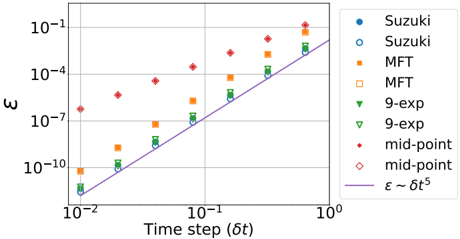
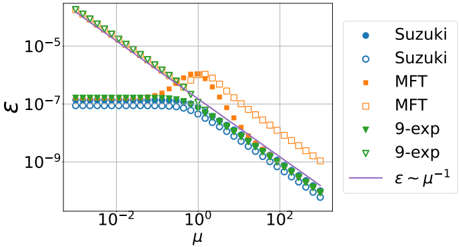
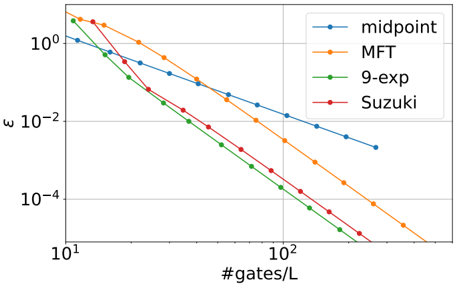
When a time propagator eδtA for duration δt consists of two noncommuting parts A=X+Y, Trotterization approximately decomposes the propagator into a product of exponentials of X and Y. Various Trotterization formulas have been utilized in quantum and classical computers, but much less is known for the Trotterization with the time-dependent generator A(t). Here, for A(t) given by the sum of two operators X and Y with time-dependent coefficients A(t)=x(t)X+y(t)Y, we develop a systematic approach to derive high-order Trotterization formulas with minimum possible exponentials. In particular, we obtain fourth-order and sixth-order Trotterization formulas involving seven and fifteen exponentials, respectively, which are no more than those for time-independent generators. We also construct another fourth-order formula consisting of nine exponentials having a smaller error coefficient. Finally, we numerically benchmark the fourth-order formulas in a Hamiltonian simulation for a quantum Ising chain, showing that the 9-exponential formula accompanies smaller errors per local quantum gate than the well-known Suzuki formula.
Overview
The claims and statistics of this paper haven’t been checked yet.
Free: it reads the open-access text and checks the first 5 claims that cite a source we can check. Create a free account to check every claim.
Integrity signals
Registry
Cites
Statistics
Figures
Verification
Claims the paper makes
The claims and statistics of this paper haven’t been checked yet.
Free: it reads the open-access text and checks the first 5 claims that cite a source we can check. Create a free account to check every claim.
Claims other papers make about this one
Each is checked against this paper’s own text: does it say what the citing paper says it does?
The cited source says what the claim attributes to it.
In the citing paper
“Trotterization methods are commonly employed, and allow discretization errors that are controlled polynomially in dt, with a number of unitary operations that scales linearly in the number of Hamiltonian terms and simulation time IV .”
From Beyond-classical computation in quantum simulation (2025) · cites this paper as [104]
Self-check
Percentages, sums and reported differences re-computed from the paper’s own numbers.
The self-check needs the paper’s full text.
Citations
Cites
Relation between the Anderson and Kondo Hamiltonians
Schrieffer, J. R., & Wolff, P. A. (1966) · Physical Review · doi:10.1103/physrev.149.491 · Cited by 2,389 · cited 1×
“This case implies The second remark is that Theorem 1 can also be derived using (a non-Hermitian version of) the Schrieffer-Wolff Transformation (SWT) [4, 20].”
MethodConstruction of higher order symplectic integrators
Yoshida, H. (1990) · Physics Letters A · doi:10.1016/0375-9601(90)90092-3 · Cited by 2,289 · cited 2×
“(27) reduces to Yoshida’s minimum sixth-order formula [27] in the time-independent case, where Namely, these variables are introduced as a time-dependent generalization.”
BackgroundMethodOn the product of semi-groups of operators
Trotter, H. F. (1959) · Proceedings of the American Mathematical Society · doi:10.1090/s0002-9939-1959-0108732-6 · Cited by 2,282
The Magnus expansion and some of its applications
Blanes, S., Casas, F., Oteo, J. A., & Ros, J. (2009) · Physics Reports · doi:10.1016/j.physrep.2008.11.001 · Cited by 1,157 · cited 3×
“The Magnus expansion [3] up to the fourth order in our notation (7) reads”
BackgroundInfluentialSuzuki, M. (1990) · Physics Letters A · doi:10.1016/0375-9601(90)90962-n · Cited by 853 · cited 2×
“(20) reduces to the fourth-order Forest-Ruth-Suzuki formula [6, 22] as one can check easily.”
BackgroundMethodOptimal Hamiltonian Simulation by Quantum Signal Processing
Low, G. H., & Chuang, I. L. (2017) · Physical Review Letters · doi:10.1103/physrevlett.118.010501 · Cited by 769 · cited 1×
“Although Trotterization-based algorithms do not have optimal error scalings of quantum-singular-value-transformation-based ones [13, 15, 16, 25], they have fewer overheads and are useful in near-term quantum computers.”
BackgroundSelf-citationFourth-order symplectic integration
Forest, E., & Ruth, R. D. (1990) · Physica D: Nonlinear Phenomena · doi:10.1016/0167-2789(90)90019-l · Cited by 644
Schrieffer–Wolff transformation for quantum many-body systems
Bravyi, S., DiVincenzo, D. P., & Loss, D. (2011) · Annals of Physics · doi:10.1016/j.aop.2011.06.004 · Cited by 569 · cited 1×
“This case implies The second remark is that Theorem 1 can also be derived using (a non-Hermitian version of) the Schrieffer-Wolff Transformation (SWT) [4, 20].”
MethodQuasiparticle kinetic theory for Calogero modelsPreprint
Bulchandani, V. B., Kulkarni, M., Moore, J. E., et al. (2021) · doi:10.1088/1751- · Cited by 482
Theory of Trotter Error with Commutator Scaling
Childs, A. M., Su, Y., Tran, M. C., Wiebe, N., & Zhu, S. (2021) · Physical Review X · doi:10.1103/physrevx.11.011020 · Cited by 451 · cited 2×
“Since Γ 5 is the well-known Trotter error for time-independent case [5], Υ 5 is the additional error source particular to the time dependence.”
BackgroundMethod
Research works printed but not linked: 1
- Tatsuhiko N. Ikeda and Keisuke Fujii. Trotter24: A precision-guaranteed adaptive stepsize trotterization for hamiltonian simulations. arXiv:2307.05406, 2023. https://doi.org/10.48550/arXiv.2307.05406. · arXiv · doi:10.48550/arxiv.2307.05406
Cited by
Beyond-classical computation in quantum simulation
King, A. D., Nocera, A., Rams, M. M., Dziarmaga, J., Wiersema, R., Bernoudy, W., Raymond, J., Kaushal, N., Heinsdorf, N., Harris, R., et al. (2025) · Science · doi:10.1126/science.ado6285 · Cited by 138
Belaloui, N. E., Tounsi, A., Khamadja, A. R., Louamri, M. M., Benslama, A., Bernal, D. E., & Rouabah, M. T. (2025) · Journal of Chemical Theory and Computation · doi:10.1021/acs.jctc.4c01657 · Cited by 35
Zhao, H., Bukov, M., Heyl, M., & Moessner, R. (2024) · Physical Review Letters · doi:10.1103/physrevlett.133.010603 · Cited by 31
Block encoding bosons by signal processing
Kane, C. F., Hariprakash, S., Modi, N. S., Kreshchuk, M., & Bauer, C. (2025) · Quantum · doi:10.22331/q-2025-05-15-1747 · Cited by 26
“Although the asymptotic cost of these algorithms can achieve optimal or near-optimal dependence on problem parameters, they often come with large constant prefactors compared to asymptotically sub-optimal methods based on Product Formulas (PF) [17, 26, 48, 69, 85, 86].”
Unifying framework for quantum simulation algorithms for time-dependent Hamiltonian dynamics
Cao, Y. H., Jin, S., & Liu, N. (2025) · Physical Review Research · doi:10.1103/fkh5-b669 · Cited by 22
“…a finite truncation of the Magnus expansion, it is necessary to additionally employ a quadrature scheme to estimate the integration if required, and then apply Hamiltonian simulation techniques like product formulas [17, 18, 27, 60–62], or LCU and quantum signal processing (see below) [58, 59].”
InfluentialQuantum simulations for strong-field QED
Hidalgo, L., & Draper, P. (2024) · Physical review. D/Physical review. D. · doi:10.1103/physrevd.109.076004 · Cited by 19
Theory of Trotter Errors for Time-Dependent Product and Multi-product Formulas
Anonymous, Ikeda, T. N., & Fujii, K. (2026) · PRX Quantum · doi:10.1103/ywv1-7fhf · Cited by 15
“While the existence of the commuta-tor scaling has been understood for low order time-dependent PF errors as well [14, 18–22], the error bounds for generic time-dependent PFs remain to be a difficult problem.”
BackgroundSelf-citationMeasuring Trotter error and its application to precision-guaranteed Hamiltonian simulations
Ikeda, T. N., Kono, H., & Fujii, K. (2024) · Physical Review Research · doi:10.1103/physrevresearch.6.033285 · Cited by 18
“Focusing on a special case where A ( t ) = a ( t ) A and B ( t ) = b ( t ) B with a ( t ) and b ( t ) are scalars, we utilize the minimum fourth-order Trotterization formula [40] consisting of seven exponentials, where b ( s ) ds , and ], and u ≡ β 12 /β 2 is assumed to be O ( δt 2 ).”
MethodSelf-citationQuantum simulation of time-dependent Hamiltonians via commutator-free quasi-Magnus operators
Casares, P. A. M., Zini, M. S., & Arrazola, J. M. (2024) · Quantum · doi:10.22331/q-2024-12-17-1567 · Cited by 16
“[38].”
On Strong Bounds for Trotter and Zeno Product Formulas with Bosonic Applications
Möbus, T. (2024) · Quantum · doi:10.22331/q-2024-07-25-1424 · Cited by 12
“Additionally, the extension to evolution systems (time-dependent semigroups) can, for example, be found in [58, 39, 26, 49].”
BackgroundSze, M. W., Tang, Y., Dilkes, S., Ramo, D. M., Duncan, R., & Fitzpatrick, N. (2025) · Quantum Science and Technology · doi:10.1088/2058-9565/ae2292 · Cited by 8
Harnessing intrinsic noise for quantum simulation of open quantum systems
Dambal, S., Sone, A., & Zhang, Y. (2026) · Physical Review A · doi:10.1103/q31d-1b36 · Cited by 7
Multi-target quantum compilation algorithm
Hai, V. T., Viet, N. T., Urbaneja, J., Linh, N. V., Tran, L. N., & Ho, L. B. (2024) · Machine Learning Science and Technology · doi:10.1088/2632-2153/ad9705 · Cited by 11
“For instance, for GA-VQA applied to multi-target compilation, the time complexity is approximately O ( n gene × n V × n iter × 2 N × d ) , where d is the circuit depth and n iter is the number of optimization iterations.”
Hamiltonian truncation and quantum simulation of strong-field QED beyond tree level
Draper, P., Hidalgo, L., & Ilderton, A. (2026) · Physical review. D/Physical review. D. · doi:10.1103/4lmx-psvz · Cited by 5
“For this reason, we implemented the second-order [87] version of (47): This second-order Trotterization – along with the aforementioned improved decomposition – dramatically reduces the Trotter error, even agreeing with the “Exact” Trotterization within shot noise.”
Suzuki-Trotter Decompositions and other Methods for Quantum Time EvolutionPreprint
Ostmeyer, J. (2026) · arXiv (Cornell University) · doi:10.48550/arxiv.2609.19184 · Cited by 2
“Ikeda et al. [84] have derived specialised splitting methods up to order n ≤ 6 for the special case that the time dependence of every operator is contained in a scalar prefactor A k ( t ) = x k ( t ) A k .”
Time-Dependent Low-Energy Simulation Accelerates Adiabatic State PreparationPreprint
Zhou, S., Pan, Z., Gong, W., & Li, T. (2026) · arXiv (Cornell University) · doi:10.48550/arxiv.2601.01550 · Cited by 1
“Besides, there is research [23] exploiting time-dependent product formulas with the minimum number of exponential terms.”
Grenzen der Approximation von Quanten-Markov-Halbgruppen in unendlich-dimensionalen Systemen
Möbus, T., Wolf, M. M., & München, T. U. (2024)
Metadata
- Authors
- Ikeda, T. N., Abrar, A., Chuang, I. L., & Sugiura, S.
- Affiliations
- Boston University (US)
- NTT (United States) (US)
- Massachusetts Institute of Technology (US)
- Venue
- Quantum
- Published
- 2023-11-06
- Volume
- 7
- Pages
- 1168
- ISSN
- 2521-327X (ISSN-L)
- OpenAlex
- W4388411670
- Cited by
- 14
- References
- 29
- Citations by year
- 2026: 2 · 2025: 5 · 2024: 7
- FWCI
- 1.32
- Type
- journal article
- Language
- en
- Open access
- gold
- doi.org
- Locations
- Quantum (publishedVersion, cc-by)
- arXiv (Cornell University) (submittedVersion)
- DOAJ (DOAJ: Directory of Open Access Journals) (submittedVersion, cc-by-sa)
- arXiv (Cornell University) (cc-by)
- Funders
- JST PRESTO (JPMJPR2112)
- JSPS KAKENHI (JP21K13852)
- Topics
- Physical Sciences › Computer Science › Artificial Intelligence › Quantum Computing Algorithms and Architecture
- Physical Sciences › Mathematics › Numerical Analysis › Numerical Solvers for Ordinary Differential Equations
- Physical Sciences › Physics and Astronomy › Atomic and Molecular Physics, and Optics › Quantum many-body systems
- Keywords
- Trotterization, time-dependent Hamiltonian, quantum simulation, quantum Ising chain, quantum gate errors, non-commuting operators
About these checks
Registry, retraction, Cites and statistics results are computed, not judged, with one exception: a printed reference that no index lists is read once by a model before it counts as a citation error. Claims are extracted by a model and kept only when their quote appears verbatim in the text; each cited source is then checked, with a model’s help, for whether it says what the claim relies on. Those verdicts can be wrong — read the claim’s quote and the cited source before relying on one.
Statistics and arithmetic are recomputed, not judged.
Confidence bands are shown only for fields calibrated on our annotated test set. None is calibrated yet, so no band is shown.
What counts as a claim ›How we measure confidence ›How we check this ›
Are you an author, or do you see a problem with this page? Request a review
Data sources
Bibliographic data: Semantic Scholar, OpenAlex, Crossref.
Contains information from the Semantic Scholar Academic Graph Datasets, made available under the ODC Attribution License (ODC-BY 1.0).
Semantic Scholar’s data is described in: Kinney, R., et al. (2023). The Semantic Scholar Open Data Platform. arXiv:2301.10140.
