

Pipelined correlated minimum weight perfect matching of the surface code
Open accessThe DOI matches its Crossref record; 23 of the 23 references it cites were found in a registry or an index.
Abstract
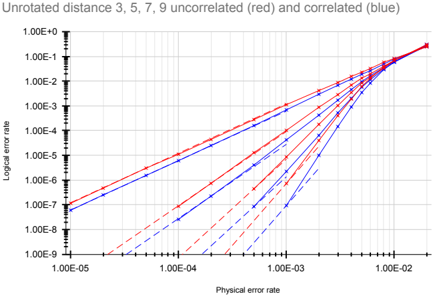
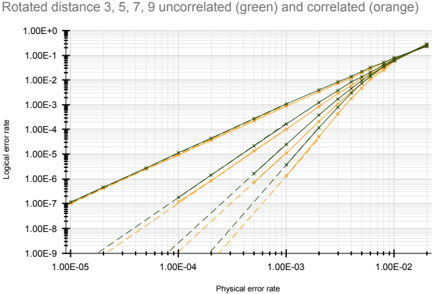
We describe a pipeline approach to decoding the surface code using minimum weight perfect matching, including taking into account correlations between detection events. An independent no-communication parallelizable processing stage reweights the graph according to likely correlations, followed by another no-communication parallelizable stage for high confidence matching. A later general stage finishes the matching. This is a simplification of previous correlated matching techniques which required a complex interaction between general matching and re-weighting the graph. Despite this simplification, which gives correlated matching a better chance of achieving real-time processing, we find the logical error rate practically unchanged. We validate the new algorithm on the fully fault-tolerant toric, unrotated, and rotated surface codes, all with standard depolarizing noise. We expect these techniques to be applicable to a wide range of other decoders.
Overview
The claims and statistics of this paper haven’t been checked yet.
Free: it reads the open-access text and checks the first 5 claims that cite a source we can check. Create a free account to check every claim.
Integrity signals
Registry
Cites
Statistics
Figures
Verification
Claims the paper makes
The claims and statistics of this paper haven’t been checked yet.
Free: it reads the open-access text and checks the first 5 claims that cite a source we can check. Create a free account to check every claim.
Self-check
Percentages, sums and reported differences re-computed from the paper’s own numbers.
The self-check needs the paper’s full text.
Citations
Cites
Surface codes: Towards practical large-scale quantum computation
Fowler, A. G., Mariantoni, M., Martinis, J. M., & Cleland, A. N. (2012) · Physical Review A · doi:10.1103/physreva.86.032324 · Cited by 3,059 · cited 1×
“The surface code [1, 2, 3, 4, 5, 6, 7, 8] is experimentally attractive as it requires only a 2D array of qubits with nearest neighbor interactions, and gate error rates of order 0.1% to achieve post-classical fault-tolerant quantum computation with fewer than 1M qubits [9].”
MethodInfluentialSelf-citationEdmonds, J. (1965) · Canadian Journal of Mathematics · doi:10.4153/cjm-1965-045-4 · Cited by 2,428 · cited 1×
“To move closer to this goal, we improve the algo-rithm used in [14] which performs a correlated-error version of minimum weight perfect matching [18, 19].”
MethodDennis, E., Kitaev, A., Landahl, A., & Preskill, J. (2002) · Journal of Mathematical Physics · doi:10.1063/1.1499754 · Cited by 1,768 · cited 2×
“Usually, most matching decoders use w = − ln p 1 − p where p is a probability of a single error associated with the qubit or gates of the code [2].”
BackgroundMethodInfluentialMaximum matching and a polyhedron with 0,1-vertices
Edmonds, J. (1965) · Journal of Research of the National Bureau of Standards Section B Mathematics and Mathematical Physics · doi:10.6028/jres.069b.013 · Cited by 1,712 · cited 1×
“To move closer to this goal, we improve the algo-rithm used in [14] which performs a correlated-error version of minimum weight perfect matching [18, 19].”
MethodDennis, E., Kitaev, A., Landahl, A., & Preskill, J. (2001) · CERN Document Server (European Organization for Nuclear Research) · Cited by 1,485
Fault-Tolerant Quantum Computation with High Threshold in Two Dimensions
Raussendorf, R., & Harrington, J. (2007) · Physical Review Letters · doi:10.1103/physrevlett.98.190504 · Cited by 812
Topological fault-tolerance in cluster state quantum computation
Raussendorf, R., Harrington, J., & Goyal, K. (2007) · New Journal of Physics · doi:10.1088/1367-2630/9/6/199 · Cited by 617
A Game of Surface Codes: Large-Scale Quantum Computing with Lattice Surgery
Litinski, D. (2019) · Quantum · doi:10.22331/q-2019-03-05-128 · Cited by 408 · cited 1×
“The surface code [1, 2, 3, 4, 5, 6, 7, 8] is experimentally attractive as it requires only a 2D array of qubits with nearest neighbor interactions, and gate error rates of order 0.1% to achieve post-classical fault-tolerant quantum computation with fewer than 1M qubits [9].”
MethodInfluentialQuantum codes on a lattice with boundary
Bravyi, S. B., & Kitaev, A. Y. (1998) · arXiv · doi:10.48550/arxiv.quant-ph/9811052 · Cited by 394 · cited 1×
“The surface code [1, 2, 3, 4, 5, 6, 7, 8] is experimentally attractive as it requires only a 2D array of qubits with nearest neighbor interactions, and gate error rates of order 0.1% to achieve post-classical fault-tolerant quantum computation with fewer than 1M qubits [9].”
MethodInfluentialA game of surface codes: Large-scale quantum computing with lattice surgery
Litinski, D. (2019) · Refubium (Universitätsbibliothek der Freien Universität Berlin) · doi:10.17169/refubium-4067 · Cited by 252
Cited by
Quantum error correction below the surface code threshold
Collaborators, G. Q. A. A., Acharya, R., Abanin, D. A., Aghababaie-Beni, L., Aleiner, I., Andersen, T. I., Ansmann, M., Arute, F., Arya, K., Asfaw, A., et al. (2025) · Nature · doi:10.1038/s41586-024-08449-y · Cited by 778
“We also use a greedy edge reweighting strategy to increase accuracy by accounting for correlations induced by Y -type errors [29, 47].”
Self-citationImproved belief propagation is sufficient for real-time decoding of quantum memoryPreprint
Müller, T., Alexander, T., Beverland, M. E., Bühler, M., Johnson, B. R., Maurer, T., & Vandeth, D. (2025) · arXiv (Cornell University) · doi:10.48550/arxiv.2506.01779 · Cited by 166
“XYZ-Relay-BP-5 outperforms Relay-BP-5 and performs comparably to Matching [48] although we note that iterative Matching variants that go beyond XZ-decoding can achieve better performance [49, 50].”
Parallel window decoding enables scalable fault tolerant quantum computation
Skoric, L., Browne, D. E., Barnes, K. M., Gillespie, N. I., & Campbell, E. T. (2023) · Nature Communications · doi:10.1038/s41467-023-42482-1 · Cited by 80
Real-time decoding for fault-tolerant quantum computing: progress, challenges and outlook
Battistel, F., Chamberland, C., Johar, K., Overwater, R. W. J., Sebastiano, F., Skorić, L., Ueno, Y., & Usman, M. (2023) · Nano Futures · doi:10.1088/2399-1984/aceba6 · Cited by 168
“Maintaining high fidelity in the presence of correlated errors [71], leakage [22, 72, 73], erasure [74], device inhomogeneities [23], and even rare high-energy events [75] necessitates modifications to standard decoders.”
BackgroundLearning high-accuracy error decoding for quantum processors
Bausch, J., Senior, A. W., Heras, F. J. H., Edlich, T., Davies, A., Newman, M., Jones, C., Satzinger, K., Niu, M. Y., Blackwell, S., et al. (2024) · Nature · doi:10.1038/s41586-024-08148-8 · Cited by 106
Creating Entangled Logical Qubits in the Heavy-Hex Lattice with Topological Codes
Hetényi, B., & Wootton, J. R. (2024) · PRX Quantum · doi:10.1103/prxquantum.5.040334 · Cited by 71
Better Than Worst-Case Decoding for Quantum Error Correction
Ravi, G. S., Baker, J. M., Fayyazi, A., Lin, S. F., Javadi-Abhari, A., Pedram, M., & Chong, F. T. (2023) · International Conference on Architectural Support for Programming Languages and Operating Systems (ASPLOS) · doi:10.1145/3575693.3575733 · Cited by 62
“Recently [35] proposed an off-chip lightweight predecoding step which re-weights the decoding graph according to likely correlations, and performs high confidence matching where possible.”
Local Predecoder to Reduce the Bandwidth and Latency of Quantum Error Correction
Smith, S. C., Brown, B. J., & Bartlett, S. D. (2023) · Physical Review Applied · doi:10.1103/physrevapplied.19.034050 · Cited by 52
Superconducting quantum computers: who is leading the future?
AbuGhanem, M. (2025) · EPJ Quantum Technology · doi:10.1140/epjqt/s40507-025-00405-7 · Cited by 61
Error-corrected Hadamard gate simulated at the circuit level
Gehér, G. P., McLauchlan, C., Campbell, E. T., Moylett, A. E., & Crawford, O. (2024) · Quantum · doi:10.22331/q-2024-07-02-1394 · Cited by 47
“Performing similar investigations on other QEC codes would allow for comparisons between very different fault-tolerant strategies under realistic noise models.”
BackgroundCompare the pair: Rotated versus unrotated surface codes at equal logical error rates
O'Rourke, A. R., & Devitt, S. J. (2025) · Physical Review Research · doi:10.1103/physrevresearch.7.033074 · Cited by 45
Error Correction of Transversal cnot Gates for Scalable Surface-Code Computation
Sahay, K., Lin, Y., Huang, S., Brown, K. R., & Puri, S. (2025) · PRX Quantum · doi:10.1103/prxquantum.6.020326 · Cited by 46
Mitigating errors in logical qubits
Smith, S. C., Brown, B. J., & Bartlett, S. D. (2024) · Communications Physics · doi:10.1038/s42005-024-01883-4 · Cited by 47
Superconducting qubits in the millions: The potential and limitations of modularity
Saadatmand, S. N., Wilson, T. L., Hodson, M. J., Field, M., Devitt, S. J., Vijayan, M. K., Robertson, A., Le, T. P., Ruh, J., Paler, A., et al. (2026) · Physical Review Applied · doi:10.1103/k3d5-v43c · Cited by 22
“For this work, we do not report the decoding of circuit-level correlated noise (e.g., [87]) and focus entirely on correcting depolarizing noise.”
Self-citationExperimentally informed decoding of stabilizer codes based on syndrome correlations
Remm, A., Lacroix, N., Bödeker, L., Genois, É., Hellings, C., Swiadek, F., Norris, G. J., Eichler, C., Blais, A., Müller, M., et al. (2026) · Physical Review Research · doi:10.1103/z1ng-wg3k · Cited by 15
Magic state cultivation: growing T states as cheap as CNOT gates
Gidney, C., Shutty, N., & Jones, C. (2024) · arXiv · doi:10.48550/arxiv.2409.17595 · Cited by 9
“Once we’ve escaped to a large matchable code the state is safe, because we have excellent decoders for this situation [Hig21; PF23; Gid+23].”
BackgroundLearning to decode logical circuits
Zhou, Y., Wan, C., Xu, Y., Zhou, J. P., Weinberger, K. Q., & Kim, E.-A. (2025) · Nature Computational Science · doi:10.1038/s43588-025-00897-4 · Cited by 15
Ji, Y., Chen, Q., Wang, R., Ji, N., & Ma, H. (2024) · Quantum Information Processing · doi:10.1007/s11128-024-04377-y · Cited by 6
Transversal cnot gate with multicycle error correction
Kim, Y., Sevior, M. E., & Usman, M. (2025) · Physical Review Applied · doi:10.1103/physrevapplied.23.024074 · Cited by 7
“Any arbitrary error can be decomposed into a combination of these error categories [57].”
Union-Intersection Union-Find for Decoding Depolarizing Errors in Topological Codes
Lin, T., & Lai, C. (2025) · IEEE Journal on Selected Areas in Information Theory · doi:10.1109/jsait.2025.3581810 · Cited by 6
“However, we note a key limitation of this iterative decoder: unlike the standard UF decoder [13], it does not guarantee the correction of errors with weights up to half the code distance.”
Decoding three-dimensional color codes with boundaries
Butt, F., Esser, L., & Müller, M. (2026) · Physical Review A · doi:10.1103/7cdb-px1d · Cited by 5
Tangling schedules eases hardware connectivity requirements for quantum error correctionPreprint
Gehér, G. P., Crawford, O., & Campbell, E. T. (2023) · arXiv (Cornell University) · doi:10.48550/arxiv.2307.10147 · Cited by 3
“A similar noise model has been used elsewhere [20].”
BackgroundMethodSimulated-annealing decoder for the XZZX code with greedy-matching initialization
Anonymous (2026) · APS Open Science · doi:10.1103/5z6j-y33z · Cited by 1
“Several decoders have been proposed that explicitly account for correlations induced by Y errors [51–53].”
Decoding the surface code with a spatio-temporal transformer
Joo, R. S. (2026) · EPJ Quantum Technology · doi:10.1140/epjqt/s40507-026-00492-0 · Cited by 1
Leveraging Correlated Decoding for Bias-Tailored Compass CodesPreprint
Meinking, A., Campos, J., & Brown, K. R. (2026) · arXiv (Cornell University) · doi:10.48550/arxiv.2605.27598 · Cited by 1
Two-Stage Neural Residual Decoding for FastSurface-Code Quantum Error CorrectionPreprint
Chen, J. Y., Peng, J., & Liu, J. (2026) · Research Square · doi:10.21203/rs.3.rs-10123128/v1
Quantum Compiler Design for Fault-Tolerant Quantum ComputingPreprint
Zhu, C., Chen, J., He, K., Yao, H., Yang, Z., Liu, J.-G., Wu, A., Ni, X., Luan, X., Fu, Z., et al. (2026) · arXiv (Cornell University) · doi:10.48550/arxiv.2609.17465 · Cited by 1
Dangi, A., & Chatterjee, A. (2026) · arXiv (Cornell University) · doi:10.48550/arxiv.2611.10796
Metadata
- Authors
- Paler, A., & Fowler, A. G.
- Affiliations
- The University of Texas at Dallas (US)
- Google (United States) (US)
- Venue
- Quantum
- Published
- 2023-12-12
- Volume
- 7
- Pages
- 1205
- ISSN
- 2521-327X (ISSN-L)
- OpenAlex
- W4389625651
- Semantic Scholar
- f3dfa7a2a70379fa346c5fdab4ddd3dcd6c5d7ee
- Cited by
- 22
- References
- 17
- Citations by year
- 2026: 5 · 2025: 7 · 2024: 6 · 2023: 4
- FWCI
- 1.95
- Type
- journal article
- Language
- en
- Open access
- gold
- doi.org
- Locations
- Quantum (publishedVersion, cc-by)
- arXiv (Cornell University) (submittedVersion)
- Aaltodoc (Aalto University) (submittedVersion, cc-by)
- DOAJ (DOAJ: Directory of Open Access Journals) (submittedVersion, cc-by-sa)
- arXiv (Cornell University) (cc-by)
- Topics
- Physical Sciences › Computer Science › Artificial Intelligence › Quantum Computing Algorithms and Architecture
- Physical Sciences › Computer Science › Computer Networks and Communications › Error Correcting Code Techniques
- Physical Sciences › Physics and Astronomy › Atomic and Molecular Physics, and Optics › Quantum Information and Cryptography
- Keywords
- surface code, minimum-weight perfect matching, quantum error correction, logical error rate, toric code, rotated surface code, depolarizing noise, real-time decoding
About these checks
Registry, retraction, Cites and statistics results are computed, not judged, with one exception: a printed reference that no index lists is read once by a model before it counts as a citation error. Claims are extracted by a model and kept only when their quote appears verbatim in the text; each cited source is then checked, with a model’s help, for whether it says what the claim relies on. Those verdicts can be wrong — read the claim’s quote and the cited source before relying on one.
Statistics and arithmetic are recomputed, not judged.
Confidence bands are shown only for fields calibrated on our annotated test set. None is calibrated yet, so no band is shown.
What counts as a claim ›How we measure confidence ›How we check this ›
Are you an author, or do you see a problem with this page? Request a review
Data sources
Bibliographic data: Semantic Scholar, OpenAlex, Crossref.
Contains information from the Semantic Scholar Academic Graph Datasets, made available under the ODC Attribution License (ODC-BY 1.0).
Semantic Scholar’s data is described in: Kinney, R., et al. (2023). The Semantic Scholar Open Data Platform. arXiv:2301.10140.
