

The DOI matches its Crossref record; 110 of the 110 references it cites were found in a registry or an index.
Learning high-accuracy error decoding for quantum processors
Open accessAbstract
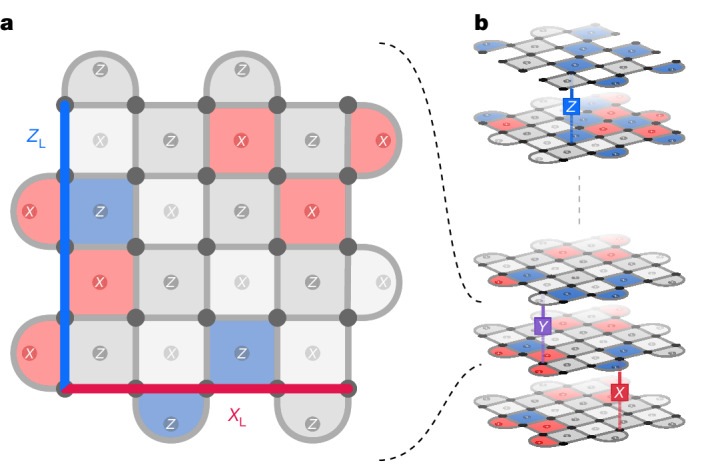
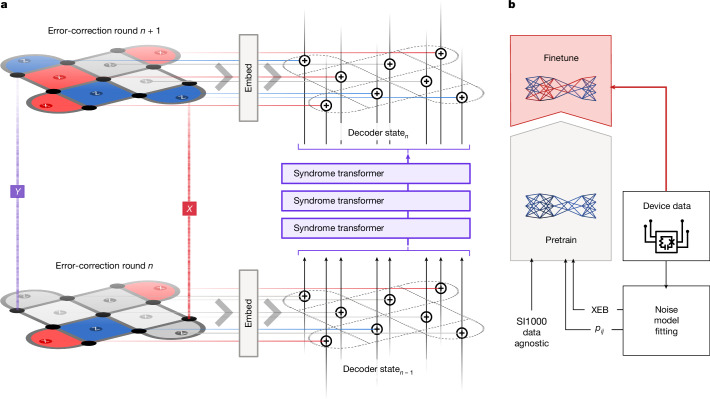
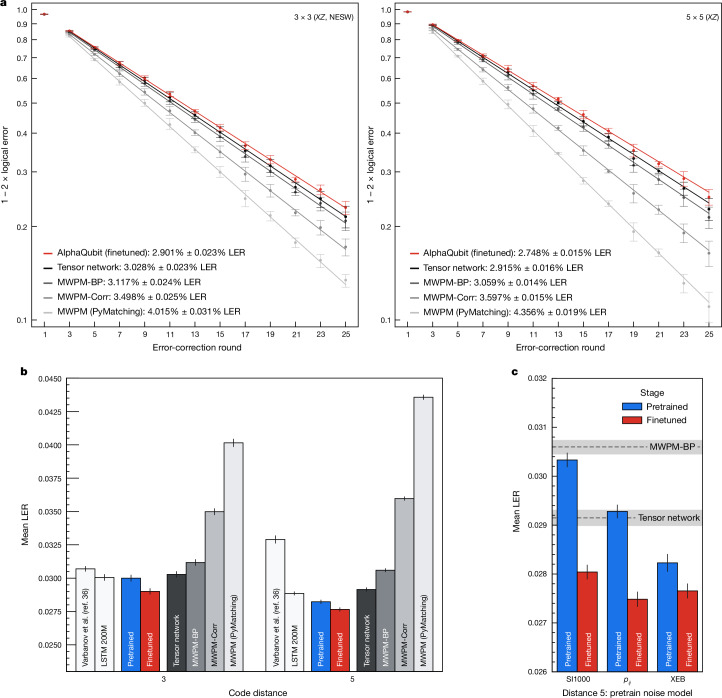
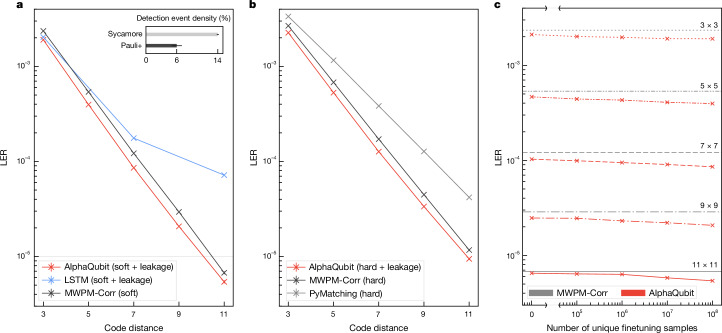
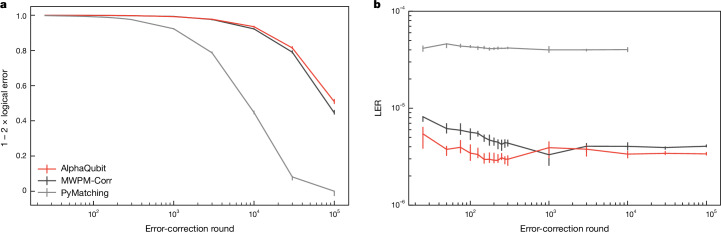
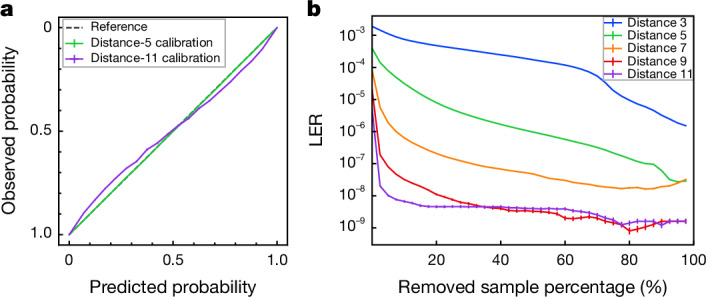
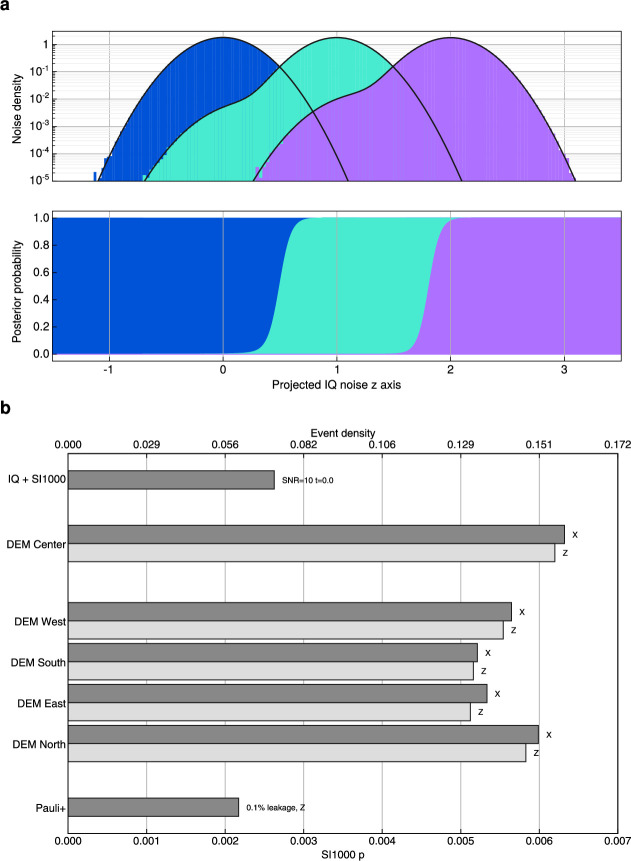
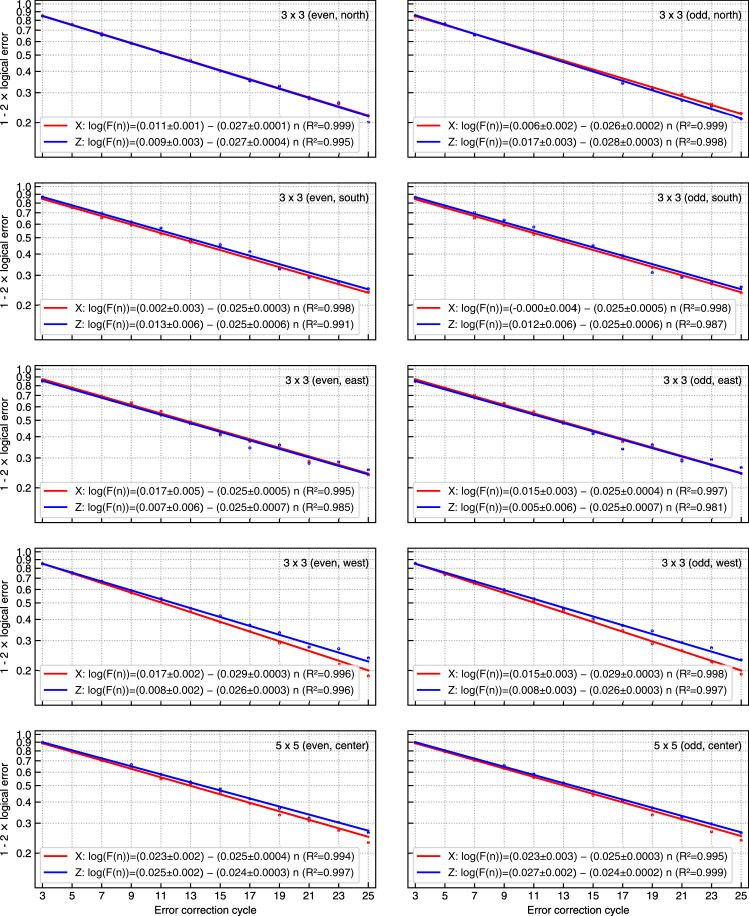
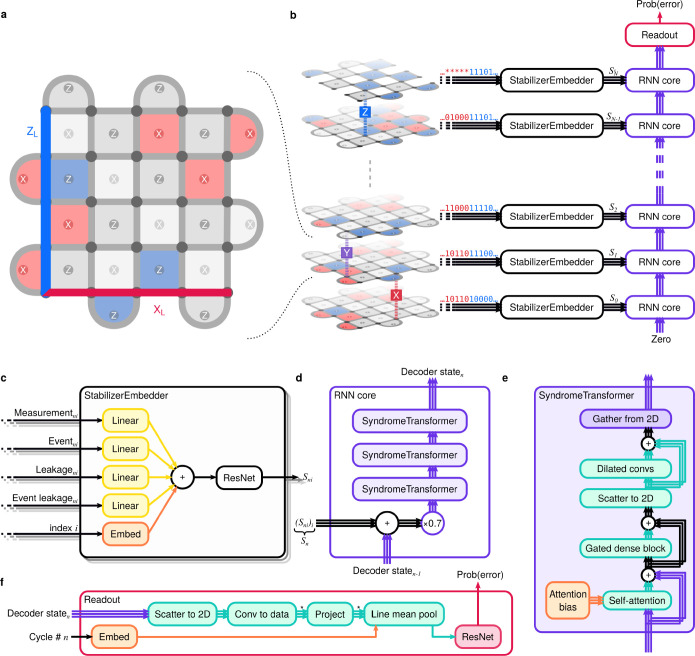
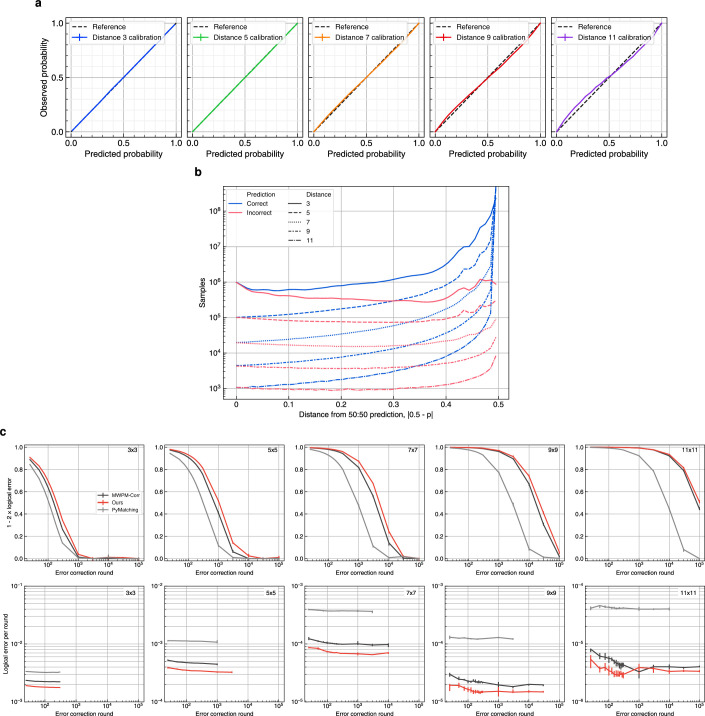
Building a large-scale quantum computer requires effective strategies to correct errors that inevitably arise in physical quantum systems 1 . Quantum error-correction codes 2 present a way to reach this goal by encoding logical information redundantly into many physical qubits. A key challenge in implementing such codes is accurately decoding noisy syndrome information extracted from redundancy checks to obtain the correct encoded logical information. Here we develop a recurrent, transformer-based neural network that learns to decode the surface code, the leading quantum error-correction code 3 . Our decoder outperforms other state-of-the-art decoders on real-world data from Google’s Sycamore quantum processor for distance-3 and distance-5 surface codes 4 . On distances up to 11, the decoder maintains its advantage on simulated data with realistic noise including cross-talk and leakage, utilizing soft readouts and leakage information. After training on approximate synthetic data, the decoder adapts to the more complex, but unknown, underlying error distribution by training on a limited budget of experimental samples. Our work illustrates the ability of machine learning to go beyond human-designed algorithms by learning from data directly, highlighting machine learning as a strong contender for decoding in quantum computers.
Overview
The claims and statistics of this paper haven’t been checked yet.
Free: it reads the open-access text and checks the first 5 claims that cite a source we can check. Create a free account to check every claim.
Integrity signals
Registry
Cites
Statistics
Figures
Verification
Claims the paper makes
The claims and statistics of this paper haven’t been checked yet.
Free: it reads the open-access text and checks the first 5 claims that cite a source we can check. Create a free account to check every claim.
Claims other papers make about this one
Each is checked against this paper’s own text: does it say what the citing paper says it does?
The source backs part of the claim, not all of it — or backs it for a different population, condition or comparison.
In the citing paper
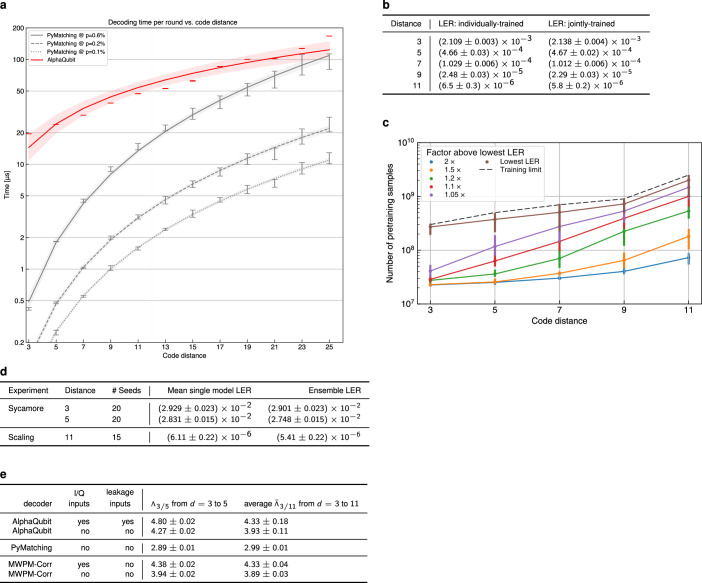
“It requires a throughput of less than 1.1 μs per cycle compared with the 24 μs per cycle of the neural network26.”
From Quantum error correction below the surface code threshold (2025) · cites this paper as [26]
Experimental — accuracy not yet measuredThe cited source says what the claim attributes to it.
In the citing paper
“With a neural-network decoder (AlphaQubit)51, we obtain Λ3/5 = 1.56(4) and ε5 = 0.0110(2).”
From Scaling and logic in the colour code on a superconducting quantum processor (2025) · cites this paper as [51]
Self-check
Percentages, sums and reported differences re-computed from the paper’s own numbers.
The self-check needs the paper’s full text.
Citations
Cites
Breiman, L. (2001) · Machine Learning · doi:10.1023/a:1010933404324 · Cited by 133,538 · cited 1×
“It is possible to combine multiple classifiers to obtain a more accurate prediction by ensembling 27,75 .”
Vaswani, A., Shazeer, N., Parmar, N., Uszkoreit, J., Jones, L., Gomez, A. N., Kaiser, L., & Polosukhin, I. (2017) · arXiv · doi:10.48550/arxiv.1706.03762 · Cited by 120,404
Highly accurate protein structure prediction with AlphaFold
Jumper, J., Evans, R., Pritzel, A., Green, T., Figurnov, M., Ronneberger, O., Tunyasuvunakool, K., Bates, R., Žídek, A., Potapenko, A., et al. (2021) · Nature · doi:10.1038/s41586-021-03819-2 · Cited by 43,764
Self-citationFocal Loss for Dense Object Detection
Lin, T.-Y., Goyal, P., Girshick, R., He, K., & Dollar, P. (2017) · 2017 IEEE International Conference on Computer Vision (ICCV) · doi:10.1109/iccv.2017.324 · Cited by 30,581 · cited 1×
“Another approach that might improve sample efficiency is the concept of ‘hard sample mining’ 91,92 , where difficult examples are collected (for example, by finding examples whose predictions are incorrect, or not confidently correct, for some decoder) or constructed.”
Language Models are Few-Shot Learners
Brown, T. B., Mann, B., Ryder, N., Subbiah, M., Kaplan, J., Dhariwal, P., Neelakantan, A., Shyam, P., Sastry, G., Askell, A., et al. (2020) · arXiv · doi:10.48550/arxiv.2005.14165 · Cited by 23,372 · cited 1×
“At the heart of our RNN block architecture is the Syndrome Transformer, a self-attention architecture based on the Transformer [97] which has seen recent success in a variety of problems [17, 49].”
MobileNets: Efficient Convolutional Neural Networks for Mobile Vision Applications
Howard, A. G., Zhu, M., Chen, B., Kalenichenko, D., Wang, W., Weyand, T., Andreetto, M., & Adam, H. (2017) · arXiv · doi:10.48550/arxiv.1704.04861 · Cited by 19,015 · cited 1×
“Then we train a smaller ‘student’ network whose architecture is tuned for inference speed 81 .”
Distilling the Knowledge in a Neural Network
Hinton, G., Vinyals, O., & Dean, J. (2015) · arXiv · doi:10.48550/arxiv.1503.02531 · Cited by 14,204 · cited 1×
“Secondly, techniques such as distillation [45], lower precision inference and weight pruning can be applied to achieve similar performance with less computation.”
LoRA: Low-Rank Adaptation of Large Language Models
Hu, E. J., Shen, Y., Wallis, P., Allen-Zhu, Z., Li, Y., Wang, S., Wang, L., & Chen, W. (2021) · arXiv · doi:10.48550/arxiv.2106.09685 · Cited by 13,453
A fast quantum mechanical algorithm for database search
Grover, L. K. (1996) · Proceedings of the twenty-eighth annual ACM symposium on Theory of computing - STOC '96 · doi:10.1145/237814.237866 · Cited by 8,830 · cited 5×
“2b) and distances beyond 5, we explore the performance of our decoder on simulated data (in place of experimental samples) at code distances 3, 5, 7, 9 and 11 (17–241 physical qubits).”
InfluentialQuantum supremacy using a programmable superconducting processor
Arute, F., Arya, K., Babbush, R., Bacon, D., Bardin, J. C., Barends, R., Biswas, R., Boixo, S., Brandao, F. G. S. L., Buell, D. A., et al. (2019) · Nature · doi:10.1038/s41586-019-1666-5 · Cited by 7,720
Self-citation
Research works printed but not linked: 4
- Gottesman, D. E. Stabilizer Codes and Quantum Error Correction. PhD thesis, California Institute of Technology (1997).
- Varbanov, B. M., Serra-Peralta, M., Byfield, D. & Terhal, B. M. Neural network decoder for near-term surface-code experiments. Preprint at https://arxiv.org/abs/2307.03280 (2023). · arXiv
- Sank, T. Fast, Accurate State Measurement in Superconducting Qubits. PhD thesis, Univ. California, Santa Barbara (2014).
- Finn, C., Abbeel, P. & Levine, S. Model-agnostic meta-learning for fast adaptation of deep networks. In International Conference on Machine Learning Vol. 70, 1126–1135 (ACM, 2017).
Cited by
Quantum error correction below the surface code threshold
Collaborators, G. Q. A. A., Acharya, R., Abanin, D. A., Aghababaie-Beni, L., Aleiner, I., Andersen, T. I., Ansmann, M., Arute, F., Arya, K., Asfaw, A., et al. (2025) · Nature · doi:10.1038/s41586-024-08449-y · Cited by 778
“Teal: weight-4 detection probabilities (distance-7, averaged over 250 cycles). c , Logical error probability, p L , for a range of memory experiment durations.”
Self-citationScaling and logic in the colour code on a superconducting quantum processor
Lacroix, N., Bourassa, A., Heras, F. J. H., Zhang, L. M., Bausch, J., Senior, A. W., Edlich, T., Shutty, N., Sivak, V., Bengtsson, A., et al. (2025) · Nature · doi:10.1038/s41586-025-09061-4 · Cited by 51
“Therefore, we employ novel decoding strategies [42, 52, 55, 64] to infer whether logical errors have occurred; see Appendix E for an overview of the different decoders used in this work.”
Self-citationArtificial intelligence for quantum computing
Alexeev, Y., Farag, M. H., Patti, T. L., Wolf, M. E., Ares, N., Aspuru‐Guzik, A., Benjamin, S. C., Cai, Z., Cao, S., Chamberland, C., et al. (2025) · Nature Communications · doi:10.1038/s41467-025-65836-3 · Cited by 137
“The following sections explore how AI may improve the demanding decoders needed to run QEC and help accelerate the discovery of more ef fi cient QEC codes 166 .”
InfluentialArtificial Intelligence‐Driven Approaches in Semiconductor Research
Zheng, Y., Xu, H., Li, Z., Li, L., Yu, Y., Jiang, P., Shi, Y., Zhang, J., Huang, Y., Luo, Q., et al. (2025) · Advanced Materials · doi:10.1002/adma.202504378 · Cited by 65
Beyond NISQ: The Megaquop Machine
Preskill, J. P. (2025) · ACM Transactions on Quantum Computing · doi:10.1145/3723153 · Cited by 150
“Google DeepMind has shown that a decoder trained by reinforcement learning can achieve a lower logical error rate than a decoder constructed by humans [8], but it’s unclear whether that will work at scale because the cost of training rises steeply with code distance.”
Metadata
- Authors
- Bausch, J., Senior, A. W., Heras, F. J. H., Edlich, T., Davies, A., Newman, M., Jones, C., Satzinger, K., Niu, M. Y., Blackwell, S., Holland, G., Kafri, D., Atalaya, J., Gidney, C., Hassabis, D., Boixo, S., Neven, H., & Kohli, P.
- Affiliations
- Google DeepMind (United Kingdom) (GB)
- Google (United States) (US)
- Corresponding author
- Bausch, Johannes
- Senior, Andrew W.
- ORCID
- Venue
- Nature
- Published
- 2024-11-20
- Volume
- 635
- Issue
- 8040
- Pages
- 834-840
- ISSN
- 0028-0836 (ISSN-L)
- 1476-4687
- PMC
- PMC11602728
- OpenAlex
- W4404566610
- Cited by
- 106
- References
- 91
- Citations by year
- 2026: 53 · 2025: 47 · 2024: 6
- FWCI
- 15.61
- Type
- journal article
- Language
- en
- Open access
- hybrid
- doi.org
- Licence
- cc-by
- creativecommons.org/licenses/by/4.0 (tdm)
- creativecommons.org/licenses/by/4.0 (vor)
- Locations
- Nature (publishedVersion, cc-by)
- PubMed Central (publishedVersion, cc-by)
- PubMed (publishedVersion)
- arXiv (Cornell University) (submittedVersion)
- RePEc: Research Papers in Economics (submittedVersion)
- arXiv (Cornell University)
- Funders
- DeepMind
- Topics
- Physical Sciences › Computer Science › Artificial Intelligence › Quantum Computing Algorithms and Architecture
- Physical Sciences › Physics and Astronomy › Atomic and Molecular Physics, and Optics › Quantum many-body systems
- Physical Sciences › Physics and Astronomy › Atomic and Molecular Physics, and Optics › Quantum Information and Cryptography
- Keywords
- quantum error correction, surface code, error decoding, syndrome decoding, recurrent transformer, leakage, crosstalk, synthetic data training
About these checks
Registry, retraction, Cites and statistics results are computed, not judged, with one exception: a printed reference that no index lists is read once by a model before it counts as a citation error. Claims are extracted by a model and kept only when their quote appears verbatim in the text; each cited source is then checked, with a model’s help, for whether it says what the claim relies on. Those verdicts can be wrong — read the claim’s quote and the cited source before relying on one.
Statistics and arithmetic are recomputed, not judged.
Confidence bands are shown only for fields calibrated on our annotated test set. None is calibrated yet, so no band is shown.
What counts as a claim ›How we measure confidence ›How we check this ›
Are you an author, or do you see a problem with this page? Request a review
How to cite
Cite CoChat for the checks on this page, and the paper for its own findings.
- This page
- CoChat. (2026). Citation check: Learning high-accuracy error decoding for quantum processors. https://app.cochat.ai/papers/10.1038/s41586-024-08148-8
- The paper
- Bausch, J., Senior, A. W., Heras, F. J. H., Edlich, T., Davies, A., Newman, M., Jones, C., Satzinger, K., Niu, M. Y., Blackwell, S., Holland, G., Kafri, D., Atalaya, J., Gidney, C., Hassabis, D., Boixo, S., Neven, H., & Kohli, P. (2024). Learning high-accuracy error decoding for quantum processors. Nature. https://doi.org/10.1038/s41586-024-08148-8
Data sources
Bibliographic data: Semantic Scholar, OpenAlex, Crossref.
Contains information from the Semantic Scholar Academic Graph Datasets, made available under the ODC Attribution License (ODC-BY 1.0).
Semantic Scholar’s data is described in: Kinney, R., et al. (2023). The Semantic Scholar Open Data Platform. arXiv:2301.10140.
