

Are fiscal deficits inflationary in Nigeria? New evidence from bounds testing to cointegration with structural breaks
Open accessThe DOI matches its Crossref record; 44 of the 50 references it cites were found in a registry or an index; 1 of the 11 sources its claims cite were checked for support.
Abstract
The paper models the relationship between fiscal deficit and inflation for Nigeria using annual data from 1980 to 2016 and accounts for structural breaks using the Bai-Perron test.
Overview
CoChat Summary
TL;DR
Using annual Nigerian data from 1980–2016, the paper finds that fiscal deficits are inflationary, especially when structural breaks are allowed for. It concludes that models with structural breaks fit better than those without, and that fiscal deficit, exchange rate, lending rate, and money supply matter for inflation.
Key findings
- In the long run, fiscal deficit has a positive effect on inflation in all models with structural breaks; it is statistically significant in Models 1, 3, and 4, with coefficients of 0.001*, 0.11*, and 0.46 respectively.
- Without structural breaks, the long-run fiscal-deficit coefficient is significant only in Model 3 at 0.124*; the abstract and conclusion both say the deficit is a “major determinant of inflation.”
- The ARDL bounds tests change once breaks are included: without breaks, only Model 5 shows evidence of a long-run relationship, but with breaks the F-statistics are significant for all reported models, including 19.078* for lcpi=f(fd) and 26.284* for lcpi=f(fd, exr).
- In the short run with breaks, fiscal deficit is positive in all estimated models and significant in Model 2, Model 3, and Model 4 at lag 1; the paper reports an error-correction speed of adjustment of 26.5% in the no-break short-run model discussion, and later ECT coefficients of -0.57*, -0.44*, and -0.38* in three short-run break models.
Methods
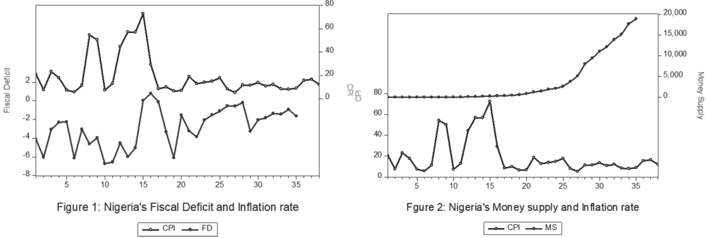
- Annual time-series data for Nigeria covering 1980–2016; variables are CPI (inflation), fiscal deficit as a ratio of GDP, real exchange rate, lending interest rate, and money supply, sourced from the Central Bank of Nigeria Statistical Bulletin and the WDI database.
- Applied unit root tests (ADF, PP, and Vogelsang-Perron structural-break tests), then estimated five ARDL/bounds-test cointegration models, both without and with structural breaks.
- Used Bai-Perron multiple structural break tests to endogenously identify breaks, and then estimated long-run and short-run ARDL/error-correction models; diagnostics reported include F-statistics, adjusted R², Durbin-Watson, Jarque-Bera, ARCH-LM, B-G LM, RESET, CUSUM, and CUSUMSQ.
Limitations
- The paper does not state formal limitations.
- Evident from the text: the data are annual and stop at 2016, so the results may not capture later inflation-fiscal dynamics in Nigeria.
- Evident from the text: some reported tables are incomplete or partially truncated in the provided full text, so not all model details and coefficients are visible here.
Model-written summary. Check it against the paper before relying on it.
Integrity signals
Registry
Cites
Statistics
Figures
Verification
Claims the paper makes
1 Valid · 0 Not valid · 5 Not checked · 33 Own results and interpretations
A result the paper reports from its own data — it cites no other source for it, so there is none to check. The quote shows it is in the paper.
In the paper
“with the inclusion of structural breaks, as specified in the Bai-Perron break test result in Table 3, the conclusion was completely reversed, as there was presence of a long-run relationship among the variables considered in the models.”
boostedstates an association- Asserted: passes — The authors put it forward as true.
- Checkable: passes — It can be checked against evidence.
- Load-bearing: passes — The paper’s conclusions depend on it.
- Based: passes — The paper gives a reason why it holds.
A result the paper reports from its own data — it cites no other source for it, so there is none to check. The quote shows it is in the paper.
In the paper
“The tests identified several breaks in the linear combination of the variables used in this study.”
- Also stated in: § 4. RESULTS AND DISCUSSIONS · plain
“The result shows the several breaks identified by the tests.”
plain- Asserted: passes — The authors put it forward as true.
- Checkable: passes — It can be checked against evidence.
- Load-bearing: passes — The paper’s conclusions depend on it.
- Based: passes — The paper gives a reason why it holds.
- Also stated in: § 4. RESULTS AND DISCUSSIONS · plain
A result the paper reports from its own data — it cites no other source for it, so there is none to check. The quote shows it is in the paper.
In the paper
“evidence of a long-run relationship was found in Model 5.”
plainstates an association- Asserted: passes — The authors put it forward as true.
- Checkable: passes — It can be checked against evidence.
- Load-bearing: unclear — It is unclear whether the paper’s conclusions depend on it.
- Based: passes — The paper gives a reason why it holds.
A result the paper reports from its own data — it cites no other source for it, so there is none to check. The quote shows it is in the paper.
In the paper
“The adjusted R-squared indicates that around 93% of variation in the inflation rate is explained by fiscal deficit, real exchange rate, lending interest rate, and money supply.”
hedgedstates an association- Asserted: passes — The authors put it forward as true.
- Checkable: passes — It can be checked against evidence.
- Load-bearing: unclear — It is unclear whether the paper’s conclusions depend on it.
- Based: passes — The paper gives a reason why it holds.
A result the paper reports from its own data — it cites no other source for it, so there is none to check. The quote shows it is in the paper.
In the paper
“While the Model 2 result was found to be inconclusive”
plain- Asserted: passes — The authors put it forward as true.
- Checkable: passes — It can be checked against evidence.
- Load-bearing: unclear — It is unclear whether the paper’s conclusions depend on it.
- Based: passes — The paper gives a reason why it holds.
17 more claims
Create a free account to see all 39 claims and every source verdict.
- It may state two separate claims as one. 14
- The quote only partly states this claim. 4
- Probably not a substantial claim. 3
Self-check
Percentages, sums and reported differences re-computed from the paper’s own numbers.
Each contradiction between two passages listed here was confirmed by an independent check.
Rated minor: it would not touch a result — a value no result rests on, a p-value that stays on the same side of the significance level, or a conflict that is clerical, resolved elsewhere in the paper, or outside its own findings.
In the paper
§ 3.1 Data
“Since the Jarque-Bera probability values for the variables (with the exception of EXR) are less than 5% the hypothesis of normal distribution cannot be rejected and the series can be regarded as having a normal distribution. However, since the Jarque-Bera probability value for EXR is less than 5% the hypothesis of normal distribution is rejected for EXR.”
§ 3.1 Data
“| (0.152) | (0.406) | (0.858) | (0.000) | (0.110) | (probability) |”
Citations
Cites
Yaşlı Kadınlarda Üreme Sağlığı
Kokanalı, D., & Engin Üstün, Y. (n.d.) · DergiPark (Istanbul University) · Cited by 170,090
Bounds testing approaches to the analysis of level relationships
Pesaran, M. H., Shin, Y., & Smith, R. J. (2001) · Journal of Applied Econometrics · doi:10.1002/jae.616 · Cited by 20,385 · cited 2×
“Following the study by Ouattara (2004), the computed F-statistics provided by Pesaran et al. (2001) are not valid in the presence of I(2) variables because the bounds test is based on the assumption that the variables are I(0) or I(1).”
MethodComputation and analysis of multiple structural change models
Bai, J., & Perron, P. (2003) · Journal of Applied Econometrics · doi:10.1002/jae.659 · Cited by 5,771 · cited 3×
“Regarding the structural break test, Bai and Perron (2003) advocate the determination of multiple breaks among series, rather than the conventional way of determining breaks individually among variables that post a challenge while estimating the variables or while trying to neutralize the effect of the breaks during e…”
BackgroundMethodInfluentialAn Autoregressive Distributed-Lag Modelling Approach to Cointegration Analysis
Pesaran, M. H., & Shin, Y. (2012) · Econometrics and Economic Theory in the 20th Century · doi:10.1017/ccol521633230.011 · Cited by 3,937 · cited 1×
“Sahan and Bektasoglu (2010) observe no long-run relation between inflation and budget deficits, but the relationship changes depending on the developmental level and structural features of the economy.”
BackgroundSome Unpleasant Monetarist Arithmetic
Sargent, T. J. (1981) · Quarterly Review · doi:10.21034/qr.531 · Cited by 1,511
An Autoregressive Distributed-Lag Modelling Approach to Cointegration Analysis
Pesaran, M. H. (2008) · Econometrics and Economic Theory in the 20th Century: The Ragnar Frisch Centennial Symposium · doi:10.1017/ccol0521633230.011 · Cited by 1,484
Monetary policy and price level determinacy in a cash-in-advance economy
Woodford, M. (1994) · Economic Theory · doi:10.1007/bf01215377 · Cited by 753 · cited 2×
“Wosowei (2013) reveals a negative but insignificant relationship between fiscal deficit and gross domestic product.”
BackgroundModern Hyper- and High Inflations
Fischer, S., Sahay, R., & Végh, C. A. (2002) · Journal of Economic Literature · doi:10.1257/002205102760273805 · Cited by 570
Price-level determinacy without control of a monetary aggregate
Woodford, M. (1995) · Carnegie-Rochester Conference Series on Public Policy · doi:10.1016/0167-2231(95)00038-0 · Cited by 472
Long-Term Debt and Optimal Policy in the Fiscal Theory of the Price Level
Cochrane, J. H. (2001) · Econometrica · doi:10.1111/1468-0262.00179 · Cited by 404
Cited by
Sumba, J. O., Ochenge, R. O., Mugambi, P. J., & Musafiri, C. M. (2024) · Cogent Economics & Finance · doi:10.1080/23322039.2024.2326451 · Cited by 22
“For instance, political class is likely not to allow undue inflation and declining economic growth since it would affect the voters attitude and government choice during elections (Fasanya et al., 2021).”
Fasanya, I. O., & Adekoya, O. B. (2022) · Scientific African · doi:10.1016/j.sciaf.2022.e01292 · Cited by 13
Self-citationAladejare, S. A. (2022) · Asian Journal of Economic Modelling · doi:10.55493/5009.v10i1.4454 · Cited by 11
The asymmetry effect of budget deficit and inflation in Nigeria
Garba, A. M. (2023) · Journal of Global Economics and Business · doi:10.58934/jgeb.v4i13.143 · Cited by 11
Zermeño, M. Á. T., Preciado, V. H. T., & Venegas-Martínez, F. (2022) · Investigación Administrativa · doi:10.35426/iav51n129.02 · Cited by 10
“, 2019), fiscal policy variables (Asandului et al., 2021; Bordo and Levy, 2021; Fasanya et al., 2021; Ologbenla, 2019), stock market (Jelilov et al.”
Background
Metadata
- Authors
- Fasanya, I., Fajobi, A., & Adetokunbo, A.
- Affiliations
- University of the Witwatersrand (ZA)
- Federal University of Agriculture, Abeokuta (NG)
- Corresponding author
- Fasanya, Ismail
- Venue
- Economic Annals
- Publisher
- National Library of Serbia
- Published
- 2021
- Volume
- 66
- Issue
- 228
- Pages
- 123-147
- ISSN
- 0013-3264 (ISSN-L)
- 1820-7375
- OpenAlex
- W3150471248
- Cited by
- 8
- References
- 50
- Citations by year
- 2026: 1 · 2024: 2 · 2023: 2 · 2022: 3
- FWCI
- 2.65
- Type
- journal article
- Language
- en
- Open access
- diamond
- doi.org
- Licence
- Locations
- Economic Annals (publishedVersion, cc-by-nc-nd)
- RePEc: Research Papers in Economics (submittedVersion)
- DOAJ (DOAJ: Directory of Open Access Journals) (submittedVersion, cc-by-sa)
- Topics
- Social Sciences › Economics, Econometrics and Finance › General Economics, Econometrics and Finance › Monetary Policy and Economic Impact
- Social Sciences › Economics, Econometrics and Finance › Economics and Econometrics › Fiscal Policies and Political Economy
- Social Sciences › Economics, Econometrics and Finance › Economics and Econometrics › Economic and Fiscal Studies
- Keywords
- budget deficit, inflation, Nigeria, structural breaks, Bai-Perron test, ARDL bounds testing, fiscal management, macroeconomic determinants of inflation
About these checks
Registry, retraction, Cites and statistics results are computed, not judged, with one exception: a printed reference that no index lists is read once by a model before it counts as a citation error. Claims are extracted by a model and kept only when their quote appears verbatim in the text; each cited source is then checked, with a model’s help, for whether it says what the claim relies on. Those verdicts can be wrong — read the claim’s quote and the cited source before relying on one.
A language model drew the claims from the paper on 2026-10-10, under version 3 of the claim definition (model deepseek-v4.1-flash, prompt extract-v3).
A second model labelled each claim on 2026-10-10 (model jev-1.13-20260917, definition revision gold-guideline-v0.2).
Statistics and arithmetic are recomputed, not judged.
Confidence bands are shown only for fields calibrated on our annotated test set. None is calibrated yet, so no band is shown.
What counts as a claim ›How we measure confidence ›How we check this ›
Are you an author, or do you see a problem with this page? Request a review
How to cite
Cite CoChat for the checks on this page, and the paper for its own findings.
- This page
- CoChat. (2026). Citation check: Are fiscal deficits inflationary in Nigeria? New evidence from bounds testing to cointegration with structural breaks. https://app.cochat.ai/papers/10.2298/eka2128123f
- The paper
- Fasanya, I., Fajobi, A., & Adetokunbo, A. (2021). Are fiscal deficits inflationary in Nigeria? New evidence from bounds testing to cointegration with structural breaks. Economic Annals. https://doi.org/10.2298/eka2128123f
Data sources
Bibliographic data: Semantic Scholar, OpenAlex, Crossref.
Contains information from the Semantic Scholar Academic Graph Datasets, made available under the ODC Attribution License (ODC-BY 1.0).
Semantic Scholar’s data is described in: Kinney, R., et al. (2023). The Semantic Scholar Open Data Platform. arXiv:2301.10140.
