

Randomized Trial of the Effect of Mindfulness-Based Stress Reduction on Pain-Related Disability, Pain Intensity, Health-Related Quality of Life, and A1C in Patients With Painful Diabetic Peripheral Neuropathy
Open accessThe DOI matches its Crossref record; 38 of the 39 references it cites were found in a registry or an index.
Abstract
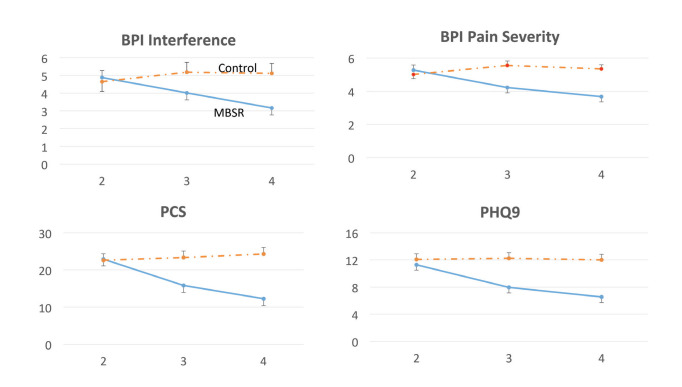
Painful diabetic peripheral neuropathy (PDPN) has a large negative impact on patients' physical and mental functioning, and pharmacological therapies rarely provide more than partial relief. Mindfulness-based stress reduction (MBSR) is a group psychosocial intervention that was developed for patients with chronic illness who were not responding to existing medical treatments. This study tested the effects of community-based MBSR courses for patients with PDPN. Among patients whose PDPN pharmacotherapy had been optimized in a chronic pain clinic, those randomly assigned to treatment with MBSR experienced improved function, better health-related quality of life, and reduced pain intensity, pain catastrophizing, and depression compared to those receiving usual care.
Overview
The claims and statistics of this paper haven’t been checked yet.
Free: it reads the open-access text and checks the first 5 claims that cite a source we can check. Create a free account to check every claim.
Integrity signals
Registry
Cites
Statistics
Figures
Verification
Claims the paper makes
The claims and statistics of this paper haven’t been checked yet.
Free: it reads the open-access text and checks the first 5 claims that cite a source we can check. Create a free account to check every claim.
Claims other papers make about this one
Each is checked against this paper’s own text: does it say what the citing paper says it does?
The cited source says what the claim attributes to it.
In the citing paper
“Encouragingly, the benefits of MBI for psychological disorders have been found in people with diabetes 12 , 13 , 14 .”
From Effects of mindfulness-based intervention on glycemic control and psychological outcomes in people with diabetes: a systematic review and meta-analysis (2021) · cites this paper as [14]
The cited source says what the claim attributes to it.
In the citing paper
“Five studies carried out intention‐to‐treat analysis, Six studies 12 , 13 , 14 , 27 , 33 , 41 reported attrition rates of <20%, and two studies 26 , 40 reported attrition rates of >20%, but no significant difference between groups regarding attrition rates.”
From Effects of mindfulness-based intervention on glycemic control and psychological outcomes in people with diabetes: a systematic review and meta-analysis (2021) · cites this paper as [14]
The cited source says what the claim attributes to it.
In the citing paper
“Seven studies detailed their random sequence generation process, and four studies carried out allocation concealment 12 , 14 , 27 , 40 .”
From Effects of mindfulness-based intervention on glycemic control and psychological outcomes in people with diabetes: a systematic review and meta-analysis (2021) · cites this paper as [14]
In the citing paper
“In this case, once chronic pain had been medically managed as best as possible, mindfulness training added value over usual care in terms of further reducing pain intensity and improving coping, functioning, and quality of life.”
From Mindfulness and physical disease: a concise review (2019) · cites this paper as [27]
In the citing paper
“Three studies blinded the outcome assessors and were rated a low risk of detection bias 14 , 27 , 40 .”
From Effects of mindfulness-based intervention on glycemic control and psychological outcomes in people with diabetes: a systematic review and meta-analysis (2021) · cites this paper as [14]
1 more claim about this paper
Create a free account to see every claim other papers make about this one.
Self-check
Percentages, sums and reported differences re-computed from the paper’s own numbers.
The self-check needs the paper’s full text.
Citations
Cites
WARE, J. E., KOSINSKI, M., & KELLER, S. D. (1996) · Medical Care · doi:10.1097/00005650-199603000-00003 · Cited by 17,392
International Diabetes Federation 2017
Carracher, A. M., Marathe, P. H., & Close, K. L. (2018) · Journal of Diabetes · doi:10.1111/1753-0407.12644 · Cited by 13,418
The Pain Catastrophizing Scale: Development and validation.
Sullivan, M. J. L., Bishop, S. R., & Pivik, J. (1995) · Psychological Assessment · doi:10.1037//1040-3590.7.4.524 · Cited by 8,227 · cited 2×
“• The Pain Catastrophizing Scale (PCS) (22), a well-validated 13-item instrument designed to evaluate the degree to which patients have negative self-statements and catastrophizing thoughts and ideations when in pain.”
BackgroundFarrar, J. T., Young, J. P., LaMoreaux, L., Werth, J. L., & Poole, M. R. (2001) · Pain · doi:10.1016/s0304-3959(01)00349-9 · Cited by 5,808
Kabat-Zinn, J. (1982) · General Hospital Psychiatry · doi:10.1016/0163-8343(82)90026-3 · Cited by 4,255 · cited 1×
“Mindfulness-based stress reduction (MBSR) is a group psychosocial intervention that was first developed by Kabat-Zinn (9) for patients with chronic illness who were not responding to existing medical treatments.”
BackgroundPharmacotherapy for neuropathic pain in adults: a systematic review and meta-analysis
Finnerup, N. B., Attal, N., Haroutounian, S., McNicol, E., Baron, R., Dworkin, R. H., Gilron, I., Haanpää, M., Hansson, P., Jensen, T. S., et al. (2015) · The Lancet Neurology · doi:10.1016/s1474-4422(14)70251-0 · Cited by 3,980
Self-citationDworkin, R. H., Turk, D. C., Wyrwich, K. W., Beaton, D., Cleeland, C. S., Farrar, J. T., Haythornthwaite, J. A., Jensen, M. P., Kerns, R. D., Ader, D. N., et al. (2008) · The Journal of Pain · doi:10.1016/j.jpain.2007.09.005 · Cited by 3,471
The biopsychosocial approach to chronic pain: Scientific advances and future directions.
Gatchel, R. J., Peng, Y. B., Peters, M. L., Fuchs, P. N., & Turk, D. C. (2007) · Psychological Bulletin · doi:10.1037/0033-2909.133.4.581 · Cited by 3,392 · cited 1×
“This finding supports the biopsychosocial model of pain (37), which postulates that the pain experienced by a patient depends on affective-motivational and cognitive-evaluative processes in the central nervous system and not only on the degree of nociceptor activation.”
ResultSearle, S. R., & Searle, S. R. (1971) · Cited by 3,229
The summary of diabetes self-care activities measure: results from 7 studies and a revised scale.
Toobert, D. J., Hampson, S. E., & Glasgow, R. E. (2000) · Diabetes Care · doi:10.2337/diacare.23.7.943 · Cited by 2,561 · cited 4×
“Severe pain (n [%]) 17 (27) 8 (25) 9 (30)”
MethodInfluential
Research works printed but not linked: 1
- National Institute for Health and Care Excellence Neuropathic pain in adults: pharmacological management in non-specialist settings (NICE clinical guideline 173). Available from https://www.nice.org.uk/guidance/cg173/chapter/1-recommendations?unlid=773239836201724223722. Accessed 5 February 2017 31961628
Cited by
Moisset, X., Bouhassira, D., Avez Couturier, J., Alchaar, H., Conradi, S., Delmotte, M. H., Lanteri-Minet, M., Lefaucheur, J. P., Mick, G., Piano, V., et al. (2020) · Revue Neurologique · doi:10.1016/j.neurol.2020.01.361 · Cited by 450
Mindfulness and physical disease: a concise review
Greeson, J. M., & Chin, G. R. (2019) · Current Opinion in Psychology · doi:10.1016/j.copsyc.2018.12.014 · Cited by 85
İzgü, N., Metin, Z. G., Karadaş, C., Özdemir, L., Metinarikan, N., & Çorapçıoğlu, D. (2020) · Journal of Nursing Scholarship · doi:10.1111/jnu.12580 · Cited by 78
Ni, Y., Ma, L., & Li, J. (2021) · Journal of Diabetes Investigation · doi:10.1111/jdi.13439 · Cited by 59
Fisher, V., Li, W. W., & Malabu, U. H. (2023) · Applied Psychology Health and Well-Being · doi:10.1111/aphw.12441 · Cited by 74
Metadata
- Authors
- Nathan, H. J., Poulin, P., Wozny, D., Taljaard, M., Smyth, C., Gilron, I., Sorisky, A., Lochnan, H., & Shergill, Y.
- Affiliations
- University of Ottawa (CA)
- Ottawa Hospital Research Institute (CA)
- Queen's University (CA)
- Ottawa Hospital Research Institute, Ottawa, Ontario, Canada
- Corresponding author
- Nathan, Howard J.
- Venue
- Clinical Diabetes
- Publisher
- American Diabetes Association
- Published
- 2017-12-01
- Volume
- 35
- Issue
- 5
- Pages
- 294-304
- ISSN
- 0891-8929 (ISSN-L)
- 1945-4953
- PMC
- PMC5734176
- OpenAlex
- W2771252002
- Cited by
- 61
- References
- 39
- Citations by year
- 2026: 7 · 2025: 1 · 2024: 7 · 2023: 7 · 2022: 9 · 2021: 7 · 2020: 12 · 2019: 8 · 2018: 2
- FWCI
- 7.46
- Type
- journal article
- Language
- en
- Open access
- hybrid
- doi.org
- Licence
- Locations
- Clinical Diabetes (publishedVersion, cc-by-nc-nd)
- Europe PMC (PubMed Central) (publishedVersion, cc-by-nc-nd)
- PubMed Central (publishedVersion, cc-by-nc-nd)
- PubMed (publishedVersion)
- Funders
- University of Ottawa
- Topics
- Social Sciences › Psychology › Clinical Psychology › Mindfulness and Compassion Interventions
- Health Sciences › Medicine › Physiology (medical) › Pain Mechanisms and Treatments
- Health Sciences › Medicine › Anesthesiology and Pain Medicine › Pain Management and Treatment
- Keywords
- mindfulness-based stress reduction, diabetic neuropathic pain, chronic pain, pain-related disability, health-related quality of life, pain intensity, pain catastrophizing, depression, psychosocial interventions, glycemic control, HbA1c
About these checks
Registry, retraction, Cites and statistics results are computed, not judged, with one exception: a printed reference that no index lists is read once by a model before it counts as a citation error. Claims are extracted by a model and kept only when their quote appears verbatim in the text; each cited source is then checked, with a model’s help, for whether it says what the claim relies on. Those verdicts can be wrong — read the claim’s quote and the cited source before relying on one.
Statistics and arithmetic are recomputed, not judged.
Confidence bands are shown only for fields calibrated on our annotated test set. None is calibrated yet, so no band is shown.
What counts as a claim ›How we measure confidence ›How we check this ›
Are you an author, or do you see a problem with this page? Request a review
How to cite
Cite CoChat for the checks on this page, and the paper for its own findings.
- This page
- CoChat. (2026). Citation check: Randomized Trial of the Effect of Mindfulness-Based Stress Reduction on Pain-Related Disability, Pain Intensity, Health-Related Quality of Life, and A1C in Patients With Painful Diabetic Peripheral Neuropathy. https://app.cochat.ai/papers/10.2337/cd17-0077
- The paper
- Nathan, H. J., Poulin, P., Wozny, D., Taljaard, M., Smyth, C., Gilron, I., Sorisky, A., Lochnan, H., & Shergill, Y. (2017). Randomized Trial of the Effect of Mindfulness-Based Stress Reduction on Pain-Related Disability, Pain Intensity, Health-Related Quality of Life, and A1C in Patients With Painful Diabetic Peripheral Neuropathy. Clinical Diabetes. https://doi.org/10.2337/cd17-0077
Data sources
Bibliographic data: Semantic Scholar, OpenAlex, Crossref.
Contains information from the Semantic Scholar Academic Graph Datasets, made available under the ODC Attribution License (ODC-BY 1.0).
Semantic Scholar’s data is described in: Kinney, R., et al. (2023). The Semantic Scholar Open Data Platform. arXiv:2301.10140.
