

Association among acrylamide, blood insulin, and insulin resistance in adults.
Open accessThe DOI matches its Crossref record; 21 of the 21 references it cites were found in a registry or an index.
Abstract
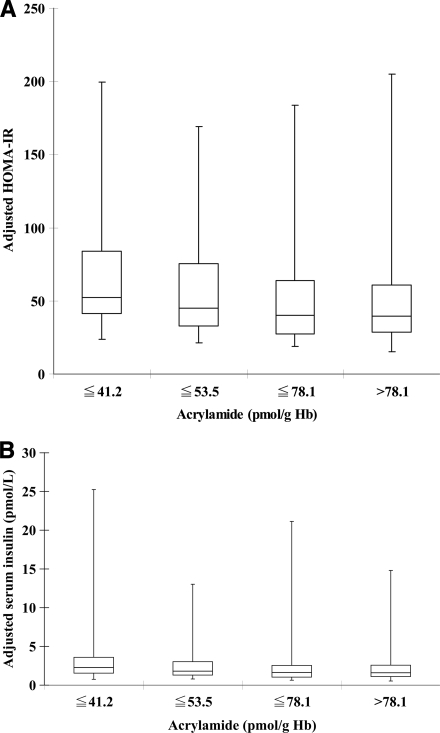
OBJECTIVE: Exposure to acrylamide in foodstuffs and smoking has become a worldwide concern. The effect of acrylamide on glucose homeostasis is not known. The goal of the present study was to test the hypothesis that trace acrylamide exposure might be independently associated with both reduced blood insulin and reduced insulin resistance. RESEARCH DESIGN AND METHODS: We examined 1,356 participants with reliable measures of glucose homeostasis and Hb adducts of acrylamide (HbAA) and glycidamide from the National Health and Nutrition Examination Survey, 2003-2004. Glucose homeostasis was assessed by the measurement of plasma glucose, serum insulin, and the homeostasis model assessment of insulin resistance (HOMA-IR). RESULTS: In a linear regression model, a 1-unit increase in log HbAA was associated with a decrease in serum insulin (beta coefficient = -0.20 +/- 0.05, P = 0.001) and HOMA-IR (beta coefficient = -0.23 +/- 0.05, P < 0.001). After HbAA concentrations were divided into quartiles in the fully adjusted models, the adjusted serum insulin level and HOMA-IR significantly decreased across quartiles of HbAA (P(trend) < 0.001 for both). In subgroup analysis, the association of HbAA levels with HOMA-IR and insulin levels was stronger in subjects who were white or had ever smoked or in subjects with a lower education level or a BMI <25 or >30 kg/m(2). CONCLUSIONS: Acrylamide is associated with reduced serum insulin levels in adults. Further clinical and animal studies are warranted to clarify the putative causal relationship.
Overview
The claims and statistics of this paper haven’t been checked yet.
Free: it reads the open-access text and checks the first 5 claims that cite a source we can check. Create a free account to check every claim.
Integrity signals
Registry
Cites
Statistics
Figures
Verification
Claims the paper makes
The claims and statistics of this paper haven’t been checked yet.
Free: it reads the open-access text and checks the first 5 claims that cite a source we can check. Create a free account to check every claim.
Claims other papers make about this one
Each is checked against this paper’s own text: does it say what the citing paper says it does?
The check wasn’t confident either way, so it gives no verdict — never disputed.
In the citing paper
“In particular, the exposure to bisphenol-A (BPA), a hydrophobic substance of very high concern, 66 having endocrine disrupting properties, as well as high BPA serum concentrations, have been associated with increased T2D risk in recent meta-analyses.29,67”
From Ultraprocessed Food Consumption and Risk of Type 2 Diabetes Among Participants of the NutriNet-Santé Prospective Cohort (2020) · cites this paper as [66]
Experimental — accuracy not yet measuredIn the citing paper
“Moreover, 2 meta-analyses observed associations between T2D risk and the intakes of nonnutritive sweeteners and artificially sweetened beverages.28,66”
From Ultraprocessed Food Consumption and Risk of Type 2 Diabetes Among Participants of the NutriNet-Santé Prospective Cohort (2020) · cites this paper as [66]
Self-check
Percentages, sums and reported differences re-computed from the paper’s own numbers.
The self-check needs the paper’s full text.
Citations
Cites
IARC Monographs on the Evaluation of Carcinogenic Risks to Humans
Zuckerman, A. J. (1995) · Journal of Clinical Pathology · doi:10.1136/jcp.48.7.691-a · Cited by 8,728
Use and Abuse of HOMA Modeling
Wallace, T. M., Levy, J. C., & Matthews, D. R. (2004) · Diabetes Care · doi:10.2337/diacare.27.6.1487 · Cited by 5,114 · cited 2×
“Because the homeostasis model assessment for insulin resistance (HOMA-IR) is a reliable surrogate measure of insulin resistance (16), we can use fasting glucose and insulin concentrations to accurately estimate insulin resistance status.”
MethodGlutathione Metabolism and Its Implications for Health
Wu, G., Lupton, J. R., Turner, N. D., Fang, Y.-Z., & Yang, S. (2004) · The Journal of Nutrition · doi:10.1093/jn/134.3.489 · Cited by 3,842 · cited 1×
“Nutritional status, particularly amino acid balance, has an important effect on glutathione homeostasis (25), which may be relevant in detoxification.”
BackgroundAnalysis of Acrylamide, a Carcinogen Formed in Heated Foodstuffs
Tareke, E., Rydberg, P., Karlsson, P., Eriksson, S., & Törnqvist, M. (2002) · Journal of Agricultural and Food Chemistry · doi:10.1021/jf020302f · Cited by 2,215 · cited 1×
“(2) in 2002, and subsequent biochemical analysis showed that heating of free amino acids (asparagines) and sugars during food processing at 248°F (120°C) resulted in the formation of acrylamide concentrations of up to 1 mg/kg food (3).”
BackgroundArsenic Exposure and Prevalence of Type 2 Diabetes in US Adults
Navas-Acien, A. (2008) · JAMA · doi:10.1001/jama.300.7.814 · Cited by 467 · cited 1×
“1–10, or 10 ng/ml) in the same manner as in a previous study (19).”
ResultMcManus, M. (1994) · PubMed · Cited by 397
Protein adducts: quantitative and qualitative aspects of their formation, analysis and applications
Törnqvist, M., Fred, C., Haglund, J., Helleberg, H., Paulsson, B., & Rydberg, P. (2002) · Journal of Chromatography B · doi:10.1016/s1570-0232(02)00172-1 · Cited by 332 · cited 2×
“Hb adducts reflect an integrated concentration over 4 months (8); therefore, these adducts are useful as predictors of toxicity.”
BackgroundAcrylamide: Review of Toxicity Data and Dose-Response Analyses for Cancer and Noncancer Effects
Shipp, A., Lawrence, G., Gentry, R., McDonald, T., Bartow, H., Bounds, J., Macdonald, N., Clewell, H., Allen, B., & Van Landingham, C. (2006) · Critical Reviews in Toxicology · doi:10.1080/10408440600851377 · Cited by 305 · cited 2×
“The biological consequences of acrylamide exposure have chiefly centered on neurotoxicity ever since this effect was observed in humans exposed to this compound in the workplace (9).”
BackgroundHogervorst, J. G., Schouten, L. J., Konings, E. J., Goldbohm, R. A., & van den Brandt, P. A. (2007) · Cancer Epidemiology, Biomarkers & Prevention · doi:10.1158/1055-9965.epi-07-0581 · Cited by 305
Tobacco Smoke Exposure Is Associated With the Metabolic Syndrome in Adolescents
Weitzman, M., Cook, S., Auinger, P., Florin, T. A., Daniels, S., Nguyen, M., & Winickoff, J. P. (2005) · Circulation · doi:10.1161/circulationaha.104.520650 · Cited by 272 · cited 1×
“Smoking status was categorized as active smoker, former smoker, and nonsmoker by a questionnaire on smoking (18).”
Background
Cited by
Srour, B., Fezeu, L. K., Kesse-Guyot, E., Allès, B., Debras, C., Druesne-Pecollo, N., Chazelas, E., Deschasaux, M., Hercberg, S., Galan, P., et al. (2020) · JAMA Internal Medicine · doi:10.1001/jamainternmed.2019.5942 · Cited by 465
Ultra-processed foods and human health: from epidemiological evidence to mechanistic insights
Srour, B., Kordahi, M. C., Bonazzi, E., Deschasaux-Tanguy, M., Touvier, M., & Chassaing, B. (2022) · The Lancet Gastroenterology & Hepatology · doi:10.1016/s2468-1253(22)00169-8 · Cited by 303
“102,103 Furthermore, bisphenols were associated with increased risks of cardiovascular disease, 104 cancer, 105 type 2 diabetes, 106 and obesity.”
BackgroundUltra-processed food consumption and type 2 diabetes incidence: A prospective cohort study
Levy, R. B., Rauber, F., Chang, K., Louzada, M. L. D. C., Monteiro, C. A., Millett, C., & Vamos, E. P. (2021) · Clinical Nutrition · doi:10.1016/j.clnu.2020.12.018 · Cited by 223
Pedersen, M., von Stedingk, H., Botsivali, M., Agramunt, S., Alexander, J., Brunborg, G., Chatzi, L., Fleming, S., Fthenou, E., Granum, B. B., et al. (2012) · Environmental Health Perspectives · doi:10.1289/ehp.1205327 · Cited by 124
Moradi, S., Hojjati Kermani, M. A., Bagheri, R., Mohammadi, H., Jayedi, A., Lane, M. M., Asbaghi, O., Mehrabani, S., & Suzuki, K. (2021) · Nutrients · doi:10.3390/nu13124410 · Cited by 116
Metadata
- Authors
- Lin, C.-Y., Lin, Y.-C., Kuo, H.-K., Hwang, J.-J., Lin, J.-L., Chen, P.-C., & Lin, L.-Y.
- Affiliations
- Fu Jen Catholic University (TW)
- National Taiwan University (TW)
- National Taiwan University Hospital (TW)
- Corresponding author
- Chen, Pau-Chung
- Lin, Lian-Yu
- Venue
- Diabetes Care
- Publisher
- American Diabetes Association
- Published
- 2009-09-03
- Volume
- 32
- Issue
- 12
- Pages
- 2206-2211
- ISSN
- 0149-5992 (ISSN-L)
- 1935-5548
- PMC
- PMC2782978
- OpenAlex
- W2164448435
- Cited by
- 80
- References
- 21
- Citations by year
- 2026: 6 · 2025: 7 · 2024: 4 · 2023: 9 · 2022: 12 · 2021: 15 · 2020: 6 · 2019: 4 · 2018: 6 · 2017: 4 · 2016: 1 · 2015: 1 · 2013: 2 · 2012: 2
- FWCI
- 1.59
- Type
- journal article
- Language
- en
- Open access
- hybrid
- doi.org
- Licence
- Locations
- Diabetes Care (publishedVersion, cc-by-nc-nd)
- PubMed Central (publishedVersion, cc-by-nc-nd)
- PubMed (publishedVersion)
- Funders
- Centers for Disease Control and Prevention
- Topics
- Life Sciences › Agricultural and Biological Sciences › Food Science › Potato Plant Research
- Life Sciences › Biochemistry, Genetics and Molecular Biology › Clinical Biochemistry › Advanced Glycation End Products research
- Health Sciences › Medicine › Endocrinology, Diabetes and Metabolism › Diabetes, Cardiovascular Risks, and Lipoproteins
- Keywords
- acrylamide, blood insulin, insulin resistance, glycidamide, glucose homeostasis, smoking, dietary exposure, HOMA-IR, obesity, educational attainment
- MeSH terms
- Acrylamides, Adult, Aged, Alcohol Drinking, Blood Glucose, C-Reactive Protein, Educational Status, Environmental Exposure, Female, Hemoglobin A, Humans, Insulin, Insulin Resistance, Lipids, Male, Middle Aged, Nutrition Surveys, Nutritional Status, Regression Analysis, United States, Body Mass Index, Young Adult
About these checks
Registry, retraction, Cites and statistics results are computed, not judged, with one exception: a printed reference that no index lists is read once by a model before it counts as a citation error. Claims are extracted by a model and kept only when their quote appears verbatim in the text; each cited source is then checked, with a model’s help, for whether it says what the claim relies on. Those verdicts can be wrong — read the claim’s quote and the cited source before relying on one.
Statistics and arithmetic are recomputed, not judged.
Confidence bands are shown only for fields calibrated on our annotated test set. None is calibrated yet, so no band is shown.
What counts as a claim ›How we measure confidence ›How we check this ›
Are you an author, or do you see a problem with this page? Request a review
Data sources
Bibliographic data: Semantic Scholar, OpenAlex, Crossref.
Contains information from the Semantic Scholar Academic Graph Datasets, made available under the ODC Attribution License (ODC-BY 1.0).
Semantic Scholar’s data is described in: Kinney, R., et al. (2023). The Semantic Scholar Open Data Platform. arXiv:2301.10140.
