

Association among acrylamide, blood insulin, and insulin resistance in adults.
Open accessThe DOI matches its Crossref record; 21 of the 21 references it cites were found in a registry or an index.
Abstract
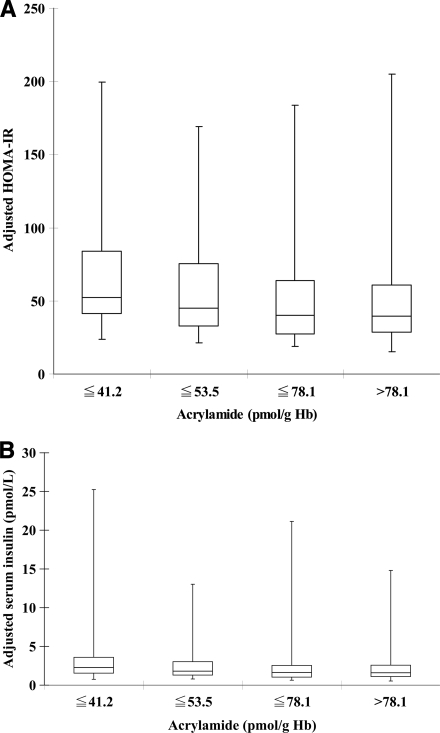
OBJECTIVE: Exposure to acrylamide in foodstuffs and smoking has become a worldwide concern. The effect of acrylamide on glucose homeostasis is not known. The goal of the present study was to test the hypothesis that trace acrylamide exposure might be independently associated with both reduced blood insulin and reduced insulin resistance. RESEARCH DESIGN AND METHODS: We examined 1,356 participants with reliable measures of glucose homeostasis and Hb adducts of acrylamide (HbAA) and glycidamide from the National Health and Nutrition Examination Survey, 2003-2004. Glucose homeostasis was assessed by the measurement of plasma glucose, serum insulin, and the homeostasis model assessment of insulin resistance (HOMA-IR). RESULTS: In a linear regression model, a 1-unit increase in log HbAA was associated with a decrease in serum insulin (beta coefficient = -0.20 +/- 0.05, P = 0.001) and HOMA-IR (beta coefficient = -0.23 +/- 0.05, P < 0.001). After HbAA concentrations were divided into quartiles in the fully adjusted models, the adjusted serum insulin level and HOMA-IR significantly decreased across quartiles of HbAA (P(trend) < 0.001 for both). In subgroup analysis, the association of HbAA levels with HOMA-IR and insulin levels was stronger in subjects who were white or had ever smoked or in subjects with a lower education level or a BMI <25 or >30 kg/m(2). CONCLUSIONS: Acrylamide is associated with reduced serum insulin levels in adults. Further clinical and animal studies are warranted to clarify the putative causal relationship.
Overview
The claims and statistics of this paper haven’t been checked yet.
Free: it reads the open-access text and checks the first 5 claims that cite a source we can check. Create a free account to check every claim.
Integrity signals
Registry
Cites
Statistics
Figures
Verification
Claims the paper makes
The claims and statistics of this paper haven’t been checked yet.
Free: it reads the open-access text and checks the first 5 claims that cite a source we can check. Create a free account to check every claim.
Claims other papers make about this one
Each is checked against this paper’s own text: does it say what the citing paper says it does?
The check wasn’t confident either way, so it gives no verdict — never disputed.
In the citing paper
“In particular, the exposure to bisphenol-A (BPA), a hydrophobic substance of very high concern, 66 having endocrine disrupting properties, as well as high BPA serum concentrations, have been associated with increased T2D risk in recent meta-analyses.29,67”
From Ultraprocessed Food Consumption and Risk of Type 2 Diabetes Among Participants of the NutriNet-Santé Prospective Cohort (2020) · cites this paper as [66]
Experimental — accuracy not yet measuredIn the citing paper
“Moreover, 2 meta-analyses observed associations between T2D risk and the intakes of nonnutritive sweeteners and artificially sweetened beverages.28,66”
From Ultraprocessed Food Consumption and Risk of Type 2 Diabetes Among Participants of the NutriNet-Santé Prospective Cohort (2020) · cites this paper as [66]
Self-check
Percentages, sums and reported differences re-computed from the paper’s own numbers.
The self-check needs the paper’s full text.
Citations
Cites
IARC Monographs on the Evaluation of Carcinogenic Risks to Humans
Zuckerman, A. J. (1995) · Journal of Clinical Pathology · doi:10.1136/jcp.48.7.691-a · Cited by 8,728
Use and Abuse of HOMA Modeling
Wallace, T. M., Levy, J. C., & Matthews, D. R. (2004) · Diabetes Care · doi:10.2337/diacare.27.6.1487 · Cited by 5,114 · cited 2×
“Because the homeostasis model assessment for insulin resistance (HOMA-IR) is a reliable surrogate measure of insulin resistance (16), we can use fasting glucose and insulin concentrations to accurately estimate insulin resistance status.”
MethodGlutathione Metabolism and Its Implications for Health
Wu, G., Lupton, J. R., Turner, N. D., Fang, Y.-Z., & Yang, S. (2004) · The Journal of Nutrition · doi:10.1093/jn/134.3.489 · Cited by 3,842 · cited 1×
“Nutritional status, particularly amino acid balance, has an important effect on glutathione homeostasis (25), which may be relevant in detoxification.”
BackgroundAnalysis of Acrylamide, a Carcinogen Formed in Heated Foodstuffs
Tareke, E., Rydberg, P., Karlsson, P., Eriksson, S., & Törnqvist, M. (2002) · Journal of Agricultural and Food Chemistry · doi:10.1021/jf020302f · Cited by 2,215 · cited 1×
“(2) in 2002, and subsequent biochemical analysis showed that heating of free amino acids (asparagines) and sugars during food processing at 248°F (120°C) resulted in the formation of acrylamide concentrations of up to 1 mg/kg food (3).”
BackgroundArsenic Exposure and Prevalence of Type 2 Diabetes in US Adults
Navas-Acien, A. (2008) · JAMA · doi:10.1001/jama.300.7.814 · Cited by 467 · cited 1×
“1–10, or 10 ng/ml) in the same manner as in a previous study (19).”
ResultMcManus, M. (1994) · PubMed · Cited by 397
Protein adducts: quantitative and qualitative aspects of their formation, analysis and applications
Törnqvist, M., Fred, C., Haglund, J., Helleberg, H., Paulsson, B., & Rydberg, P. (2002) · Journal of Chromatography B · doi:10.1016/s1570-0232(02)00172-1 · Cited by 332 · cited 2×
“Hb adducts reflect an integrated concentration over 4 months (8); therefore, these adducts are useful as predictors of toxicity.”
BackgroundAcrylamide: Review of Toxicity Data and Dose-Response Analyses for Cancer and Noncancer Effects
Shipp, A., Lawrence, G., Gentry, R., McDonald, T., Bartow, H., Bounds, J., Macdonald, N., Clewell, H., Allen, B., & Van Landingham, C. (2006) · Critical Reviews in Toxicology · doi:10.1080/10408440600851377 · Cited by 305 · cited 2×
“The biological consequences of acrylamide exposure have chiefly centered on neurotoxicity ever since this effect was observed in humans exposed to this compound in the workplace (9).”
BackgroundHogervorst, J. G., Schouten, L. J., Konings, E. J., Goldbohm, R. A., & van den Brandt, P. A. (2007) · Cancer Epidemiology, Biomarkers & Prevention · doi:10.1158/1055-9965.epi-07-0581 · Cited by 305
Tobacco Smoke Exposure Is Associated With the Metabolic Syndrome in Adolescents
Weitzman, M., Cook, S., Auinger, P., Florin, T. A., Daniels, S., Nguyen, M., & Winickoff, J. P. (2005) · Circulation · doi:10.1161/circulationaha.104.520650 · Cited by 272 · cited 1×
“Smoking status was categorized as active smoker, former smoker, and nonsmoker by a questionnaire on smoking (18).”
Background
Cited by
Srour, B., Fezeu, L. K., Kesse-Guyot, E., Allès, B., Debras, C., Druesne-Pecollo, N., Chazelas, E., Deschasaux, M., Hercberg, S., Galan, P., et al. (2020) · JAMA Internal Medicine · doi:10.1001/jamainternmed.2019.5942 · Cited by 465
Ultra-processed foods and human health: from epidemiological evidence to mechanistic insights
Srour, B., Kordahi, M. C., Bonazzi, E., Deschasaux-Tanguy, M., Touvier, M., & Chassaing, B. (2022) · The Lancet Gastroenterology & Hepatology · doi:10.1016/s2468-1253(22)00169-8 · Cited by 303
“102,103 Furthermore, bisphenols were associated with increased risks of cardiovascular disease, 104 cancer, 105 type 2 diabetes, 106 and obesity.”
BackgroundUltra-processed food consumption and type 2 diabetes incidence: A prospective cohort study
Levy, R. B., Rauber, F., Chang, K., Louzada, M. L. D. C., Monteiro, C. A., Millett, C., & Vamos, E. P. (2021) · Clinical Nutrition · doi:10.1016/j.clnu.2020.12.018 · Cited by 223
Pedersen, M., von Stedingk, H., Botsivali, M., Agramunt, S., Alexander, J., Brunborg, G., Chatzi, L., Fleming, S., Fthenou, E., Granum, B. B., et al. (2012) · Environmental Health Perspectives · doi:10.1289/ehp.1205327 · Cited by 124
Moradi, S., Hojjati Kermani, M. A., Bagheri, R., Mohammadi, H., Jayedi, A., Lane, M. M., Asbaghi, O., Mehrabani, S., & Suzuki, K. (2021) · Nutrients · doi:10.3390/nu13124410 · Cited by 116
Louzada, M. L. D. C., Costa, C. D. S., Souza, T. N., da Cruz, G. L., Levy, R. B., & Monteiro, C. A. (2021) · Cadernos de Saúde Pública · doi:10.1590/0102-311x00323020 · Cited by 295
Bayesian shrinkage estimation of high dimensional causal mediation effects in omics studies
Song, Y., Zhou, X., Zhang, M., Zhao, W., Liu, Y., Kardia, S. L. R., Roux, A. V. D., Needham, B. L., Smith, J. A., & Mukherjee, B. (2019) · Biometrics · doi:10.1111/biom.13189 · Cited by 99
Impact of ultra-processed food consumption on metabolic health
de Miranda, R. C., Rauber, F., & Levy, R. B. (2020) · Current Opinion in Lipidology · doi:10.1097/mol.0000000000000728 · Cited by 80
Hazardous effects of acrylamide on immature male and female rats
Rawi, S. M. (2012) · African Journal of Pharmacy and Pharmacology · doi:10.5897/ajpp12.148 · Cited by 65
“…and exhibit strongly positive correlation with the experimental time after ACR treatment, these results are confirmed by the reports of Lin et al. (2009); they attributed the increase in serum glucose level to a decrease in blood insulin and insulin resistance status, which is…”
BackgroundThe role of ultra-processed food in obesity
Juul, F., Steele, E. M., Parekh, N., & Monteiro, C. A. (2025) · Nature Reviews Endocrinology · doi:10.1038/s41574-025-01143-7 · Cited by 86
“Acryla-mide has been associated with insulin resistance, adiposity and cardio-vascular disease in human epidemiological studies 117–119 and has been shown to induce adipocyte differentiation and obesity in mice 120 .”
Quan, W., Zeng, M., Ye, J., Li, Y., Xue, C., Liu, G., Wang, Z., Qin, F., He, Z., & Chen, J. (2020) · Advances in Nutrition · doi:10.1093/advances/nmaa184 · Cited by 69
Huang, M., Zhuang, P., Jiao, J., Wang, J., & Zhang, Y. (2018) · The Science of The Total Environment · doi:10.1016/j.scitotenv.2018.02.338 · Cited by 48
Hemoglobin adducts of acrylamide in human blood – What has been done and what is next?
Pedersen, M., Vryonidis, E., Joensen, A., & Törnqvist, M. (2022) · Food and Chemical Toxicology · doi:10.1016/j.fct.2021.112799 · Cited by 49
Negative association between acrylamide exposure and body composition in adults: NHANES, 2003–2004
Chu, P.-L., Lin, L.-Y., Chen, P.-C., Su, T., & Lin, C.-Y. (2017) · Nutrition and Diabetes · doi:10.1038/nutd.2016.48 · Cited by 46
Ghorbel, I., Elwej, A., Jamoussi, K., Boudawara, T. S., Kamoun, N. G., & Zeghal, N. (2015) · Food & Function · doi:10.1039/c4fo01128g · Cited by 43
Yin, G., Liao, S., Gong, D., & Qiu, H.-X. (2021) · Environmental Pollution · doi:10.1016/j.envpol.2021.116816 · Cited by 41
Huang, M., Jiao, J., Wang, J., Chen, X., & Zhang, Y. (2018) · Environmental Pollution · doi:10.1016/j.envpol.2018.03.109 · Cited by 38
Ultra-processed Food Intake and Risk of Type 2 Diabetes in Korean Adults
Cho, Y., Ryu, S., Kim, R., Shin, M., & Oh, H. (2023) · Journal of Nutrition · doi:10.1016/j.tjnut.2023.11.021 · Cited by 47
Leone, A., Martínez-González, M. Á., Craig, W., Fresán, U., Gómez-Donoso, C., & Bes-Rastrollo, M. (2021) · Nutrients · doi:10.3390/nu13072202 · Cited by 36
Martínez Steele, E., Buckley, J. P., & Monteiro, C. A. (2023) · Preventive Medicine · doi:10.1016/j.ypmed.2023.107598 · Cited by 36
Lin, C., Lee, H.-L., Chen, Y.-C., Lien, G., Lin, L.-Y., Wen, L.-L., Liao, C., Chien, K., Sung, F.-C., Chen, P., et al. (2013) · Journal of Hazardous Materials · doi:10.1016/j.jhazmat.2013.06.069 · Cited by 35
Li, M., & Shi, Z. (2022) · Nutrients · doi:10.3390/nu14204241 · Cited by 39
“Furthermore, heat treatment during food processing, in particularly, could pose exposure to contaminants such as acrylamide which was associated with insulin resistance [42].”
BackgroundGhorbel, I., Elwej, A., Chaabene, M., Boudawara, O., marrakchi, R., Jamoussi, K., Boudawara, T. S., & Zeghal, N. (2017) · Toxicology and Industrial Health · doi:10.1177/0748233717696613 · Cited by 32
“ACR, a small organic molecule with very high water solubility, can be rapidly absorbed and distributed through the body (Mannaa et al., 2006). Our present study suggests that graded doses of ACR (20 and 40 mg/kg BW) caused oxidative stress based on histomorphological changes, induction of MT genes expression and disru…”
BackgroundGuo, J., Yu, D., Lv, N., Bai, R., Xu, C., Chen, G., & Cao, W. (2017) · Environmental Pollution · doi:10.1016/j.envpol.2017.03.016 · Cited by 34
“On one hand, acrylamide exposure is associated with both reduced levels of serum insulin and insulin resistance in adults (Lin et al., 2009).”
BackgroundWang, B., Wang, X., Yang, S., Cheng, M., Zhou, Y., Zhou, M., Ye, Z., Qiu, W., He, H., Cen, X., et al. (2021) · The Science of The Total Environment · doi:10.1016/j.scitotenv.2021.146304 · Cited by 34
Stošić, M., Matavulj, M., & Marković, J. (2018) · Acta Histochemica · doi:10.1016/j.acthis.2018.02.002 · Cited by 26
Hogervorst, J. G. F., Virgolino, A., Halldorsson, T. I., Vinceti, M., Åkesson, A., Leander, K., Nawrot, T. S., Filippini, T., & Laguzzi, F. (2022) · Environmental Research · doi:10.1016/j.envres.2022.113705 · Cited by 26
Yue, Z., Chen, Y., Dong, Q., Li, D., Guo, M., Zhang, L., Shi, Y., Wu, H., Li, L., & Sun, Z. (2022) · Food Research International · doi:10.1016/j.foodres.2022.111405 · Cited by 28
Marković, J., Karan, J., Ivelja, I., Matavulj, M., & Stošić, M. (2022) · International Journal of Molecular Sciences · doi:10.3390/ijms23116112 · Cited by 27
“Several studies have revealed an association between AA exposure and biomarkers of diabetes in the human population [1,23,26,45].”
BackgroundCheang, I., Liao, S., Zhu, X., Lu, X., Zhu, Q., Yao, W., Zhou, Y., Zhang, H., & Li, X. (2021) · Ecotoxicology and Environmental Safety · doi:10.1016/j.ecoenv.2021.112111 · Cited by 27
Quan, W., Ye, J., Xue, C., Li, Y., Wang, Z., Zeng, M., Qin, F., He, Z., & Chen, J. (2020) · Critical Reviews in Food Science and Nutrition · doi:10.1080/10408398.2020.1843395 · Cited by 25
“Three articles contain five prospective studies conducted in the United States (Halton et al. 2006; Liu et al. 2004; Muraki et al. 2016), one in Finland (Montonen et al. 2005), one in European countries (Von Ruesten et al. 2013), and one in Australia (Hodge et al. 2004), and the remaining study was…”
BackgroundAlanazi, I. S., Emam, M., Elsabagh, M., Alkahtani, S. H., & Abdel‐Daim, M. M. (2021) · Environmental Science and Pollution Research · doi:10.1007/s11356-021-14742-4 · Cited by 23
Su, H.-H., Cheng, C.-M., Yang, Y., Chang, Y., Li, C., Wu, S.-T., Lin, C., Wu, H., & Suen, J. (2023) · Mucosal Immunology · doi:10.1016/j.mucimm.2023.09.007 · Cited by 23
Ultra-processed foods – a scoping review for Nordic Nutrition Recommendations 2023
Juul, F., & Bere, E. T. (2024) · Food & Nutrition Research · doi:10.29219/fnr.v68.10616 · Cited by 32
“For example, advanced glycation-end products have been linked to increased oxidative stress and inflammation (114); acrolein (115) and acrylamide (116) have been linked to insulin resistance, and polycyclic aromatic hydrocarbons have been associated with diabetes (117).”
BackgroundHogervorst, J. G. F., Vesper, H. W., Madhloum, N., Gyselaers, W., & Nawrot, T. S. (2021) · Environmental Health · doi:10.1186/s12940-021-00715-0 · Cited by 21
“Acrylamide has been shown to be associated with reduced serum insulin levels in both rats [23] and human adults [24].”
BackgroundHashem, M. M., Abo‐EL‐Sooud, K., Abd‐Elhakim, Y. M., Badr, Y. A.-H., El‐Metwally, A. E., & Bahy-EL-Dien, A. (2022) · International Immunopharmacology · doi:10.1016/j.intimp.2022.108568 · Cited by 22
Li, Z., Sun, J., & Zhang, D. (2021) · Journal of Agricultural and Food Chemistry · doi:10.1021/acs.jafc.1c04647 · Cited by 20
Hogervorst, J. G. F., Saenen, N. D., & Nawrot, T. S. (2021) · Environment International · doi:10.1016/j.envint.2021.106668 · Cited by 20
Hosseini‐Esfahani, F., Beheshti, N., Nematollahi, A., Koochakpoor, G., verij-Kazemi, S., Mirmiran, P., & Azizi, F. (2023) · Scientific Reports · doi:10.1038/s41598-023-35493-x · Cited by 18
“In the American adult population, acrylamide exposure was associated with the insulin resistance and a decrease in insulin levels 17 .”
BackgroundZhan, Y., Xiao, Y., Guan, T., Zhang, S., & Jiang, Y. (2020) · Public Health Nutrition · doi:10.1017/s1368980019005123 · Cited by 19
“level and insulin resistance in adults(25), and further affects”
BackgroundAssociation between acrylamide exposure and sex hormones in males: NHANES, 2003–2004
Chu, P., Liu, H.-S., Wang, C., & Lin, C. (2020) · PLoS ONE · doi:10.1371/journal.pone.0234622 · Cited by 21
“We previously have demonstrated that HbAA was negatively associated with BMI, fat mass, [27] reduced serum insulin and insulin resistance in the NHANES cohort.[2] It was reported that low serum SHBG concentrations were associated with insulin resistance and type 2 diabetes mellitus.”
BackgroundNegative Association between Acrylamide Exposure and Metabolic Syndrome Markers in Adult Population
Hung, C.-C., Cheng, Y., Chen, W., & Fang, W. (2021) · International Journal of Environmental Research and Public Health · doi:10.3390/ijerph182211949 · Cited by 17
“AA exposure reduces blood insulin levels and causes insulin resistance [15].”
BackgroundResultInfluentialWan, X., Zhu, F., Zhuang, P., Liu, X., Zhang, L., Jia, W. P., Jiao, J., Xu, C., & Zhang, Y. (2022) · Journal of Agricultural and Food Chemistry · doi:10.1021/acs.jafc.2c03016 · Cited by 16
Gravesteijn, E., Mensink, R. P., & Plat, J. (2023) · European Journal of Nutrition · doi:10.1007/s00394-023-03178-w · Cited by 18
“Although acrylamide is considered an unfavorable compound, it seems to be negatively associated with insulin resistance [35] and glucose concentrations [36].”
BackgroundZhao, T., Guo, Y., Ji, H., Mao, G., Feng, W., Chen, Y., Wu, X., & Yang, L. (2021) · Toxicology Letters · doi:10.1016/j.toxlet.2021.12.004 · Cited by 16
The rapid rise of ultra-processed foods brings up human health concerns
Zhang, L., Jiang, L., Liu, C., Wu, J., Li, Z., & Wang, J. (2025) · Journal of Future Foods · doi:10.1016/j.jfutfo.2025.08.013 · Cited by 24
El-Houseiny, W., AbdelMageed, M. A., Abd‐Elhakim, Y. M., Abdel‐Warith, A. A., Younis, E. M., Abd-Allah, N. A., Davies, S. J., El-Kholy, M. S., & Ahmed, S. (2023) · Aquaculture Reports · doi:10.1016/j.aqrep.2023.101576 · Cited by 16
Potato consumption, polygenic scores, and incident type 2 diabetes: An observational study
Wan, X., Liu, X., Zhang, L., Zhuang, P., Jiao, J., & Zhang, Y. (2023) · Food Research International · doi:10.1016/j.foodres.2023.112936 · Cited by 14
Quesada-Valverde, M., Artavia, G., Granados-Chinchilla, F., & Cortés-Herrera, C. (2022) · Toxin Reviews · doi:10.1080/15569543.2021.2018611 · Cited by 17
Genotoxic effects of acrylamide in mouse bone marrow cells
Algarni, A. A. (2018) · Caryologia · doi:10.1080/00087114.2018.1450801 · Cited by 14
Ultra-Processed Foods and Type 2 Diabetes Mellitus: What Is the Evidence So Far?
Vallianou, N. G., Evangelopoulos, A. A., Tzivaki, I., Daskalopoulou, S., Adamou, A., Zafeiri, G. C. M., Karampela, Ι., Dalamaga, Μ., & Kounatidis, D. C. (2025) · Biomolecules · doi:10.3390/biom15020307 · Cited by 17
“This association was described in the National Health and Nutrition Examination Survey (NHANES) study in the American adult population, which showed that among 1356 adult individuals in the NHANES, be-tween 2003–2004, acrylamide was related to decreased serum levels of insulin [41].”
Quan, W., Lin, Y., Xue, C., Cheng, Y., Luo, J., Lou, A., Zeng, M., He, Z., Shen, Q. W., & Chen, J. (2022) · Food & Function · doi:10.1039/d2fo00143h · Cited by 13
Liu, Z., Wang, J., Chen, S., Xu, C., & Zhang, Y. (2021) · Environmental Health · doi:10.1186/s12940-021-00783-2 · Cited by 15
“[20] reported that increased HbAA was associated with decreased levels of blood insulin and the insulin resistance status in adults.”
BackgroundResultAcrylamide Exposure and Cardiovascular Risk: A Systematic Review
Mérida, D. M., Rey-García, J., Moreno‐Franco, B., & Guallar‐Castillón, P. (2024) · Nutrients · doi:10.3390/nu16244279 · Cited by 10
Effects of subchronic acrylamide treatment on the endocrine pancreas of juvenile male Wistar rats
Stošić, M., Matavulj, M., & Marković, J. (2018) · Biotechnic & Histochemistry · doi:10.1080/10520295.2017.1393562 · Cited by 10
“Totani et al. (2007) and Lin et al. (2009) confirmed that chronic exposure to AA causes decreased blood insulin levels in laboratory animals and humans.”
BackgroundInfluentialEffects of long term low dose acrylamide exposure on rat bone marrow polychromatic erythrocytes
YENER, Y. (2013) · Biotechnic & Histochemistry · doi:10.3109/10520295.2013.790561 · Cited by 10
“According to the recent literature, the average human consumption of acrylamide is between 1 and 4 μ g/kg/day (WHO 2006, Lin et al. 2009) and the median consumption in children and adolescents is two to three times greater because of their lower body weight and tendency to consume foods such as…”
BackgroundCho, W.-H., Park, J. M., Kim, E., Mohibbullah, M., & Choi, J. (2022) · Foods · doi:10.3390/foods11111599 · Cited by 12
“On heating protein compounds in food to the temperature range of 130–140 °C, different colors and flavors are obtained by the Maillard reaction, which cause browning and impart a nutty smell to food (Lin et al., 2009) [28].”
BackgroundUltra-Processed Foods and Cardiometabolic Health: A Review of Current Evidence
Gövez, N. E., & Köksal, E. (2025) · Current Nutrition Reports · doi:10.1007/s13668-025-00703-7 · Cited by 11
“Additionally, insulin resistance has been linked to metabolites of acrylamide and acrolein during the high-temperature heating and extrusion processes used to produce UPFs [ 89 , 90].”
Vitamin D mediates the association between acrylamide hemoglobin biomarkers and obesity
Yin, T., Xu, F., Shi, S., Liao, S., Tang, X., Zhang, H., Zhou, Y., & Li, X. (2021) · Environmental Science and Pollution Research · doi:10.1007/s11356-021-16798-8 · Cited by 8
“1 3 generated by hemoglobin adducts (Regnier and Sargis 2014) and changes in metabolism, including altered thyroid function (Lin et al. 2009), increased oxidative stress (Lin et al.”
BackgroundFood contaminants and potential risk of diabetes development: A narrative review
Milanović, M., Milosevic, N. P., Milić, N., Medic‐Stojanoska, M., Petri, E. T., & Marković, J. (2023) · World Journal of Diabetes · doi:10.4239/wjd.v14.i6.705 · Cited by 8
Wu, H., Sun, X., Jiang, H., Hu, C., Xu, J., Sun, C., Wei, W., Han, T., & Jiang, W. (2022) · Frontiers in Cardiovascular Medicine · doi:10.3389/fcvm.2022.930135 · Cited by 5
“Moreover, recent population-based studies found that serum biomarkers of acrylamide exposure were associated with hyperglycemia and dyslipidemia, prompting the conclusion that daily exposure to acrylamide probably influences the daily glucose control among people with hyperglycemia (8, 9).”
BackgroundQuality Characteristic, Acrylamide Content, and Antioxidant Activity of Cookies by Baking Time
Hwang, E., & Lee, S. (2021) · Journal of the Korean Society of Food Science and Nutrition · doi:10.3746/jkfn.2021.50.3.264 · Cited by 4
Acrylamide Intake and Metabolic Syndrome Risk: The Tehran Lipid and Glucose Study
Hosseini‐Esfahani, F., Ildarabadi, A., Daei, S., Koochakpoor, G., Nematollahi, A., Mirmiran, P., & Azizi, F. (2025) · Food Science & Nutrition · doi:10.1002/fsn3.70038 · Cited by 3
Derrigo, K., & LaFata, E. M. (2023) · Eating Behaviors · doi:10.1016/j.eatbeh.2023.101824 · Cited by 4
Çelik, M. N., & Uluğ, E. (2025) · International Journal of Obesity · doi:10.1038/s41366-025-01961-9 · Cited by 2
“M.N. Çelik and E. Ulug”
Wan, X., Liu, X., Yang, A., Zhang, L., Zhuang, P., Jiao, J., & Zhang, Y. (2024) · Environmental Pollution · doi:10.1016/j.envpol.2024.124662 · Cited by 2
Khudair, K. K. (2017) · The Iraqi Journal of Veterinary Medicine · doi:10.30539/iraqijvm.v40i2.126 · Cited by 3
Mendoza, K., Marrero, A., Taméz, M., Espinosa, A., Sotres‐Alvarez, D., McClain, A. C., Cordero, C., Elfassy, T., Perreira, K. M., Mossavar‐Rahmani, Y., et al. (2026) · American Journal of Epidemiology · doi:10.1093/aje/kwag139 · Cited by 1
Dietary Acrylamide: An Update on the Chronic Risks
Hogervorst, J. G. F. (2018) · Elsevier eBooks · doi:10.1016/b978-0-08-100596-5.21820-9 · Cited by 1
Muraki, I., & Sun, Q. (2016) · Diabetes Care · doi:10.2337/dci16-0015
“The possibility that other compounds such as acrylamide may also explain some of the associations cannot be excluded, although the current evidence regarding the association of total exposure of acrylamide with T2D is quite limited (4).”
BackgroundCurrent literature in diabetes
(2010) · Diabetes/Metabolism Research and Reviews · doi:10.1002/dmrr.1021
Hogervorst, J. G. F., Vesper, H. W., Madhloum, N., Gyselaers, W., & Nawrot, T. S. (2019) · doi:10.21203/rs.2.17400/v1
Acrylamide As Food Contaminant
Stošić, M., & Marković, J. (2024) · Food Safety · doi:10.69860/nobel.9786053358787.17
Jia, W., Xing, K., Huang, A., Zhuang, P., Zhang, Y., Wan, X., Jiao, J., Kong, Z., & Zhang, Y. (2025) · Analytical Methods · doi:10.1039/d5ay00162e
Food processing and risk of non-communicable diseases : findings from the NutriNet-Santé cohort
Srour, B. (2019) · theses.fr (ABES) · doi:10.70675/a836731az0f9cz4c79zb114z5fe899d59164 · Cited by 1
Aliments ultra-transformés – définition et risque de maladies non transmissibles
Delarue, J., & Gall, M. L. (2026) · Bulletin de l Académie Nationale de Médecine · doi:10.1016/j.banm.2025.10.015
Association between acrylamide hemoglobin adduct levels and rheumatoid arthritis: A NHANES analysis
Zhang, Y., Lu, C., Li, D., Wang, C., & Wu, M. (2026) · Medicine · doi:10.1097/md.0000000000048753
“25] Notably, chronic inflammation is the core pathologic feature of RA, an autoimmune disease that leads to joint destruction.”
Costa, S. A., Severo, M., Lopes, C. M. M., & Torres, D. P. M. (2026) · Food Additives & Contaminants Part A · doi:10.1080/19440049.2026.2658572
“Another cross-sectional study found an inverse association between acrylamide biomarkers and blood insulin or insulin resistance but failed when glycidamide biomarkers were used (Lin et al. 2009).”
Protective Potential of Vinpocetine on Acrylamide Induced Liver Toxicity in Male Albino Rats
Shaheen, E., & El‐Maksoud, M. A. E. A. (2026) · Journal of Biochemical and Molecular Toxicology · doi:10.1002/jbt.71039
“These findings are consistent with authors [21, 22], who revealed that elevated levels of the hemoglobin adduct of ACR (HbAA) in humans were correlated with insulin resistance and reduction in insulin level.”
Hamed, K. J. A., Bundid, R. M., Sayah, M. A., Taha, R. S. M., Nuri, N., & Gamal, M. (2026) · medRxiv · doi:10.64898/2026.08.10.26360101
Metadata
- Authors
- Lin, C.-Y., Lin, Y.-C., Kuo, H.-K., Hwang, J.-J., Lin, J.-L., Chen, P.-C., & Lin, L.-Y.
- Affiliations
- Fu Jen Catholic University (TW)
- National Taiwan University (TW)
- National Taiwan University Hospital (TW)
- Corresponding author
- Chen, Pau-Chung
- Lin, Lian-Yu
- Venue
- Diabetes Care
- Publisher
- American Diabetes Association
- Published
- 2009-09-03
- Volume
- 32
- Issue
- 12
- Pages
- 2206-2211
- ISSN
- 0149-5992 (ISSN-L)
- 1935-5548
- PMC
- PMC2782978
- OpenAlex
- W2164448435
- Cited by
- 80
- References
- 21
- Citations by year
- 2026: 6 · 2025: 7 · 2024: 4 · 2023: 9 · 2022: 12 · 2021: 15 · 2020: 6 · 2019: 4 · 2018: 6 · 2017: 4 · 2016: 1 · 2015: 1 · 2013: 2 · 2012: 2
- FWCI
- 1.59
- Type
- journal article
- Language
- en
- Open access
- hybrid
- doi.org
- Licence
- Locations
- Diabetes Care (publishedVersion, cc-by-nc-nd)
- PubMed Central (publishedVersion, cc-by-nc-nd)
- PubMed (publishedVersion)
- Funders
- Centers for Disease Control and Prevention
- Topics
- Life Sciences › Agricultural and Biological Sciences › Food Science › Potato Plant Research
- Life Sciences › Biochemistry, Genetics and Molecular Biology › Clinical Biochemistry › Advanced Glycation End Products research
- Health Sciences › Medicine › Endocrinology, Diabetes and Metabolism › Diabetes, Cardiovascular Risks, and Lipoproteins
- Keywords
- acrylamide, blood insulin, insulin resistance, glycidamide, glucose homeostasis, smoking, dietary exposure, HOMA-IR, obesity, educational attainment
- MeSH terms
- Acrylamides, Adult, Aged, Alcohol Drinking, Blood Glucose, C-Reactive Protein, Educational Status, Environmental Exposure, Female, Hemoglobin A, Humans, Insulin, Insulin Resistance, Lipids, Male, Middle Aged, Nutrition Surveys, Nutritional Status, Regression Analysis, United States, Body Mass Index, Young Adult
About these checks
Registry, retraction, Cites and statistics results are computed, not judged, with one exception: a printed reference that no index lists is read once by a model before it counts as a citation error. Claims are extracted by a model and kept only when their quote appears verbatim in the text; each cited source is then checked, with a model’s help, for whether it says what the claim relies on. Those verdicts can be wrong — read the claim’s quote and the cited source before relying on one.
Statistics and arithmetic are recomputed, not judged.
Confidence bands are shown only for fields calibrated on our annotated test set. None is calibrated yet, so no band is shown.
What counts as a claim ›How we measure confidence ›How we check this ›
Are you an author, or do you see a problem with this page? Request a review
Data sources
Bibliographic data: Semantic Scholar, OpenAlex, Crossref.
Contains information from the Semantic Scholar Academic Graph Datasets, made available under the ODC Attribution License (ODC-BY 1.0).
Semantic Scholar’s data is described in: Kinney, R., et al. (2023). The Semantic Scholar Open Data Platform. arXiv:2301.10140.
