

The DOI matches its Crossref record; 47 of the 49 references it cites were found in a registry or an index.
Hypoglycemia and Cardiovascular Risks
Open accessAbstract
Although hypoglycemia is the most common side effect of insulin therapy in diabetes and its morbidity is well known, for many years, the potentially life-threatening effects of hypoglycemia on the cardiovascular (CV) system have either been overlooked or have been dismissed as inconsequential to people with insulin-treated type 2 diabetes. This scenario may possibly be a consequence of the persisting misconception that this population is seldom exposed to severe hypoglycemia, defined as any episode that requires external assistance for recovery, whereas self-treated events are classified as “mild” (1). This myth was firmly repudiated by the findings of the large prospective study by the U.K. Hypoglycemia Study Group (2), which demonstrated that severe hypoglycemia is a common problem in insulin-treated type 2 diabetes and that the incidence increases with duration of insulin therapy. However, evidence for CV morbidity associated with hypoglycemia has been predominantly hypothetical and anecdotal (1,3). The potential dangers of intensive treatment regimens and strict glycemic control in people with type 2 diabetes who have CV disease (CVD) have now been highlighted by the disconcerting outcomes of recent studies (4–6), in which hypoglycemia was implicated in the excess mortality that was observed in some of these trials. It is therefore timely to review the effects of hypoglycemia on the CV system, how this major metabolic stress could precipitate major vascular events such as myocardial infarction and stroke, and its potential role in these recent clinical studies. In the adult human, acute hypoglycemia causes pronounced physiological responses as a consequence of autonomic activation, principally of the sympatho-adrenal system, and results in end-organ stimulation and a profuse release of epinephrine (adrenaline). This profound autonomic stimulus provokes hemodynamic changes, the important consequences of which are to maintain the supply of glucose to the brain and promote the hepatic …
Overview
The claims and statistics of this paper haven’t been checked yet.
Free: it reads the open-access text and checks the first 5 claims that cite a source we can check. Create a free account to check every claim.
Integrity signals
Registry
Cites
Statistics
Figures

Verification
Claims the paper makes
The claims and statistics of this paper haven’t been checked yet.
Free: it reads the open-access text and checks the first 5 claims that cite a source we can check. Create a free account to check every claim.
Claims other papers make about this one
Each is checked against this paper’s own text: does it say what the citing paper says it does?
The cited source says what the claim attributes to it.
In the citing paper
“Hypoglycemia is associated with increased heart rate, systolic blood pressure (BP), myocardial contractility, stroke volume and cardiac output, and can induce ST-and T-wave changes with a lengthening of the QT interval (slower repolarization), which may increase the risk of arrhythmias (67)(68)(69)(70)(71).”
From Hypoglycemia (2018) · cites this paper as [70]
Self-check
Percentages, sums and reported differences re-computed from the paper’s own numbers.
The self-check needs the paper’s full text.
Citations
Cites
Effects of Intensive Glucose Lowering in Type 2 Diabetes
(2008) · New England Journal of Medicine · doi:10.1056/nejmoa0802743 · Cited by 7,888
Intensive blood glucose control and vascular outcomes in patients with type 2 diabetes
(2008) · New England Journal of Medicine · doi:10.1056/nejmoa0802987 · Cited by 7,397 · cited 2×
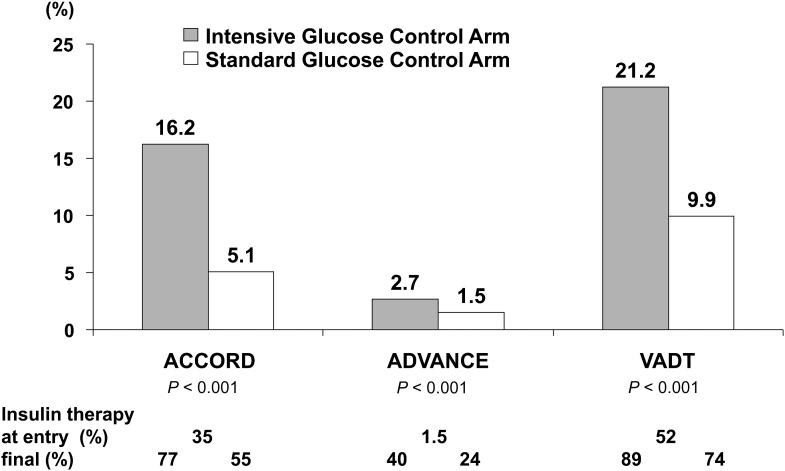
“HYPOGLYCEMIA IN ACCORD, ADVANCE, AND VADT—CVD is the predominant cause of death in patients with type 2 diabetes, and reducing the risk of CVD has recently been the focus of three large glucose-lowering trials: ACCORD (Action to Control Cardiovascular Risk in Diabetes) (4), ADVANCE (Action in Diabetes and Vascular Dis…”
BackgroundResultIntensive versus Conventional Glucose Control in Critically Ill Patients
(2009) · New England Journal of Medicine · doi:10.1056/nejmoa0810625 · Cited by 5,119 · cited 2×
“In a large multicenter randomized controlled trial in Australia (NICESUGAR) (35), the relationship of glycemic control to outcome from critical illness was examined in patients being treated in intensive care units.”
BackgroundGlucose control and vascular complications in veterans with type 2 diabetes
Duckworth, W., Abraira, C., Moritz, T., Reda, D., Emanuele, N., Reaven, P. D., Zieve, F. J., Marks, J., Davis, S. N., Hayward, R., et al. (2009) · New England Journal of Medicine · doi:10.1056/nejmoa0808431 · Cited by 4,762 · cited 1×
“HYPOGLYCEMIA IN ACCORD, ADVANCE, AND VADT—CVD is the predominant cause of death in patients with type 2 diabetes, and reducing the risk of CVD has recently been the focus of three large glucose-lowering trials: ACCORD (Action to Control Cardiovascular Risk in Diabetes) (4), ADVANCE (Action in Diabetes and Vascular Dis…”
BackgroundA molecular basis for cardiac arrhythmia: HERG mutations cause long QT syndrome
Curran, M. E., Splawski, I., Timothy, K. W., Vincen, G. M., Green, E. D., & Keating, M. T. (1995) · Cell · doi:10.1016/0092-8674(95)90358-5 · Cited by 2,259 · cited 1×
“Those affected have abnormal cardiac repolarization represented by prolonged QT on their electrocardiograms and an increased risk of sudden death due to cardiac arrhythmias (26).”
BackgroundSevere hypoglycemia and risks of vascular events and death
Zoungas, S., Patel, A., Chalmers, J., de Galan, B. E., Li, Q., Billot, L., Woodward, M., Ninomiya, T., Neal, B., MacMahon, S., et al. (2010) · New England Journal of Medicine · doi:10.1056/nejmoa1003795 · Cited by 1,471
Self-citationIntensive glucose control and macrovascular outcomes in type 2 diabetes
Turnbull, F. M., Abraira, C., Anderson, R. J., Byington, R. P., Chalmers, J. P., Duckworth, W. C., Evans, G. W., Gerstein, H. C., Holman, R. R., Moritz, T. E., et al. (2009) · Diabetologia · doi:10.1007/s00125-009-1470-0 · Cited by 1,189
Griesdale, D. E. G., de Souza, R. J., van Dam, R. M., Heyland, D. K., Cook, D. J., Malhotra, A., Dhaliwal, R., Henderson, W. R., Chittock, D. R., Finfer, S., et al. (2009) · Canadian Medical Association Journal · doi:10.1503/cmaj.090206 · Cited by 1,096 · cited 1×
“Two meta-analyses (36,37) have shown that strict glycemic control in seriously ill patients does not improve overall survival but reduces the risk of septicemia in surgical intensive care units at the expense of a fivefold higher incidence of hypoglycemia (13.”
BackgroundBonds, D. E., Miller, M. E., Bergenstal, R. M., Buse, J. B., Byington, R. P., Cutler, J. A., Dudl, R. J., Ismail-Beigi, F., Kimel, A. R., Hoogwerf, B., et al. (2010) · BMJ · doi:10.1136/bmj.b4909 · Cited by 933
Survival as a function of HbA1c in people with type 2 diabetes: a retrospective cohort study
Currie, C. J., Peters, J. R., Tynan, A., Evans, M., Heine, R. J., Bracco, O. L., Zagar, T., & Poole, C. D. (2010) · The Lancet · doi:10.1016/s0140-6736(09)61969-3 · Cited by 874 · cited 2×
“A study using the large U.K. General Practice Research Database (39) examined the relationship between HbA1c and survival using data collected for .20 years from 48,000 patients with type 2 diabetes.”
Cited by
Cosentino, F., Grant, P. J., Aboyans, V., Bailey, C. J., Ceriello, A., Delgado, V., Federici, M., Filippatos, G., Grobbee, D. E., Hansen, T. B., et al. (2020) · European Heart Journal · doi:10.1093/eurheartj/ehz486 · Cited by 4,763
(2013) · European Heart Journal · doi:10.1093/eurheartj/eht108 · Cited by 1,955
(2014) · Revista Española de Cardiología (English Edition) · doi:10.1016/j.rec.2013.10.013 · Cited by 609
Efficacy and safety of degludec versus glargine in type 2 diabetes.
Marso, S. P., McGuire, D. K., Zinman, B., Poulter, N. R., Emerson, S. S., Pieber, T. R., Pratley, R. E., Haahr, P.-M., Lange, M., Brown-Frandsen, K., et al. (2017) · New England Journal of Medicine · doi:10.1056/nejmoa1615692 · Cited by 574
Amiel, S. A., Aschner, P., Childs, B., Cryer, P. E., de Galan, B. E., Frier, B. M., Gonder-Frederick, L., Heller, S. R., Jones, T., Khunti, K., et al. (2019) · The Lancet Diabetes & Endocrinology · doi:10.1016/s2213-8587(18)30315-2 · Cited by 526
Self-citation
Metadata
- Authors
- Frier, B. M., Schernthaner, G., & Heller, S. R.
- Affiliations
- Edinburgh Royal Infirmary (GB)
- Krankenanstalt Rudolfstiftung der Stadt Wien (AT)
- Northern General Hospital (GB)
- Corresponding author
- Schernthaner, Guntram
- Venue
- Diabetes Care
- Publisher
- American Diabetes Association
- Published
- 2011-04-22
- Volume
- 34
- Issue
- Supplement_2
- Pages
- S132-S137
- ISSN
- 0149-5992 (ISSN-L)
- 1935-5548
- PMC
- PMC3632150
- OpenAlex
- W2004870840
- Cited by
- 381
- References
- 49
- Citations by year
- 2026: 12 · 2025: 18 · 2024: 22 · 2023: 16 · 2022: 18 · 2021: 32 · 2020: 24 · 2019: 35 · 2018: 26 · 2017: 24 · 2016: 31 · 2015: 43 · 2014: 34 · 2013: 29 · 2012: 15
- FWCI
- 3.57
- Type
- journal article
- Language
- en
- Open access
- hybrid
- doi.org
- Licence
- Locations
- Diabetes Care (publishedVersion, cc-by-nc-nd)
- Europe PMC (PubMed Central) (publishedVersion, cc-by-nc-nd)
- PubMed Central (publishedVersion, cc-by-nc-nd)
- PubMed (publishedVersion)
- White Rose Research Online (University of Leeds, The University of Sheffield, University of York) (acceptedVersion)
- Topics
- Health Sciences › Medicine › Endocrinology, Diabetes and Metabolism › Diabetes Management and Research
- Health Sciences › Medicine › Endocrinology, Diabetes and Metabolism › Diabetes Treatment and Management
- Health Sciences › Medicine › Endocrinology, Diabetes and Metabolism › Diabetes, Cardiovascular Risks, and Lipoproteins
- Keywords
- hypoglycemia, cardiovascular risk, type 2 diabetes, insulin therapy, severe hypoglycemia, myocardial infarction, stroke, autonomic responses, sympathoadrenal system, epinephrine, glycemic control, cardiovascular disease, mortality
- MeSH terms
- Cardiovascular Diseases, Humans, Hypoglycemia, Hypoglycemic Agents, Insulin
About these checks
Registry, retraction, Cites and statistics results are computed, not judged, with one exception: a printed reference that no index lists is read once by a model before it counts as a citation error. Claims are extracted by a model and kept only when their quote appears verbatim in the text; each cited source is then checked, with a model’s help, for whether it says what the claim relies on. Those verdicts can be wrong — read the claim’s quote and the cited source before relying on one.
Statistics and arithmetic are recomputed, not judged.
Confidence bands are shown only for fields calibrated on our annotated test set. None is calibrated yet, so no band is shown.
What counts as a claim ›How we measure confidence ›How we check this ›
Are you an author, or do you see a problem with this page? Request a review
How to cite
Cite CoChat for the checks on this page, and the paper for its own findings.
- This page
- CoChat. (2026). Citation check: Hypoglycemia and Cardiovascular Risks. https://app.cochat.ai/papers/10.2337/dc11-s220
- The paper
- Frier, B. M., Schernthaner, G., & Heller, S. R. (2011). Hypoglycemia and Cardiovascular Risks. Diabetes Care. https://doi.org/10.2337/dc11-s220
Data sources
Bibliographic data: Semantic Scholar, OpenAlex, Crossref.
Contains information from the Semantic Scholar Academic Graph Datasets, made available under the ODC Attribution License (ODC-BY 1.0).
Semantic Scholar’s data is described in: Kinney, R., et al. (2023). The Semantic Scholar Open Data Platform. arXiv:2301.10140.
