

The DOI matches its Crossref record; 24 of the 24 references it cites were found in a registry or an index.
Adult-Onset Autoimmune Diabetes in Europe Is Prevalent With a Broad Clinical Phenotype
Open accessAbstract
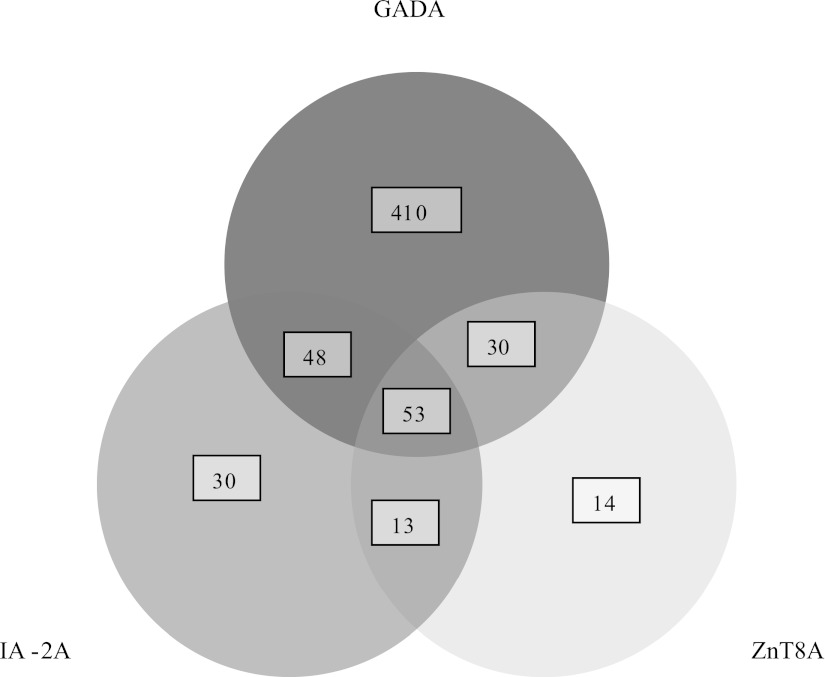
OBJECTIVE: Specific autoantibodies characterize type 1 diabetes in childhood but are also found in adult-onset diabetes, even when initially non–insulin requiring, e.g., with latent autoimmune diabetes (LADA). We aimed to characterize adult-onset autoimmune diabetes. RESEARCH DESIGN AND METHODS: We consecutively studied 6,156 European diabetic patients attending clinics within 5 years of diagnosis (age range, 30–70 years) examined cross-sectionally clinically and for GAD antibodies (GADA) and antibodies to insulinoma-associated antigen-2 (IA-2A) and zinc-transporter 8 (ZnT8A). RESULTS: Of 6,156 patients, 541 (8.8%) had GADA and only 57 (0.9%) IA-2A or ZnT8A alone. More autoantibody-positive than autoantibody-negative patients were younger, leaner, on insulin (49.5 vs. 13.2%), and female (P < 0.0001 for each), though LADA patients (9.7% of total) did not show categorically distinct clinical features from autoantibody-negative type 2 diabetes. Similarly, more GADA patients with high (>200 World Health Organization IU) (n = 403) compared with low (n = 138) titer were female, lean, and insulin treated (54.6 vs. 39.7%) (P < 0.02 for each). Autoantibody-positive patients usually had GADA (541 of 598; 90.5%) and had LADA more often than type 1 autoimmune diabetes (odds ratio 3.3). CONCLUSIONS: Adult-onset autoimmune diabetes emerges as a prevalent form of autoimmune diabetes. Our results indicate that adult-onset autoimmune diabetes in Europe encompasses type 1 diabetes and LADA in the same broad clinical and autoantibody-positive spectrum. At diagnosis, patients with adult-onset autoimmune diabetes are usually non–insulin requiring and clinically indistinguishable from patients with type 2 diabetes, though they tend to be younger and leaner. Only with screening for autoantibodies, especially GADA, can they be identified with certainty.
Overview
The claims and statistics of this paper haven’t been checked yet.
Run the check — free, no account needed. It reads the open-access text and checks the sources it cites.
Integrity signals
Registry
Cites
Statistics
Figures
Verification
Claims the paper makes
The claims and statistics of this paper haven’t been checked yet.
Run the check — free, no account needed. It reads the open-access text and checks the sources it cites.
Claims other papers make about this one
Each is checked against this paper’s own text: does it say what the citing paper says it does?
The source backs part of the claim, not all of it — or backs it for a different population, condition or comparison.
In the citing paper
“LADA is the most common form of autoimmune diabetes mellitus diagnosed in adults, with a prevalence in Europe, China and the United Arab Emirates between 3 and 12 times higher than that of adult-onset T1DM77–79.”
From The epidemiology of type 1 diabetes mellitus in older adults (2025) · cites this paper as [77]
Experimental — accuracy not yet measured
Self-check
Percentages, sums and reported differences re-computed from the paper’s own numbers.
The self-check needs the paper’s full text.
Citations
Cites
Report of the Expert Committee on the Diagnosis and Classification of Diabetes Mellitus
The Expert Committee on the Diagnosis and Classification of Diabetes Mellitus* (2002) · Diabetes Care · doi:10.2337/diacare.25.2007.s5 · Cited by 10,325
Report of the Expert Committee on the Diagnosis and Classification of Diabetes Mellitus
The Expert Committee on the Diagnosis and Classification of Diabetes Mellitus (1997) · Diabetes Care · doi:10.2337/diacare.20.7.1183 · Cited by 6,220
Genetics, pathogenesis and clinical interventions in type 1 diabetes
Bluestone, J. A., Herold, K., & Eisenbarth, G. (2010) · Nature · doi:10.1038/nature08933 · Cited by 1,265
The cation efflux transporter ZnT8 (Slc30A8) is a major autoantigen in human type 1 diabetes
Wenzlau, J. M., Juhl, K., Yu, L., Moua, O., Sarkar, S. A., Gottlieb, P., Rewers, M., Eisenbarth, G. S., Jensen, J., Davidson, H. W., et al. (2007) · Proceedings of the National Academy of Sciences · doi:10.1073/pnas.0705894104 · Cited by 1,014
Turner, R., Stratton, I., Horton, V., Manley, S., Zimmet, P., Mackay, I. R., Shattock, M., Bottazzo, G. F., & Holman, R. (1997) · The Lancet · doi:10.1016/s0140-6736(97)03062-6 · Cited by 779
Gale, E. A. M., & Gillespie, K. M. (2001) · Diabetologia · doi:10.1007/s001250051573 · Cited by 558
Clinical and genetic characteristics of type 2 diabetes with and without GAD antibodies.
Tuomi, T., Carlsson, A., Li, H., Isomaa, B., Miettinen, A., Nilsson, A.-L., Nissén, M., Ehrnström, B. O., Forsén, B., Snickars, B., et al. (1999) · Diabetes · doi:10.2337/diabetes.48.1.150 · Cited by 504
Latent autoimmune diabetes in adults (LADA) should be less latent
Fourlanos, S., Dotta, F., Greenbaum, C. J., Palmer, J. P., Rolandsson, O., Colman, P. G., & Harrison, L. C. (2005) · Diabetologia · doi:10.1007/s00125-005-1960-7 · Cited by 411
Diabetes Antibody Standardization Program: first assay proficiency evaluation
Bingley, P. J., Bonifacio, E., Mueller, P. W., & Laboratories, P. (2003) · Diabetes · doi:10.2337/diabetes.52.5.1128 · Cited by 362
Latent Autoimmune Diabetes in Adults
Naik, R. G., Brooks-Worrell, B. M., & Palmer, J. P. (2009) · The Journal of Clinical Endocrinology & Metabolism · doi:10.1210/jc.2009-1120 · Cited by 249
Cited by
Sorted by citations
Items 301–339 of 339
Latent autoimmune diabetes of adults
Štechová, K. (2022) · Medicína pro praxi · doi:10.36290/med.2022.038
Managing latent autoimmune disease in adults
Morris, D. (2023) · Independent Nurse · doi:10.12968/indn.2023.1.18
Rusyaeva, N. V., Иванович, Г. И., Кононенко, И. В., Nikonova, T. V., & Shestakova, M. V. (2023) · Diabetes Mellitus · doi:10.14341/dm13070 · Cited by 1
Erstdiagnose eines Typ-1-Diabetes im hohen Alter
Müssig, K., & Harms, M. (2024) · Info Diabetologie · doi:10.1007/s15034-024-4939-5
Nuevas propuestas de la clasificación de diabetes: revisión narrativa
Herrera, G. J. M., & Mendoza-Fuentes, M. (2024) · Revista Colombiana de Endocrinología Diabetes & Metabolismo · doi:10.53853/encr.11.3.870
Alexander, L., Cheng-ting, T., Lernmark, Å., & JENDLE, J. H. (2024) · Journal of Clinical & Translational Endocrinology · doi:10.1016/j.jcte.2024.100367
Salam, M., McGill, J. B., & Hughes, J. W. (2018) · American Diabetes Association eBooks · doi:10.2337/9781580406666.ch06
RECENT ADVANCE IN DIABETES: INNOVATION, CHALLENGES AND FUTURE DIRECTION
Kathiriya, V. (2024) · Journal of Population Therapeutics and Clinical Pharmacology · doi:10.53555/4xz9gr51
LADA diabetes as an orphan disease and its connection with other autoimmune diseases
Garnytska, A. V., & Orlyk, O. S. (2024) · Infusion & Chemotherapy · doi:10.32902/2663-0338-2024-4-43-50
Is This Type 2 Diabetes, Type 1 Diabetes, or Late Autoimmune Diabetes in Adults?
Tripathy, D., Pinkson, S., Koops, M. K., & DeFronzo, R. A. (2015) · doi:10.2337/9781580405713.case17
Recurrent Ketoacidosis: Lessons from Multiple Clinical Presentations
Ipp, E., & Djekic, K. (2015) · doi:10.2337/9781580405713.case5
Latent Autoimmune Diabetes of the Adult (LADA) in an Elderly Patient
Shah, M., Sohrevardi, M., & Baldwin, D. S. (2015) · doi:10.2337/9781580405713.case23
Ohnishi, M., Anno, T., Takahashi, K., Okauchi, S., Murakami, K., Kaku, K., Kaneto, H., & Kamei, S. (2025) · Internal Medicine · doi:10.2169/internalmedicine.5567-25
Arai, K., Oishi, M., Yagi, N., Shirabe, S., & Maegawa, H. (2025) · Diabetology International · doi:10.1007/s13340-025-00844-8
Ibrahim, A., Mohmed, M. H. A., Darwish, H., Maximus, P., Rezzek, M. S., Daoud, M. H. S., & Labad, A. (2025) · Cureus · doi:10.7759/cureus.91219
Cui, Y., Liu, H., & Dong, R. (2025) · BMC Nephrology · doi:10.1186/s12882-025-04626-x
Danne, T., Freckmann, G., Kautzky‐Willer, A., Lang, U. E., Lehmann, R., Pfohl, M., Schloot, N. C., & Schumm‐Draeger, P. (2014) · Springer eBooks · doi:10.1007/978-3-642-41358-2_3
Self-citationNarasimhan, A., Deshpande, I., Kalluru, P. K. R., & Chan, K. (2025) · AACE Endocrinology and Diabetes · doi:10.1016/j.aed.2025.12.017
Saiprasad, S., & Swamy, N. (2026) · Cureus · doi:10.7759/cureus.102728
Yaroslavceva, M. V., Kataeva, D. A., Galstyan, G. R., & Bondarenko, O. N. (2026) · Diabetes Mellitus · doi:10.14341/dm13383 · Cited by 1
Sairaan-Damir, A., Schloot, N. C., Rosenbauer, J., Seufert, J., Zimny, S., & Holl, R. (2026) · Diabetologie und Stoffwechsel · doi:10.1055/s-0046-1819866
Self-citationLian, P. (2026) · Highlights in Science Engineering and Technology · doi:10.54097/vr5y8484
Alfadhli, E. M., Mohammedsaeed, W. M., Surrati, A. M. Q., Alharbi, M., Alharbi, M., & Alghamdi, Z. (2026) · Journal of Research in Medical Sciences · doi:10.4103/jrms.jrms_438_25
Sørgjerd, E., Hals, I., Lønnum, B. E., Edstorp, J., Ahlqvist, E., Carlsson, S., & Grill, V. (2026) · Journal of Autoimmunity · doi:10.1016/j.jaut.2026.103576
Herranz-Antolín, S., Gomez-Peralta, F., Xu, Y., Martínez‐Brocca, M. A., Molina, G. C., Alonso, A. A., Brito-Sanfiel, M. Á., Martínez‐Montoro, J. I., Bellido, V., Azriel, S., et al. (2026) · Diabetes Technology & Therapeutics · doi:10.1177/15209156261451052
Prevalence of diabetic retinopathy across different diabetes phenotypes
Rastogi, A., & Khamesra, A. (2026) · World Journal of Diabetes · doi:10.4239/wjd.119328
Lunati, M. E., Galesi, G., Bernasconi, D., Tinari, C., & Fiorina, P. (2026) · Frontiers in Endocrinology · doi:10.3389/fendo.2026.1833794
Dutta, P., Dutta, D. A., Kakati, S., Barman, K. K., Agarwal, D., Bhattacharjee, B., Bhattacharyya, N., Neog, R., Nath, R., & Yajnik, C. S. (2026) · Cureus · doi:10.7759/cureus.111894
Ying, H., Yu, H., 冉丽莎, Yao, S., Zhao, T., Cen, J., Yang, H., & Chang, D. (2026) · Research Square · doi:10.21203/rs.3.rs-10561121/v1
Impact of GAD-65 antibody detection on antihyperglycemic therapy in T2D
Halliburton, S., Herber, E., Pantalone, K. M., Parker, M., & Soric, A. (2026) · Endocrine Connections · doi:10.1530/ec-25-0785
Zhang, Q. X., Zhou, H., Zhu, G., Li, R., Xu, W., Lin, R., Zhao, Y., Li, H., Gu, X., & Zhu, X. (2026) · Journal of Diabetes Research · doi:10.1155/jdr/7481709
Saraogi, H., & Khan, W. (2026) · International Journal of Diabetes in Developing Countries · doi:10.1007/s13410-026-01718-8
Variability in Autoantibody Ordering Patterns Suggests Potential for Diabetes Misclassification
Abram, M. C., Matson, B. C., Pfaff, E. R., DeWalt, D. A., VITALE, R. J., & Klein, K. R. (2026) · Diabetes Obesity and Cardiometabolic CARE · doi:10.2337/doc26-0071
Luksameejaroenchai, C., Tangjarusritaratorn, T., & Preechasuk, L. (2026) · Journal of Diabetes Investigation · doi:10.1111/jdi.70449
Janabi, M. Y., Abdullah, A., Eltayieb, L., Hussain, H., & Mlawa, G. (2026) · Cureus · doi:10.7759/cureus.118193
Vich-Pérez, P., Taulero-Escalera, B., Regueiro-Toribio, P., Moratinos-Recuenco, I., Hernández-Jiménez, J., Villanova-Cuadra, L., Sevilla-Machuca, I., Timoner-García, J., Martínez-Grandmontagne, M., Abós-Pueyo, T., et al. (2026) · Journal of Clinical Medicine · doi:10.3390/jcm15218317
Diabetes Mellitus: Review of the Common, Rare, and Uncommon (Conceptual and Metaphorical) Types
Pliszka, M., & Szablewski, L. (2026) · International Journal of Molecular Sciences · doi:10.3390/ijms27219611
Prasad, S., Sharma, A., Sharma, A., Malu, N., Jindal, T., Shah, P., Gohain, A. B., & Kuraku, D. R. (2026) · Frontiers in Endocrinology · doi:10.3389/fendo.2026.1996912
Metadata
- Authors
- Hawa, M. I., Kolb, H., Schloot, N., Beyan, H., Paschou, S. A., Buzzetti, R., Mauricio, D., De Leiva, A., Yderstraede, K., Beck-Neilsen, H., Tuomilehto, J., Sarti, C., Thivolet, C., Hadden, D., Hunter, S., Schernthaner, G., Scherbaum, W. A., Williams, R., Brophy, S., Pozzilli, P., Leslie, R. D., & on behalf of the Action LADA consortium
- Affiliations
- Queen Mary University of London (GB)
- Heinrich Heine University Düsseldorf (DE)
- Blizard Institute, Queen Mary University of London, London, U.K.
- Sapienza University of Rome (IT)
- Hospital de la Santa Creu i Sant Pau, Barcelona, Spain; Centro de Investigación Biomédica en Red en Bioingeniería, Biomateriales y Nanomedicina (CIBER-BBN)
- Hospital de Sant Pau (ES)
- Odense University Hospital, Odense, Denmark
- Odense University Hospital (DK)
- Finnish Institute for Health and Welfare (FI)
- Hôpital Edouard Herriot (FR)
- Royal Victoria Hospital (GB)
- Krankenanstalt Rudolfstiftung der Stadt Wien (AT)
- Swansea University (GB)
- Università Campus Bio-Medico (IT)
- Corresponding author
- Leslie, Richard David
- ORCID
- Venue
- Diabetes Care
- Publisher
- American Diabetes Association
- Published
- 2013-03-14
- Volume
- 36
- Issue
- 4
- Pages
- 908-913
- ISSN
- 0149-5992 (ISSN-L)
- 1935-5548
- PMC
- PMC3609504
- OpenAlex
- W1969080742
- Cited by
- 339
- References
- 24
- Citations by year
- 2026: 25 · 2025: 22 · 2024: 19 · 2023: 15 · 2022: 33 · 2021: 22 · 2020: 23 · 2019: 29 · 2018: 31 · 2017: 30 · 2016: 23 · 2015: 25 · 2014: 25 · 2013: 16
- FWCI
- 12.87
- Type
- journal article
- Language
- en
- Open access
- hybrid
- doi.org
- Licence
- cc-by-nc-nd
- Locations
- Diabetes Care (publishedVersion, cc-by-nc-nd)
- Topics
- Life Sciences › Biochemistry, Genetics and Molecular Biology › Genetics › Diabetes and associated disorders
- Health Sciences › Medicine › Endocrinology, Diabetes and Metabolism › Diabetes Management and Research
- Health Sciences › Medicine › Endocrinology, Diabetes and Metabolism › Adrenal Hormones and Disorders
- Keywords
- latent autoimmune diabetes in adults, type 1 diabetes, glutamic acid decarboxylase antibodies, IA-2 autoantibodies, autoantibody detection, clinical phenotype, type 2 diabetes misdiagnosis, insulin requirement, antibody titers
About these checks
Registry, retraction, Cites and statistics results are computed, not judged, with one exception: a printed reference that no index lists is read once by a model before it counts as a citation error. Claims are extracted by a model and kept only when their quote appears verbatim in the text; each cited source is then checked, with a model’s help, for whether it says what the claim relies on. Those verdicts can be wrong — read the claim’s quote and the cited source before relying on one.
Statistics and arithmetic are recomputed, not judged.
Confidence bands are shown only for fields calibrated on our annotated test set. None is calibrated yet, so no band is shown.
What counts as a claim ›How we measure confidence ›How we check this ›
Are you an author, or do you see a problem with this page? Request a review
