

The DOI matches its Crossref record; 17 of the 17 references it cites were found in a registry or an index.
Hypoglycemia, With or Without Insulin Therapy, Is Associated With Increased Mortality Among Hospitalized Patients
Open accessAbstract
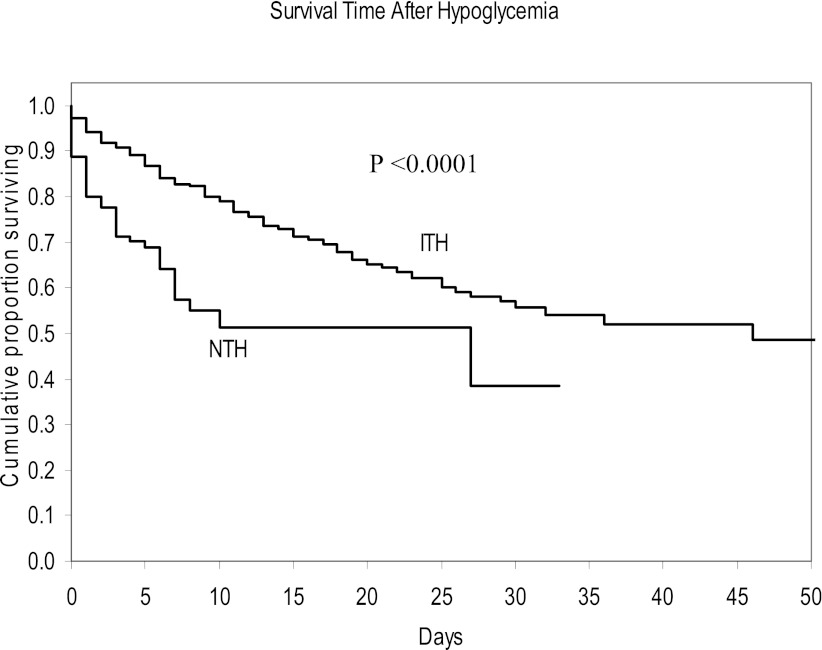
OBJECTIVE: Hypoglycemia is associated with increased mortality in hospitalized patients. We investigated the relationship between spontaneous hypoglycemia versus insulin-associated hypoglycemia and mortality in hospitalized patients. RESEARCH DESIGN AND METHODS: Data for this retrospective cohort study were obtained from electronic databases of patients admitted between 1 April 2008 and 30 November 2010. Patients with one or more blood glucose values ≤50 mg/dL on point-of-care glucose testing were considered hypoglycemic. Patients treated with insulin were assumed to have insulin-associated hypoglycemia. Age-, sex-, and race-matched patients with all blood glucose values >70 mg/dL were selected as controls. The Charlson comorbidity index (CCI) was used to control for severity of illness. RESULTS: There were four groups: 1) noninsulin-treated hypoglycemia (NTH) (n = 135), 2) insulin-treated hypoglycemia (ITH) (n = 961), 3) noninsulin-treated control (NTC) (n = 1,058), and 4) insulin-treated control (ITC) (n = 736). Mortality was higher in the ITH group compared with the ITC group (20.3 vs. 4.5%, P < 0.0001), with a relatively higher CCI (1.8 vs. 1.5%, P < 0.0001), but much higher in the NTH group compared with the NTC group (34.5 vs. 1.1%, P < 0.0001), with much higher CCI (2.4 vs. 1.1%, P < 0.0001). Mortality was higher in the NTH group compared with the ITH group (P < 0.0001) but lower in the NTC group compared with the ITC group (P < 0.0001). After controlling for age, sex, CCI, and admission to the intensive care unit, insulin treatment was associated with a lower mortality among the hypoglycemic patients; hazard ratio of death in the ITH group relative to the NTH group was 0.34 (95% CI 0.25-0.47, P < 0.0001). CONCLUSIONS: Insulin-associated and spontaneous hypoglycemia are associated with increased mortality among hospitalized patients.
Overview
The claims and statistics of this paper haven’t been checked yet.
Run the check — free, no account needed. It reads the open-access text and checks the sources it cites.
Integrity signals
Registry
Cites
Statistics
Figures
Verification
Claims the paper makes
The claims and statistics of this paper haven’t been checked yet.
Run the check — free, no account needed. It reads the open-access text and checks the sources it cites.
Claims other papers make about this one
Each is checked against this paper’s own text: does it say what the citing paper says it does?
The source backs part of the claim, not all of it — or backs it for a different population, condition or comparison.
In the citing paper
“While hypoglycemia is associated with increased mortality (97,98), in many cases, it is a marker of an underlying disease rather than the cause of fatality.”
From 16. Diabetes Care in the Hospital: Standards of Care in Diabetes—2026 (2026) · cites this paper as [98]
Experimental — accuracy not yet measuredThe cited source says what the claim attributes to it.
In the citing paper
“While hypoglycemia is associated with increased mortality (97,98), in many cases, it is a marker of an underlying disease rather than the cause of fatality.”
From 16. Diabetes Care in the Hospital: Standards of Care in Diabetes—2026 (2026) · cites this paper as [98]
Self-check
Percentages, sums and reported differences re-computed from the paper’s own numbers.
The self-check needs the paper’s full text.
Citations
Cites
Intensive insulin therapy in critically ill patients.
Van den Berghe, G., Wouters, P., Weekers, F., Verwaest, C., Bruyninckx, F., Schetz, M., Vlasselaers, D., Ferdinande, P., Lauwers, P., & Bouillon, R. (2001) · New England Journal of Medicine · doi:10.1056/nejmoa011300 · Cited by 9,977
Validation of a combined comorbidity index
Charlson, M., Szatrowski, T. P., Peterson, J., & Gold, J. (1994) · Journal of Clinical Epidemiology · doi:10.1016/0895-4356(94)90129-5 · Cited by 6,587
Intensive versus Conventional Glucose Control in Critically Ill Patients
(2009) · New England Journal of Medicine · doi:10.1056/nejmoa0810625 · Cited by 5,119
Intensive insulin therapy in the medical ICU
Van den Berghe, G., Wilmer, A., Hermans, G., Meersseman, W., Wouters, P. J., Milants, I., Van Wijngaerden, E., Bobbaers, H., & Bouillon, R. (2006) · New England Journal of Medicine · doi:10.1056/nejmoa052521 · Cited by 3,639
Intensive insulin therapy and pentastarch resuscitation in severe sepsis
Brunkhorst, F. M., Engel, C., Bloos, F., Meier-Hellmann, A., Ragaller, M., Weiler, N., Moerer, O., Gruendling, M., Oppert, M., Grond, S., et al. (2008) · New England Journal of Medicine · doi:10.1056/nejmoa070716 · Cited by 2,921
Severe hypoglycemia and risks of vascular events and death
Zoungas, S., Patel, A., Chalmers, J., de Galan, B. E., Li, Q., Billot, L., Woodward, M., Ninomiya, T., Neal, B., MacMahon, S., et al. (2010) · New England Journal of Medicine · doi:10.1056/nejmoa1003795 · Cited by 1,471
Moghissi, E. S., Korytkowski, M. T., DiNardo, M., Einhorn, D., Hellman, R., Hirsch, I. B., Inzucchi, S. E., Ismail-Beigi, F., Kirkman, M. S., & Umpierrez, G. E. (2009) · Diabetes Care · doi:10.2337/dc09-9029 · Cited by 1,444
Bonds, D. E., Miller, M. E., Bergenstal, R. M., Buse, J. B., Byington, R. P., Cutler, J. A., Dudl, R. J., Ismail-Beigi, F., Kimel, A. R., Hoogwerf, B., et al. (2010) · BMJ · doi:10.1136/bmj.b4909 · Cited by 933 · cited 1×
“Most studies, in the inpatient setting as well as in the outpatient setting, have demonstrated that spontaneous hypoglycemia is associated with increasedmortality as compared with insulin-induced hypoglycemia, and our study supports these data (7,16,17).”
ResultPreiser, J.-C., Devos, P., Ruiz-Santana, S., Mélot, C., Annane, D., Groeneveld, J., Iapichino, G., Leverve, X., Nitenberg, G., Singer, P., et al. (2009) · Intensive Care Medicine · doi:10.1007/s00134-009-1585-2 · Cited by 911
Lee, E. W., Wei, L. J., Amato, D. A., & Leurgans, S. (1992) · Survival Analysis: State of the Art · doi:10.1007/978-94-015-7983-4_14 · Cited by 688
Cited by
Sorted by citations
Diabetic emergencies - ketoacidosis, hyperglycaemic hyperosmolar state and hypoglycaemia
Umpierrez, G., & Korytkowski, M. (2016) · Nature Reviews Endocrinology · doi:10.1038/nrendo.2016.15 · Cited by 563
Treatment of Diabetes in Older Adults: An Endocrine Society* Clinical Practice Guideline
LeRoith, D., Biessels, G. J., Braithwaite, S. S., Casanueva, F. F., Draznin, B., Halter, J. B., Hirsch, I. B., McDonnell, M. E., Molitch, M. E., Murad, M. H., et al. (2019) · The Journal of Clinical Endocrinology & Metabolism · doi:10.1210/jc.2019-00198 · Cited by 616
Glycemic Goals in Diabetes: Trade-off Between Glycemic Control and Iatrogenic Hypoglycemia
Cryer, P. E. (2014) · Diabetes · doi:10.2337/db14-0059 · Cited by 241
Underwood, P., Askari, R., Hurwitz, S., Chamarthi, B., & Garg, R. (2014) · Diabetes Care · doi:10.2337/dc13-1929 · Cited by 231
Self-citation16. Diabetes Care in the Hospital: Standards of Care in Diabetes—2025
ElSayed, N. A., McCoy, R. G., Aleppo, G., Balapattabi, K., Beverly, E. A., Early, K. B., Bruemmer, D., Echouffo-Tcheugui, J. B., Ekhlaspour, L., Galindo, R. J., et al. (2024) · Diabetes Care · doi:10.2337/dc25-s016 · Cited by 242
Self-citation
Metadata
- Authors
- Garg, R., Hurwitz, S., Turchin, A., & Trivedi, A.
- Affiliations
- Brigham and Women's Hospital (US)
- Corresponding author
- Garg, Rajesh
- Venue
- Diabetes Care
- Publisher
- American Diabetes Association
- Published
- 2013-04-13
- Volume
- 36
- Issue
- 5
- Pages
- 1107-1110
- ISSN
- 0149-5992 (ISSN-L)
- 1935-5548
- PMC
- PMC3631882
- OpenAlex
- W2130532045
- Cited by
- 176
- References
- 17
- Citations by year
- 2026: 5 · 2025: 10 · 2024: 9 · 2023: 12 · 2022: 14 · 2021: 12 · 2020: 19 · 2019: 11 · 2018: 14 · 2017: 13 · 2016: 19 · 2015: 17 · 2014: 12 · 2013: 9
- FWCI
- 9.75
- Type
- journal article
- Language
- en
- Open access
- hybrid
- doi.org
- Licence
- Locations
- Diabetes Care (publishedVersion, cc-by-nc-nd)
- Europe PMC (PubMed Central) (publishedVersion, cc-by-nc-nd)
- PubMed Central (publishedVersion, cc-by-nc-nd)
- PubMed (publishedVersion)
- Digital Access to Scholarship at Harvard (DASH) (Harvard University) (submittedVersion, cc-by)
- Funders
- National Center for Research Resources (UL1RR025758)
- Topics
- Health Sciences › Medicine › Endocrinology, Diabetes and Metabolism › Hyperglycemia and glycemic control in critically ill and hospitalized patients
- Health Sciences › Medicine › Endocrinology, Diabetes and Metabolism › Diabetes Management and Research
- Health Sciences › Medicine › Public Health, Environmental and Occupational Health › Patient Safety and Medication Errors
- Keywords
- insulin therapy, mortality, hospitalized patients, spontaneous hypoglycemia, blood glucose, intensive care unit admission, comorbidities, point-of-care glucose testing, critically ill patients, diabetes management, glycemic control, mortality risk factors, mortality risk stratification
- MeSH terms
- Female, Humans, Hypoglycemia, Hypoglycemic Agents, Insulin, Male, Retrospective Studies, Hospital Mortality
About these checks
Registry, retraction, Cites and statistics results are computed, not judged, with one exception: a printed reference that no index lists is read once by a model before it counts as a citation error. Claims are extracted by a model and kept only when their quote appears verbatim in the text; each cited source is then checked, with a model’s help, for whether it says what the claim relies on. Those verdicts can be wrong — read the claim’s quote and the cited source before relying on one.
Statistics and arithmetic are recomputed, not judged.
Confidence bands are shown only for fields calibrated on our annotated test set. None is calibrated yet, so no band is shown.
What counts as a claim ›How we measure confidence ›How we check this ›
Are you an author, or do you see a problem with this page? Request a review
