

The DOI matches its Crossref record.
Intimate partner violence in lesbian, gay, transgender, men who have sex with men, women who have sex with women, and bisexual people: A systematic review and meta-analysis of prevalence
Open accessAbstract
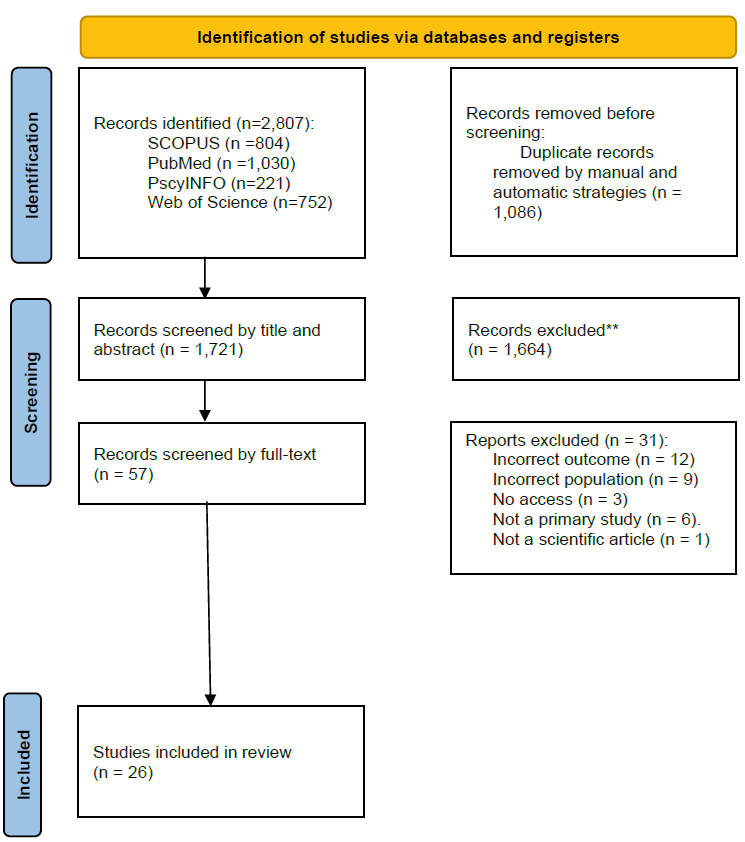
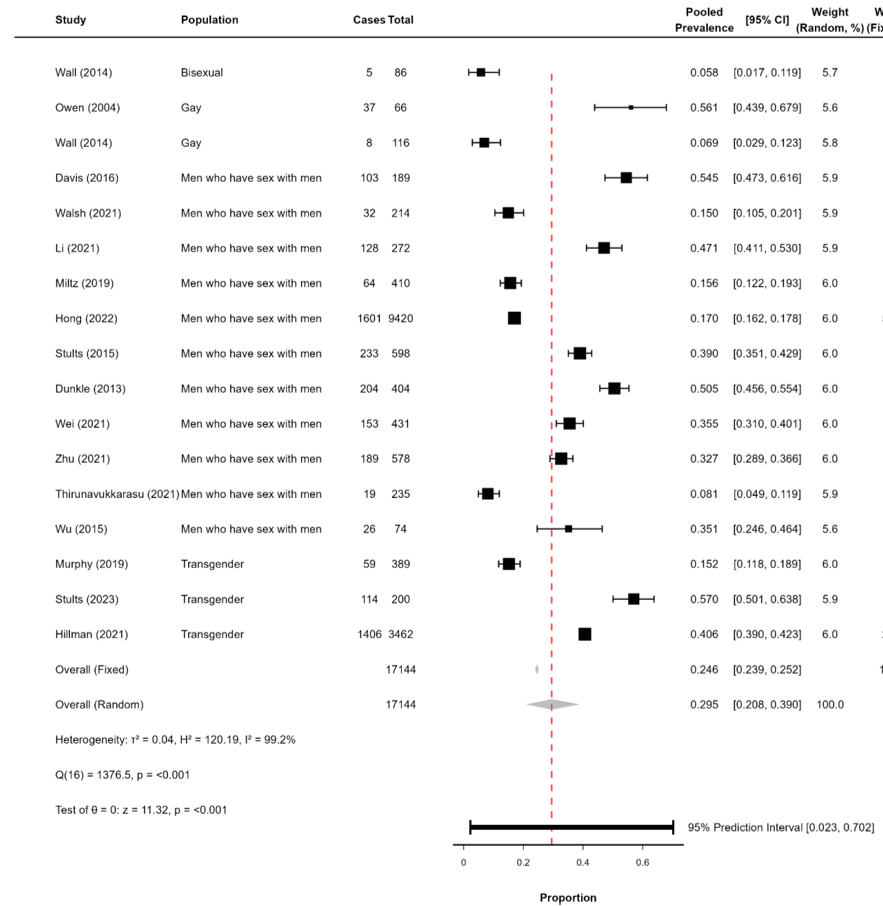
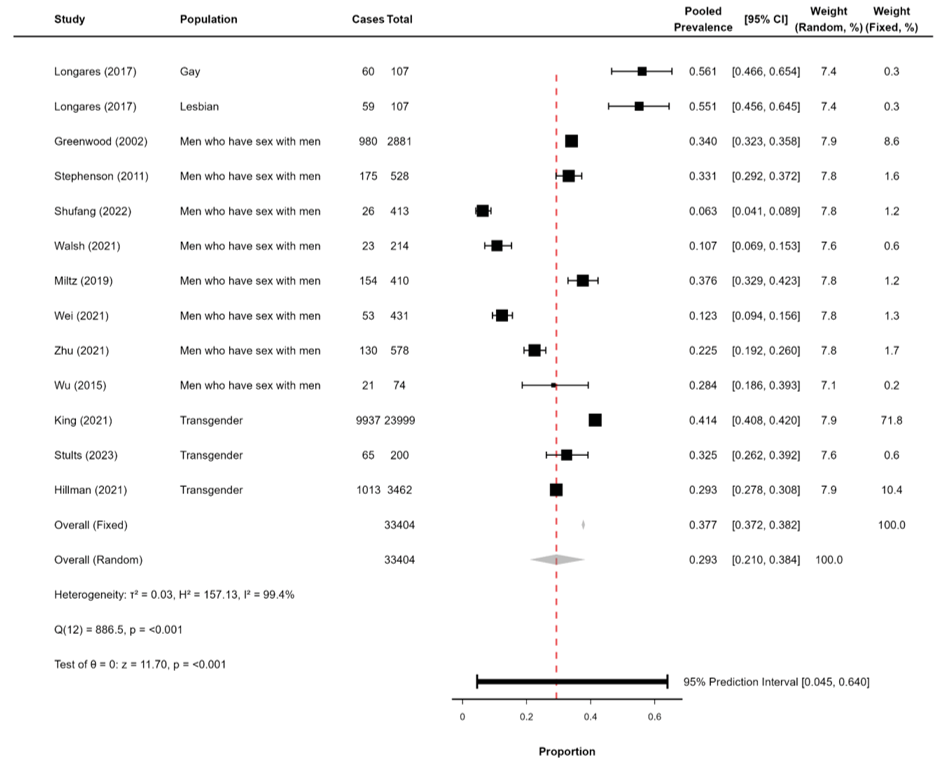
Background: Intimate partner violence (IPV) in LGBT populations represents a major public health problem, and although research on the topic is increasing, knowledge remains limited, as current reviews have focused on specific populations. The prevalence of IPV in some studies reaches up to 48% in lesbian populations and 33% in MSM, while among transgender individuals, 37.5% have experienced physical violence and 25% sexual violence. Various factors aggravate the impact and make data collection more difficult. Objective: This systematic review and meta-analysis aimed to synthesize the available evidence on the prevalence of intimate partner violence among lesbian, gay, bisexual, and transgender adults, considering the different forms of IPV and providing more precise estimates to inform future interventions and policies. Methods: Our study is a systematic review. We searched four specialized databases of scientific articles: Scopus, Web of Science, PsycINFO, and PubMed. We included studies where the population was adults 18 to 65 years of age, who are in a casual or formal same-sex or same-gender partner relationship. We included cross-sectional studies and baseline cohort study measurements. We used the JBI Systematic Reviews "Checklist for Prevalence Studies" tool to assess the risk of bias for each study. Our study was registered in PROSPERO (CRD42024529982). Results: Twenty-six studies met inclusion criteria; 17 were included in the meta-analysis, comprising 17,144 participants from various LGBT subgroups. The pooled prevalence was 29.5% (95% CI: 20.8%–39.0%), with high heterogeneity across studies (I² = 99.2%). Prevalence rates varied widely, especially among men who have sex with men (MSM) (8.1% to 54.5%) and transgender individuals (15.2% to 57.0%), highlighting significant variability depending on the subpopulation analyzed. Conclusions: Our study concluded that IPV represents a significant global concern for both MSM and transgender individuals. Notably, psychological and emotional violence emerged as the most prevalent form of IPV in both groups. On the other hand, the need for more inclusive research that reflects diverse cultural and social contexts is highlighted.
Overview
The claims and statistics of this paper haven’t been checked yet.
Run the check — free, no account needed. It reads the open-access text and checks the sources it cites.
Integrity signals
Registry
Cites
Statistics
Figures
Verification
Claims the paper makes
The claims and statistics of this paper haven’t been checked yet.
Run the check — free, no account needed. It reads the open-access text and checks the sources it cites.
Claims other papers make about this one
Each is checked against this paper’s own text: does it say what the citing paper says it does?
The source backs part of the claim, not all of it — or backs it for a different population, condition or comparison.
In the citing paper
“Similarly, among lesbian, gay, bisexual, and transgender (LGBT) individuals, perpetration of psychological violence is the most frequently reported form of violence (Kimmes et al., 2017; Trujillo‑Guablocho et al., 2025).”
From Psychological Intimate Partner Violence Across Identities: Preliminary Psychometrics of the Multidimensional Measure of Emotional Abuse-Short Form Among Heterosexual, Lesbian, and Bisexual Samples in Türkiye (2026) · cites this paper as Trujillo‑Guablocho et al., 2025
Experimental — accuracy not yet measured
Self-check
Percentages, sums and reported differences re-computed from the paper’s own numbers.
The self-check needs the paper’s full text.
Citations
Cites
No references could be resolved yet.
Research works printed but not linked: 26
- Badenes-Ribera, L., Bonilla-Campos, A., Frias-Navarro, D., Pons-Salva- dor, G., & Monterde-i-Bort, H. (2016). Intimate Partner Violence in Self-Identified Lesbians: A Systematic Review of Its Prevalence and Correlates. Trauma, Violence, & Abuse, 17(3), 284-297. https://doi. org/10.1177/1524838015584363 · DOI
- Badenes-Ribera, L., Frias-Navarro, D., Bonilla-Campos, A., Pons-Salvador, G., & Monterde-i-Bort, H. (2014). Intimate Partner Violence in Self-identified Lesbians: A Meta-analysis of its Prevalence. Sexuality Research and Social Policy, 12(1), 47-59. https://doi.org/10.1007/s13178-014-0164-7 · DOI
- Badenes-Ribera, L., Sánchez-Meca, J., & Longobardi, C. (2019). The relation- ship between internalized homophobia and intimate partner violence in same-sex relationships: A meta-analysis. Trauma Violence & Abuse, 20(3), 331-343. https://doi.org/10.1177/1524838017708781 · DOI · Paper page
- Buller, A. M., Devries, K. M., Howard, L. M., & Bacchus, L. J. (2014). Associations between intimate partner violence and health among men who have sex with men: A systematic review and meta-analysis. PLoS Medicine, 11(3), e1001609. https://doi.org/10.1371/journal.pmed.1001609 · DOI
- Callan, A., Corbally, M., & McElvaney, R. (2021). A scoping review of inti- mate partner violence as it relates to the experiences of gay and bi- sexual men. Trauma Violence & Abuse, 22(2), 233-248. https://doi. org/10.1177/1524838020970898 · DOI
- Duval, S., & Tweedie, R. (2000). Trim and Fill: A Simple Funnel-Plot-Based Meth- od of Testing and Adjusting for Publication Bias in Meta-Analysis. Biomet- rics, 56(2), 455-463. https://doi.org/10.1111/j.0006-341X.2000.00455.x · DOI · Paper page
- Edwards, K. M., Sylaska, K. M., Barry, J. E., Moynihan, M. M., Banyard, V. L., Cohn, E. S., Walsh, W. A., & Ward, S. K. (2014). Physical dating violence, sexual violence, and unwanted pursuit victimization: A comparison of incidence rates among sexual-minority and heterosexual college stu- dents. Journal of Interpersonal Violence, 30(4), 580-600. https://doi. org/10.1177/0886260514535260 · DOI
- Edwards, K. M., Sylaska, K. M., & Neal, A. M. (2015). Intimate partner violence among sexual minority populations: A critical review of the literature and agenda for future research. Psychology of Violence, 5(2), 112-121. https:// doi.org/10.1037/a0038656 · DOI
- Falluji, E., Li, N., Newman, Z., & Carpino, T. (2024). Intimate partner violence in sexual minority women in same-sex relationships: A review. HPHR Journal, 82. https://doi.org/10.54111/0001/DDDD8 · DOI
- Finneran, C., & Stephenson, R. (2012). Intimate Partner Violence among Men Who Have Sex with Men: A Systematic Review. Trauma, Violence, & Abuse, 14(2), 168-185. https://doi.org/10.1177/1524838012470034 · DOI
- Finneran, C., & Stephenson, R. (2013). Intimate partner violence among men who have sex with men: A systematic review. Trauma Violence & Abuse, 14(2), 168-185. https://doi.org/10.1177/1524838012470034 · DOI
- Huedo-Medina, T. B., Sánchez-Meca, J., Marín-Martínez, F., & Botella, J. (2006). Assessing heterogeneity in meta-analysis: Q statistic or I2 index? Psychological Methods, 11(2), 193-206. https://doi.org/10.1037/1082- 989X.11.2.193 · DOI · Paper page
- Liu, M., Cai, X., Hao, G., Li, W., Chen, Q., Chen, Y., & Xiong, P. (2021). Prevalence of intimate partner violence among men who have sex with men: An up- dated systematic review and meta-analysis. Sexual Medicine, 9(6), 100433. https://doi.org/10.1016/j.esxm.2021.100433 · DOI
- Longobardi, C., & Badenes-Ribera, L. (2017). Intimate partner violence in same- sex relationships and the role of sexual minority stressors: A systematic review of the past 10 years. Journal of Child and Family Studies, 26(8), 2039-2049. https://doi.org/10.1007/s10826-017-0734-4 · DOI
- Munn, Z., Moolla, S., Lisy, K., Riitano, D., & Tufanaru, C. (2020). Chapter 5: Sys- tematic reviews of prevalence and incidence. In Aromataris E, Munn Z (Edi- tors). JBI Manual for Evidence Synthesis. JBI.
- Otero, L., Fernández, M., Fernández, M., & Castro, Y. (2015). Violence in trans- sexual, transgender and intersex couples: A systematic review. Saude e so- ciedade, 24(3), 914-935. https://doi.org/10.1590/S0104-12902015134224 · DOI
- Peitzmeier, S. M., Malik, M., Kattari, S. K., Marrow, E., Stephenson, R., Agénor, M., & Reisner, S. L. (2020). Intimate partner violence in transgender pop- ulations: Systematic review and meta-analysis of prevalence and cor- relates. American Journal of Public Health, 110(9), e1-e14. https://doi. org/10.2105/AJPH.2020.305774 · DOI · Paper page
- Peters, J.L., Sutton, A.J.; Jones, D.R.; Abrams, K.R. & Rushton L. (2006). Compar- ison of Two Methods to Detect Publication Bias in Meta-analysis. JAMA, 295(6), 676-680. doi:10.1001/jama.295.6.676 · DOI · Paper page
- Porsch, L. M., Xu, M., Veldhuis, C. B., Bochicchio, L. A., Zollweg, S. S., & Hughes, T. L. (2023). Intimate partner violence among sexual minority women: A scoping review. Trauma Violence & Abuse, 24(5), 3014-3036. https://doi. org/10.1177/15248380221122815 · DOI
- Riley, R. D., Higgins, J. P. T., & Deeks, J. J. (2011). Interpretation of random effects meta-analyses. BMJ, 342, d549. https://doi.org/10.1136/bmj.d549 · DOI · Paper page
- Rojas-Solís, J. L., Meza-Marín, R. N., Villalobos-Raygoza, A., & Rojas-Alonso, I. (2020). Revisión sistemática sobre características metodológicas en el estudio de la violencia de pareja en hombres que tienen sexo con hom- bres. Revista Logos, Ciencia & Tecnología, 13(1), 144-159. https://doi. org/10.22335/rlct.v13i1.1312 · DOI
- Rojas-Solís, J. L., Rojas Alonso, I., Meza Marín, R. N., & Villalobos Raygoza, A. (2021). Violencia de parejas gays y en hombres que tienen sexo con hom- bres: una revisión sistemática exploratoria. Revista Criminalidad, 63(1), 173-186.
- Rollè, L., Giardina, G., Caldarera, A. M., Gerino, E., & Brustia, P. (2018). When intimate partner violence meets same sex couples: A review of same sex intimate partner violence. Frontiers in Psychology, 9, 1506. https://doi. org/10.3389/fpsyg.2018.01506 · DOI · Paper page
- Stephenson, R., & Finneran, C. (2013). The IPV-GBM scale: A new scale to mea- sure intimate partner violence among gay and bisexual men. PLoS One, 8(6), e62592. https://doi.org/10.1371/journal.pone.0062592 · DOI
- Thompson, S. G., & Higgins, J. P. T. (2002). How should meta-regression analyses be undertaken and interpreted? Statistics in Medicine, 21(11), 1559-1573. https://doi.org/10.1002/sim.1187 · DOI · Paper page
- West, C. M. (2012). Partner abuse in ethnic minority and gay, lesbian, bisexual, and transgender populations. Partner Abuse, 3(3), 336-357. https://doi. org/10.1891/1946-6560.3.3.336 · DOI · Paper page
Cited by
Sorted by citations
Demirtaş, E. T., & Zurnacı, B. (2026) · Archives of Sexual Behavior · doi:10.1007/s10508-026-03422-4
“Similarly, among lesbian, gay, bisexual, and transgender (LGBT) individuals, perpetration of psychological violence is the most frequently reported form of violence (Kimmes et al., 2017; Trujillo-Guablocho et al., 2025).”
Metadata
- Authors
- Trujillo-Guablocho, J., Mosquera Minaya, C., & Centeno-Terrazas, G.
- Affiliations
- National University of San Marcos (PE)
- Instituto Peruano de Orientación Psicológica (PE)
- Venue
- Interacciones
- Published
- 2025-06-02
- Pages
- e459
- ISSN
- 2411-5940 (ISSN-L)
- 2413-4465
- OpenAlex
- W4411044422
- Cited by
- 8
- References
- 0
- Citations by year
- 2026: 7 · 2025: 1
- FWCI
- 1.45
- Type
- journal article
- Language
- en
- Open access
- diamond
- doi.org
- Locations
- Interacciones Revista de Avances en Psicología (publishedVersion, cc-by)
- Dialnet (Universidad de la Rioja) (submittedVersion)
- DOAJ (DOAJ: Directory of Open Access Journals) (submittedVersion, cc-by-sa)
- Topics
- Social Sciences › Health › Intimate Partner and Family Violence
- Social Sciences › Psychology › Social Psychology › LGBTQ Health, Identity, and Policy
- Social Sciences › Gender Studies › Sexual Assault and Victimization Studies
- Keywords
- intimate partner violence, LGBT adults, prevalence, men who have sex with men, transgender people, psychological violence, emotional abuse, physical violence, sexual violence, same-sex relationships
About these checks
Registry, retraction, Cites and statistics results are computed, not judged, with one exception: a printed reference that no index lists is read once by a model before it counts as a citation error. Claims are extracted by a model and kept only when their quote appears verbatim in the text; each cited source is then checked, with a model’s help, for whether it says what the claim relies on. Those verdicts can be wrong — read the claim’s quote and the cited source before relying on one.
Statistics and arithmetic are recomputed, not judged.
Confidence bands are shown only for fields calibrated on our annotated test set. None is calibrated yet, so no band is shown.
What counts as a claim ›How we measure confidence ›How we check this ›
Are you an author, or do you see a problem with this page? Request a review
