

Student Interaction with Generative AI: An Exploration of an Emergent Information-Search Process
The DOI matches its Crossref record; 25 of the 25 references it cites were found in a registry or an index.
Abstract
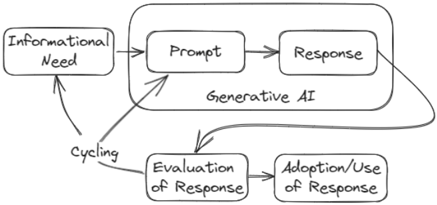
ChatGPT, a generative artificial intelligence, is one of the fastest-adopted tools in history and has quickly become a valued tool in education. This study seeks to understand how generative artificial intelligence has changed the information search process. We collected prompts submitted to ChatGPT and thoughts about ChatGPT responses through a survey of 455 students at a US university. Using thematic analysis, we identified ways that ChatGPT changes the information search process of students by supporting diverse information needs, allowing cycling of prompt adjustments, and promoting easy adoption of results.
Overview
The claims and statistics of this paper haven’t been checked yet.
Free: it reads the open-access text and checks the first 5 claims that cite a source we can check. Create a free account to check every claim.
Integrity signals
Registry
Cites
Statistics
Figures
Verification
Claims the paper makes
The claims and statistics of this paper haven’t been checked yet.
Free: it reads the open-access text and checks the first 5 claims that cite a source we can check. Create a free account to check every claim.
Claims other papers make about this one
Each is checked against this paper’s own text: does it say what the citing paper says it does?
In the citing paper
“The opaque nature of GenAI algorithms, absence of traditional cues signifying information credibility and quality, and occurrence of hallucinations in GenAI-enabled systems can complicate the evaluation process (Schuetzler et al., 2024;Shin et al., 2024).”
From College students' credibility assessments of GenAI‐generated information for academic tasks: An interview study (2025) · cites this paper as Schuetzler et al., 2024
Self-check
Percentages, sums and reported differences re-computed from the paper’s own numbers.
The self-check needs the paper’s full text.
Citations
Cites
Braun, V., & Clarke, V. (2012) · APA handbook of research methods in psychology, Vol 2: Research designs: Quantitative, qualitative, neuropsychological, and biological. · doi:10.1037/13620-004 · Cited by 10,299
Baidoo-Anu, D., & Owusu Ansah, L. (2023) · doi:10.2139/ssrn.4337484 · Cited by 3,004
Inside the search process: Information seeking from the user's perspective
Kuhlthau, C. C. (1991) · Journal of the American Society for Information Science · doi:10.1002/(sici)1097-4571(199106)42:5<361::aid-asi6>3.0.co;2-# · Cited by 2,166
What Is the Impact of ChatGPT on Education? A Rapid Review of the Literature
Lo, C. K. (2023) · Education Sciences · doi:10.3390/educsci13040410 · Cited by 2,024
Is ChatGPT a General-Purpose Natural Language Processing Task Solver?
Qin, C., Zhang, A., Zhang, Z., Chen, J., Yasunaga, M., & Yang, D. (2023) · arXiv · doi:10.48550/arxiv.2302.06476 · Cited by 869
Wells, J. D., Valacich, J. S., & Hess, T. J. (2011) · MIS Quarterly · doi:10.2307/23044048 · Cited by 759
Haleem, A., Javaid, M., & Singh, R. P. (2022) · BenchCouncil Transactions on Benchmarks, Standards and Evaluations · doi:10.1016/j.tbench.2023.100089 · Cited by 694 · cited 1×
“One such use of LLMs (e.g., ChatGPT) is its potential as an information search platform (Haleem et al., 2022; X. Hu et al., 2023).”
BackgroundIs ChatGPT a General-Purpose Natural Language Processing Task Solver?
Qin, C., Zhang, A., Zhang, Z., Chen, J., Yasunaga, M., & Yang, D. (2023) · Proceedings of the 2023 Conference on Empirical Methods in Natural Language Processing · doi:10.18653/v1/2023.emnlp-main.85 · Cited by 504
Exploring Students’ Perceptions of ChatGPT: Thematic Analysis and Follow-Up Survey
Shoufan, A. (2023) · IEEE Access · doi:10.1109/access.2023.3268224 · Cited by 499
Hassani, H., & Silva, E. S. (2023) · Big Data and Cognitive Computing · doi:10.3390/bdcc7020062 · Cited by 401 · cited 1×
“ChatGPT excels at information searching for language modeling, text classification, and question answering (Hassani & Silva, 2023) and has the potential to combine vision and language models (Yang et al., 2023).”
Background
Research works printed but not linked: 8
- Bates, M. J. (1979). Information Search Tactics. Journal of the American Society for Information Science, 30(4), 205- 214.
- Brown, T., Mann, B., Ryder, N., Subbiah, M., Kaplan, J. D., Dhariwal, P., Neelakantan, A., Shyam, P., Sastry, G., & Askell, A. (2020). Language models are few-shot learners. Advances in Neural Information Processing Systems, 33, 1877-1901.
- Browne, G. J., & Pitts, M. G. (2004). Stopping rule use during information search in design problems. Organizational Behavior and Human Decision Processes, 95(2), 208- 224.
- Browne, G. J., Pitts, M. G., & Wetherbe, J. C. (2007). Cognitive stopping rules for terminating information search in online tasks. MIS Quarterly, 31(1), 89-104.
- Buzzetto-Hollywood, N. A., Wang, H. C., Elobeid, M., & Elobaid, M. E. (2018). Addressing Information Literacy and the Digital Divide in Higher Education. Interdisciplinary Journal of E-Skills and Lifelong Learning, 14, 077-093.
- Ebrahimi, S., Ghasemaghaei, M., & Benbasat, I. (2022). The Impact of Trust and Recommendation Quality on Adopting Interactive and Non-Interactive Recommendation Agents: A Meta-Analysis. Journal of Management Information Systems, 39(3), 733-764.
- Fauzi, F., Tuhuteru, L., Sampe, F., Ausat, A. M. A., & Hatta, H. R. (2023). Analysing the Role of ChatGPT in Improving Student Productivity in Higher Education. Journal on Education, 5(4), 14886-14891.
- Hu, X., Tian, Y., Nagato, K., Nakao, M., & Liu, A. (2023). Opportunities and challenges of ChatGPT for design knowledge management (arXiv:2304.02796 [cs.IR]). · arXiv
Cited by
Choi, W., Bak, H., An, J., Zhang, Y., & Stvilia, B. (2025) · Journal of the Association for Information Science and Technology · doi:10.1002/asi.24978 · Cited by 27
GAI-Assisted Personal Discussion Process Analysis
Chen, M.-S., Hsu, T.-P., & Hsu, T.-C. (2024) · Lecture Notes in Computer Science · doi:10.1007/978-3-031-65884-6_20 · Cited by 4
Metadata
- Authors
- Schuetzler, R., Giboney, J., Wells, T., Richardson, B., Meservy, T., Sutton, C., Posey, C., Steffen, J., & Hughes, A.
- Venue
- Proceedings of the Annual Hawaii International Conference on System Sciences
- Published
- 2024
- ISSN
- 2572-6862
- Cited by
- 6
- References
- 25
About these checks
Registry, retraction, Cites and statistics results are computed, not judged, with one exception: a printed reference that no index lists is read once by a model before it counts as a citation error. Claims are extracted by a model and kept only when their quote appears verbatim in the text; each cited source is then checked, with a model’s help, for whether it says what the claim relies on. Those verdicts can be wrong — read the claim’s quote and the cited source before relying on one.
Statistics and arithmetic are recomputed, not judged.
Confidence bands are shown only for fields calibrated on our annotated test set. None is calibrated yet, so no band is shown.
What counts as a claim ›How we measure confidence ›How we check this ›
Are you an author, or do you see a problem with this page? Request a review
Data sources
Bibliographic data: Semantic Scholar, OpenAlex, Crossref.
Contains information from the Semantic Scholar Academic Graph Datasets, made available under the ODC Attribution License (ODC-BY 1.0).
Semantic Scholar’s data is described in: Kinney, R., et al. (2023). The Semantic Scholar Open Data Platform. arXiv:2301.10140.
