

Are we Ready to Use Microchip Implants? An International Cross-sectional Study
Open accessThe DOI matches its Crossref record; 38 of the 39 references it cites were found in a registry or an index, and 1 are not checked yet.
Abstract
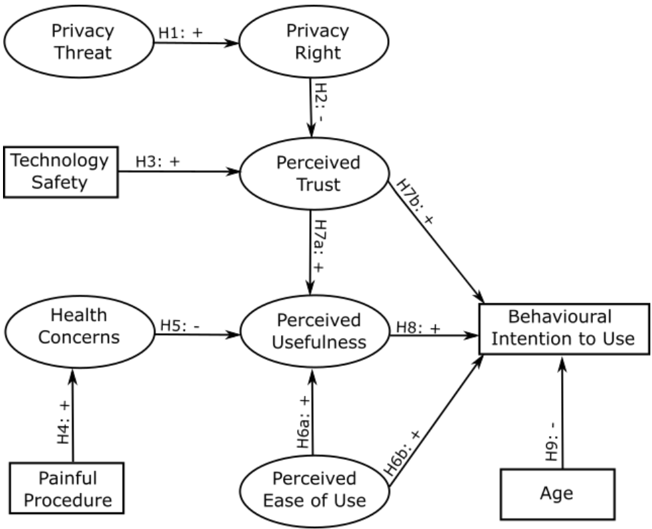
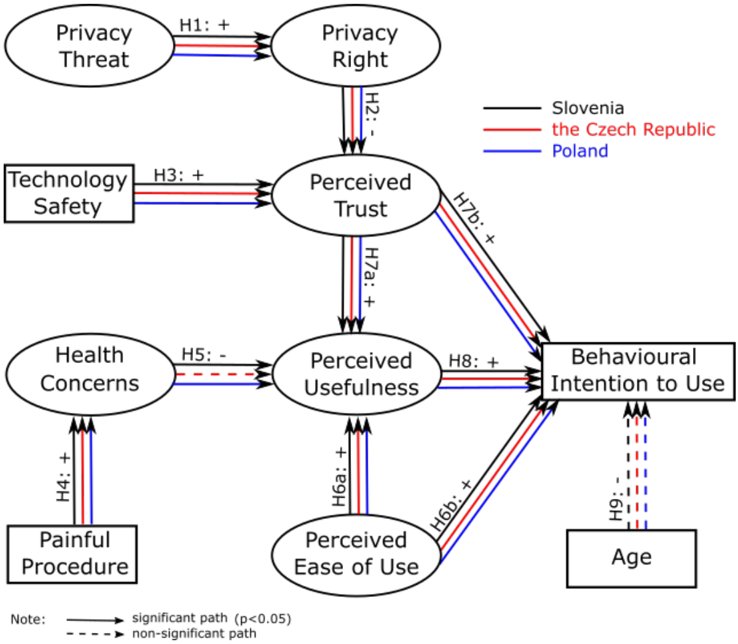
Background and purpose: Despite their clear relevance to human life, microchip implants are still widely viewed as negative, threatening our privacy and raising growing concerns about our health. This paper aims to investigate the important factors influencing people’s perception of microchip implants and their willingness to use them for different purposes. Methodology: The cross-sectional study was conducted in three European countries and the data were analysed using the group Structural Equation Modeling approach. Only complete answers to the online survey questionnaire items were used representing a convenience sample of 804 respondents. Results: The results show that perceived ease of use, usefulness and perceived trust are significant predictors of intention to use microchip implants. Perceived trust is influenced by privacy and technology safety. Concerns about painful procedures and other health concerns reduce the perceived usefulness of microchip implants. Apart from the predictor health concerns, the results were similar in all countries. Conclusion: Based on the presented results, researchers interested in investigating the actual use of microchip implants can establish a solid foundation for their research. The results may assist policy makers in developing the regulations to ensure the safe use of microchip implants and allow for a higher level of security. As a follow-up, investigation of changes in the acceptance of microchip implants following the threat of a global pandemic is proposed.
Overview
The claims and statistics of this paper haven’t been checked yet.
Free: it reads the open-access text and checks the first 5 claims that cite a source we can check. Create a free account to check every claim.
Integrity signals
Registry
Cites
Statistics
Figures
Verification
Claims the paper makes
The claims and statistics of this paper haven’t been checked yet.
Free: it reads the open-access text and checks the first 5 claims that cite a source we can check. Create a free account to check every claim.
Claims other papers make about this one
Each is checked against this paper’s own text: does it say what the citing paper says it does?
The check wasn’t confident either way, so it gives no verdict — never disputed.
In the citing paper
“Narcissistic leadership seems to more effectively elucidate numerous adverse outcomes (e.g., work deviance; diminished job embeddedness; reduced job engagement; lack of innovative behavior) [8–10].”
From Narcissistic leadership, workplace bullying, turnover intention, and creative performance: a study of nurses (2025) · cites this paper as [8]
Experimental — accuracy not yet measured
Self-check
Percentages, sums and reported differences re-computed from the paper’s own numbers.
The self-check needs the paper’s full text.
Citations
Cites
Controlling the False Discovery Rate: A Practical and Powerful Approach to Multiple Testing
Benjamini, Y., & Hochberg, Y. (1995) · Journal of the Royal Statistical Society Series B: Statistical Methodology · doi:10.1111/j.2517-6161.1995.tb02031.x · Cited by 109,482 · cited 1×
“Due to relatively large number of tests, the adjusted p-values using false discovery rate method (Benjamini & Hochberg, 1995) were calculated.”
MethodEvaluating Structural Equation Models with Unobservable Variables and Measurement Error
Fornell, C., & Larcker, D. F. (1981) · Journal of Marketing Research · doi:10.2307/3151312 · Cited by 109,314
Evaluating structural equation models with unobservable variables and measurement error
Fornell, C., & Larcker, D. F. (1981) · Journal of Marketing Research · doi:10.1177/002224378101800104 · Cited by 109,190 · cited 1×
“The AVE for PEU is slightly below 0.5 (AVE = 0.47), but its CR is higher than 0.6 (CR = 0.73) the convergent validity of the construct is still adequate (Fornell & Larcker, 1981).”
BackgroundInfluentialHu, L., & Bentler, P. M. (1999) · Structural Equation Modeling A Multidisciplinary Journal · doi:10.1080/10705519909540118 · Cited by 108,788 · cited 2×
“• The standardised root mean square residual (SRMR) should be less than 0.05, however values as high as 0.08 are deemed acceptable (Hu & Bentler, 1999).”
BackgroundInfluentialPerceived usefulness, perceived ease of use, and user acceptance of information technology
Davis, F. D. (1989) · MIS Quarterly · doi:10.2307/249008 · Cited by 68,483 · cited 2×
“TAM model anticipates two basic factors that influence the behavioural intention to use technology: perceived usefulness and perceived ease of use (Davis, 1989).”
BackgroundMethodEvaluating Goodness-of-Fit Indexes for Testing Measurement Invariance
Cheung, G. W., & Rensvold, R. B. (2002) · Structural Equation Modeling: A Multidisciplinary Journal · doi:10.1207/s15328007sem0902_5 · Cited by 16,280 · cited 16×
“RMSEA is equal to 0.070 and the upper bound of RMSEA 90% confidence interval (0.066,0.075) is lower than 0.08 suggesting a good model fit (MacCallum et al., 1996).”
BackgroundInfluentialSensitivity of Goodness of Fit Indexes to Lack of Measurement Invariance
Chen, F. F. (2007) · Structural Equation Modeling: A Multidisciplinary Journal · doi:10.1080/10705510701301834 · Cited by 12,217 · cited 3×
“The results for each invariance test are explained by the change of several alternative fit indices (AFI) since χ^2 tends to be oversensitive to small, unimportant deviations from a perfect model in large samples (Chen, 2007).”
BackgroundInfluentialPower analysis and determination of sample size for covariance structure modeling.
MacCallum, R. C., Browne, M. W., & Sugawara, H. M. (1996) · Psychological Methods · doi:10.1037/1082-989x.1.2.130 · Cited by 10,418 · cited 2×
“RMSEA is equal to 0.070 and the upper bound of RMSEA 90% confidence interval (0.066,0.075) is lower than 0.08 suggesting a good model fit (MacCallum et al., 1996).”
BackgroundResultInfluentialPutnick, D. L., & Bornstein, M. H. (2016) · Developmental Review · doi:10.1016/j.dr.2016.06.004 · Cited by 4,369 · cited 4×
“The configural invariance tests whether the model configuration (all constructs have the same pattern of free and fixed parameters) is the same among all groups in a multigroup context (Putnick & Bornstein, 2016).”
BackgroundMethodInfluentialKoufteros, X. A. (1999) · Journal of Operations Management · doi:10.1016/s0272-6963(99)00002-9 · Cited by 725 · cited 2×
“When examining convergent validity, one needs to examine that the estimates of standardized factor loadings do not exceed 0.5 (or even 0.7), Composite Reliability (CR) for each latent variable exceeds 0.7, and Average Variance Extracted (AVE) for each latent variable exceeds 0.5 (Koufteros, 1999).”
BackgroundMethodInfluential
Research works printed but not linked: 3
- Carr, N. K. (2020). As Society Strives for Reduced Contact during the Pandemic, How Can Human Microchipping Help? Villanova Law Review, 65, 46-60. https://digi- talcommons.law.villanova.edu/vlr/vol65/iss6/3
- Hair, J. F., Black, W. C., Babin, B. J., & Anderson, R. E. (2019). Multivariate Data Analysis (8th ed.). Cengage Learning.
- Rodriguez, D. A. (2019). Chipping in at work: Privacy con- cerns related to the use of body microchip ("RFID") implants in the employer-employee context. Iowa Law Review, 104(3), 1581-1611. https://ilr.law.uiowa.edu/ assets/Uploads/ILR-104-3-Rodriguez.pdf
Cited by
Theoretical Models for Acceptance of Human Implantable Technologies: A Narrative Review
Chaudry, B., Shafeie, S., & Mohamed, M. A. (2023) · Informatics · doi:10.3390/informatics10030069 · Cited by 32
Faeq, D. K. (2025) · BMC Nursing · doi:10.1186/s12912-025-03479-x · Cited by 6
Maras, M., & Miranda, M. D. (2023) · Technology in Society · doi:10.1016/j.techsoc.2023.102295 · Cited by 6
Payment implants as an element of human enhancement technology
Sułkowski, Ł., & Kaczorowska–Spychalska, D. (2023) · Human Technology · doi:10.14254/1795-6889.2023.19-2.6 · Cited by 3
“On the one hand, they show that perceived ease of use, usability and trust are identified as the most important predictors of the intention to use microchip implants (Žnidaršič et al., 2021).”
BackgroundResultFrascaria, G., Jaramillo-Dent, D., & Latzer, M. (2026) · International Journal of Human-Computer Interaction · doi:10.1080/10447318.2026.2625258 · Cited by 2
Metadata
- Authors
- Žnidaršič, A., Baggia, A., Pavlíček, A., Fischer, J., Rostański, M., & Werber, B.
- Affiliations
- University of Maribor (SI)
- Faculty of Organizational Sciences , University of Maribor , Kranj , Slovenia
- Prague University of Economics and Business (CZ)
- WSB University (PL)
- Corresponding author
- Werber, Borut
- Venue
- Organizacija
- Publisher
- Walter de Gruyter GmbH
- Published
- 2021-12-01
- Volume
- 54
- Issue
- 4
- Pages
- 275-292
- ISSN
- 1318-5454 (ISSN-L)
- 1581-1832
- OpenAlex
- W4200513829
- Cited by
- 14
- References
- 38
- Citations by year
- 2026: 3 · 2025: 5 · 2023: 4 · 2022: 2
- FWCI
- 1.28
- Type
- journal article
- Language
- en
- Open access
- diamond
- doi.org
- Licence
- Locations
- Organizacija (publishedVersion, cc-by-nc-nd)
- University of Maribor digital library (University of Maribor) (submittedVersion, cc-by-nc-nd)
- DOAJ (DOAJ: Directory of Open Access Journals) (submittedVersion, cc-by-sa)
- Funders
- Javna Agencija za Raziskovalno Dejavnost RS (P5-0018)
- Topics
- Social Sciences › Decision Sciences › Information Systems and Management › Technology Adoption and User Behaviour
- Social Sciences › Sociology and Political Science › Privacy, Security, and Data Protection
- Health Sciences › Health Professions › Health Information Management › Health, Technology, Consumer Behavior
- Keywords
- biomedical implants, technology acceptance, intention to use, perceived ease of use, perceived usefulness, perceived trust, privacy concerns, technology safety, health concerns, cross-national comparison, regulatory policy
About these checks
Registry, retraction, Cites and statistics results are computed, not judged, with one exception: a printed reference that no index lists is read once by a model before it counts as a citation error. Claims are extracted by a model and kept only when their quote appears verbatim in the text; each cited source is then checked, with a model’s help, for whether it says what the claim relies on. Those verdicts can be wrong — read the claim’s quote and the cited source before relying on one.
Statistics and arithmetic are recomputed, not judged.
Confidence bands are shown only for fields calibrated on our annotated test set. None is calibrated yet, so no band is shown.
What counts as a claim ›How we measure confidence ›How we check this ›
Are you an author, or do you see a problem with this page? Request a review
How to cite
Cite CoChat for the checks on this page, and the paper for its own findings.
- This page
- CoChat. (2026). Citation check: Are we Ready to Use Microchip Implants? An International Cross-sectional Study. https://app.cochat.ai/papers/10.2478/orga-2021-0019
- The paper
- Žnidaršič, A., Baggia, A., Pavlíček, A., Fischer, J., Rostański, M., & Werber, B. (2021). Are we Ready to Use Microchip Implants? An International Cross-sectional Study. Organizacija. https://doi.org/10.2478/orga-2021-0019
Data sources
Bibliographic data: Semantic Scholar, OpenAlex, Crossref.
Contains information from the Semantic Scholar Academic Graph Datasets, made available under the ODC Attribution License (ODC-BY 1.0).
Semantic Scholar’s data is described in: Kinney, R., et al. (2023). The Semantic Scholar Open Data Platform. arXiv:2301.10140.
