

The DOI matches its Crossref record; 21 of the 21 references it cites were found in a registry or an index; none of the 18 sources its claims cite is checked for support yet.
Genetic Examination of Remains from the Two Largest Mass Burials of 1238 in Yaroslavl Detynets
Open accessAbstract
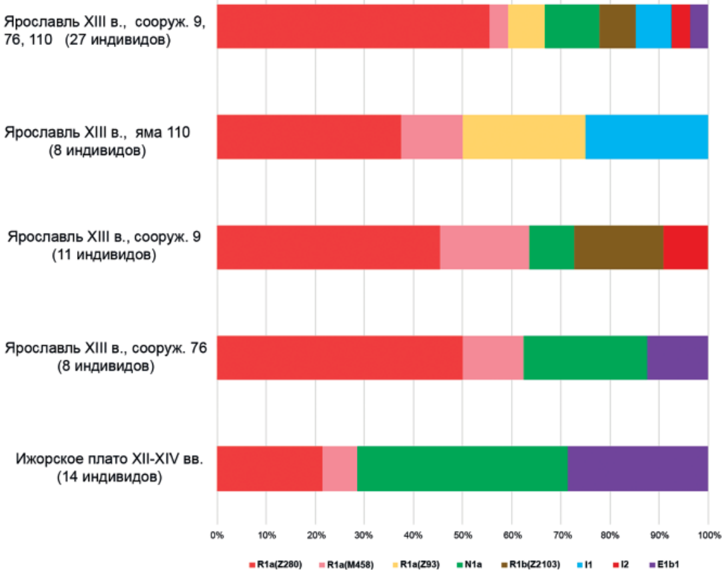
The article presents the results of genetic studies of the remains of people who died and were buried in 1238 on the territory of the citadel in the city of Yaroslavl. The analysis of ancient DNA allows us to directly study the composition of the population of this ancient Russian city along the Volga at the time of the Mongol conquest. By the genetic profile of both Y-chromosomal and mitochondrial DNA, we can say that about 40% of the samples studied do not belong to the dominant haplogroups. The lowest homogeneity in the Y-chromosome is typical for the burial in pit No. 110, which was located near the fortifications. It also contained the remains of two men belonging to the haplogroup R1a (Z93), marking the possible "eastern" origin of their ancestors. In the authors’ opinion, not only ordinary residents of the city and its environs, but also professional defenders, as well as attackers, could get into the burials near the walls of the citadel. Absence of grave goods and in the conditions of a sanitary burial, makes not possible to determine who the men of "eastern" origin were. However, their presence undoubtedly affects the genetic diversity of the city's population.
Overview
CoChat Summary
Written by AI from the paper’s full text.
TL;DR
Ancient DNA from the two largest 1238 mass burials in Yaroslavl Detynets shows that about 40% of the studied individuals carried non-dominant Y-chromosome and mitochondrial haplogroups, with the greatest Y-chromosome heterogeneity in pit No. 110 near the fortifications. Two men there belonged to R1a(Z93), a possible marker of “eastern” ancestry, but the sanitary burial context prevents identifying them as defenders or attackers.
Key findings
- By both Y-chromosome and mitochondrial DNA profiles, about 40% of the studied sample did not belong to the dominant haplogroups.
- The dominant Y subclades R1a(Z282>Z280) and R1a(Z280>M458) made up just over 60% of samples from structure No. 9 and structure No. 76, and almost 50% from pit No. 110.
- The lowest Y-chromosome homogeneity was in pit No. 110, located near the fortifications; it contained two men with haplogroup R1a(Z93), possibly indicating “eastern” origin. Among four men from pit No. 110 with healed cranial trauma, only one (ind. 72) belonged to the most common R1a(Z282>Z280); two (ind. 67, 81) were I1a(DF29), and one (ind. 79) was R1a(Z93).
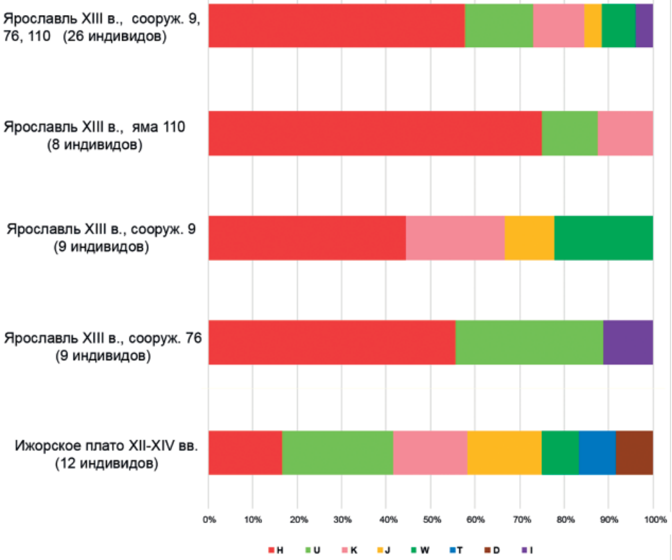
- Mitochondrial haplogroup diversity was greatest in structure No. 9 near Uspensky Cathedral; the combined Yaroslavl series was heterogeneous but less so than the non-urban 12th–14th-century Izhora Plateau series.
Methods
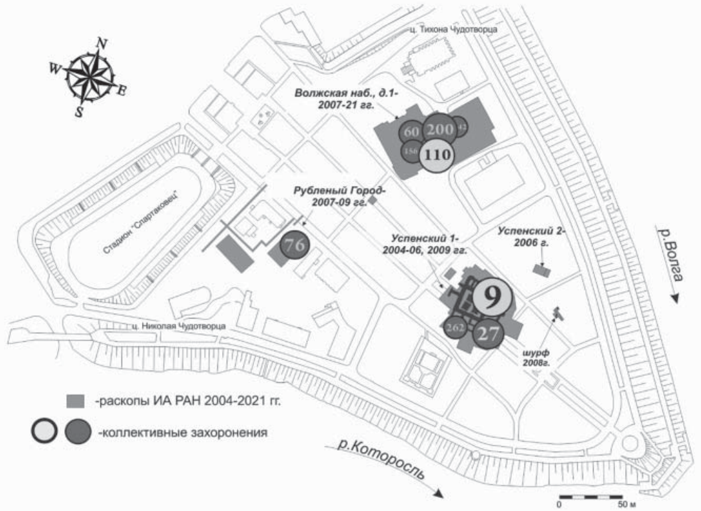
- Remains were sampled from the two largest mass burials: structure No. 9 in the city center near Uspensky Cathedral and pit No. 110 near the fortification line. Samples were teeth or bone fragments; selection prioritized men with possible combat trauma and the so-called “horseman complex.” The broader Yaroslavl collection includes remains of more than 250 individuals from the 1238 mass graves.
- Ancient DNA was extracted following Dabney et al. (2013). DNA quality and sex were assessed with Quantifiler Trio; male individuals were genotyped for 27 Y-STR markers with Yfiler Plus, with fragment analysis on AB3500xl and GeneMapper IDX, and haplogroups predicted via nevgen.org. Targeted NGS used GenSeq v1.1 libraries and VariFind M-RU module IL-v.1 (32 Y-SNP, 52 X-SNP, and 288 autosomal SNP markers); mtDNA HVS I–III was sequenced with PowerSeq CRM. Reads were mapped to GRCh38.p7 and rCRS, filtered for depth >15x and mapping quality >35, and mtDNA haplogroups were predicted via empop.online.
- Y-STR haplotypes were obtained for 11 men from structure No. 9 and 8 from pit No. 110; targeted Y NGS succeeded for all but one (ind. 154, low DNA). Mitochondrial DNA was analyzed for 9 individuals from structure No. 9 (8 men, 1 woman) and 8 from pit No. 110 (4 men, 4 women). Haplogroup distributions were compared across three mass burials, including structure No. 76, and with published medieval series.
Limitations
- Stated: the absence of grave goods and the sanitary burial context make it impossible to determine whether the men of “eastern” origin were residents, traders, defenders, or attackers.
- Stated: the mass-burial series reflects who was in the city on the day of the 1238 assault, not necessarily the genetic profile of medieval Yaroslavl’s population; data from city necropolises would be more conclusive.
- Evident from the text: male sample sizes are small (11 from structure No. 9, 8 from pit No. 110; one failed Y NGS due to low DNA), and the mtDNA sample is even smaller, limiting representativeness.
Model-written summary. Check it against the paper before relying on it.
Integrity signals
Registry
Cites
Statistics
Figures
Verification
Claims the paper makes
21 Own result · 19 Own interpretation · 10 Sources not found · 3 Own method · 1 Check pending · 1 Not checked yet
A result the paper reports from its own data — it cites no other source for it, so there is none to check. The quote shows it is in the paper.
In the paper
“У остальных индивидов из исследуемых захоронений были выявлены гаплогруппы, не найденные в ранее изученном погребении в сооружении № 76.”
§ АКАДЕМИЯ НАУК РЕСПУБЛИКИ ТАТАРСТАН > GENETIC EXAMINATION OF REMAINS FROM THE TWO LARGEST MASS BURIALS OF 1238 IN YAROSLAVL DETYNETS Kh.Kh. Mustafi n, A.V. Engovatova, I.E. Alborova, A.A. Tarasova
plain- Asserted: passes — The authors put it forward as true.
- Checkable: passes — It can be checked against evidence.
- Load-bearing: unclear — It is unclear whether the paper’s conclusions depend on it.
- Based: passes — The paper gives a reason why it holds.
A result the paper reports from its own data — it cites no other source for it, so there is none to check. The quote shows it is in the paper.
In the paper
“При фрагментном анализе получены гаплотипы для одиннадцати мужчин из сооружения № 9 и восьми из ямы № 110.”
§ АКАДЕМИЯ НАУК РЕСПУБЛИКИ ТАТАРСТАН > Материал и метод
plainn = 11- Asserted: passes — The authors put it forward as true.
- Checkable: passes — It can be checked against evidence.
- Load-bearing: passes — The paper’s conclusions depend on it.
- Based: passes — The paper gives a reason why it holds.
A result the paper states — it cites no source for it, so there is none to check. The quote shows it is in the paper.
In the paper
“Более заметным это разнообразие выглядит при сравнении с выборкой из погребений сельского населения с территории Ижорского плато.”
§ АКАДЕМИЯ НАУК РЕСПУБЛИКИ ТАТАРСТАН > Материал и метод
hedgedstates an association- Asserted: passes — The authors put it forward as true.
- Checkable: passes — It can be checked against evidence.
- Load-bearing: unclear — It is unclear whether the paper’s conclusions depend on it.
- Based: passes — The paper gives a reason why it holds.
A result the paper reports from its own data — it cites no other source for it, so there is none to check. The quote shows it is in the paper.
In the paper
“The lowest homogeneity in the Y-chromosome is typical for the burial in pit No. 110, which was located near the fortifi cations.”
- Also stated in: § GENETIC EXAMINATION OF REMAINS FROM THE TWO LARGEST MASS BURIALS OF 1238 IN YAROSLAVL DETYNETS Kh.Kh. Mustafi n, A.V. Engovatova, I.E. Alborova, A.A. Tarasova · plain
“Сравнение представленности гаплогрупп в трех (включая сооружение № 76) исследованных нами массовых захоронениях показало наибольшее разнообразие в выборке из ямы № 110, которая располагалась вблизи фортификационных сооружений (рис.2).”
§ АКАДЕМИЯ НАУК РЕСПУБЛИКИ ТАТАРСТАН > GENETIC EXAMINATION OF REMAINS FROM THE TWO LARGEST MASS BURIALS OF 1238 IN YAROSLAVL DETYNETS Kh.Kh. Mustafi n, A.V. Engovatova, I.E. Alborova, A.A. Tarasova
plainstates an association- Asserted: passes — The authors put it forward as true.
- Checkable: passes — It can be checked against evidence.
- Load-bearing: passes — The paper’s conclusions depend on it.
- Based: passes — The paper gives a reason why it holds.
- Also stated in: § GENETIC EXAMINATION OF REMAINS FROM THE TWO LARGEST MASS BURIALS OF 1238 IN YAROSLAVL DETYNETS Kh.Kh. Mustafi n, A.V. Engovatova, I.E. Alborova, A.A. Tarasova · plain
A result the paper reports from its own data — it cites no other source for it, so there is none to check. The quote shows it is in the paper.
In the paper
“В нем же были обнаружены останки двух мужчин, относящихся к гаплогруппе R1a(Z93), маркирующей возможное «восточное» происхождение их предков.”
§ АКАДЕМИЯ НАУК РЕСПУБЛИКИ ТАТАРСТАН > Abstract
plainn = 2- Asserted: passes — The authors put it forward as true.
- Checkable: passes — It can be checked against evidence.
- Load-bearing: passes — The paper’s conclusions depend on it.
- Based: passes — The paper gives a reason why it holds.
- It may state two separate claims as one. 15
- Probably not a substantial claim. 13
- The quote only partly states this claim. 1
Create a free account to see these claims.
Create a free account to see these assumptions.
28 more claims
Create a free account to see all 55 claims and to verify the 1 reference still open.
Self-check
Percentages, sums and reported differences re-computed from the paper’s own numbers.
Each contradiction between two passages listed here was confirmed by an independent check.
Rated minor: it would not touch a result — a value no result rests on, a p-value that stays on the same side of the significance level, or a conflict that is clerical, resolved elsewhere in the paper, or outside its own findings.
In the paper
§ АКАДЕМИЯ НАУК РЕСПУБЛИКИ ТАТАРСТАН > Материал и метод
“Сооруж.9: 34, 36, 54, 110 Сооруж.76: 1, 7, 8, 10, 15 Яма 110: 23, 42, 49, 69, 71, 83 H (и субветви)”
§ АКАДЕМИЯ НАУК РЕСПУБЛИКИ ТАТАРСТАН > Материал и метод
“36 М T146C HV 54 М”
Rated minor: it would not touch a result — a value no result rests on, a p-value that stays on the same side of the significance level, or a conflict that is clerical, resolved elsewhere in the paper, or outside its own findings.
In the paper
§ АКАДЕМИЯ НАУК РЕСПУБЛИКИ ТАТАРСТАН > GENETIC EXAMINATION OF REMAINS FROM THE TWO LARGEST MASS BURIALS OF 1238 IN YAROSLAVL DETYNETS Kh.Kh. Mustafi n, A.V. Engovatova, I.E. Alborova, A.A. Tarasova
“и почти 50% из ямы № 110 (инд.№ 70, 71, 72, 78, 79).”
§ АКАДЕМИЯ НАУК РЕСПУБЛИКИ ТАТАРСТАН > Материал и метод
“Яма 110: 23, 79 R1a (Z93)”
Citations
Cites
Dabney, J., Knapp, M., Glocke, I., Gansauge, M.-T., Weihmann, A., Nickel, B., Valdiosera, C., García, N., Pääbo, S., Arsuaga, J.-L., et al. (2013) · Proceedings of the National Academy of Sciences · doi:10.1073/pnas.1314445110 · Cited by 1,443
Population genomics of the Viking world
Margaryan, A., Lawson, D. J., Sikora, M., Racimo, F., Rasmussen, S., Moltke, I., Cassidy, L. M., Jørsboe, E., Ingason, A., Pedersen, M. W., et al. (2020) · Nature · doi:10.1038/s41586-020-2688-8 · Cited by 354
Haak, W., Brandt, G., de Jong, H. N., Meyer, C., Ganslmeier, R., Heyd, V., Hawkesworth, C. J., Pike, A. W. G., Meller, H., & Alt, K. W. (2008) · Proceedings of the National Academy of Sciences · doi:10.1073/pnas.0807592105 · Cited by 309
(2020) · Rossiiskaia arkheologiia · doi:10.31857/s08696063 · Cited by 259
The new Y Chromosome Haplotype Reference Database
Willuweit, S., & Roewer, L. (2014) · Forensic Science International Genetics · doi:10.1016/j.fsigen.2014.11.024 · Cited by 256
Wang, C., Reinhold, S., Kalmykov, A., Wissgott, A., Brandt, G., Jeong, C., Cheronet, O., Ferry, M., Harney, É., Keating, D., et al. (2019) · Nature Communications · doi:10.1038/s41467-018-08220-8 · Cited by 238
Ancestry and demography and descendants of Iron Age nomads of the Eurasian Steppe
Unterländer, M., Palstra, F., Lazaridis, I., Pilipenko, A., Hofmanová, Z., Groß, M., Sell, C., Blöcher, J., Kirsanow, K., Rohland, N., et al. (2017) · Nature Communications · doi:10.1038/ncomms14615 · Cited by 142
Neparáczki, E., Maróti, Z., Kalmár, T., Maár, K., Nagy, I., Latinovics, D., Kustár, Á., Pálfi, G., Molnár, E., Marcsik, A., et al. (2019) · Scientific Reports · doi:10.1038/s41598-019-53105-5 · Cited by 77
Neparáczki, E., Maróti, Z., Kalmár, T., Kocsy, K., Maár, K., Bihari, P., Nagy, I., Fóthi, E., Pap, I., Kustár, Á., et al. (2018) · PLoS ONE · doi:10.1371/journal.pone.0205920 · Cited by 51
Immel, A., Key, F. M., Szolek, A., Barquera, R., Robinson, M. K., Harrison, G. F., Palmer, W. H., Spyrou, M. A., Susat, J., Krause‐Kyora, B., et al. (2021) · Molecular Biology and Evolution · doi:10.1093/molbev/msab147 · Cited by 51
Genetic Diversity among Ancient Nordic Populations
Melchior, L. C., Lynnerup, N., SIEGISMUND, H. R., Kivisild, T., & Dissing, J. (2010) · PLoS ONE · doi:10.1371/journal.pone.0011898 · Cited by 44
Csáky, V., Gerber, D., Szeifert, B., Egyed, B., Stégmár, B., Botalov, S. G., Grudochko, I. V., Матвеева, Н. П., Зеленков, А. С., Sleptsova, A. V., et al. (2020) · Scientific Reports · doi:10.1038/s41598-020-75910-z · Cited by 43
Ancient DNA Reveals Matrilineal Continuity in Present-Day Poland over the Last Two Millennia
Juras, A., Dabert, M., Kushniarevich, A., Malmström, H., Raghavan, M., Kosicki, J. Z., Metspalu, E., Willerslev, E., & Piontek, J. (2014) · PLoS ONE · doi:10.1371/journal.pone.0110839 · Cited by 42
Översti, S., Majander, K., Salmela, E., Salo, K., Arppe, L., Belskiy, S., Etu‐Sihvola, H., Laakso, V., Mikkola, E., Pfrengle, S., et al. (2019) · Scientific Reports · doi:10.1038/s41598-019-51045-8 · Cited by 42
Hollard, C., Keyser, C., Giscard, P.-H., Turbat, T., Bayarkhuu, N., Bemmann, J., Crubézy, É., & Ludes, B. (2014) · Forensic Science International Genetics · doi:10.1016/j.fsigen.2014.05.012 · Cited by 38
Nagy, P. L., Olasz, J., Neparáczki, E., Rouse, N. A., Kapuria, K., Cano, S., Chen, H., Cristofaro, J. D., Runfeldt, G., Ekomasova, N. V., et al. (2020) · European Journal of Human Genetics · doi:10.1038/s41431-020-0683-z · Cited by 35
Maternal Lineages from 10–11th Century Commoner Cemeteries of the Carpathian Basin
Maár, K., Varga, G. I. B., Kovács, B., Schütz, O., Maróti, Z., Kalmár, T., Nyerki, E., Nagy, I., Latinovics, D., Tihanyi, B., et al. (2021) · Genes · doi:10.3390/genes12030460 · Cited by 34
Fóthi, E., Gonzalez, A., Fehér, T., Gugora, A., Fóthi, Á., Biró, O., & Keyser, C. (2020) · Archaeological and Anthropological Sciences · doi:10.1007/s12520-019-00996-0 · Cited by 27
Археология Подмосковья: Материалы научного семинара
РАН, И. А. (2019) · doi:10.25681/iaras.2019.978-5-94375-272-8 · Cited by 25
Genetic kinship and admixture in Iron Age Scytho-Siberians
Mary, L., Zvénigorosky, V., Kovalev, A., Gonzalez, A., Fausser, J., Jagorel, F., Kilunovskaya, M. E., Semenov, V., Crubézy, É., Ludes, B., et al. (2019) · Human Genetics · doi:10.1007/s00439-019-02002-y · Cited by 23
Engovatova, A. V., Cherkinsky, A., & Zaiseva, G. I. (2020) · Radiocarbon · doi:10.1017/rdc.2020.137 · Cited by 3
Research works printed but not linked: 25
- Afanas'ev, G. E., Ven', Sh., Tun, S., Van, L., Vey, L., Dobrovol'skaya, M. V., Korobov, D. S., Reshetova, I. K., Li, Kh. 2015. In Dobrovol'skaia, M. V., Chernykh, E. N. (eds.). Estestvennonauchnye metody issledovaniya i paradigma sovremennoy arkheologii (Natural Science Methods of Research and the Paradigm of Modern Archaeology). Moscow: Institute of Archaeology, Russian Academy of Sciences, 146-153 (in Russian).
- Buzhilova, A. P. 2008. In Buzhilova, A. P. (ed.). OPUS: Mezhdistsiplinarnye issledovaniia v arkheologii (OPUS: Interdisciplinary Investigation in Archaeology) 6. Moscow: Institute of Archaeol- ogy RAS, 110-120 (in Russian).
- Goncharova, N. N., Buzhilova, A. P. 2007. In Leont'ev, A. E. (ed.). Arkheologiia: istoriia i per- spektivy (Archaeology: History and Perspectives). Yaroslavl: Institute of Archaeology of the Russian Academy of Sciences; Yaroslavl Museum-Reserve; "Rostov Kremlin" State Museum-Reserve, 56-63 (in Russian).
- Mustafi n, Kh. Kh., Engovatova, A. V., Al'borova, I. E., Tarasova, A. A. 2022. In Engovatova, A. V. (ed.). Arkheologiia Podmoskov'ia: Materialy nauchnogo seminara (Archaeology of the Moscow Region: Proceedings of the Seminar) 18. Moscow: Institute of Archaeology, Russian Academy of Sci- ences Publ., 107-119 (in Russian).
- Engovatova A.V. Drevnyaya Rus'. Voprosy Medievistiki (Old Russia. The Questions of Middle Ages) 4(78), 91-111 (in Russian).
- Enгovatova, A. V., Antipina, E. E., Vlasov, D. V., Dobrovol'skaya, M. V., Karpukhin, A. A., Osipov, D. O. 2012. In Leont'ev, A. E. (ed.). Arkheologiia: istoriia i perspektivy (Archaeology: History and Perspectives). Yaroslavl: Institute of Archaeology of the Russian Academy of Sciences; Yaroslavl Museum-Reserve, 185-208 (in Russian).
- Csáky, V., Gerber, D., Szeifert B. et al. 2020. In Scientifi c Reports 10, 19137. DOI: https:// doi. org/10.1038/ s41598-020-75910-z. · DOI
- Dabney, J., Knapp, M., Glocke, I. et al. 2013. In Proceedings of the National Academy of Sci- ences 110 (39), 15758-15763. DOI: https://doi.org/10.1073/pnas.1314445110. · DOI · Paper page
- Engovatova, A. V., Cherkinsky, A., Zaiseva, G.I. 2021. In Radiocarbon 62 (6), 1833-1844. DOI: 10.1017/RDC.2020.137 · DOI · Paper page
- Fóthi, E., Gonzalez, A., Fehér, T. et al. 2020. In Archaeol Anthropol Sci 12, 31. DOI: https://doi. org/10.1007/s12520-019-00996-0. · DOI · Paper page
- Haak, W., Brandt, G., de Jong, H.N., Meyer, C., Ganslmeier, R. Heyd, V., Hawkesworth, C., Pike, A., Meller, H., Alt, K. 2008. In Proceedings of the National Academy of Sciences of the United States of America 105, 18226-18231. DOI: https://doi.org/10.1073/pnas.0807592105. · DOI
- Hollard, C., Keyser, C., Giscard, P. H., Tsagaan, T., Bayarkhuu, N., Bemmann, J., ... & Ludes, B. 2014. In Forensic Science International: Genetics. Vol. 12, 199-207. DOI: https://doi.org/10.1016/j. fsigen.2014.05.012. · DOI
- Immel, A., Key, F.M., Szolek, A., Barquera, S., Robinson, M.K.,..., & Krause, J. 2021. In Mo- lecular Biology and Evolution. Vol. 38, Issue 10. P. 4059-4076. DOI: https://doi.org/10.1093/molbev/ msab147. · DOI
- Juras, A., Dabert, M., Kushniarevich, A., Malmström, H., Raghavan, M., Kosicki, J. Z., ... & Piontek, J. 2014. In PLoS ONE, 9 (10), e110839. DOI: https://doi.org/10.1371/journal.pone.0110839. · DOI
- Maár, K., Varga, G.I.B., Kovacs, B., Schutz, O.,... & Neparaczki, E. 2021. In Genes (Basel). Mar 23;12(3):460. DOI: doi: https://doi.org/10.1101/2021.01.26.428268. · DOI
- Margaryan, A., Lawson, D. J., Sikora, M. et al. 2020. In Nature 585, 390-396. DOI: ht- tps://10.1038/s41586-020-2688-8. · DOI
- Mary, L., Zvénigorosky, V., Kovalev, A., Gonzalez, A., Fausser, J.-L., Jagorel, F., Kilunovs- kaya, M., Semenov, V., Crubézy, E., Ludes, B., Keyse, Ch. 2019. In Human Genetics 138(4), 411-423. DOI: 10.1007/s00439-019-02002-y. · DOI
- Melchior, L., Lynnerup, N., Siegismund, H. R., Kivisild, T., & Dissing, J. 2010. In PLoS ONE 5 (7), e11898. https://doi.org/10.1371/journal.pone.0011898. · DOI
- Nagy, P.L., Olasz, J., Neparáczki, E. et al. 2021. In European Journal of Human Genetics 29, 164-172. DOI: https://doi.org/10.1038/s41431-020-0683-z. · DOI
- Neparáczki, E., Maróti, Z., Kalmár, T. et al. 2019. In Scientifi c Reports 9, 16569. DOI: https://10.1038/s41598-019-53105-5. · DOI
- Neparáczki, E., Maróti, Z., Kalmár, T., Kocsy, K., Maár, K., Bihari, P., ... & Pálfi , G. 2018. In PLoS ONE 13 (10). https://doi.org/10.1371/journal.pone.0205920. · DOI
- Översti, S., Majander, K., Salmela, E. et al. 2019. In Sci Rep 9, 16883 (2019). DOI: https://doi. org/10.1038/s41598-019-51045-8. · DOI
- Unterländer, M., Palstra, F., Lazaridis, I. et al. 2017. In Nature Communications 8, 14615. DOI: https://doi.org/10.1038/ncomms14615. · DOI · Paper page
- Wang, C., Reinhold, S., Kalmykov, A. et al. 2019. In Nature Communications 10 (590). DOI: https://doi.org/10.1038/s41467-018-08220-8. · DOI
- Willuweit, S., Roewer, L. 2015. In Forensic Sci. Int. Genet. 15, 43-48. DOI: https://doi. org/10.1016/j.fsigen.2014.11.024. · DOI
Cited by
Archaeological DNA Data from the XII-XIV Centuries from Ancient Klyazma Settlements
Kabaev, D. A., Chernyaeva, L. L., Chernov, S. Z., Goncharova, N. N., & Semenov, A. S. (2022) · Историческая информатика · doi:10.7256/2585-7797.2022.3.38562 · Cited by 2
Archaeological DNA data of the XII century from ancient Klyazma settlements. Part 2
Semenov, A. S., Kabaev, D. A., Chernyaeva, L. L., Chernov, S. Z., & Goncharova, N. N. (2023) · Историческая информатика · doi:10.7256/2585-7797.2023.4.68943 · Cited by 1
Палеогенетические исследования погребенных в курганах 3 и 4 могильника Исаковка I
Alborova, I., Mustafin, K. K., Trufanov, A. Y., Сергеевич, Ш. Ф., & Владимировна, Ш. С. (n.d.) · CyberLeninK (CyberLeninka)
Self-citation
Metadata
- Authors
- Moscow Institute of Physics and Technology (National Research University), Mustafin, K. K., Engovatova, A. V., Institute of Archaeology of the Russian Academy of Sciences, Alborova, I. E., Moscow Institute of Physics and Technology (National Research University), Tarasova, A. A., & Institute of Archaeology of the Russian Academy of Sciences
- Affiliations
- Moscow Institute of Physics and Technology (RU)
- Institute of Archaeology (RU)
- Venue
- Povolzhskaya Arkheologiya (The Volga River Region Archaeology)
- Publisher
- Tatarstan Academy of Sciences
- Published
- 2022-06-27
- Volume
- 2
- Issue
- 40
- Pages
- 215-230
- ISSN
- 2306-4099 (ISSN-L)
- 2500-2856
- OpenAlex
- W4285100277
- Cited by
- 3
- References
- 21
- Citations by year
- 2023: 1 · 2022: 2
- FWCI
- 0.37
- Type
- journal article
- Language
- en
- Open access
- diamond
- doi.org
- Licence
- cc-by-sa
- Locations
- Povolzhskaya Arkheologiya (The Volga River Region Archaeology) (publishedVersion, cc-by-sa)
- DOAJ (DOAJ: Directory of Open Access Journals) (submittedVersion, cc-by-sa)
- Topics
- Life Sciences › Biochemistry, Genetics and Molecular Biology › Genetics › Forensic and Genetic Research
- Life Sciences › Biochemistry, Genetics and Molecular Biology › Genetics › Genetic diversity and population structure
- Social Sciences › Arts and Humanities › Archeology (arts and humanities) › Forensic Anthropology and Bioarchaeology Studies
- Keywords
- mass burials, Yaroslavl, Mongol conquests, ancient DNA, Y-chromosome haplogroups, mitochondrial DNA, genetic diversity, demographic structure, citadel, combat casualties, genetic homogeneity
About these checks
Registry, retraction, Cites and statistics results are computed, not judged, with one exception: a printed reference that no index lists is read once by a model before it counts as a citation error. Claims are extracted by a model and kept only when their quote appears verbatim in the text; each cited source is then checked, with a model’s help, for whether it says what the claim relies on. Those verdicts can be wrong — read the claim’s quote and the cited source before relying on one.
A language model drew the claims from the paper on 2026-11-12, under version 3 of the claim definition (model deepseek-v4.1-flash, prompt extract-v3).
A second model labelled each claim on 2026-11-12 (model jev-1.13-20260917, definition revision gold-guideline-v0.2).
Statistics and arithmetic are recomputed, not judged.
Confidence bands are shown only for fields calibrated on our annotated test set. None is calibrated yet, so no band is shown.
What counts as a claim ›How we measure confidence ›How we check this ›
Are you an author, or do you see a problem with this page? Request a review
