

The DOI matches its Crossref record; 16 of the 16 references it cites were found in a registry or an index; none of the 14 sources its claims cite is checked for support yet.
Neither housing nor hotel: The emergence of “medium-term rentals” in post-Covid Canadian cities
Open accessAbstract
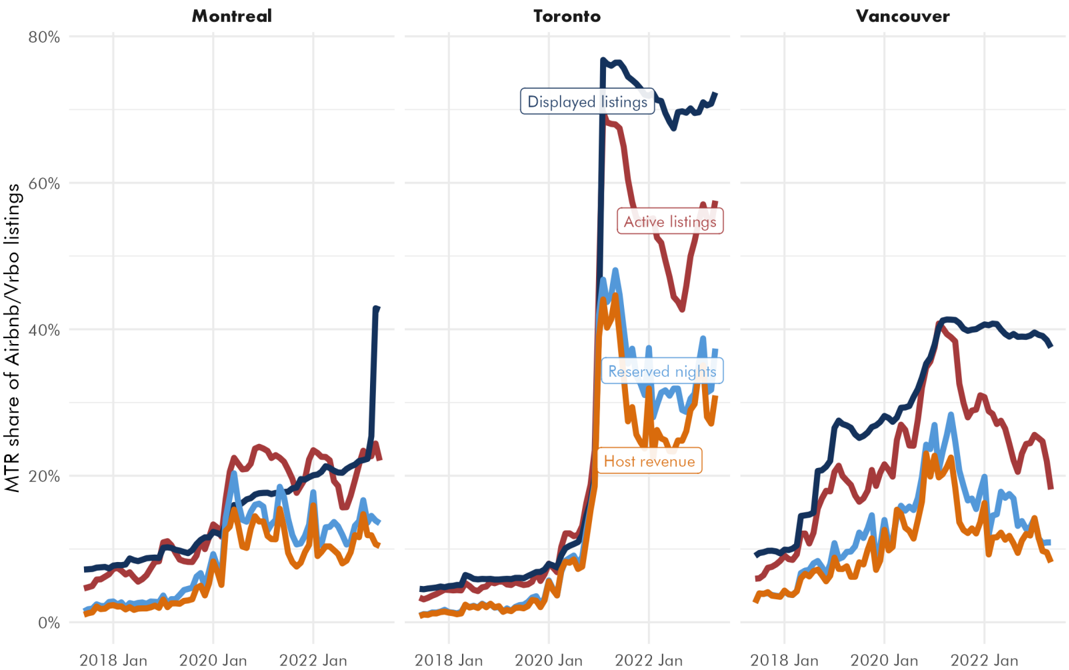
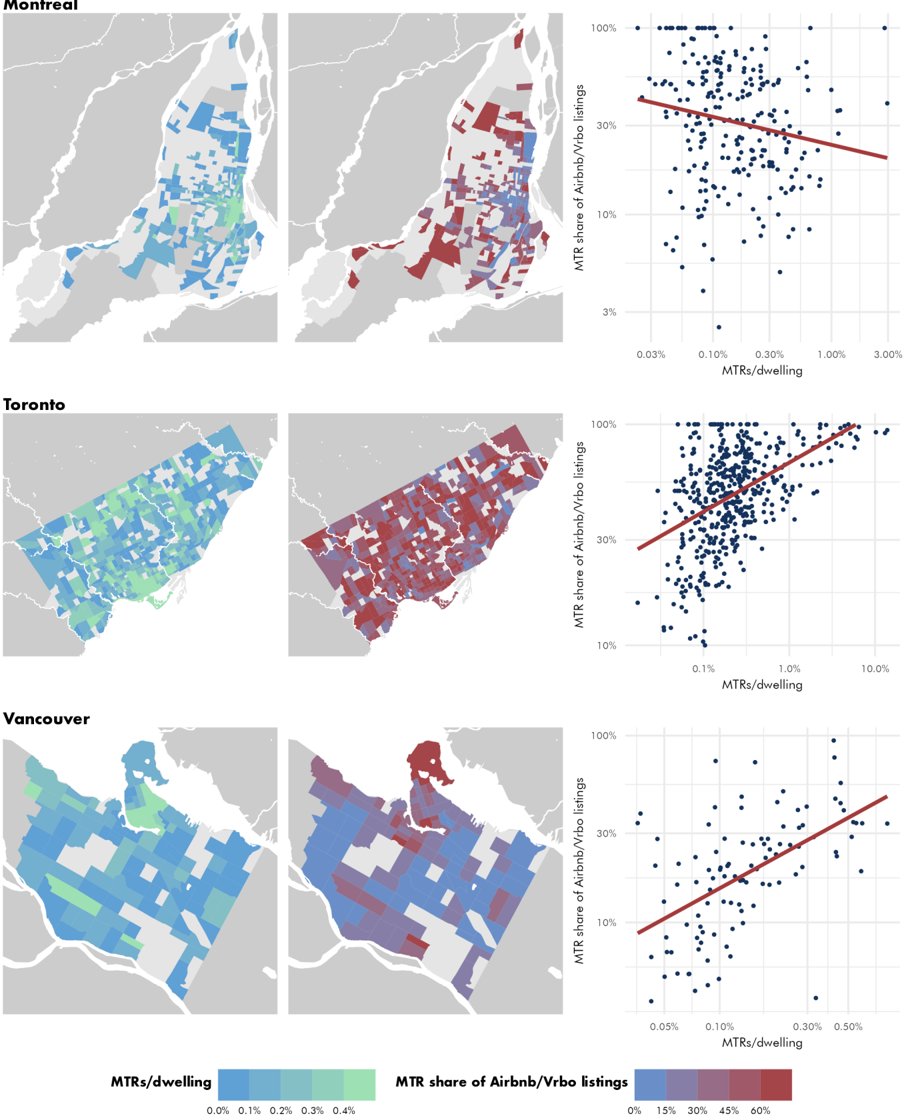
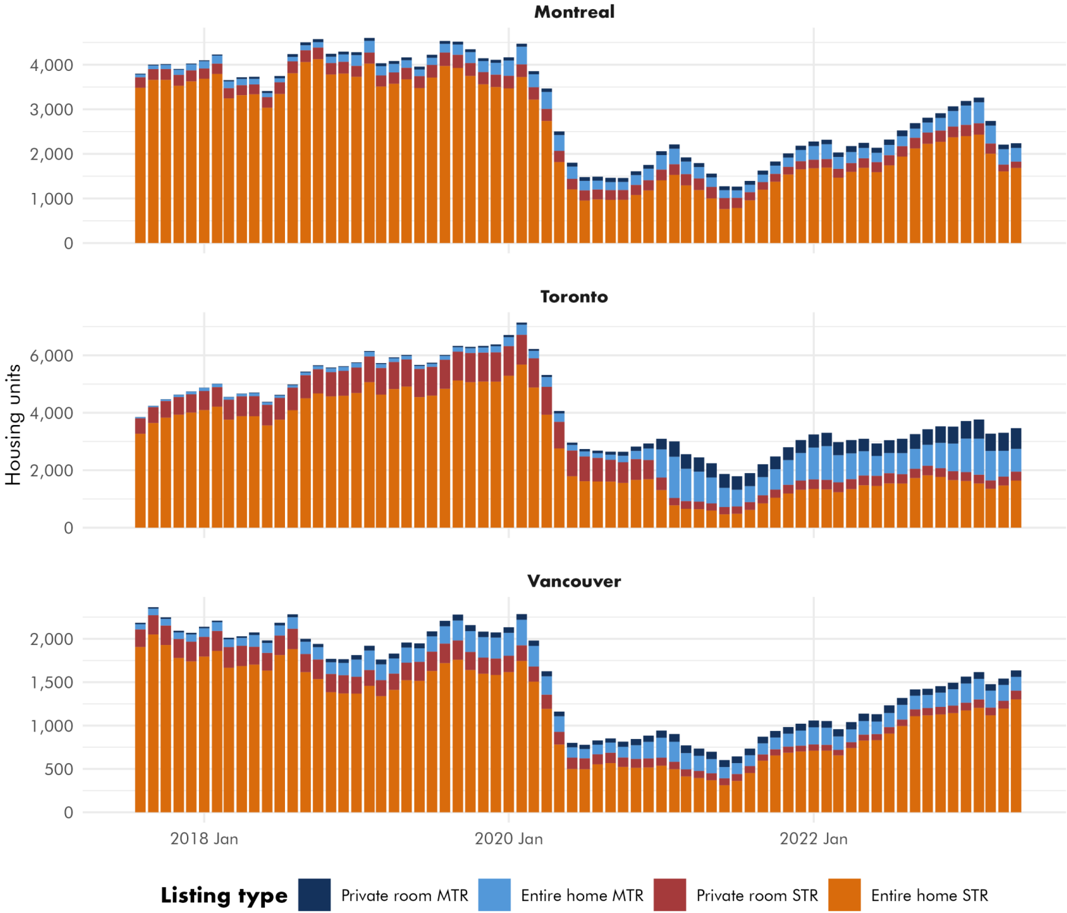
One of the many impacts of the Covid pandemic on Canadian cities was the complete collapse of short-term rental (STR) markets, as long-distance travel nearly vanished for more than a year. Many dedicated STRs shifted back to the long-term rental market, but others remained on STR platforms such as Airbnb but with minimum stays of one month or more—a land use we describe as “medium-term rentals” (MTRs). This paper provides a planning analysis of online-platform-mediated MTRs in Canadian cities and their housing-market, land-use, and regulatory implications. First, we identify and explore the regulatory grey zone inhabited by MTRs, which appear to be neither standard residential tenancies nor short-term tourist accommodations. Second, the paper provides a brief empirical overview of the emergence of MTRs during and after the Covid pandemic in Toronto, Montreal, and Vancouver. Third, the paper uses a policy case study of situations in which Ontario’s Landlord and Tenant Board has been asked to adjudicate non-standard tenancies to establish whether there is a planning basis for distinguishing medium-term rentals from other tenancy types. The paper concludes by identifying a key planning principle which could allow Canadian municipalities to pull MTRs out of the regulatory grey zone: regulating type of stay instead of length of stay.
Overview
CoChat Summary
TL;DR
This paper analyzes platform-mediated “medium-term rentals” (MTRs) in post-Covid Canadian cities, arguing they occupy a regulatory grey zone between municipally regulated short-term rentals and provincially regulated long-term tenancies. It combines quantitative platform data from Montreal, Toronto, and Vancouver with a qualitative case study of Ontario Landlord and Tenant Board rulings, concluding that municipalities should regulate “type of stay” rather than “length of stay.”
Key findings
- MTRs grew substantially on Airbnb/Vrbo across all three cities. In Montreal, MTRs’ share of active listings ranged from 22.1% to 24.4% in 2023, about four times the 2017 range of 4.6% to 6.6%. In December 2019, MTR shares of active listings were 11.6% in Montreal, 6.6% in Toronto, and 20.4% in Vancouver; one year later they rose to 24.0%, 23.5%, and 35.6%, respectively.
- Dedicated housing units operating as MTRs increased sharply as a share of total dedicated STR/MTR activity. In April 2018, MTRs accounted for 4.8% (Montreal), 2.1% (Toronto), and 5.4% (Vancouver); by April 2023, these had climbed to 20.4%, 46.2%, and 16.7%—a 3x increase in Vancouver, 4x in Montreal, and 10x in Toronto.
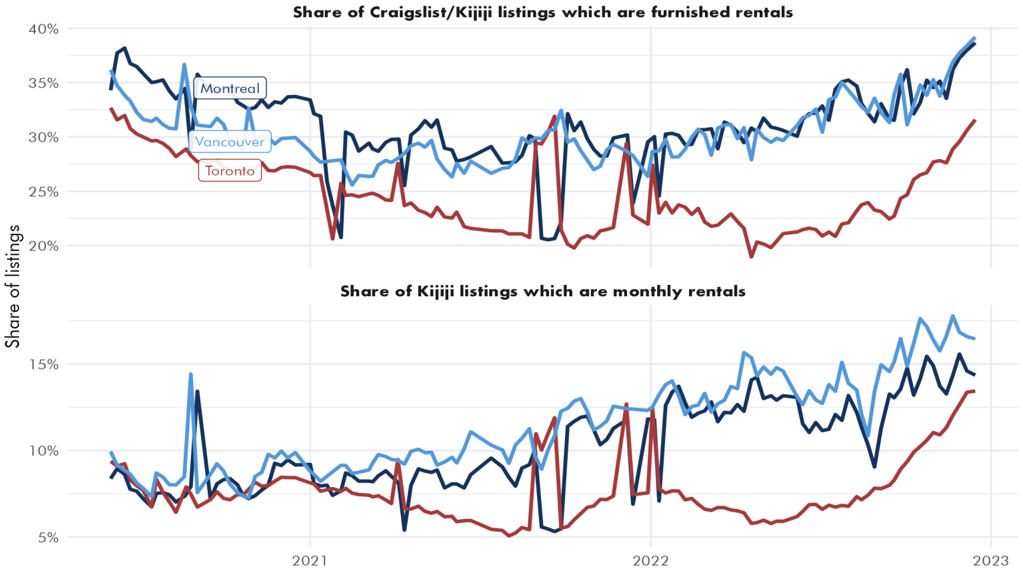
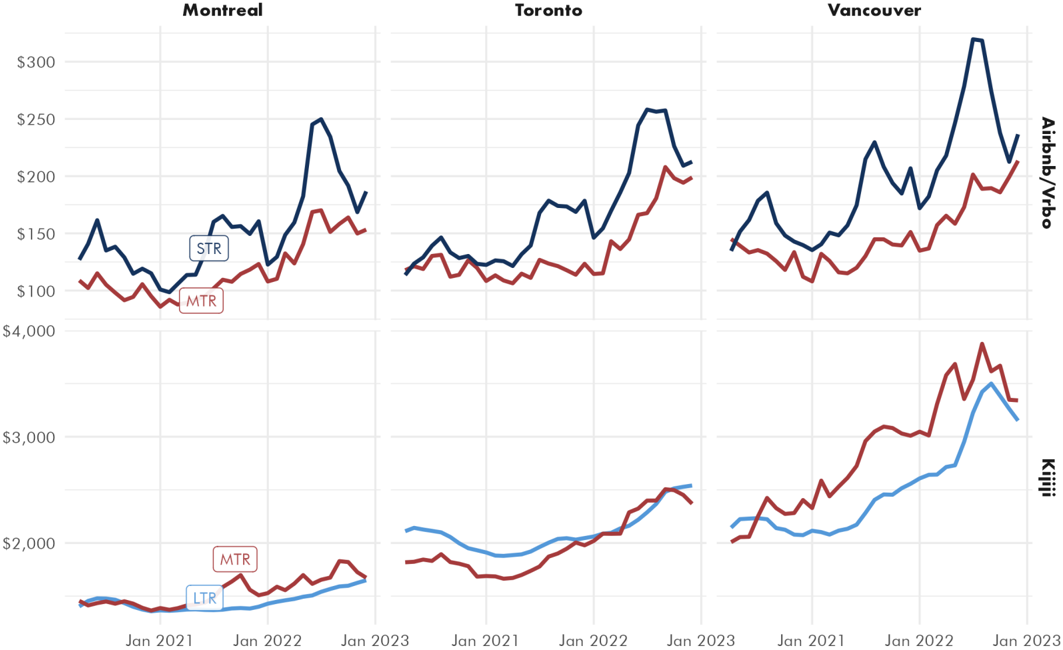
- MTRs also appeared on long-term rental platforms. By end-2022, furnished Craigslist/Kijiji ads reached 38.7% in Montreal, 31.6% in Toronto, and 39.2% in Vancouver. MTR prices generally sat between STR and LTR prices; in Montreal, nightly MTR prices on Airbnb/Vrbo correlated with monthly MTR prices on Kijiji at ρ = 0.84.
- The Ontario LTB case study found no single test for whether the Residential Tenancies Act applies to MTRs. In *Porter v. Ning (Wong)* (2023), a family booked a Toronto Airbnb for a 10-month stay but was evicted after the LTB found the rental exempt under section 5(a), despite the tenants’ efforts to establish residency.
Methods
- Quantitative analysis combined two datasets: Airdna web-scraped Airbnb/Vrbo STR data for Montreal, Toronto, and Vancouver from January 2015 to May 2023 (269,374 unique properties; 122,949,354 data points), and weekly Craigslist/Kijiji long-term rental scrapes from April 2020 to December 2022 (967,171 unique properties; 3,296,469 data points).
- The paper used descriptive and spatial analysis in R, including MTR shares of listings/activity, housing units converted to dedicated STRs/MTRs, furnished and short-term LTR ad shares, and price comparisons.
- Qualitative case study examined 16 Ontario Landlord and Tenant Board cases from 1993 to 2023 involving non-standard tenancies, selected for relevance to medium-term rentals and potential influence on future decisions.
Limitations
- The paper states that reliable estimates of the MTR market are nearly impossible because it is not tracked by Statistics Canada, CMHC, or other government agencies; Airdna’s machine-learning estimates of reserved versus blocked nights are described as the only significant potential source of error, mitigated by using large aggregates.
- The LTR platform data are only rental advertisements, with no availability calendars or confirmation of actual tenancies, so they are used only as supply-side indicators.
- The LTB case study is not a formal limitations section, but the text makes evident that findings are based on 16 selected Ontario cases and may not generalize to other provinces or all MTR arrangements; the quantitative analysis covers only Montreal, Toronto, and Vancouver.
Model-written summary. Check it against the paper before relying on it.
Integrity signals
Registry
Cites
Statistics
Figures


Verification
Claims the paper makes
0 Valid · 7 Not valid · 11 Not checked · 108 Own results and interpretations
A result the paper reports from its own data — it cites no other source for it, so there is none to check. The quote shows it is in the paper.
In the paper
“Second, in all three cities the trajectory of MTRs as a share of overall STR platform activity increased significantly over the 2017 -2023 time period.”
§ Neither housing nor hotel: The emergence of "medium-term rentals" in post-Covid Canadian cities > Evidence from STR platforms
plainstates an associationn = 3- Asserted: passes — The authors put it forward as true.
- Checkable: passes — It can be checked against evidence.
- Load-bearing: passes — The paper’s conclusions depend on it.
- Based: passes — The paper gives a reason why it holds.
A result the paper states — it cites no source for it, so there is none to check. The quote shows it is in the paper.
In the paper
“As we discuss in the case study of Toronto and Ontario below, cases which have come before the Ontario Landlord and Tenant Board imply considerable ambiguity concerning the conditions under which the Province would apply the Residential Tenancies Act to a medium-term rental.”
§ Neither housing nor hotel: The emergence of "medium-term rentals" in post-Covid Canadian cities > The regulatory grey zone of medium-term rentals
hedged- Asserted: passes — The authors put it forward as true.
- Checkable: passes — It can be checked against evidence.
- Load-bearing: passes — The paper’s conclusions depend on it.
- Based: passes — The paper gives a reason why it holds.
A result the paper states — it cites no source for it, so there is none to check. The quote shows it is in the paper.
In the paper
“But beyond this fact, there is no basis in either municipal or provincial policy in any of these cities for distinguishing a medium-term rental from other types of residential rental agreements.”
§ Neither housing nor hotel: The emergence of "medium-term rentals" in post-Covid Canadian cities > The regulatory grey zone of medium-term rentals
plain- Asserted: passes — The authors put it forward as true.
- Checkable: passes — It can be checked against evidence.
- Load-bearing: passes — The paper’s conclusions depend on it.
- Based: passes — The paper gives a reason why it holds.
A result the paper reports from its own data — it cites no other source for it, so there is none to check. The quote shows it is in the paper.
In the paper
“Our analysis suggests that the intended use has often been the key factor that the LTB considers-and particularly the question of whether the tenant has established their principal residency in the dwelling unit.”
§ Neither housing nor hotel: The emergence of "medium-term rentals" in post-Covid Canadian cities > Are MTR renters protected under the Residential Tenancies Act?
hedgedstates an association- Asserted: passes — The authors put it forward as true.
- Checkable: passes — It can be checked against evidence.
- Load-bearing: passes — The paper’s conclusions depend on it.
- Based: passes — The paper gives a reason why it holds.
A result the paper states — it cites no source for it, so there is none to check. The quote shows it is in the paper.
In the paper
“However, in cases where the tenant intended to stay long-term, the LTB has decided to apply the RTA instead of deferring to the Innkeepers Act-as there is the possibility that these accommodation types intended for the travelling public can instead be used for long-term residency.”
§ Neither housing nor hotel: The emergence of "medium-term rentals" in post-Covid Canadian cities > Are MTR renters protected under the Residential Tenancies Act?
plainstates a cause- Asserted: passes — The authors put it forward as true.
- Checkable: passes — It can be checked against evidence.
- Load-bearing: passes — The paper’s conclusions depend on it.
- Based: passes — The paper gives a reason why it holds.
35 more claims
Create a free account to see all 126 claims and every source verdict.
- It may state two separate claims as one. 68
- Probably not a substantial claim. 28
Claims other papers make about this one
Each is checked against this paper’s own text: does it say what the citing paper says it does?
In the citing paper
“This is a finding which is consistent with the well-documented difficulties municipalities have faced in applying STR regulations in a binding manner (Boeing et al., 2021;Nieuwland & Van Melik, 2020;Wachsmuth & Buglioni, 2024); it is plausible that, over time, principal-residence restrictions have become better implemented, and hence have had stronger ameliorative effects on rents.”
From Housing versus home sharing: the causal impact of short-term rental regulation on residential rents (2026) · cites this paper as Wachsmuth & Buglioni, 2024
Citations
Cites
Airbnb: disruptive innovation and the rise of an informal tourism accommodation sector
Guttentag, D. (2015) · Current Issues in Tourism · doi:10.1080/13683500.2013.827159 · Cited by 1,848
Sharing economy: A review and agenda for future research
Cheng, M. (2016) · International Journal of Hospitality Management · doi:10.1016/j.ijhm.2016.06.003 · Cited by 888
Airbnb and the rent gap: Gentrification through the sharing economy
Wachsmuth, D., & Weisler, A. (2018) · Environment and Planning A: Economy and Space · doi:10.1177/0308518x18778038 · Cited by 720
Self-citationWhen Tourists Move In: How Should Urban Planners Respond to Airbnb?
Gurran, N., & Phibbs, P. (2017) · Journal of the American Planning Association · doi:10.1080/01944363.2016.1249011 · Cited by 538
Airbnb: the future of networked hospitality businesses
Oskam, J., & Boswijk, A. (2016) · Journal of Tourism Futures · doi:10.1108/jtf-11-2015-0048 · Cited by 505
Is Home Sharing Driving up Rents? Evidence from Airbnb in Boston
Horn, K. M., & Merante, M. (2016) · Journal of Housing Economics · doi:10.1016/j.jhe.2017.08.002 · Cited by 423
Holiday Rentals: The New Gentrification Battlefront
Gant, A. C. (2016) · Sociological Research Online · doi:10.5153/sro.4071 · Cited by 408
Regulating Airbnb: how cities deal with perceived negative externalities of short-term rentals
Nieuwland, S., & van Melik, R. (2020) · Current Issues in Tourism · doi:10.1080/13683500.2018.1504899 · Cited by 403
The Effect of Home-Sharing on House Prices and Rents: Evidence from Airbnb
Barron, K., Kung, E., & Proserpio, D. (2021) · Marketing Science · doi:10.1287/mksc.2020.1227 · Cited by 326
Digital Nomads Beyond the Buzzword: Defining Digital Nomadic Work and Use of Digital Technologies
Nash, C., Jarrahi, M. H., Sutherland, W., & Phillips, G. (2018) · Lecture Notes in Computer Science · doi:10.1007/978-3-319-78105-1_25 · Cited by 203
Research works printed but not linked: 3
- Combs, J., Kerrigan, D., & Wachsmuth, D. (2020). Short-term rentals in Canada. Canadian Journal of Urban Research, 29 (1), 119-134.
- Lee, D. (2016). How Airbnb short-term rentals exacerbate Los Angeles's affordable housing crisis: Analysis and policy recommendations. Harvard Law & Policy Review, 10, 229.
- Mermet, A. C. (2017). Airbnb and tourism gentrification: critical insights from the exploratory analysis of the 'Airbnb syndrome' in Reykjavik. In M. Gravari-Barbas, & S. Guinand (Eds.), Tourism and Gentrification in Contemporary Metropolises (pp. 52-74). London: Routledge.
Cited by
Geographies of Digital Nomadism: A Research Agenda
Sciuva, E. (2025) · Geography Compass · doi:10.1111/gec3.70016 · Cited by 36
The Recent Rise in Mid-Term Rentals in Barcelona: Causes and Implications
Orozco-Martínez, C., & Alonso, F. G. (2024) · Critical Housing Analysis · doi:10.13060/23362839.2024.11.2.572 · Cited by 10
Belot, C., Kerrigan, D., & Wachsmuth, D. (2024) · Urban Research & Practice · doi:10.1080/17535069.2024.2382248 · Cited by 9
Self-citation(Other) temporary populations and the rise of platform-mediated medium-term rentals
Sciuva, E. (2025) · Regional Studies · doi:10.1080/00343404.2025.2523977 · Cited by 7
Uyttebrouck, C., & Paccoud, A. (2026) · Regional Studies · doi:10.1080/00343404.2026.2626500 · Cited by 5
Déjean, S., Robertson, C., & Suire, R. (2025) · Regional Studies · doi:10.1080/00343404.2025.2533472 · Cited by 4
Housing versus home sharing: the causal impact of short-term rental regulation on residential rents
Wachsmuth, D., & St-Hilaire, C. (2026) · Regional Studies · doi:10.1080/00343404.2026.2670360 · Cited by 2
Self-citationMid-term rentals and the Airbnbification of housing
Bei, G., Brollo, B., & Celata, F. (2026) · Journal of Urban Affairs · doi:10.1080/07352166.2026.2702434 · Cited by 1
Motels as rural homeless shelters: A qualitative study across five Ontario communities
Buck‐McFadyen, E., & Okoye, N. (2025) · Wellbeing Space and Society · doi:10.1016/j.wss.2025.100272 · Cited by 1
Short term rental accommodation: Models, impacts and policy responses
Gurran, N., Buckle, C., Troy, L., Nasreen, Z., Crommelin, L., Phibbs, P., Shrestha, P., Redmond, D., & Harrison, J. (2026) · AHURI Final Report · doi:10.18408/ahuri7333501
Temporarily housing the homeless in Northern Indigenous communities: a case of the Tłı̨chǫ region
Agrawal, S., & Zoe, C. (2026) · Planning Practice and Research · doi:10.1080/02697459.2026.2663340
Uyttebrouck, C., & Paccoud, A. (2026) · International Journal of Housing Policy · doi:10.1080/19491247.2026.2707742
Direct and Indirect Platform Labour: Cleaning for Short-Term Rental (STR) platforms
Goyette, K. (2026) · TSpace (University of Toronto)
Brollo, B. (2026) · Population Space and Place · doi:10.1002/psp.70370
Conte, V. (2026) · International Journal of Housing Policy · doi:10.1080/19491247.2026.2736048
Metadata
- Authors
- Wachsmuth, D., & Buglioni, B.
- Affiliations
- McGill University (CA)
- Venue
- Canadian Planning and Policy / Aménagement et politique au Canada
- Publisher
- Queen's University Library
- Published
- 2024-03-15
- Volume
- 2024
- Issue
- 1
- Pages
- 68-89
- ISSN
- 2562-122X (ISSN-L)
- OpenAlex
- W4392884799
- Cited by
- 15
- References
- 14
- Citations by year
- 2026: 9 · 2025: 4 · 2024: 2
- FWCI
- 3.61
- Type
- journal article
- Language
- en
- Open access
- diamond
- doi.org
- Locations
- Canadian Planning and Policy / Aménagement et politique au Canada (publishedVersion, cc-by)
- Érudit (Université de Montréal) (submittedVersion, cc-by)
- DOAJ (DOAJ: Directory of Open Access Journals) (submittedVersion)
- Funders
- McGill University
- Social Sciences and Humanities Research Council of Canada (435-2019-0720)
- Topics
- Social Sciences › Business, Management and Accounting › Marketing › Sharing Economy and Platforms
- Social Sciences › Economics, Econometrics and Finance › Finance › Housing, Finance, and Neoliberalism
- Social Sciences › Urban Studies › Urban Planning and Governance
- Keywords
- short-term rentals, Airbnb, COVID-19 pandemic, housing regulation, land use regulation, residential tenancy law, length of hospital stay, Canadian cities, Toronto, Montreal, Vancouver
About these checks
Registry, retraction, Cites and statistics results are computed, not judged, with one exception: a printed reference that no index lists is read once by a model before it counts as a citation error. Claims are extracted by a model and kept only when their quote appears verbatim in the text; each cited source is then checked, with a model’s help, for whether it says what the claim relies on. Those verdicts can be wrong — read the claim’s quote and the cited source before relying on one.
A language model drew the claims from the paper on 2026-11-13, under version 3 of the claim definition (model deepseek-v4.1-flash, prompt extract-v3).
A second model labelled each claim on 2026-11-13 (model jev-1.13-20260917, definition revision gold-guideline-v0.2).
Statistics and arithmetic are recomputed, not judged.
Confidence bands are shown only for fields calibrated on our annotated test set. None is calibrated yet, so no band is shown.
What counts as a claim ›How we measure confidence ›How we check this ›
Are you an author, or do you see a problem with this page? Request a review
Data sources
Bibliographic data: Semantic Scholar, OpenAlex, Crossref.
Contains information from the Semantic Scholar Academic Graph Datasets, made available under the ODC Attribution License (ODC-BY 1.0).
Semantic Scholar’s data is described in: Kinney, R., et al. (2023). The Semantic Scholar Open Data Platform. arXiv:2301.10140.
