

The DOI matches its Crossref record; 1 of the 1 references it cites were found in a registry or an index.
Repurposing a Fully-Reducing Polyketide Synthase for 2-Methyl Guerbet-like Lipid Production
Open accessPreprint — published as 10.1021/acscatal.4c04714 · Paper page
Abstract
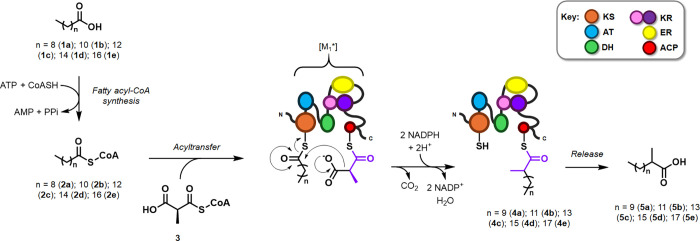
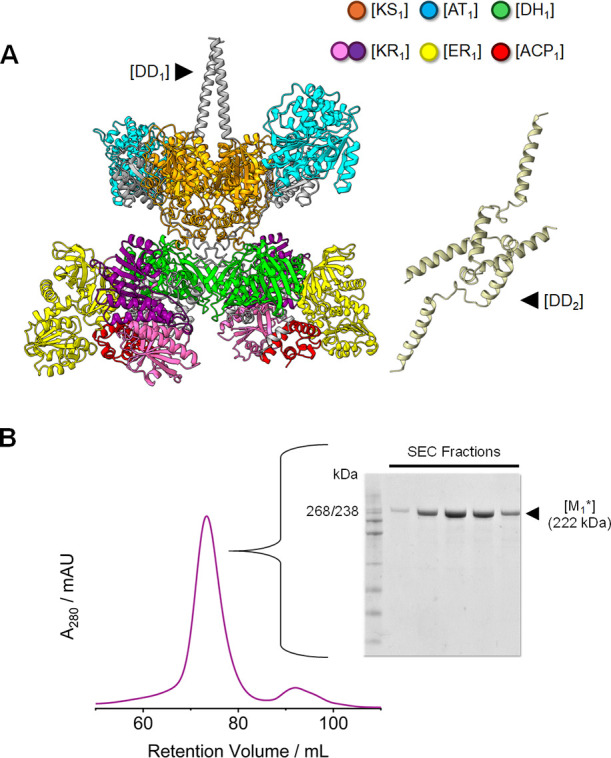
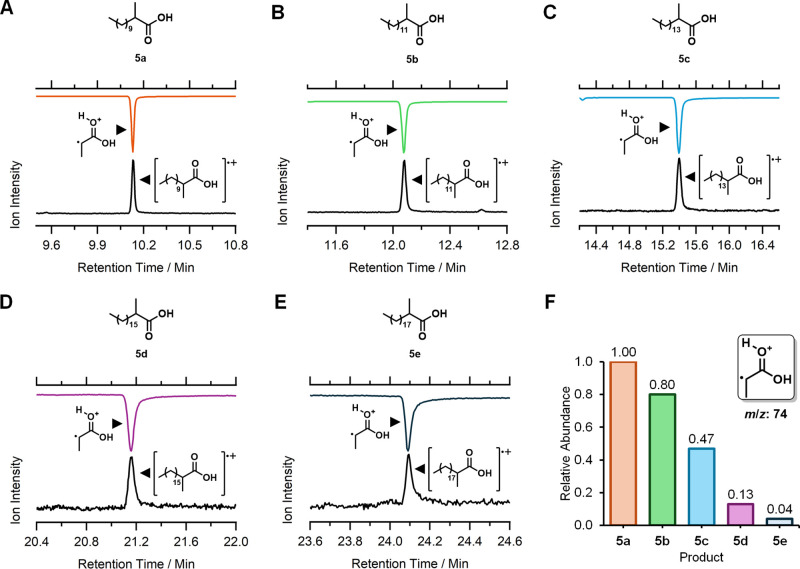
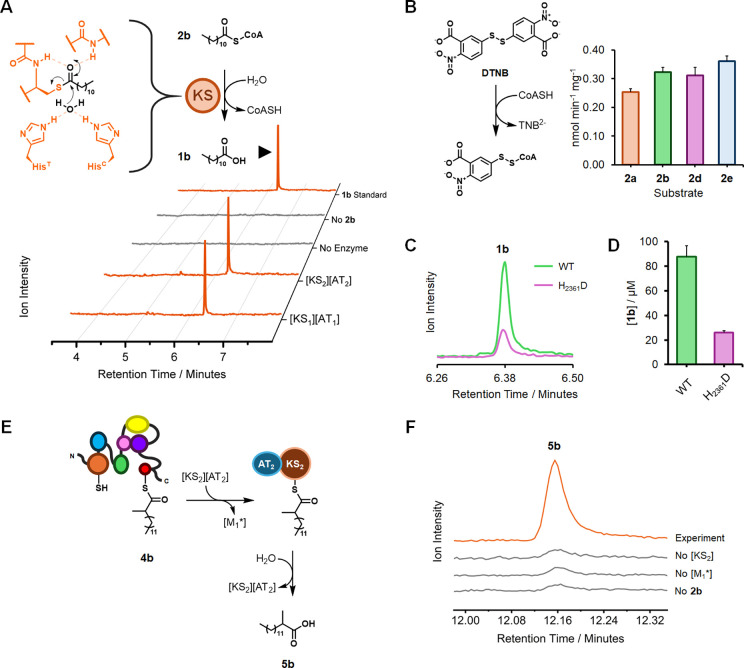
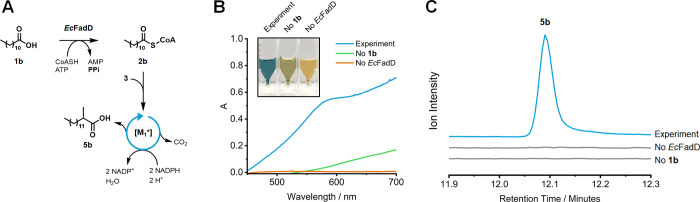
In Nature, thousands of diverse and bioactive polyketides are assembled by a family of multifunctional, “assembly line” enzyme complexes called Polyketide Synthases (PKS). Since the late 20th century, there have been several attempts to decode, re-arrange and “re-programme” the PKS assembly line to generate valuable materials such as biofuels and platform chemicals. By mastering the biosynthetic logic underpinning PKSs, there exists the potential to develop these enzymes into scalable biocatalysts for sustainable chemical production. Here, the first module from Mycobacterium tuberculosis (Mt) PKS12 – an unorthodox, “modularly-iterative” PKS – was modified and repurposed towards the production of 2-methyl Guerbet lipids, which have wide applications in industry. We established a robust method for the recombinant expression and purification of this modified module (named [M1*]), and we demonstrated its synthetic utility in generating several 2-methyl Guerbet-like lipids (C13-C21). Furthermore, we studied and applied the promiscuous thioesterase (TE) activity of a neighbouring β-ketoacyl synthase (KS) to release [M1*]-bound condensation products in a one-pot biosynthetic cascade. Finally, by coupling the E. coli fatty acyl-CoA synthetase FadD to [M1*], we could generate our primary target compound – 2-methyltetradecanoic acid – from lauric acid, highlighting the potential to derive valuable lipids from inexpensive fatty acids. This work demonstrates the biosynthetic potential of [M1*] in generating industrially-useful Guerbet-like chemicals, whilst also contributing to the broader exploration and application of PKS modules for sustainable chemical manufacturing.
Overview
The claims and statistics of this paper haven’t been checked yet.
Run the check — free, no account needed. It reads the open-access text and checks the sources it cites.
Integrity signals
Registry
Cites
Statistics
Figures
Verification
Claims the paper makes
The claims and statistics of this paper haven’t been checked yet.
Run the check — free, no account needed. It reads the open-access text and checks the sources it cites.
Self-check
Percentages, sums and reported differences re-computed from the paper’s own numbers.
The self-check needs the paper’s full text.
Citations
Cites
Highly accurate protein structure prediction with AlphaFold
Jumper, J., Evans, R., Pritzel, A., Green, T., Figurnov, M., Ronneberger, O., Tunyasuvunakool, K., Bates, R., Žídek, A., Potapenko, A., et al. (2021) · Nature · doi:10.1038/s41586-021-03819-2 · Cited by 43,764
Metadata
- Authors
- Herrera, M. A., McColm, S., Craigie, L.-M., Simpson, J., Brown, F., Clarke, D., Carr, R., & Campopiano, D.
- Affiliations
- University of Edinburgh (GB)
- Ingenza (United Kingdom) (GB)
- Corresponding author
- Campopiano, Dominic
- Venue
- ACS Catalysis
- Publisher
- American Chemical Society (ACS)
- Published
- 2024-06-25
- Volume
- 14
- Issue
- 22
- Pages
- 16834-16842
- ISSN
- 2155-5435 (ISSN-L)
- PMC
- PMC11574752
- OpenAlex
- W4403942416
- Cited by
- 1
- References
- 1
- Citations by year
- 2025: 1
- FWCI
- 0.28
- Type
- journal article
- Language
- en
- Open access
- hybrid
- doi.org
- Locations
- ACS Catalysis (publishedVersion, cc-by)
- ChemRxiv (acceptedVersion, cc-by-nc-nd)
- PubMed Central (publishedVersion, cc-by)
- PubMed (publishedVersion)
- Edinburgh Research Explorer (University of Edinburgh) (submittedVersion, cc-by)
- Funders
- Industrial Biotechnology Innovation Centre (BB/S506953/1)
- Engineering and Physical Sciences Research Council (EP/K039717/1)
- Topics
- Life Sciences › Immunology and Microbiology › Applied Microbiology and Biotechnology › Microbial Natural Products and Biosynthesis
- Life Sciences › Biochemistry, Genetics and Molecular Biology › Molecular Biology › Microbial Metabolic Engineering and Bioproduction
- Life Sciences › Biochemistry, Genetics and Molecular Biology › Biochemistry › Lipid metabolism and biosynthesis
- Keywords
- polyketide synthase, beta-ketoacyl synthase, lauric acid, polyketide biosynthesis, recombinant protein expression
About these checks
Registry, retraction, Cites and statistics results are computed, not judged, with one exception: a printed reference that no index lists is read once by a model before it counts as a citation error. Claims are extracted by a model and kept only when their quote appears verbatim in the text; each cited source is then checked, with a model’s help, for whether it says what the claim relies on. Those verdicts can be wrong — read the claim’s quote and the cited source before relying on one.
Statistics and arithmetic are recomputed, not judged.
Confidence bands are shown only for fields calibrated on our annotated test set. None is calibrated yet, so no band is shown.
What counts as a claim ›How we measure confidence ›How we check this ›
Are you an author, or do you see a problem with this page? Request a review
How to cite
Cite CoChat for the checks on this page, and the paper for its own findings.
- This page
- CoChat. (2026). Citation check: Repurposing a Fully-Reducing Polyketide Synthase for 2-Methyl Guerbet-like Lipid Production. https://app.cochat.ai/papers/10.26434/chemrxiv-2024-0lrh8
- The paper
- Herrera, M. A., McColm, S., Craigie, L.-M., Simpson, J., Brown, F., Clarke, D., Carr, R., & Campopiano, D. (2024). Repurposing a Fully-Reducing Polyketide Synthase for 2-Methyl Guerbet-like Lipid Production. ACS Catalysis. https://doi.org/10.26434/chemrxiv-2024-0lrh8
Data sources
Bibliographic data: Semantic Scholar, OpenAlex, Crossref.
Contains information from the Semantic Scholar Academic Graph Datasets, made available under the ODC Attribution License (ODC-BY 1.0).
Semantic Scholar’s data is described in: Kinney, R., et al. (2023). The Semantic Scholar Open Data Platform. arXiv:2301.10140.
