PreprintCited by 170Alzheimer's disease research and treatmentsDementia and Cognitive Impairment ResearchNeuroinflammation and Neurodegeneration Mechanisms

The DOI matches its Crossref record; 1 of the 1 references it cites were found in a registry or an index.

Alzheimer's Disease: Exploring the Landscape of Cognitive Decline

Open access
Tenchov, Rumiana, Sasso, Janet, Zhou, Qiongqiong Angela·2024·ACS Chemical Neuroscience

Preprint — published as 10.1021/acschemneuro.4c00339 · Paper page

Abstract

Alzheimer's disease (AD) is a progressive neurodegenerative disorder characterized by cognitive decline, memory loss, and impaired daily functioning. The pathology of AD is marked by the accumulation of amyloid-beta plaques and tau protein tangles in brain, along with neuroinflammation and synaptic dysfunction. Genetic factors, such as mutations in APP, PSEN1, and PSEN2 genes, as well as APOE ε4 allele, contribute to increased risk of acquiring AD. Currently available treatments provide symptomatic relief but do not halt disease progression. Research efforts are focused on developing disease-modifying therapies that target the underlying pathological mechanisms of AD. Advances in identification and validation of reliable biomarkers for AD hold great promise for enhancing early diagnosis, monitoring disease progression, and assessing treatment response in clinical practice, in effort to alleviate the burden of this devastating disease. In this paper, we analyze data from the CAS Content Collection to summarize the research progress in Alzheimer’s disease. We examine the publication landscape in effort to provide insights into current knowledge advances and developments. We also review the most discussed and emerging concepts and assess the strategies to combat the disease. We explore the genetic risk factors, pharmacological targets, and comorbid diseases. Finally, we inspect clinical applications of products against AD with their development pipelines and efforts for drug repurposing. The objective of this review is to provide a broad overview of the evolving landscape of current knowledge regarding AD, to outline challenges, and evaluate growth opportunities to further efforts in combating the disease.

Overview

The claims and statistics of this paper haven’t been checked yet.

Run the check — free, no account needed. It reads the open-access text and checks the sources it cites.

A few free checks a day · papers already verified open instantly · results are public

Integrity signals

Registry

Crossref · 10.26434/chemrxiv-2024-f0zz5

Cites

1 of 1 references verified0 citation errors · 0 not checkable

Statistics

Figures

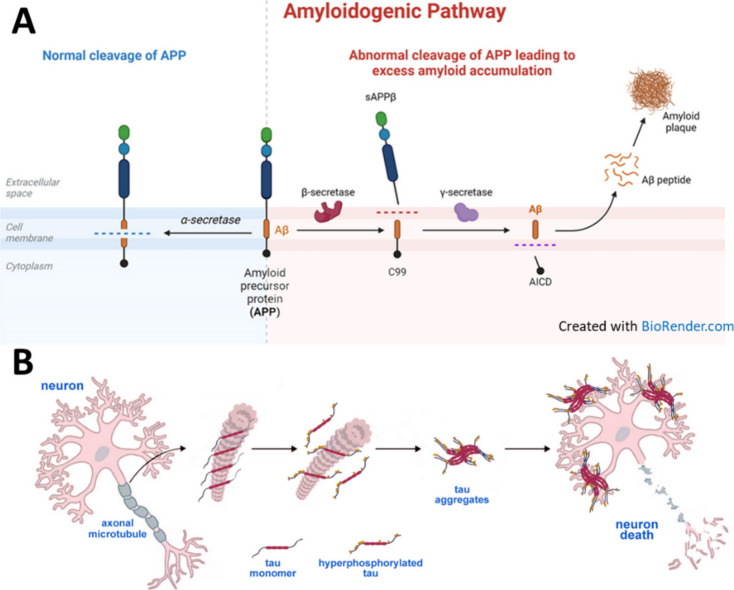
Figure 1 (A) Normal (left) and pathological (right) cleavage of amyloid precursor protein (APP): when cleaved by α-secretase in the middle of the β-amyloid domain (Aβ), it is not amyloidogenic; however, when APP is cleaved by β- and γ-secretase enzymes, neurotoxic Aβ peptides are released, which can accumulate into oligomer aggregates and further form insoluble β-sheet amyloid fibrils triggering local inflammatory response (Created with BioRender.com). C99: 99-residue transmembrane fragment of APP, which is cleaved by β-secretase, is a key step in the amyloidogenic pathway. C99 is then cleaved by γ-secretase to release Aβ and AICD. AICD: an AβPP intracellular domain fragment that is generated by γ-secretase cleavage. Data suggests that AICD mainly comes from C99. AICD, along with C99 and Aβ peptides, may contribute to Alzheimer’s disease pathology. The amyloidogenic pathway mainly takes place in endosomes. (B) Formation of neurofibrillary tangles by the tau protein and subsequent neuron death in tauopathies, such as Alzheimer’s disease. In pathologies, tau becomes hyperphosphorylated and detaches from microtubules, which causes microtubule destabilization; phosphorylated tau aggregates to form neurofibrillary tangles.
Figure 1 (A) Normal (left) and pathological (right) cleavage of amyloid precursor protein (APP): when cleaved by α-secretase in the middle of the β-amyloid domain (Aβ), it is not amyloidogenic; however, when APP is cleaved by β- and γ-secretase enzymes, neurotoxic Aβ peptides are released, which can accumulate into oligomer aggregates and further form insoluble β-sheet amyloid fibrils triggering local inflammatory response (Created with BioRender.com). C99: 99-residue transmembrane fragment of APP, which is cleaved by β-secretase, is a key step in the amyloidogenic pathway. C99 is then cleaved by γ-secretase to release Aβ and AICD. AICD: an AβPP intracellular domain fragment that is generated by γ-secretase cleavage. Data suggests that AICD mainly comes from C99. AICD, along with C99 and Aβ peptides, may contribute to Alzheimer’s disease pathology. The amyloidogenic pathway mainly takes place in endosomes. (B) Formation of neurofibrillary tangles by the tau protein and subsequent neuron death in tauopathies, such as Alzheimer’s disease. In pathologies, tau becomes hyperphosphorylated and detaches from microtubules, which causes microtubule destabilization; phosphorylated tau aggregates to form neurofibrillary tangles.CC BY · PubMed Central
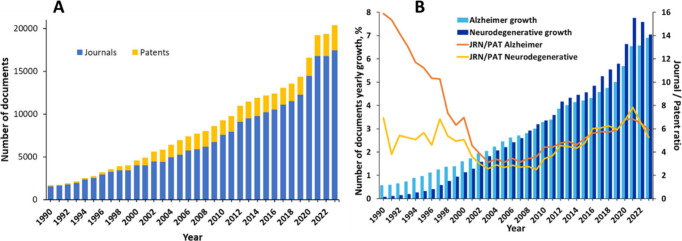
Figure 2 (A) Yearly trend of the number of documents (journal articles and patents) in the CAS Content Collection related to the AD. (B) Comparison between relative growth in the number of documents related to the AD (dark blue bars) and all neurodegenerative diseases (light blue bars); orange and yellow lines compare the journal (JRN)/patent (PAT) ratio for the AD and all neurodegenerative diseases, respectively.
Figure 2 (A) Yearly trend of the number of documents (journal articles and patents) in the CAS Content Collection related to the AD. (B) Comparison between relative growth in the number of documents related to the AD (dark blue bars) and all neurodegenerative diseases (light blue bars); orange and yellow lines compare the journal (JRN)/patent (PAT) ratio for the AD and all neurodegenerative diseases, respectively.CC BY · PubMed Central
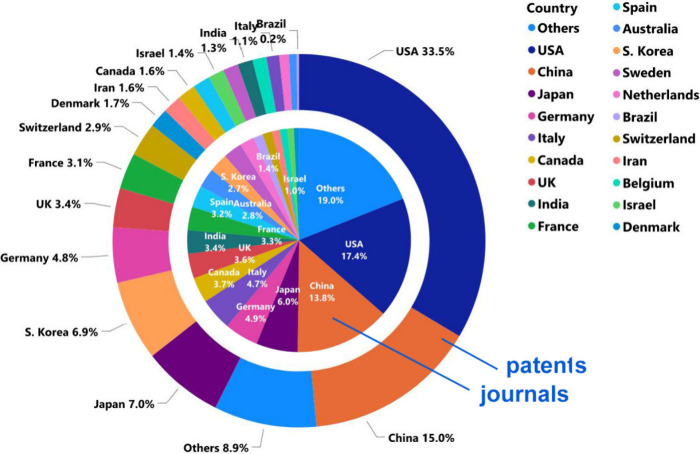
Figure 3 Top countries/regions with respect to the number of AD-related journal articles (inner pie chart) and patents (outer donut chart) in the CAS Content Collection.
Figure 3 Top countries/regions with respect to the number of AD-related journal articles (inner pie chart) and patents (outer donut chart) in the CAS Content Collection.CC BY · PubMed Central
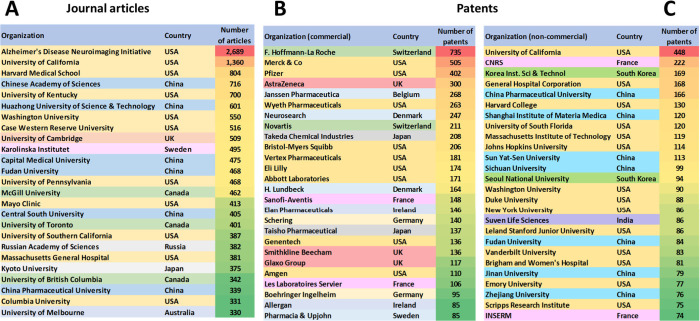
Figure 4 Leading organizations publishing documents related to AD as found in the CAS Content Collection: (A) journal articles, (B) patents by commercial organizations, (C) patents by noncommercial organizations.
Figure 4 Leading organizations publishing documents related to AD as found in the CAS Content Collection: (A) journal articles, (B) patents by commercial organizations, (C) patents by noncommercial organizations.CC BY · PubMed Central
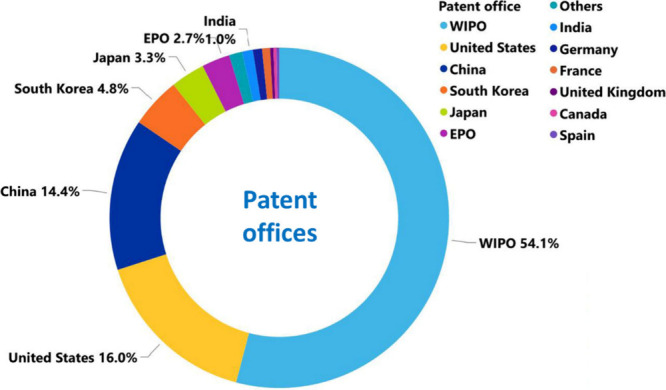
Figure 5 Distribution of patents related to AD with respect to patent offices they have been filed at (WIPO, World Intellectual Property Organization; EPO, European Patent Office).
Figure 5 Distribution of patents related to AD with respect to patent offices they have been filed at (WIPO, World Intellectual Property Organization; EPO, European Patent Office).CC BY · PubMed Central
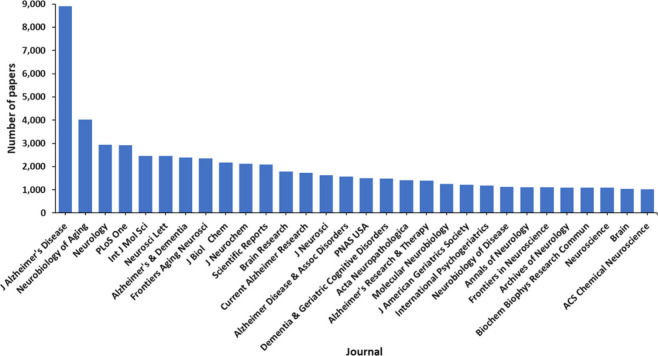
Figure 6 Leading scientific journals publishing articles related to AD as found in the CAS Content Collection.
Figure 6 Leading scientific journals publishing articles related to AD as found in the CAS Content Collection.CC BY · PubMed Central
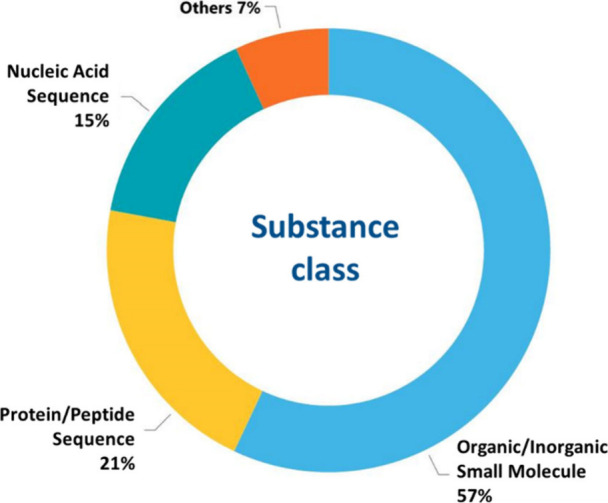
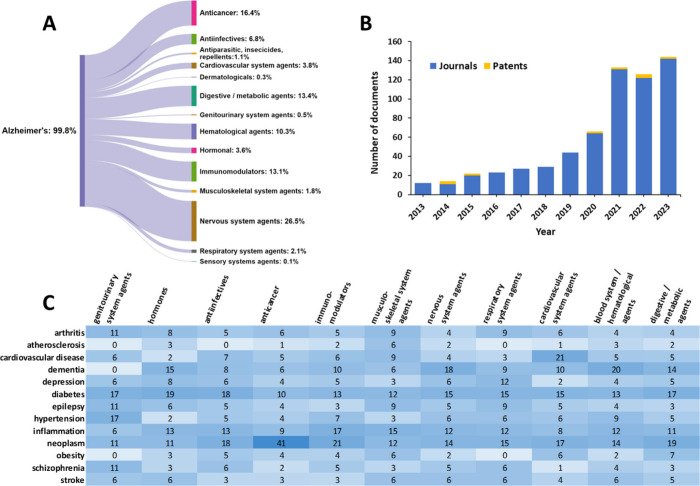
Figure 7 Distribution of the major substance classes between the documents related to the AD research.
Figure 7 Distribution of the major substance classes between the documents related to the AD research.CC BY · PubMed Central
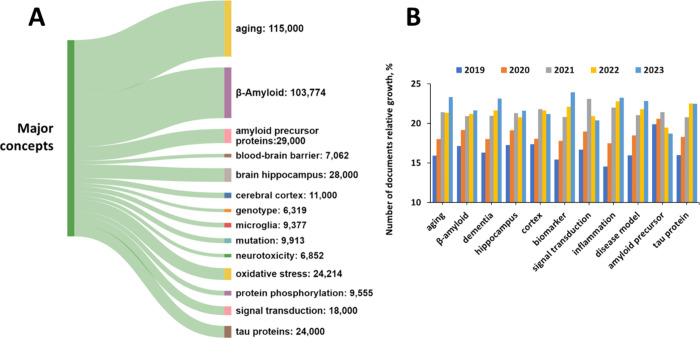
Figure 8 (A) Key concepts explored in the scientific publications related to AD as found in the CAS Content Collection, with a number of documents indicated. (B) Yearly growth of the number of documents (journal articles and patents) exploring certain essential AD-related concepts.
Figure 8 (A) Key concepts explored in the scientific publications related to AD as found in the CAS Content Collection, with a number of documents indicated. (B) Yearly growth of the number of documents (journal articles and patents) exploring certain essential AD-related concepts.CC BY · PubMed Central
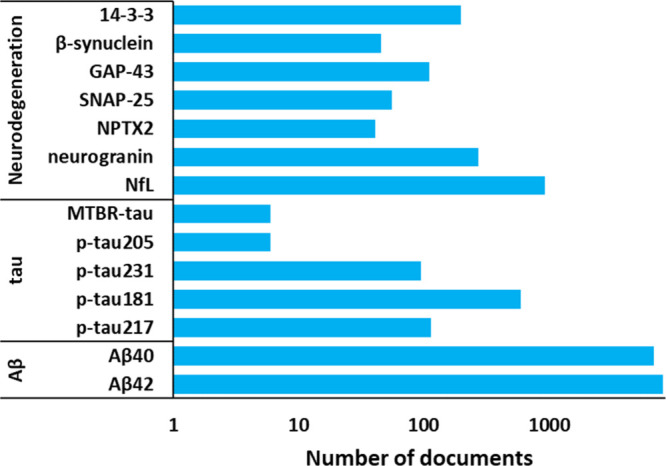
Figure 9 AD biomarkers as represented in the CAS Content Collection.
Figure 9 AD biomarkers as represented in the CAS Content Collection.CC BY · PubMed Central
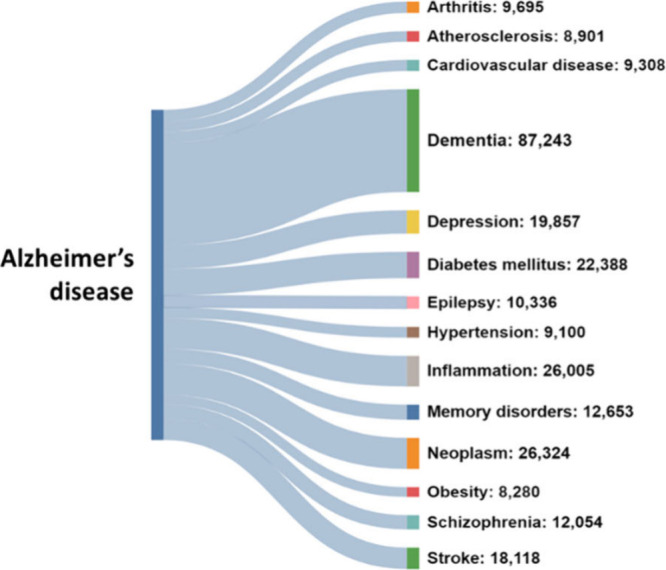
Figure 10 Co-occurrence of the AD concept with other disease concepts in the CAS Content Collection documents, with the associated number of documents shown.
Figure 10 Co-occurrence of the AD concept with other disease concepts in the CAS Content Collection documents, with the associated number of documents shown.CC BY · PubMed Central
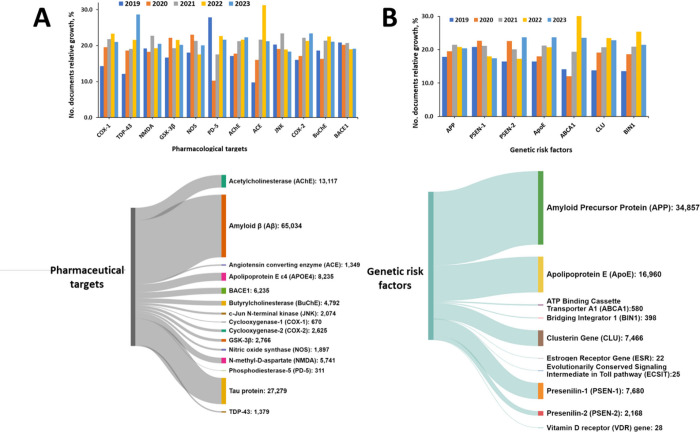
Figure 11 Pharmacological targets (A) and genetic risk factors (B) of AD. Upper panels illustrate the relative growth of the number of documents in the last five years (2019–2023), while the lower panels show the number of documents related to various major target proteins and genetic risk factors.
Figure 11 Pharmacological targets (A) and genetic risk factors (B) of AD. Upper panels illustrate the relative growth of the number of documents in the last five years (2019–2023), while the lower panels show the number of documents related to various major target proteins and genetic risk factors.CC BY · PubMed Central
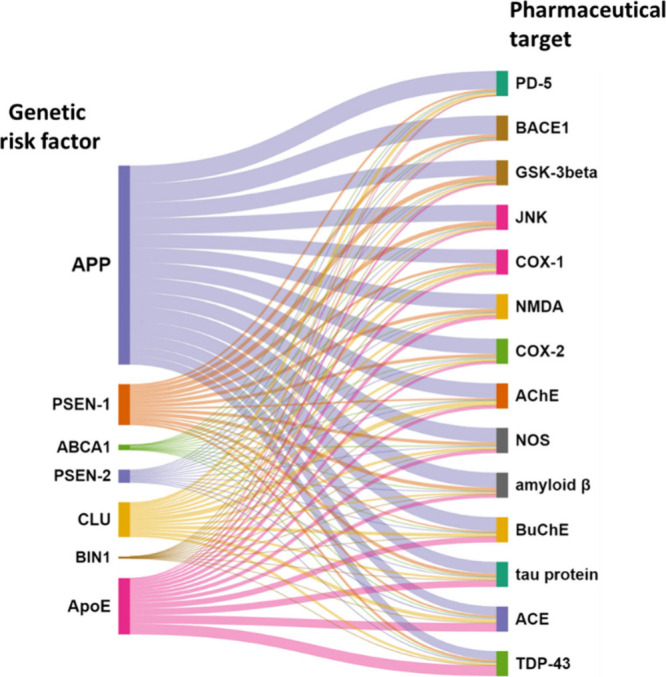
Figure 12 Co-occurrences of the genetic risk factors and pharmacological target proteins concepts in documents in the CAS Content Collection related to AD.
Figure 12 Co-occurrences of the genetic risk factors and pharmacological target proteins concepts in documents in the CAS Content Collection related to AD.CC BY · PubMed Central
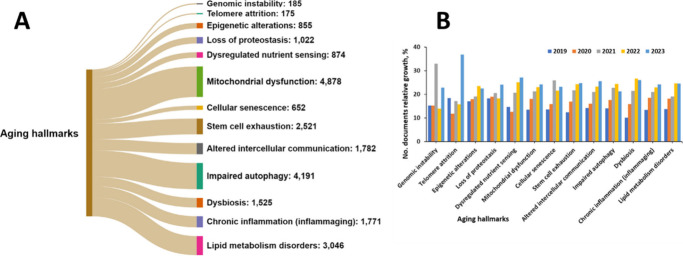
Figure 13 Correlation between primary aging hallmarks and AD as reflected by their co-occurrence in the documents in the CAS Content Collection: (A) number of documents and (B) relative growth in the years 2019–2023 related to the respective aging hallmark.
Figure 13 Correlation between primary aging hallmarks and AD as reflected by their co-occurrence in the documents in the CAS Content Collection: (A) number of documents and (B) relative growth in the years 2019–2023 related to the respective aging hallmark.CC BY · PubMed Central
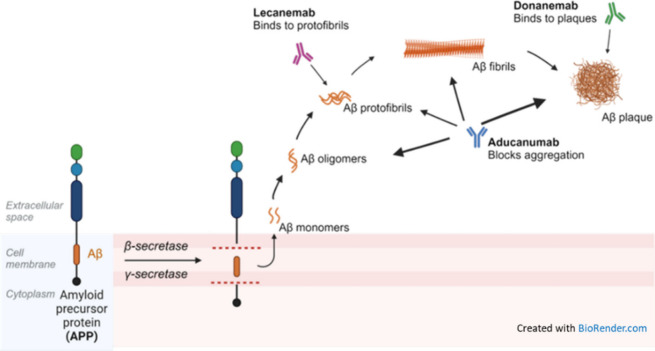
Figure 14 Scheme of the formation of amyloid plaques and target sites of the antiamyloid antibody drugs. Adapted from “Cleavage of Amyloid Precursor Protein” by BioRender.com (2024). Retrieved from https://app.biorender.com/biorender-templates.
Figure 14 Scheme of the formation of amyloid plaques and target sites of the antiamyloid antibody drugs. Adapted from “Cleavage of Amyloid Precursor Protein” by BioRender.com (2024). Retrieved from https://app.biorender.com/biorender-templates.CC BY · PubMed Central
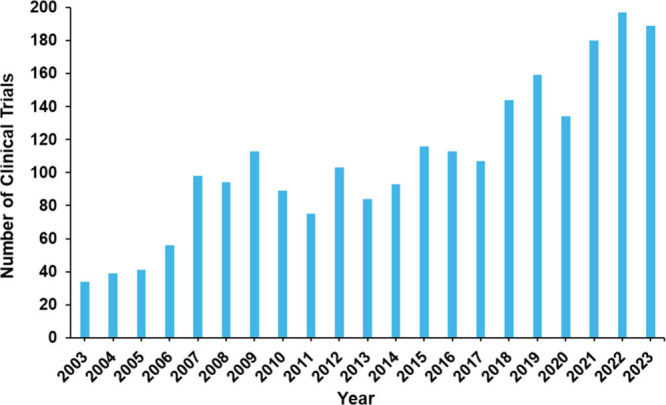
Figure 15 Number of Alzheimer’s disease therapeutic clinical trials by year.
Figure 15 Number of Alzheimer’s disease therapeutic clinical trials by year.CC BY · PubMed Central
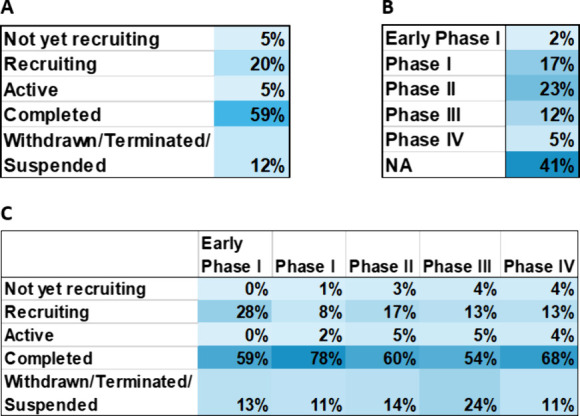
Figure 16 Percentage of therapeutic Alzheimer’s disease clinical trials for various phases and statuses: (A) overall clinical trial phase development, (B) overall clinical trial statuses, (C) clinical trial phases compared against statuses. Phase I/II and Phase II/III studies are classified under Phase II and Phase III studies, respectively.
Figure 16 Percentage of therapeutic Alzheimer’s disease clinical trials for various phases and statuses: (A) overall clinical trial phase development, (B) overall clinical trial statuses, (C) clinical trial phases compared against statuses. Phase I/II and Phase II/III studies are classified under Phase II and Phase III studies, respectively.CC BY · PubMed Central
Figure 17 (A) Classes of drugs explored for repurposing to AD treatment with associated number of documents indicated. (B) Annual growth of the drug repurposing-related documents (journal articles and patents). (C) Correlation between diseases co-occurring with AD and potential drugs for repurposing to AD as judged by the concepts co-occurrence in the CAS Content Collection documents.
Figure 17 (A) Classes of drugs explored for repurposing to AD treatment with associated number of documents indicated. (B) Annual growth of the drug repurposing-related documents (journal articles and patents). (C) Correlation between diseases co-occurring with AD and potential drugs for repurposing to AD as judged by the concepts co-occurrence in the CAS Content Collection documents.CC BY · PubMed Central

Verification

Claims the paper makes

The claims and statistics of this paper haven’t been checked yet.

Run the check — free, no account needed. It reads the open-access text and checks the sources it cites.

A few free checks a day · papers already verified open instantly · results are public

Self-check

Percentages, sums and reported differences re-computed from the paper’s own numbers.

The self-check needs the paper’s full text.

Citations

Cites

Metadata

Authors
Tenchov, R., Sasso, J., & Zhou, Q. A.
Affiliations
American Chemical Society (US)
Corresponding author
Zhou, Qiongqiong Angela
Venue
ACS Chemical Neuroscience
Published
2024-04-25
Volume
15
Issue
21
Pages
3800-3827
ISSN
1948-7193 (ISSN-L)
OpenAlex
W4403334326
Cited by
170
References
1
Citations by year
2026: 115 · 2025: 53 · 2024: 2
FWCI
9.70
Type
journal article
Language
en
Open access
Locations
  • ACS Chemical Neuroscience (publishedVersion, cc-by)
  • ChemRxiv (acceptedVersion, cc-by)
  • PubMed Central (publishedVersion, cc-by)
  • PubMed (publishedVersion)
Topics
  • Life Sciences › Neuroscience › Cellular and Molecular Neuroscience › Alzheimer's disease research and treatments
  • Health Sciences › Medicine › Psychiatry and Mental health › Dementia and Cognitive Impairment Research
  • Life Sciences › Neuroscience › Neurology › Neuroinflammation and Neurodegeneration Mechanisms
Keywords
Alzheimer's disease, cognitive decline, amyloid plaques, neuroinflammation, synaptic dysfunction, genetic risk factors, APP mutations, presenilin 1, presenilin 2, APOE ε4, disease-modifying therapy, biomarkers, early diagnosis, drug repurposing, comorbid diseases, therapeutic target, drug development pipeline
MeSH terms
Alzheimer Disease, Animals, Humans, Cognitive Dysfunction

About these checks

Registry, retraction, Cites and statistics results are computed, not judged, with one exception: a printed reference that no index lists is read once by a model before it counts as a citation error. Claims are extracted by a model and kept only when their quote appears verbatim in the text; each cited source is then checked, with a model’s help, for whether it says what the claim relies on. Those verdicts can be wrong — read the claim’s quote and the cited source before relying on one.

Statistics and arithmetic are recomputed, not judged.

Confidence bands are shown only for fields calibrated on our annotated test set. None is calibrated yet, so no band is shown.

What counts as a claim ›How we measure confidence ›How we check this ›

Are you an author, or do you see a problem with this page? Request a review