

The DOI matches its Crossref record; 11 of the 12 references it cites were found in a registry or an index.
Effectiveness of airport screening at detecting travellers infected with novel coronavirus (2019-nCoV)
Open accessPublished version of a preprint
Abstract
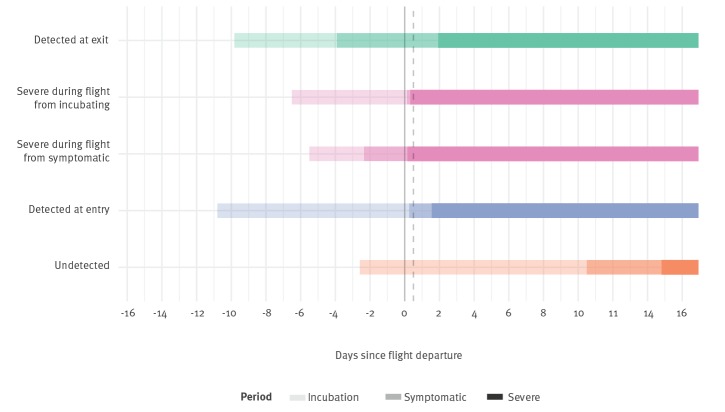
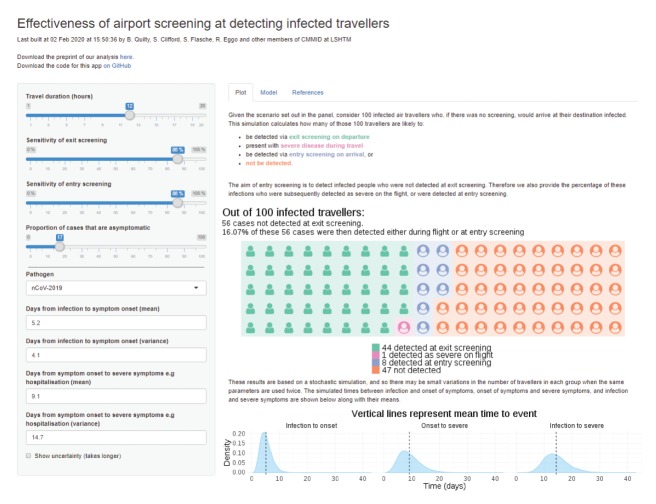
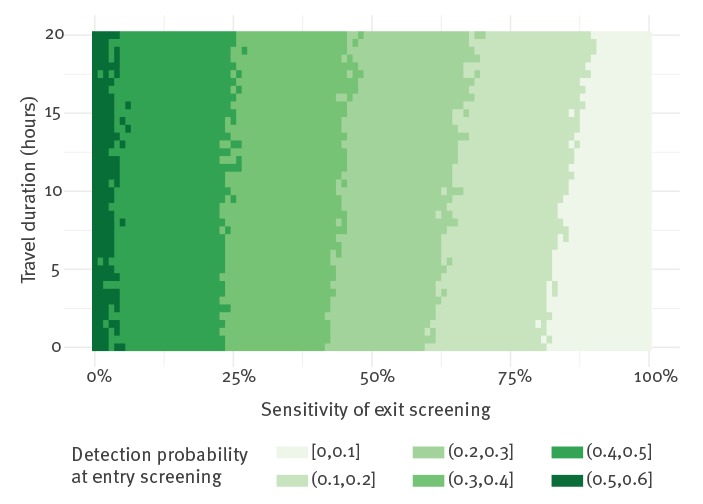
We evaluated effectiveness of thermal passenger screening for 2019-nCoV infection at airport exit and entry to inform public health decision-making. In our baseline scenario, we estimated that 46% (95% confidence interval: 36 to 58) of infected travellers would not be detected, depending on incubation period, sensitivity of exit and entry screening, and proportion of asymptomatic cases. Airport screening is unlikely to detect a sufficient proportion of 2019-nCoV infected travellers to avoid entry of infected travellers.
Overview
The claims and statistics of this paper haven’t been checked yet.
Run the check — free, no account needed. It reads the open-access text and checks the sources it cites.
Integrity signals
Registry
Cites
Statistics
Figures
Verification
Claims the paper makes
The claims and statistics of this paper haven’t been checked yet.
Run the check — free, no account needed. It reads the open-access text and checks the sources it cites.
Claims other papers make about this one
Each is checked against this paper’s own text: does it say what the citing paper says it does?
The source backs part of the claim, not all of it — or backs it for a different population, condition or comparison.
In the citing paper
“The large numbers of false-positive and false-negative results mean that this is unlikely to have a substantial effect beyond increasing awareness 51,52 .”
From Digital technologies in the public-health response to COVID-19 (2020) · cites this paper as [52]
Experimental — accuracy not yet measured
Self-check
Percentages, sums and reported differences re-computed from the paper’s own numbers.
The self-check needs the paper’s full text.
Citations
Cites
Early transmission dynamics in Wuhan, China, of novel coronavirus-infected pneumonia
Li, Q., Guan, X., Wu, P., Wang, X., Zhou, L., Tong, Y., Ren, R., Leung, K. S. M., Lau, E. H. Y., Wong, J. Y., et al. (2020) · New England Journal of Medicine · doi:10.1056/nejmoa2001316 · Cited by 16,575
Chan, J., Yuan, S.-F., Kok, K.-H., To, K., Chu, H., Yang, J., Xing, F., Liu, J.-L., Yip, C., Poon, R., et al. (2020) · The Lancet · doi:10.1016/s0140-6736(20)30154-9 · Cited by 8,450
Early dynamics of transmission and control of COVID-19: a mathematical modelling study
Kucharski, A. J., Russell, T., Diamond, C., Liu, Y., Edmunds, J., Funk, S., Eggo, R. M., Sun, F., Jit, M., Munday, J. D., et al. (2020) · The Lancet Infectious Diseases · doi:10.1016/s1473-3099(20)30144-4 · Cited by 2,699
Self-citationFactors influencing compliance with quarantine in Toronto during the 2003 SARS outbreak
DiGiovanni, C., Conley, J., Chiu, D., & Zaborski, J. (2004) · Biosecurity and Bioterrorism: Biodefense Strategy, Practice, and Science · doi:10.1089/bsp.2004.2.265 · Cited by 483
Entry screening for severe acute respiratory syndrome (SARS) or influenza: policy evaluation
Pitman, R., Cooper, B. S., Trotter, C. L., Gay, N. J., & Edmunds, W. J. (2005) · BMJ · doi:10.1136/bmj.38573.696100.3a · Cited by 90
Thermal Image Scanning for Influenza Border Screening: Results of an Airport Screening Study
Priest, P. C., Duncan, A. R., Jennings, L., & Baker, M. G. (2011) · PLoS ONE · doi:10.1371/journal.pone.0014490 · Cited by 79
Gostic, K. M., Kucharski, A. J., & Lloyd‐Smith, J. O. (2015) · eLife · doi:10.7554/elife.05564 · Cited by 55
Border screening for SARS in Australia: what has been learnt?
Samaan, G., Spencer, J. D., Roberts, L., & Patel, M. S. (2004) · The Medical Journal of Australia · doi:10.5694/j.1326-5377.2004.tb05889.x · Cited by 53
Mabey, D. C. W., Flasche, S., & Edmunds, W. J. (2014) · BMJ · doi:10.1136/bmj.g6202 · Cited by 39
Self-citationSleeping sickness—a growing problem?
Jannin, J. G. (2005) · BMJ · doi:10.1136/bmj.331.7527.1242 · Cited by 18
SAN FRANCISCO INTERNATIONAL AIRPORT
Fein, S. R. (1984) · ITE journal · Cited by 8
Cited by
Sorted by citations
Feasibility of controlling COVID-19 outbreaks by isolation of cases and contacts
Hellewell, J., Abbott, S., Gimma, A., Bosse, N. I., Jarvis, C. I., Russell, T. W., Munday, J. D., Kucharski, A. J., Edmunds, W. J., Sun, F., et al. (2020) · The Lancet Global Health · doi:10.1016/s2214-109x(20)30074-7 · Cited by 2,550
Self-citationPrem, K., Liu, Y., Russell, T., Kucharski, A. J., Eggo, R. M., Davies, N. G. M., Flasche, S., Clifford, S., Pearson, C. A. B., Munday, J. D., et al. (2020) · The Lancet Public Health · doi:10.1016/s2468-2667(20)30073-6 · Cited by 2,149
Self-citationEffect of non-pharmaceutical interventions to contain COVID-19 in China
Lai, S., Ruktanonchai, N., Zhou, L., Prosper, O., Luo, W. P., Floyd, J., Wesolowski, A., Santillana, M., Zhang, C., Du, X., et al. (2020) · Nature · doi:10.1038/s41586-020-2293-x · Cited by 1,357
Linton, N. M., Kobayashi, T., Yang, Y., Hayashi, K., Akhmetzhanov, A. R., Jung, S.-M., Yuan, B., Kinoshita, R., & Nishiura, H. (2020) · Journal of Clinical Medicine · doi:10.3390/jcm9020538 · Cited by 1,376
Digital technologies in the public-health response to COVID-19
Budd, J., Miller, B. S., Manning, E. M., Lampos, V., Zhuang, M., Edelstein, M., Rees, G., Emery, V. C., Stevens, M. M., Keegan, N., et al. (2020) · Nature Medicine · doi:10.1038/s41591-020-1011-4 · Cited by 1,195
Metadata
- Authors
- Quilty, B. J., Clifford, S., group2, C. N. W., Flasche, S., & Eggo, R. M.
- Affiliations
- London School of Hygiene & Tropical Medicine (GB)
- Centre for the Mathematical Modelling of Infectious Diseases, Department of Infectious Disease Epidemiology, London School of Hygiene and Tropical Medicine, London, United Kingdom
- Corresponding author
- Quilty, Billy J
- Venue
- Eurosurveillance
- Published
- 2020-02-06
- Volume
- 25
- Issue
- 5
- ISSN
- 1025-496X (ISSN-L)
- 1560-7917
- PMC
- PMC7014668
- OpenAlex
- W3005151538
- Cited by
- 321
- References
- 12
- Citations by year
- 2026: 10 · 2025: 10 · 2024: 13 · 2023: 27 · 2022: 36 · 2021: 80 · 2020: 144
- FWCI
- 11.41
- Type
- journal article
- Language
- en
- Update notices
- correction (2020-02-13)
- Open access
- diamond
- doi.org
- Locations
- Eurosurveillance (publishedVersion, cc-by)
- medRxiv (acceptedVersion, cc-by)
- Europe PMC (PubMed Central) (publishedVersion, cc-by)
- PubMed Central (publishedVersion, cc-by)
- PubMed (publishedVersion)
- LSHTM Research Online (London School of Hygiene and Tropical Medicine) (acceptedVersion)
- Funders
- Wellcome Trust (206250, 210758/Z/18/Z, 206250/Z/17/Z, Z/17/Z, 208812, 03010, 210758, 208812/Z/17/Z)
- Government of the United Kingdom
- National Institute for Health and Care Research (ITCRZ 03010, 16/137/109, 16/137/10)
- Department of Health and Social Care (ITCRZ 03010)
- Royal Society (208812, Z/17/Z, 206250/Z/17/Z, 208812/Z/17/Z)
- Research Councils UK (MR/S003975/1, ES/P010873/1)
- Medical Research Council (MR/S003975/1)
- Economic and Social Research Council (ES/P010873/1)
- Topics
- Physical Sciences › Mathematics › Modeling and Simulation › COVID-19 epidemiological studies
- Health Sciences › Medicine › Public Health, Environmental and Occupational Health › Travel-related health issues
- Health Sciences › Medicine › Infectious Diseases › SARS-CoV-2 detection and testing
- Keywords
- SARS-CoV-2, airport security screening, thermal screening, infection detection, asymptomatic infection, incubation period, screening sensitivity, public health decision-making
- MeSH terms
- COVID-19, Body Temperature, Decision Making, Fever, Humans, Mass Screening, Models, Theoretical, Pneumonia, Viral, Population Surveillance, Public Health, Coronavirus Infections, Communicable Diseases, Emerging, Air Travel
About these checks
Registry, retraction, Cites and statistics results are computed, not judged, with one exception: a printed reference that no index lists is read once by a model before it counts as a citation error. Claims are extracted by a model and kept only when their quote appears verbatim in the text; each cited source is then checked, with a model’s help, for whether it says what the claim relies on. Those verdicts can be wrong — read the claim’s quote and the cited source before relying on one.
Statistics and arithmetic are recomputed, not judged.
Confidence bands are shown only for fields calibrated on our annotated test set. None is calibrated yet, so no band is shown.
What counts as a claim ›How we measure confidence ›How we check this ›
Are you an author, or do you see a problem with this page? Request a review
