

The DOI matches its Crossref record; 9 of the 9 references it cites were found in a registry or an index; none of the 12 sources its claims cite is checked for support yet.
Case fatality risk of the SARS-CoV-2 variant of concern B.1.1.7 in England, 16 November to 5 February
Open accessPublished version of a preprint
Abstract
The SARS-CoV-2 B.1.1.7 variant of concern (VOC) is increasing in prevalence across Europe. Accurate estimation of disease severity associated with this VOC is critical for pandemic planning. We found increased risk of death for VOC compared with non-VOC cases in England (hazard ratio: 1.67; 95% confidence interval: 1.34–2.09; p < 0.0001). Absolute risk of death by 28 days increased with age and comorbidities. This VOC has potential to spread faster with higher mortality than the pandemic to date.
Overview
AI snapshot
Written from the paper’s full text.
TL;DR
In England, infection with the SARS-CoV-2 B.1.1.7 variant of concern (VOC) was associated with a higher risk of death than non-VOC infection after adjustment for demographics and comorbidities (HR: 1.67; 95% CI: 1.34–2.09). Absolute 28-day death risk increased with age and comorbidities and was consistently higher for VOC across strata.
Key findings
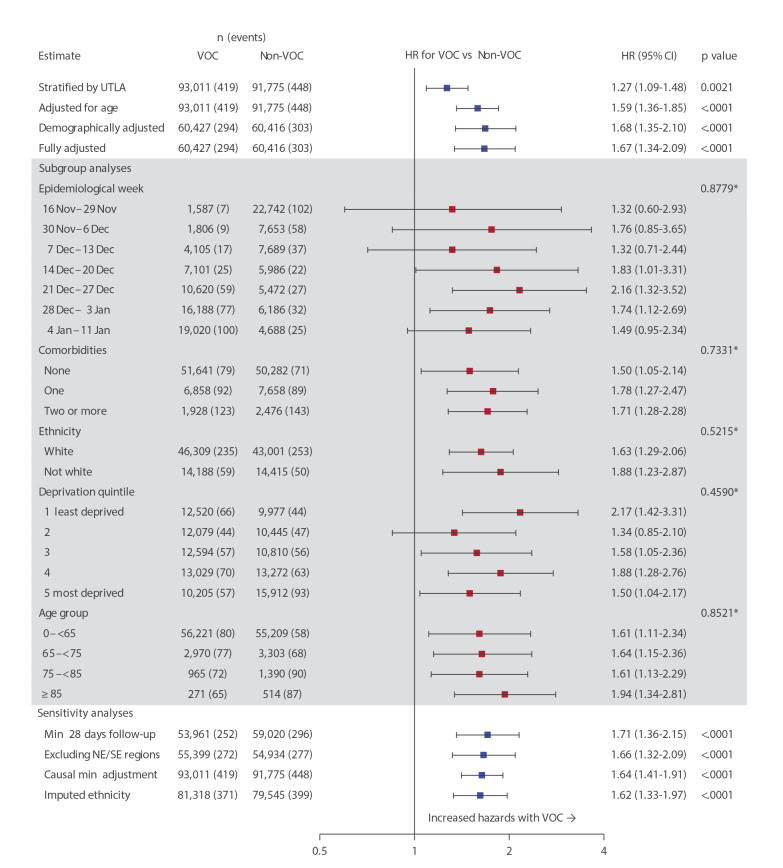
- In a fully adjusted Cox model, VOC infection was associated with two-thirds higher hazard of death compared with non-VOC (HR: 1.67; 95% CI: 1.34–2.09; p < 0.0001); a sensitivity analysis restricted to people testing positive at least 28 days before censoring gave HR: 1.71 (95% CI: 1.36–2.15; p < 0.0001).
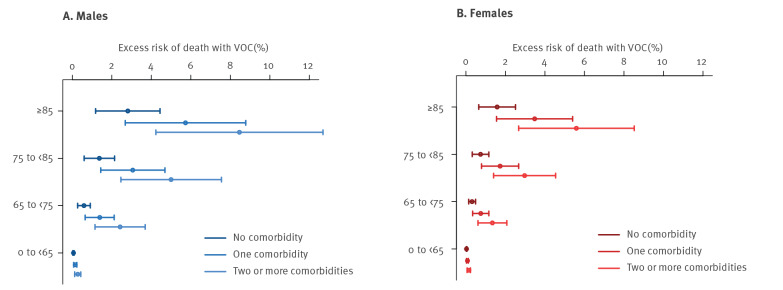
- In a fully adjusted logistic model, VOC was associated with increased odds of death by 28 days (adjusted odds ratio: 1.73; 95% CI: 1.34–2.23; p < 0.0001). Absolute risk was higher for VOC across age, sex, and comorbidity strata; the highest risk was among those aged ≥85 years with two or more comorbidities (VOC: males 24.3%, females 14.7%; non-VOC: males 16.7%, females 9.7%).
- Among 184,786 people with known spike gene target failure (SGTF) status, there were 867 deaths (419 VOC; 448 non-VOC). The VOC group was younger and had fewer comorbidities, and median follow-up was shorter for VOC (36 days; IQR: 30–45) than non-VOC (57 days; IQR: 40–72).
- Increased hazards for VOC were consistent across all pre-specified subgroup analyses, including epidemiological week, age group, number of comorbidities, ethnicity, and index of multiple deprivation quintile.
Methods
- Data came from the OpenSAFELY electronic health records platform covering 40% of England’s population registered with a general practitioner, with linked GP, SARS-CoV-2 testing, vaccination, and mortality records. Cases were people testing positive for SARS-CoV-2 between 16 November 2020 and 11 January 2021, followed until death or censoring on 5 February 2021; vaccinations and diagnoses before the study period were exclusion criteria. SGTF status was known for 184,786 of 441,161 (42%) confirmed infections (91,775 VOC; 93,011 non-VOC).
- Relative hazard of death was estimated using a Cox proportional hazards regression model stratified by upper tier local authority, with follow-up from positive test and censoring on 5 February 2021 or 7 days before vaccination. Absolute risk of death by 28 days was estimated from marginal means of a fully adjusted logistic regression model restricted to 112,979 people diagnosed at least 28 days before the censoring date, with deaths beyond 28 days censored.
Limitations
- The paper states that people with asymptomatic or mild infection may not present for testing, so estimates of absolute risk of death by 28 days may overestimate the true case fatality ratio. It also states that SARS-CoV-2 tests performed in hospital settings in the UK are not tested for PCR S-gene target failure and are therefore not included.
- Evident from the text: SGTF status was known for only 42% of confirmed SARS-CoV-2 infections in the study period, so the analysed population may not represent all cases. The VOC group also had shorter median follow-up than the non-VOC group, although the sensitivity analysis restricted to at least 28 days from testing to censoring was consistent.
Model-written summary. Check it against the paper before relying on it.
Integrity signals
Registry
Cites
Statistics
Figures
Verification
Claims the paper makes
8 Not checked yet · 7 Own result · 6 Own interpretation · 5 Own method
A result the paper reports from its own data — it cites no other source for it, so there is none to check. The quote shows it is in the paper.
In the paper
“Consistent with the Cox model above, VOC was associated with increased odds of death in this model (adjusted odds ratio (AOR): 1.73; 95% CI: 1.34–2.23; p value < 0.0001, vs non-VOC).”
§ Case fatality risk of the SARS-CoV-2 variant of concern B.1.1.7 in England, 16 November to 5 February > Absolute risk of death by 28 days
plaincorrelationaln = 112,979 ·- Asserted: passes — The authors put it forward as true.
- Checkable: passes — It can be checked against evidence.
- Load-bearing: passes — The paper’s conclusions depend on it.
- Based: passes — The paper gives a reason why it holds.
A result the paper reports from its own data — it cites no other source for it, so there is none to check. The quote shows it is in the paper.
In the paper
“The highest risk of death within 28 days was seen among those 85 years and older with two or more comorbidities: VOC: males 24.3%; females: 14.7%; non-VOC: males: 16.7%; females: 9.7%).”
§ Case fatality risk of the SARS-CoV-2 variant of concern B.1.1.7 in England, 16 November to 5 February > Absolute risk of death by 28 days
plaincorrelationaln = 112,979- Asserted: passes — The authors put it forward as true.
- Checkable: passes — It can be checked against evidence.
- Load-bearing: unclear — It is unclear whether the paper’s conclusions depend on it.
- Based: passes — The paper gives a reason why it holds.
A result the paper reports from its own data — it cites no other source for it, so there is none to check. The quote shows it is in the paper.
In the paper
“The risk of death was consistently higher for male cases and increased with age and the presence of comorbidities.”
§ Case fatality risk of the SARS-CoV-2 variant of concern B.1.1.7 in England, 16 November to 5 February > Absolute risk of death by 28 days
plaincorrelationaln = 112,979- Asserted: passes — The authors put it forward as true.
- Checkable: passes — It can be checked against evidence.
- Load-bearing: unclear — It is unclear whether the paper’s conclusions depend on it.
- Based: passes — The paper gives a reason why it holds.
A result the paper reports from its own data — it cites no other source for it, so there is none to check. The quote shows it is in the paper.
In the paper
“in an analysis restricted to people testing positive for SARS-CoV-2 infection a minimum of 28 days before the censoring date, the hazard ratio was 1.71 (95% CI: 1.36–2.15; p < 0.0001).”
§ Case fatality risk of the SARS-CoV-2 variant of concern B.1.1.7 in England, 16 November to 5 February > Relative hazard of death
plaincorrelational- Asserted: passes — The authors put it forward as true.
- Checkable: passes — It can be checked against evidence.
- Load-bearing: unclear — It is unclear whether the paper’s conclusions depend on it.
- Based: passes — The paper gives a reason why it holds.
A result the paper reports from its own data — it cites no other source for it, so there is none to check. The quote shows it is in the paper.
In the paper
“We found increased risk of death for VOC compared with non-VOC cases in England (hazard ratio: 1.67; 95% confidence interval: 1.34–2.09; p < 0.0001).”
- Also stated in: § Relative hazard of death · plain
“In a fully adjusted analysis accounting for demographics and comorbidities, hazards were two-thirds higher in the VOC group (hazard ratio (HR): 1.67; 95% confidence interval (CI): 1.34–2.09; p < 0.0001) compared with non-VOC (Figure 1).”
§ Case fatality risk of the SARS-CoV-2 variant of concern B.1.1.7 in England, 16 November to 5 February > Abstract
plaincorrelational- Asserted: passes — The authors put it forward as true.
- Checkable: passes — It can be checked against evidence.
- Load-bearing: passes — The paper’s conclusions depend on it.
- Based: passes — The paper gives a reason why it holds.
- Rests on an assumption: The non-VOC comparison group represents infection with the previously circulating SARS-CoV-2 virus.
- Rests on an assumption: The proportional hazards assumption of the Cox regression model holds.
- Also stated in: § Relative hazard of death · plain
In the paper
“Increased hazards for VOC were consistent across all pre-specified subgroup analyses including epidemiological week, age group, categorical number of comorbidities, ethnicity and index of multiple deprivation (IMD) quintile [6].”
§ Case fatality risk of the SARS-CoV-2 variant of concern B.1.1.7 in England, 16 November to 5 February > Relative hazard of death
What the sources say
- Not checked yetcites [6] Ministry of Housing, Communities Local Government. The English indices of deprivation 2019 (IoD2019). London: Ministry of Housing, Communities Local Government; 2019. Available from: https://www.gov.uk/government/statistics/english-indices-of-deprivation-2019
plaincorrelational- Asserted: passes — The authors put it forward as true.
- Checkable: passes — It can be checked against evidence.
- Load-bearing: passes — The paper’s conclusions depend on it.
- Based: passes — The paper gives a reason why it holds.
None of the sources cited for this claim have been checked yet.
In the paper
“Other studies have assessed the relative mortality of the VOC with similar conclusions [7-10], however, our results are the first to include detailed information on the presence of comorbidities.”
§ Case fatality risk of the SARS-CoV-2 variant of concern B.1.1.7 in England, 16 November to 5 February > Discussion
What the sources say
- Not checked yetcites [7] NERVTAG. NERVTAG paper on COVID-19 variant of concern B.1.1.7: Paper from the New and Emerging Respiratory Virus Threats Advisory Group (NERVTAG) on new coronavirus (COVID-19) variant B.1.1.7. London: Department of Health and Social Care; 2021. Available from: https://www.gov.uk/government/publications/nervtag-paper-on-covid-19-variant-of-concern-b117
- Not checked yetcites [8] Iacobucci, 2021, Covid-19: New UK variant may be linked to increased death rate, early data indicate., BMJ source
- Not checked yetcites [9] Davies, 2021, Increased mortality in community-tested cases of SARS-CoV-2 lineage B.1.1.7., Nature source
- Not checked yetcites [10] Challen, 2021, Risk of mortality in patients infected with SARS-CoV-2 variant of concern 202012/1: matched cohort study., BMJ source
plain- Asserted: passes — The authors put it forward as true.
- Checkable: passes — It can be checked against evidence.
- Load-bearing: passes — The paper’s conclusions depend on it.
- Based: passes — The paper gives a reason why it holds.
What the paper did — it cites no source for this, so there is none to check. The quote shows it is in the paper.
In the paper
“Consequently, median follow-up time was shorter among the VOC group (36 days; interquartile range (IQR): 30–45) than the non-VOC group (57 days; IQR: 40–72).”
§ Case fatality risk of the SARS-CoV-2 variant of concern B.1.1.7 in England, 16 November to 5 February > Study population
plaincorrelational- Asserted: passes — The authors put it forward as true.
- Checkable: passes — It can be checked against evidence.
- Load-bearing: unclear — It is unclear whether the paper’s conclusions depend on it.
- Based: passes — The paper gives a reason why it holds.
A conclusion the paper draws from its own results — it cites no other source for it, so there is none to check. The quote shows it is in the paper.
In the paper
“The consistency of the effect for each epidemiological week of diagnosis shows that the increase in mortality due to VOC could not be explained by other secular changes in mortality such as hospitals exceeding capacity.”
§ Case fatality risk of the SARS-CoV-2 variant of concern B.1.1.7 in England, 16 November to 5 February > Discussion
hedgeddirect- Asserted: passes — The authors put it forward as true.
- Checkable: passes — It can be checked against evidence.
- Load-bearing: passes — The paper’s conclusions depend on it.
- Based: passes — The paper gives a reason why it holds.
A conclusion the paper draws from its own results — it cites no other source for it, so there is none to check. The quote shows it is in the paper.
In the paper
“However, age and comorbidity risk factors associated with poor non-VOC outcomes appear to be similar to those with this VOC.”
§ Case fatality risk of the SARS-CoV-2 variant of concern B.1.1.7 in England, 16 November to 5 February > Discussion
hedged- Asserted: passes — The authors put it forward as true.
- Checkable: passes — It can be checked against evidence.
- Load-bearing: passes — The paper’s conclusions depend on it.
- Based: passes — The paper gives a reason why it holds.
What the paper did — it cites no source for this, so there is none to check. The quote shows it is in the paper.
In the paper
“The exposure groups were similar demographically (Table 1).”
§ Case fatality risk of the SARS-CoV-2 variant of concern B.1.1.7 in England, 16 November to 5 February > Study population
plain- Asserted: passes — The authors put it forward as true.
- Checkable: passes — It can be checked against evidence.
- Load-bearing: unclear — It is unclear whether the paper’s conclusions depend on it.
- Based: passes — The paper gives a reason why it holds.
A conclusion the paper draws from its own results — it cites no other source for it, so there is none to check. The quote shows it is in the paper.
In the paper
“People with asymptomatic or mild infection may not present for testing. Consequently, our estimates of absolute risk of death by 28 days may be overestimates of the true case fatality ratio.”
§ Case fatality risk of the SARS-CoV-2 variant of concern B.1.1.7 in England, 16 November to 5 February > Discussion
hedgedconditional- Asserted: passes — The authors put it forward as true.
- Checkable: passes — It can be checked against evidence.
- Load-bearing: unclear — It is unclear whether the paper’s conclusions depend on it.
- Based: passes — The paper gives a reason why it holds.
What the paper did — it cites no source for this, so there is none to check. The quote shows it is in the paper.
In the paper
“The 7 days prior to vaccination were censored in this analysis to remove a potential immortal time bias because illness which may lead to death would exclude the booking of and administration of a vaccine.”
§ Case fatality risk of the SARS-CoV-2 variant of concern B.1.1.7 in England, 16 November to 5 February > Relative hazard of death
plain- Asserted: passes — The authors put it forward as true.
- Checkable: passes — It can be checked against evidence.
- Load-bearing: passes — The paper’s conclusions depend on it.
- Based: passes — The paper gives a reason why it holds.
A conclusion the paper draws from its own results — it cites no other source for it, so there is none to check. The quote shows it is in the paper.
In the paper
“For every three deaths in a population with the previously circulating virus we would expect five deaths in a similar population with VOC.”
§ Case fatality risk of the SARS-CoV-2 variant of concern B.1.1.7 in England, 16 November to 5 February > Discussion
hedgeddirect- Asserted: passes — The authors put it forward as true.
- Checkable: passes — It can be checked against evidence.
- Load-bearing: passes — The paper’s conclusions depend on it.
- Based: passes — The paper gives a reason why it holds.
- It may state two separate claims as one. 7
- Probably not a substantial claim. 7
A result the paper reports from its own data — it cites no other source for it, so there is none to check. The quote shows it is in the paper.
In the paper
“The risk of death was low for people younger than 65 years in the absence of comorbidities; in this age group it was higher for male than female cases (VOC: males: 0.14%; females: 0.07% vs non-VOC: males: 0.09%; females: 0.05%).”
§ Case fatality risk of the SARS-CoV-2 variant of concern B.1.1.7 in England, 16 November to 5 February > Absolute risk of death by 28 days
plaincorrelationaln = 112,979- Asserted: passes — The authors put it forward as true.
- Checkable: passes — It can be checked against evidence.
- Load-bearing: unclear — It is unclear whether the paper’s conclusions depend on it.
- Based: passes — The paper gives a reason why it holds.
It may state two separate claims as one.
A result the paper reports from its own data — it cites no other source for it, so there is none to check. The quote shows it is in the paper.
In the paper
“Absolute risk of death by 28 days increased with age and comorbidities.”
- Also stated in: § Absolute risk of death by 28 days · plain
“The risk of death was consistently higher for male cases and increased with age and the presence of comorbidities.”
§ Case fatality risk of the SARS-CoV-2 variant of concern B.1.1.7 in England, 16 November to 5 February > Abstract
plaindirectn = 112,979- Asserted: passes — The authors put it forward as true.
- Checkable: passes — It can be checked against evidence.
- Load-bearing: unclear — It is unclear whether the paper’s conclusions depend on it.
- Based: passes — The paper gives a reason why it holds.
It may state two separate claims as one.
- Also stated in: § Absolute risk of death by 28 days · plain
What the paper did — it cites no source for this, so there is none to check. The quote shows it is in the paper.
In the paper
“The fully adjusted model includes adjustment for: age, sex, index of multiple deprivation, ethnicity, smoking status, obesity, household size, NHS England region, rural/urban classification, comorbidities, epidemiological week and care home status.”
§ Case fatality risk of the SARS-CoV-2 variant of concern B.1.1.7 in England, 16 November to 5 February > Absolute risk of death by 28 days
plainn = 112,979- Asserted: passes — The authors put it forward as true.
- Checkable: passes — It can be checked against evidence.
- Load-bearing: passes — The paper’s conclusions depend on it.
- Based: passes — The paper gives a reason why it holds.
Probably not a substantial claim.
A conclusion the paper draws from its own results — it cites no other source for it, so there is none to check. The quote shows it is in the paper.
In the paper
“Interestingly, the effects of age and comorbidities appear to be collinear as adjustment for comorbidities did not alter the findings after adjustment for age.”
§ Case fatality risk of the SARS-CoV-2 variant of concern B.1.1.7 in England, 16 November to 5 February > Discussion
hedgedcorrelational- Asserted: passes — The authors put it forward as true.
- Checkable: passes — It can be checked against evidence.
- Load-bearing: unclear — It is unclear whether the paper’s conclusions depend on it.
- Based: passes — The paper gives a reason why it holds.
It may state two separate claims as one.
In the paper
“It is now the dominant strain throughout the UK and is increasing in prevalence across Europe [2].”
§ Case fatality risk of the SARS-CoV-2 variant of concern B.1.1.7 in England, 16 November to 5 February > Abstract
What the sources say
- Not checked yetcites [2] European Centre for Disease Prevention and Control (ECDC). SARS-CoV-2 - increased circulation of variants of concern and vaccine rollout in the EU/EEA,14th update. Stockholm: ECDC; 2021. Available from: https://www.ecdc.europa.eu/sites/default/files/documents/RRA-covid-19-14th-update-15-feb-2021.pdf
plaindirect- Asserted: passes — The authors put it forward as true.
- Checkable: passes — It can be checked against evidence.
- Load-bearing: fails — The paper’s conclusions may not depend on it.
- Based: passes — The paper gives a reason why it holds.
Probably not a substantial claim. The paper’s conclusions may not depend on it. It may state two separate claims as one.
A conclusion the paper draws from its own results — it cites no other source for it, so there is none to check. The quote shows it is in the paper.
In the paper
“Unmitigated spread of the B.1.1.7 VOC has the potential to be both faster and more deadly than the pandemic to date.”
§ Case fatality risk of the SARS-CoV-2 variant of concern B.1.1.7 in England, 16 November to 5 February > Discussion
hedgedconditional- Asserted: passes — The authors put it forward as true.
- Checkable: passes — It can be checked against evidence.
- Load-bearing: passes — The paper’s conclusions depend on it.
- Based: passes — The paper gives a reason why it holds.
It may state two separate claims as one.
In the paper
“In the UK, all-cause death by 28 days after confirmation of SARS-CoV-2 infection is the standard definition of SARS-CoV-2 mortality [12], so we used death from any cause as the primary outcome.”
§ Case fatality risk of the SARS-CoV-2 variant of concern B.1.1.7 in England, 16 November to 5 February > Discussion
What the sources say
- Not checked yetcites [12] Department of Health and Social Care. New UK-wide methodology agreed to record COVID-19 deaths. London: Department of Health and Social Care; 2020. Available from: https://www.gov.uk/government/news/new-uk-wide-methodology-agreed-to-record-covid-19-deaths
plain- Asserted: passes — The authors put it forward as true.
- Checkable: passes — It can be checked against evidence.
- Load-bearing: passes — The paper’s conclusions depend on it.
- Based: passes — The paper gives a reason why it holds.
Probably not a substantial claim.
In the paper
“Spike gene target failure (SGTF) is therefore a proxy for VOC identification, with greater than 95% sensitivity for VOC diagnosis during the period from 16 November to 11 January [3].”
§ Case fatality risk of the SARS-CoV-2 variant of concern B.1.1.7 in England, 16 November to 5 February > Abstract
What the sources say
- Not checked yetcites [3] Public Health England (PHE). Investigation of novel SARS-CoV-2 variant. Variant of concern 20201/01. London: PHE. [Accessed: 25 Feb 2021]. Available from: https://assets.publishing.service.gov.uk/government/uploads/system/uploads/attachment_data/file/959438/Technical_Briefing_VOC_SH_NJL2_SH2.pdf
plaincorrelational- Asserted: passes — The authors put it forward as true.
- Checkable: passes — It can be checked against evidence.
- Load-bearing: passes — The paper’s conclusions depend on it.
- Based: passes — The paper gives a reason why it holds.
It may state two separate claims as one.
- Rests on an assumption: A test result without spike gene target failure indicates non-VOC infection.
None of the sources cited for this claim have been checked yet.
In the paper
“We calculated the relative hazard of death for VOC compared with non-VOC cases using a Cox proportional hazards regression model stratified by region (upper tier local authority area (UTLA)) [4,5].”
§ Case fatality risk of the SARS-CoV-2 variant of concern B.1.1.7 in England, 16 November to 5 February > Relative hazard of death
What the sources say
- Not checked yetcites [4] Cox, 1972, Regression models and life‐tables., J R Stat Soc B source
- Not checked yetcites [5] Cox DR, Oakes D. Analysis of survival data. London: CRC press; 1984. ISBN 9780412244902.
plaincorrelational- Asserted: passes — The authors put it forward as true.
- Checkable: passes — It can be checked against evidence.
- Load-bearing: passes — The paper’s conclusions depend on it.
- Based: passes — The paper gives a reason why it holds.
Probably not a substantial claim.
- Rests on an assumption: The proportional hazards assumption of the Cox regression model holds.
What the paper did — it cites no source for this, so there is none to check. The quote shows it is in the paper.
In the paper
“In addition, SARS-CoV-2 tests performed in hospital settings in the UK are not tested for PCR S-gene target failure and are therefore not included.”
§ Case fatality risk of the SARS-CoV-2 variant of concern B.1.1.7 in England, 16 November to 5 February > Discussion
plaindirect- Asserted: passes — The authors put it forward as true.
- Checkable: passes — It can be checked against evidence.
- Load-bearing: fails — The paper’s conclusions may not depend on it.
- Based: passes — The paper gives a reason why it holds.
Probably not a substantial claim. The paper’s conclusions may not depend on it. It may state two separate claims as one.
In the paper
“Early analysis suggests it is more transmissible than previously circulating forms (non-VOC) [1].”
§ Case fatality risk of the SARS-CoV-2 variant of concern B.1.1.7 in England, 16 November to 5 February > Abstract
What the sources say
- Not checked yetcites [1] Davies, 2021, Estimated transmissibility and impact of SARS-CoV-2 lineage B.1.1.7 in England., Science source
hedgeddirect- Asserted: passes — The authors put it forward as true.
- Checkable: passes — It can be checked against evidence.
- Load-bearing: fails — The paper’s conclusions may not depend on it.
- Based: passes — The paper gives a reason why it holds.
Probably not a substantial claim. The paper’s conclusions may not depend on it.
In the paper
“Crucially, emerging data suggest that the currently approved vaccines for SARS-CoV-2 are effective against the B.1.1.7 VOC [13].”
§ Case fatality risk of the SARS-CoV-2 variant of concern B.1.1.7 in England, 16 November to 5 February > Discussion
What the sources say
- Not checked yetcites [13] Public Health England (PHE). PHE monitoring of the effectiveness of COVID-19 vaccination. London: PHE; 2021. Available from: https://www.gov.uk/government/publications/phe-monitoring-of-the-effectiveness-of-covid-19-vaccination
hedgeddirect- Asserted: passes — The authors put it forward as true.
- Checkable: passes — It can be checked against evidence.
- Load-bearing: fails — The paper’s conclusions may not depend on it.
- Based: passes — The paper gives a reason why it holds.
Probably not a substantial claim. The paper’s conclusions may not depend on it.
The paper relies on this without support.
The non-VOC comparison group represents infection with the previously circulating SARS-CoV-2 virus.
“We found that this VOC was associated with two-thirds higher case fatality than the previously circulating virus in this unvaccinated population.”
The paper relies on this without support.
The proportional hazards assumption of the Cox regression model holds.
“using a Cox proportional hazards regression model stratified by region (upper tier local authority area (UTLA)) [4,5]”
The paper relies on this without support.
The study population, drawn from the OpenSAFELY platform covering 40% of England's population registered with a GP, is representative of the wider population of England.
“Data were drawn from the OpenSAFELY electronic health records secure research platform, covering 40% of England’s population registered with a general practitioner (GP) (see Supplement, part 1).”
The paper relies on this without support.
A test result without spike gene target failure indicates non-VOC infection.
“Spike gene target failure (SGTF) is therefore a proxy for VOC identification, with greater than 95% sensitivity for VOC diagnosis during the period from 16 November to 11 January [3].”
Claims other papers make about this one
Each is checked against this paper’s own text: does it say what the citing paper says it does?
In the citing paper
“and an estimated 50% increased mortality 194,195,202 .”
From The biological and clinical significance of emerging SARS-CoV-2 variants (2021) · cites this paper as [202]
Self-check
Percentages, sums and reported differences re-computed from the paper’s own numbers.
Each contradiction between two passages listed here was confirmed by an independent check.
Rated minor: it would not touch a result — a value no result rests on, a p-value that stays on the same side of the significance level, or a conflict that is clerical, resolved elsewhere in the paper, or outside its own findings.
In the paper
§ Case fatality risk of the SARS-CoV-2 variant of concern B.1.1.7 in England, 16 November to 5 February > Study population
“(91,775 VOC; 93,011 non-VOC)”
§ Case fatality risk of the SARS-CoV-2 variant of concern B.1.1.7 in England, 16 November to 5 February > Study population
“| | Total n | Total % | Non-VOC cases n | Non-VOC cases % | VOC cases n | VOC cases % | | --- | --- | --- | --- | --- | --- | --- | | Total population | 184,786 | 184,786 | 91,775 | 91,775 | 93,011 | 93,011 |”
Citations
Cites
Regression Models and Life-Tables
Cox, D. R. (1972) · Journal of the Royal Statistical Society Series B: Statistical Methodology · doi:10.1111/j.2517-6161.1972.tb00899.x · Cited by 39,793
Estimated transmissibility and impact of SARS-CoV-2 lineage B.1.1.7 in England
Davies, N. G., Abbott, S., Barnard, R. C., Jarvis, C. I., Kucharski, A. J., Munday, J. D., Pearson, C. A. B., Russell, T. W., Tully, D. C., Washburne, A. D., et al. (2021) · Science · doi:10.1126/science.abg3055 · Cited by 2,581 · cited 1×
“Early analysis suggests it is more transmissible than previously circulating forms (non-VOC) [1].”
BackgroundSelf-citationEstimated transmissibility and impact of SARS-CoV-2 lineage B.1.1.7 in England
Davies, N. G., Abbott, S., Barnard, R. C., Jarvis, C. I., Kucharski, A. J., Munday, J. D., Pearson, C. A. B., Russell, T. W., Tully, D. C., Washburne, A. D., et al. (2020) · doi:10.1101/2020.12.24.20248822 · Cited by 2,557
Self-citationIncreased mortality in community-tested cases of SARS-CoV-2 lineage B.1.1.7
CMMID COVID-19 Working Group, Davies, N. G., Jarvis, C. I., Edmunds, W. J., Jewell, N. P., Diaz-Ordaz, K., & Keogh, R. H. (2021) · Nature · doi:10.1038/s41586-021-03426-1 · Cited by 921
Challen, R., Brooks-Pollock, E., Read, J. M., Dyson, L., Tsaneva-Atanasova, K., & Danon, L. (2021) · BMJ · doi:10.1136/bmj.n579 · Cited by 776 · cited 1×
“Other studies have assessed the relative mortality of the VOC with similar conclusions [7-10], however, our results are the first to include detailed information on the presence of comorbidities.”
ResultIncreased mortality in community-tested cases of SARS-CoV-2 lineage B.1.1.7Preprint
Davies, N. G., Jarvis, C. I., CMMID COVID-19 Working Group, Edmunds, W. J., Jewell, N. P., Diaz‐Ordaz, K., & Keogh, R. H. (2021) · medRxiv · doi:10.1101/2021.02.01.21250959 · Cited by 211
Covid-19: New UK variant may be linked to increased death rate, early data indicate.
Iacobucci, G. (2021) · BMJ · doi:10.1136/bmj.n230 · Cited by 113
Walker, J. L., Grint, D. J., Strongman, H., Eggo, R. M., Peppa, M., Minassian, C., Mansfield, K. E., Rentsch, C. T., Douglas, I., Mathur, R., et al. (2021) · BMC Public Health · doi:10.1186/s12889-021-10427-2 · Cited by 38
Self-citationMissing, D. (2021) · Cited by 19
Research works printed but not linked: 1
- Cox DR, Oakes D. Analysis of survival data. London: CRC press; 1984. ISBN 9780412244902.
Cited by
Sorted by citations
Features, Evaluation and Treatment Coronavirus (COVID-19)
Cascella, M., Rajnik, M., Cuomo, A., Dulebohn, S. C., & Napoli, R. D. (2020) · StatPearls · Cited by 3,351
The biological and clinical significance of emerging SARS-CoV-2 variants
Tao, K., Tzou, P. L., Nouhin, J., Gupta, R. K., de Oliveira, T., Kosakovsky Pond, S. L., Fera, D., & Shafer, R. W. (2021) · Nature Reviews Genetics · doi:10.1038/s41576-021-00408-x · Cited by 1,009
Increased mortality in community-tested cases of SARS-CoV-2 lineage B.1.1.7
CMMID COVID-19 Working Group, Davies, N. G., Jarvis, C. I., Edmunds, W. J., Jewell, N. P., Diaz-Ordaz, K., & Keogh, R. H. (2021) · Nature · doi:10.1038/s41586-021-03426-1 · Cited by 921
SARS-CoV-2 spike L452R variant evades cellular immunity and increases infectivity
Motozono, C., Toyoda, M., Zahradnik, J., Saito, A., Nasser, H., Tan, T. S., Ngare, I., Kimura, I., Uriu, K., Kosugi, Y., et al. (2021) · Cell Host & Microbe · doi:10.1016/j.chom.2021.06.006 · Cited by 586
Emerging Variants of SARS-CoV-2 And Novel Therapeutics Against Coronavirus (COVID-19)
Aleem, A., Samad, A., & Slenker, A. K. (2021) · Europe PMC (PubMed Central) · Cited by 398
Metadata
- Authors
- Grint, D. J., Wing, K., Williamson, E., McDonald, H. I., Bhaskaran, K., Evans, D., Evans, S. J., Walker, A. J., Hickman, G., Nightingale, E., Schultze, A., Rentsch, C. T., Bates, C., Cockburn, J., Curtis, H. J., Morton, C. E., Bacon, S., Davy, S., Wong, A. Y., Mehrkar, A., Tomlinson, L., Douglas, I. J., Mathur, R., Blomquist, P., MacKenna, B., Ingelsby, P., Croker, R., Parry, J., Hester, F., Harper, S., DeVito, N. J., Hulme, W., Tazare, J., Goldacre, B., Smeeth, L., & Eggo, R. M.
- Affiliations
- London School of Hygiene & Tropical Medicine (GB)
- University of Oxford (GB)
- The Phoenix Partnership (TPP), TPP House, Leeds, United Kingdom
- The DataLab, Nuffield Department of Primary Care Health Sciences, University of Oxford, Oxford, United Kingdom
- Public Health England (GB)
- Corresponding author
- Grint, Daniel J
- ORCID
- Grint, Daniel J
- Wing, Kevin
- Williamson, Elizabeth
- McDonald, Helen I
- Bhaskaran, Krishnan
- Evans, David
- Evans, Stephen JW
- Walker, Alex J
- Hickman, George
- Nightingale, Emily
- Schultze, Anna
- Rentsch, Christopher T
- Bates, Chris
- Cockburn, Jonathan
- Curtis, Helen J
- Morton, Caroline E
- Davy, Simon
- Wong, Angel YS
- Mehrkar, Amir
- Tomlinson, Laurie
- Douglas, Ian J
- Mathur, Rohini
- Blomquist, Paula
- MacKenna, Brian
- Croker, Richard
- Hester, Frank
- Harper, Sam
- DeVito, Nicholas J
- Tazare, John
- Goldacre, Ben
- Smeeth, Liam
- Eggo, Rosalind M
- Venue
- Eurosurveillance
- Published
- 2021-03-18
- Volume
- 26
- Issue
- 11
- ISSN
- 1025-496X (ISSN-L)
- 1560-7917
- PMC
- PMC7976383
- OpenAlex
- W3136104126
- Cited by
- 189
- References
- 8
- Citations by year
- 2026: 1 · 2025: 3 · 2024: 13 · 2023: 18 · 2022: 68 · 2021: 85
- FWCI
- 14.73
- Type
- journal article
- Language
- en
- Open access
- diamond
- doi.org
- Locations
- Eurosurveillance (publishedVersion, cc-by)
- medRxiv (acceptedVersion, cc-by)
- PubMed Central (publishedVersion, cc-by)
- PubMed (publishedVersion)
- LSHTM Research Online (London School of Hygiene and Tropical Medicine) (acceptedVersion)
- Edinburgh Research Explorer (University of Edinburgh) (submittedVersion, cc-by)
- Funders
- National Institute for Health and Care Research ((NIHR200908), MR/S003975/1, MR/V015737/1, MR/V015737)
- Medical Research Council (MR/S003975/1, 19065, MR/R010161/1, MR/V015737/1, NIHR200908, MC_PC_19065)
- Topics
- Health Sciences › Medicine › Infectious Diseases › SARS-CoV-2 and COVID-19 Research
- Health Sciences › Medicine › Infectious Diseases › COVID-19 Clinical Research Studies
- Physical Sciences › Mathematics › Modeling and Simulation › COVID-19 epidemiological studies
- Keywords
- SARS-CoV-2, B.1.1.7 variant, variants of concern, case fatality, COVID-19 mortality, disease severity, comorbidities, age, hazard ratio, England
- MeSH terms
- COVID-19, SARS-CoV-2, Age Factors, England, Humans, Comorbidity
About these checks
Registry, retraction, Cites and statistics results are computed, not judged, with one exception: a printed reference that no index lists is read once by a model before it counts as a citation error. Claims are extracted by a model and kept only when their quote appears verbatim in the text; each cited source is then checked, with a model’s help, for whether it says what the claim relies on. Those verdicts can be wrong — read the claim’s quote and the cited source before relying on one.
A language model drew the claims from the paper on 2026-10-06, under version 3 of the claim definition (model deepseek-v4.1-flash, prompt extract-v3).
A second model labelled each claim on 2026-10-06 (model jev-1.13-20260917, definition revision gold-guideline-v0.2).
Statistics and arithmetic are recomputed, not judged.
Confidence bands are shown only for fields calibrated on our annotated test set. None is calibrated yet, so no band is shown.
What counts as a claim ›How we measure confidence ›How we check this ›
Are you an author, or do you see a problem with this page? Request a review
