

Colletotrichum – current status and future directions
Open accessThe DOI matches its Crossref record; 189 of the 293 references it cites were found in a registry or an index, and 99 are not checked yet.
Abstract
A review is provided of the current state of understanding of Colletotrichum systematics, focusing on species-level data and the major clades. The taxonomic placement of the genus is discussed, and the evolution of our approach to species concepts and anamorph-teleomorph relationships is described. The application of multilocus technologies to phylogenetic analysis of Colletotrichum is reviewed, and selection of potential genes/loci for barcoding purposes is discussed. Host specificity and its relation to speciation and taxonomy is briefly addressed. A short review is presented of the current status of classification of the species clusters that are currently without comprehensive multilocus analyses, emphasising the orbiculare and destructivum aggregates. The future for Colletotrichum biology will be reliant on consensus classification and robust identification tools. In support of these goals, a Subcommission on Colletotrichum has been formed under the auspices of the International Commission on Taxonomy of Fungi, which will administer a carefully curated barcode database for sequence-based identification of species within the BioloMICS web environment.
Overview
The claims and statistics of this paper haven’t been checked yet.
Free: it reads the open-access text and checks the first 5 claims that cite a source we can check. Create a free account to check every claim.
Integrity signals
Registry
Cites
Statistics
Figures
Verification
Claims the paper makes
The claims and statistics of this paper haven’t been checked yet.
Free: it reads the open-access text and checks the first 5 claims that cite a source we can check. Create a free account to check every claim.
Claims other papers make about this one
Each is checked against this paper’s own text: does it say what the citing paper says it does?
The source backs part of the claim, not all of it — or backs it for a different population, condition or comparison.
In the citing paper
“Lifestyle patterns in Colletotrichum can be broadly categorised as endophytic, hemibiotrophic, necrotrophic, latent or quiescent (Perfect et al. 1999, Peres et al. 2005, Cannon et al. 2012, Barimani et al. 2013, de Silva et al. 2017).”
From Colletotrichum: lifestyles, biology, morpho-species, species complexes and accepted species (2021) · cites this paper as Cannon et al. 2012
Experimental — accuracy not yet measuredThe source backs part of the claim, not all of it — or backs it for a different population, condition or comparison.
In the citing paper
“Currently, species delimitation in Colletotrichum relies solely on the use of multi locus phylogenetic analyses (Cannon et al. 2012, Hyde et al. 2014, Jayawardena et al. 2020).”
From Colletotrichum: lifestyles, biology, morpho-species, species complexes and accepted species (2021) · cites this paper as Cannon et al. 2012
Experimental — accuracy not yet measuredThe source backs part of the claim, not all of it — or backs it for a different population, condition or comparison.
In the citing paper
“Species of Colletotrichum have asexual and sexual morphs in their life cycle, which occur on the host plant or plant debris (Sutton 1992, Cannon et al. 2012, Jayawardena et al. 2016a).”
From Colletotrichum: lifestyles, biology, morpho-species, species complexes and accepted species (2021) · cites this paper as Cannon et al. 2012
Experimental — accuracy not yet measuredThe source backs part of the claim, not all of it — or backs it for a different population, condition or comparison.
In the citing paper
“This complex can be distinguished by their curved conidia with truncate base and acute, more strongly curved apex (Damm et al. 2009, Cannon et al. 2012, Jayawardena et al. 2016a).”
From Colletotrichum: lifestyles, biology, morpho-species, species complexes and accepted species (2021) · cites this paper as Cannon et al. 2012
Experimental — accuracy not yet measuredThe source backs part of the claim, not all of it — or backs it for a different population, condition or comparison.
In the citing paper
“From work in the intergenic regions of apn2 and MAT1-2-1 (ApMat) genes, 22 phenotypes (Supplementary Table S1) have been identified (Cannon et al., 2012), and four distinct phylogenies (C. fructicola, C. frgariae sensu stricto, C. melanocaulon and C. jasmine-sambac) within the complex described (Doyle et al., 2013).”
From Mango anthracnose disease: the current situation and direction for future research (2023) · cites this paper as Cannon et al., 2012
Experimental — accuracy not yet measured
12 more claims about this paper
Create a free account to see every claim other papers make about this one.
Self-check
Percentages, sums and reported differences re-computed from the paper’s own numbers.
The self-check needs the paper’s full text.
Citations
Cites
Items 201–291 of 291
Rampersad, S. N. (2011) · Plant Disease · doi:10.1094/pdis-02-11-0080 · Cited by 40
Braithwaite, K. S., & Manners, J. M. (1989) · Current Genetics · doi:10.1007/bf00340729 · Cited by 39 · cited 1×
“Initially, work focused on infraspecific variation; DNA polymorphisms were detected in C. gloeosporioides by Dale et al. (1988), Braithwaite & Manners (1989) and Braithwaite et al. (1990a, b), and strains of that species (as then circumscribed) were found to have variable numbers of chromosomes…”
BackgroundCisar, C. R., Spiegel, F. W., Tebeest, D. O., & Trout, C. (1994) · Current Genetics · doi:10.1007/bf00351486 · Cited by 39 · cited 1×
“2008, 2009d), C. coccodes (Ben-Daniel et al. 2010), C. gloeosporioides (Cisar et al .”
Ribosomal DNA polymorphism in Colletotrichum lindemuthianum
Balardin, R. S., Smith, J. J., & Kelly, J. D. (1999) · Mycological Research · doi:10.1017/s095375629800776x · Cited by 38 · cited 2×
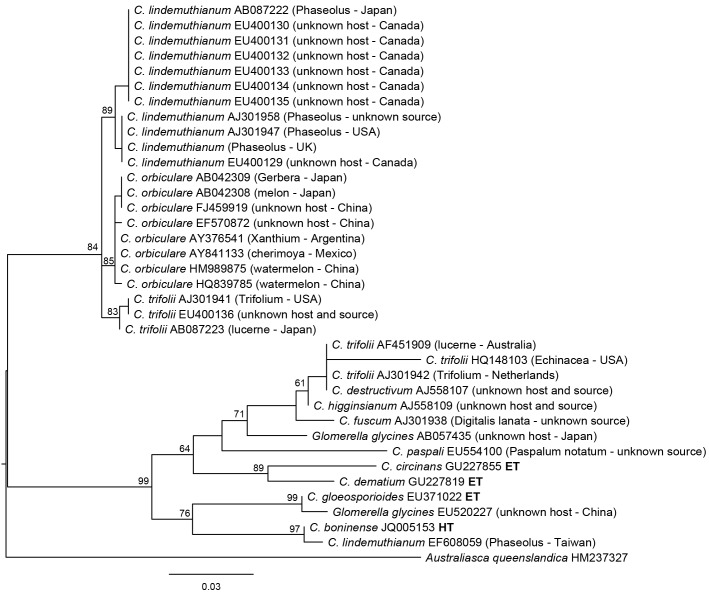
“An analysis of C. lindemuthianum rDNA data by Balardin et al. (1999) showed that Phaseolus pathogens may occur in numerous subordinate clades within the lindemuthianum subclade.”
BackgroundCrouch, J. A., & Tomaso-Peterson, M. (2012) · Mycologia · doi:10.3852/11-317 · Cited by 38 · cited 1×
“This is a diverse taxon in phylogenetic terms and there is evidence of significant gene flow between the various constituent populations (Crouch, in litt .”
BackgroundCannon, P. F. (1996) · Mycological Research · doi:10.1016/s0953-7562(96)80072-4 · Cited by 38 · cited 1×
“Petrak (1924) concluded that Phyllachora , Polystigma and Physalosporina (= Stigmatula ; see Cannon 1996) constituted a natural family that did not belong to the Dothideales .”
BackgroundSelf-citationPopulation structure and mating-type genes ofColletotrichum graminicolafromAgrostis palustris
Chen, F., Goodwin, P. H., Khan, A. S., & Hsiang, T. (2002) · Canadian Journal of Microbiology · doi:10.1139/w02-034 · Cited by 37 · cited 2×
“Despite documented heterothallic behaviour, only one mating type idiomorph has been recovered from population-level screening in a number of studies ( e.g. Chen et al .”
BackgroundA Comparative Study of the Development of Some Anthracnoses
Stoneman, B. (1898) · Botanical Gazette · doi:10.1086/327721 · Cited by 37 · cited 3×
“Colletotrichum sexual morphs were first described by Stoneman (1898) in the genus Gnomoniopsis Stoneman, in a comprehensive and well-illustrated account of the development of anthracnose diseases in the USA.”
BackgroundMolecular and Cultural Characterization of Colletotrichum spp. Causing Bitter Rot of Apples in Korea
Lee, D.-H., Kim, D.-H., Jeon, Y.-A., Uhm, J.-Y., & Hong, S.-B. (2007) · The Plant Pathology Journal · doi:10.5423/ppj.2007.23.2.037 · Cited by 37
Buergenerula and the Physosporellaceae
Barr, M. E. (1976) · Mycologia · doi:10.1080/00275514.1976.12019946 · Cited by 37 · cited 2×
“Barr (1976) introduced (but again did not validly publish) the ordinal name Phyllachorales , in which was included a disparate set of families with the Phyllachoraceae subsumed into the Melogrammataceae .”
BackgroundGENETICS OF GLOMERELLA. VIII. A GENETIC BASIS FOR THE OCCURRENCE OF MINUS MUTANTS
Wheeler, H. (1950) · American Journal of Botany · doi:10.1002/j.1537-2197.1950.tb12200.x · Cited by 37 · cited 1×
“This work has a long history; the first investigation into mating types in Glomerella was published a century ago (Edgerton 1912, 1914), and genetic mechanisms in G. cingulata were extensively studied in the 1940’s and 50’s ( e.g. Andes 1941, Lucas et al. 1944, Wheeler 1950, 1954, Olive 1951).”
BackgroundGENETICS OF GLOMERELLA. I. STUDIES ON THE BEHAVIOR OF CERTAIN STRAINS
Lucas, G. B., Chilton, S. J. P., & Edgerton, C. W. (1944) · American Journal of Botany · doi:10.1002/j.1537-2197.1944.tb08025.x · Cited by 36 · cited 1×
“This work has a long history; the first investigation into mating types in Glomerella was published a century ago (Edgerton 1912, 1914), and genetic mechanisms in G. cingulata were extensively studied in the 1940’s and 50’s ( e.g. Andes 1941, Lucas et al. 1944, Wheeler 1950, 1954, Olive 1951).”
BackgroundColletotrichum acutatum Simmds. f.sp. pinea associated with "terminal crook" disease of Pinus spp.
Dingley, J. M., & Gilmour, J. (1972) · New Zealand journal of forestry science · Cited by 36
The Identity and Perfect State of Colletotrichum Graminicola
Politis, D. J. (1975) · Mycologia · doi:10.1080/00275514.1975.12019721 · Cited by 35
Krüger, J., Hoffmann, G. M., & Hubbeling, N. (1977) · Euphytica · doi:10.1007/bf00032063 · Cited by 35
The Physiology and Development of Some Anthracnoses
Edgerton, C. W. (1908) · Botanical Gazette · doi:10.1086/329594 · Cited by 35 · cited 1×
“Shear & Wood (1907) and Edgerton (1908) considered that at least several of the putatively host-specific taxa described by Stoneman (1898) as species of Gnomoniopsis were conspecific, although they did not include material ascribed to Ga. cingulata in their studies.”
BackgroundColletotrichum echinochloae, a new species on Japanese barnyard millet (Echinochloa utilis)
Moriwaki, J., & Tsukiboshi, T. (2009) · Mycoscience · doi:10.1007/s10267-009-0485-1 · Cited by 34 · cited 1×
“To date, they have been studied in the acutatum, graminicola, gloeosporioides and orbiculare clades ( e.g. Du et al. 2005, García-Serrano et al. 2008, Marcelino et al. 2008, Crouch et al. 2009, Moriwaki & Tsukiboshi 2009, Rojas et al. 2010).”
BackgroundPhenotypic and genetic characterization of Colletotrichum isolates from Belgian strawberry fields
Hemelrijck, W. V., Debode, J., Heungens, K., Maes, M., & Creemers, P. (2010) · Plant Pathology · doi:10.1111/j.1365-3059.2010.02324.x · Cited by 34
Munaut, F., Hamaide, N., Vander Stappen, J., & Maraite, H. (1998) · Plant Pathology · doi:10.1046/j.1365-3059.1998.00287.x · Cited by 33
MacKenzie, S. J., Seijo, T. E., Legard, D. E., Timmer, L. W., & Peres, N. A. (2007) · Phytopathology® · doi:10.1094/phyto-97-9-1130 · Cited by 32 · cited 1×
“Mackenzie et al. (2007) demonstrated gene flow between populations of C. acutatum from native plants and those from adjacent strawberry crops, demonstrating the limitations of host-restricted studies.”
BackgroundChoi, K.-J., Kim, W.-G., Kim, H.-G., Choi, H.-W., Lee, Y.-K., Lee, B.-D., Lee, S.-Y., & Hong, S.-K. (2011) · The Plant Pathology Journal · doi:10.5423/ppj.2011.27.1.001 · Cited by 31
Munaut, F., Hamaide, N., & Maraite, H. (2002) · Mycological Research · doi:10.1017/s0953756202005932 · Cited by 30
Clinical Characteristics of Keratitis Due to Colletotrichum gloeosporioides
Shiraishi, A., Araki‐Sasaki, K., Mitani, A., Miyamoto, H., Sunada, A., Ueda, A., Asari, S., Zheng, X., Yamamoto, Y., Hara, Y., et al. (2011) · Journal of Ocular Pharmacology and Therapeutics · doi:10.1089/jop.2011.0011 · Cited by 30 · cited 1×
“1998, Shiraishi et al. 2011, Shivaprakash et al .”
MethodSexual recombination in Colletotrichum lindemuthianum occurs on a fine scale
de Souza, E. A., Camargo, O. A., & Pinto, J. M. A. (2010) · Genetics and Molecular Research · doi:10.4238/vol9-3gmr863 · Cited by 30
Colletotrichum dematium (Pers. ex Fr.) Grove and C. trichellum (Fr. ex Fr.) Duke
Sutton, B. C. (1962) · Transactions of the British Mycological Society · doi:10.1016/s0007-1536(62)80055-2 · Cited by 29 · cited 1×
“Colletotrichum trichellum was placed into synonymy with C. dematium by von Arx (1957), though it was treated as a separate, apparently host-limited species by Sutton (1962, 1981) based on the degree of curvature of the conidia.”
BackgroundMolecular and morphological markers for rapid distinction between 2 Colletotrichum species
Pileggi, S. A. V., Maciel, S. F. V. D. O., Waculicz‐Andrade, C. E., Vicente, V. A., Dalzoto, P. D. R., da Cruz, G. K., Gabardo, J., Júnior, N. S. M., Tozze, H. J., Pileggi, M., et al. (2009) · Canadian Journal of Microbiology · doi:10.1139/w09-059 · Cited by 28
Heilmann, L. J., Nitzan, N., Johnson, D. A., Pasche, J. S., Doetkott, C. D., & Gudmestad, N. C. (2006) · Phytopathology · doi:10.1094/phyto-96-1097 · Cited by 28 · cited 1×
“This is primarily a pathogen of Solanaceae (potato and tomato), but also survives well in soil and is reported as an associate of a wide range of crops including strawberry (Buddie et al. 1999, Heilmann et al. 2006).”
BackgroundEvaluation of Anthracnose Resistance among Tea Genetic Resources by Wound-Inoculation Assay
Yoshida, K., & TAKEDA, Y. (2006) · Japan Agricultural Research Quarterly JARQ · doi:10.6090/jarq.40.379 · Cited by 27 · cited 1×
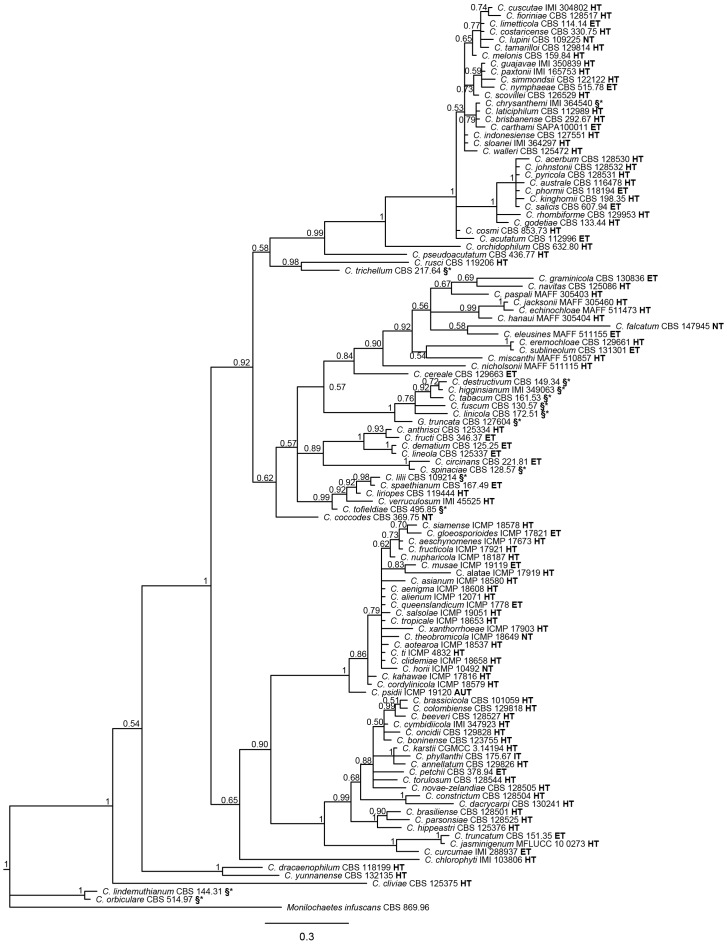
“2002, Yoshida & Takeda 2006) has unusually small conidia and may well fall outside of Colletotrichum as outlined in Fig.”
BackgroundDale, J. L., Manners, J. M., & Irwin, J. A. G. (1988) · Transactions of the British Mycological Society · doi:10.1016/s0007-1536(88)80043-3 · Cited by 26 · cited 1×
“Initially, work focused on infraspecific variation; DNA polymorphisms were detected in C. gloeosporioides by Dale et al. (1988), Braithwaite & Manners (1989) and Braithwaite et al. (1990a, b), and strains of that species (as then circumscribed) were found to have variable numbers of chromosomes…”
BackgroundO’Connell, R. J., Bailey, J. A., Vose, I. R., & Lamb, C. J. (1986) · Physiological and Molecular Plant Pathology · doi:10.1016/s0048-4059(86)80012-1 · Cited by 26 · cited 2×
“Petrak (1924) concluded that Phyllachora, Polystigma and Physalosporina (= Stigmatula; see Cannon 1996) constituted a natural family that did not belong to the Dothideales.”
BackgroundGlomerella truncata : another Glomerella species with an atypical mating system
Menat, J., Cabral, A. L., Vijayan, P., Wei, Y., & Banniza, S. (2012) · Mycologia · doi:10.3852/10-265 · Cited by 26 · cited 2×
“Glomerella truncata was described as the teleomorph of C. truncatum (Armstrong-Cho & Banniza 2006, Menat et al .”
BackgroundRibosomal DNA as a molecular taxonomic marker for the group species Colletotrichum gloeosporioides
Braithwaite, K. S., Irwin, J. A. G., & Manners, J. (1990) · Australian Systematic Botany · doi:10.1071/sb9900733 · Cited by 25 · cited 1×
“…focused on infraspecific variation; DNA polymorphisms were detected in C. gloeosporioides by Dale et al. (1988), Braithwaite & Manners (1989) and Braithwaite et al. (1990a, b), and strains of that species (as then circumscribed) were found to have variable numbers of chromosomes (Masel et al.…”
BackgroundDEVELOPMENT OF FRUCTIFICATIONS IN COLLETOTRICHUM GRAMINICOLA (CES.) WILS. AND RELATED SPECIES
Sutton, B. C. (1966) · Canadian Journal of Botany · doi:10.1139/b66-104 · Cited by 25 · cited 1×
“Important contributions were made in the 1960s by Simmonds (1965; recognition of Colletotrichum acutatum ), and by Sutton (1966, 1968; taxonomy of the C. graminicola complex and the value of appressorial morphology in classification).”
BackgroundRibosomal DNA Sequence Comparisons of Colletotrichum Graminicola from Turfgrasses and other Hosts
Hsiang, T., & Goodwin, P. H. (2001) · European Journal of Plant Pathology · doi:10.1023/a:1017974630963 · Cited by 24
Winka, K., & Eriksson, O. E. (2000) · Mycoscience · doi:10.1007/bf02464316 · Cited by 24 · cited 1×
“Winka & Eriksson (2000) found that two 18S rDNA sequences from Phyllachora species clustered in the Sordariomycetidae clade, while Glomerella cingulata was considered to be more closely related to the Hypocreomycetidae .”
BackgroundA New Anthracnose of Alfalfa and Red Clover
Bain, S. M., & Essary, S. H. (1906) · The Journal of Mycology · doi:10.2307/3753010 · Cited by 24 · cited 1×
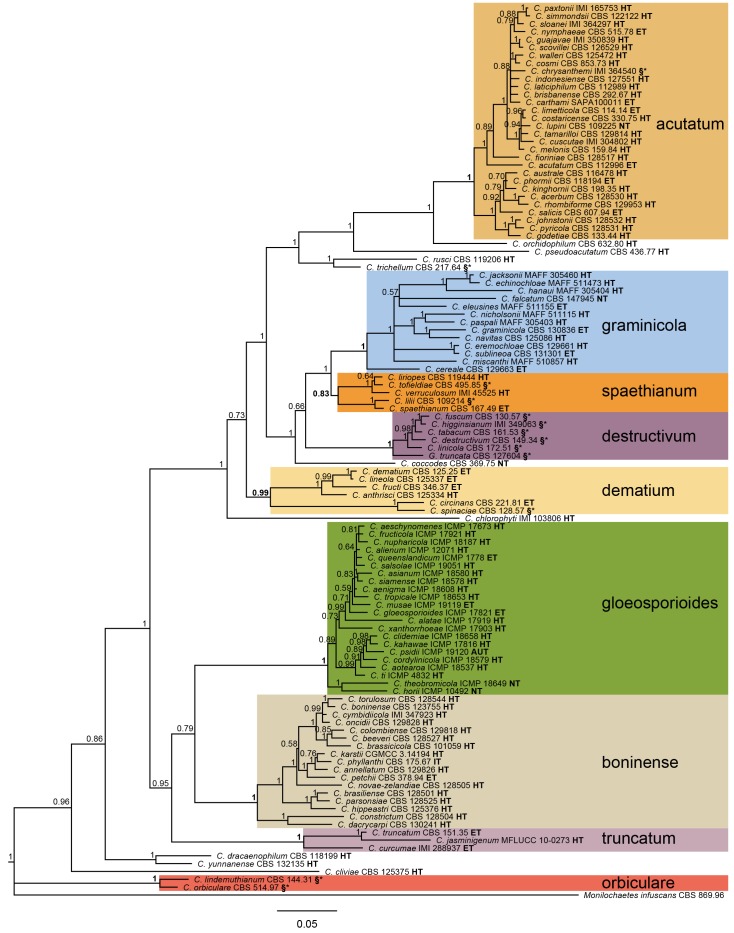
“Further research is needed before the most appropriate typification can be made; however the original description (Bain & Essary 1906) gives conidial dimensions and shape that are typical of the orbiculare clade.”
BackgroundColletotrichum yunnanense sp. nov., a new endophytic species from Buxus sp.
Liu, X., XiangMing, X., & JunXing, D. (2007) · Biodiversity Heritage Library (Smithsonian Institution) · Cited by 24
Anthracnose of lupins in South Africa is caused byColletotrichum lupinivar.setosum
Lotter, H. C., & Berger, D. K. (2005) · Australasian Plant Pathology · doi:10.1071/ap05052 · Cited by 23
Analysis of the MAT1-2-1 gene of Colletotrichum lindemuthianum
García-Serrano, M., Laguna, E. A., Simpson, J. K., & Rodríguez-Guerra, R. (2008) · Mycoscience · doi:10.1007/s10267-008-0424-6 · Cited by 23
Characterization ofColletotrichum kahawaeIsolates Causing Coffee Berry Disease in Angola
Manuel, L., Talhinhas, P., Várzea, V., & Neves-Martins, J. (2009) · Journal of Phytopathology · doi:10.1111/j.1439-0434.2009.01613.x · Cited by 23
Ontogeny of the ascoma of Glomerella cingulata
Uecker, F. A. (1994) · Mycologia · doi:10.1080/00275514.1994.12026376 · Cited by 23 · cited 1×
“Locquin’s work was generally ignored, until preliminary sequence-based studies along with ontogenetic research (Uecker 1994) confirmed that Glomerella and Phyllachora did not belong to the same order of fungi.”
BackgroundNew species and notes of Colletotrichum on daylilies (Hemerocallis spp.)
Yang, Y., Liu, Z., Cai, L., & Hyde, K. D. (2012) · Tropical Plant Pathology · doi:10.1590/s1982-56762012000300001 · Cited by 22 · cited 1×
“An additional species, C. hemerocallidis , closely related to C. dematium , was described just before finishing this review (Yang et al. 2012).”
BackgroundMarcelino, J., Gouli, S. Y., Parker, B. L., Skinner, M., & Giordano, R. (2009) · Journal of Insect Science · doi:10.1673/031.009.1301 · Cited by 22 · cited 1×
“Infection mechanisms are not fully understood; under experimental conditions the insects became infected after being sprayed with a conidial suspension (Marcelino et al. 2009).”
BackgroundColletotrichum graminicola and the anthracnose diseases of maize and sorghum.
Nicholson, R. L., Bailey, J. A., & Jeger, M. J. (1992) · Cited by 22
The Identity and Perfect State of Colletotrichum graminicola
Politis, D. J. (1975) · Mycologia · doi:10.2307/3758227 · Cited by 21
(2010) · Sydowia · Cited by 21
Glomerella magna, cause of a new anthracnose of cucurbits
Winstead, N. N. (1964) · Phytopathology · Cited by 21
On the occurrences of a species of colletotrichum
Small, W. (1926) · Transactions of the British Mycological Society · doi:10.1016/s0007-1536(26)80031-2 · Cited by 20 · cited 1×
“The equation of the name Ga. cingulata with the species aggregate rather than the fungus causing disease of Ligustrum was further established in works by Dastur (1920) and Small (1921, 1926), which focused on cross-inoculation experiments.”
BackgroundSun, H., & Zhang, J. (2009) · European Journal of Plant Pathology · doi:10.1007/s10658-009-9495-2 · Cited by 20 · cited 1×
“Colletotrichum higginsianum was reported to be synonymous with C. destructivum by Sun & Zhang (2009) based on ITS sequence similarity, but multilocus phylogenies of strains provisionally accepted as representative of C. higginsianum and C. destructivum indicate that these two species are distinct…”
BackgroundLópez, A. M. Q., & Lucas, J. A. (2010) · Brazilian Archives of Biology and Technology · doi:10.1590/s1516-89132010000400001 · Cited by 20
Host and Nonhost Resistance in Medicago–Colletotrichum Interactions
Jaulneau, V., Cazaux, M., Hoi, J. W. S., Fournier, S., Esquerré‐Tugayé, M., Jacquet, C., & Dumas, B. (2010) · Molecular Plant-Microbe Interactions · doi:10.1094/mpmi-23-9-1107 · Cited by 19 · cited 1×
“Jaulneau et al. (2010) compared the defence reactions of resistant or susceptible lines of Medicago truncatula to the alfalfa pathogen C. trifolii with reactions of the nonadapted pathogens C. lindemuthianum and C. higginsianum .”
BackgroundLenné, J. M. (2001) · CABI Publishing eBooks · doi:10.1079/9780851994581.0004 · Cited by 19 · cited 2×
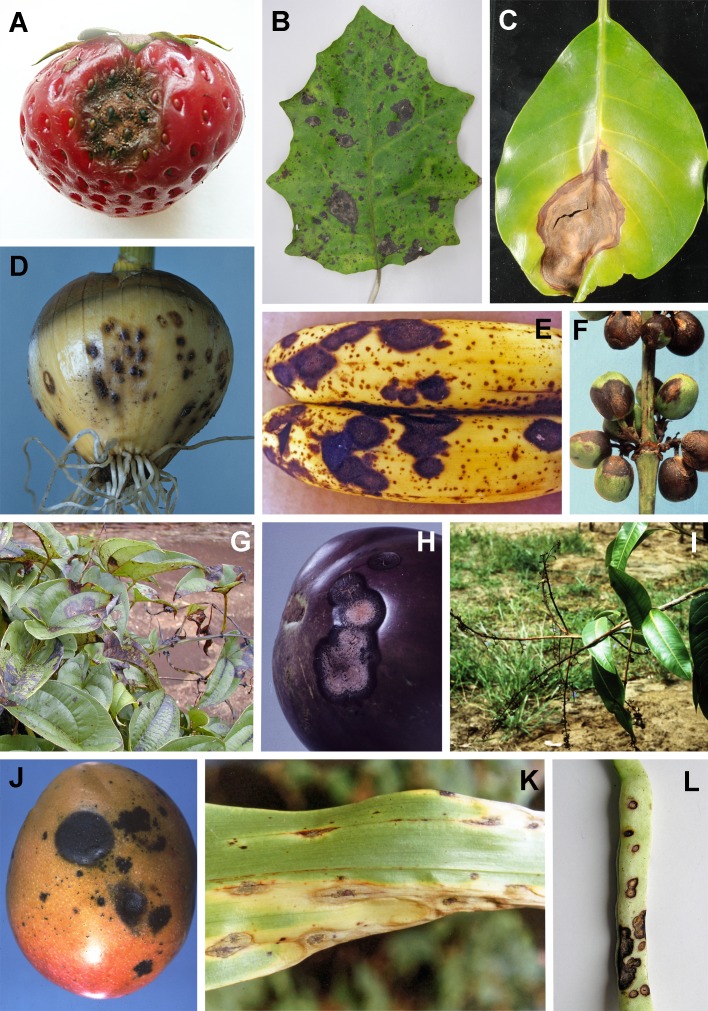
“As plant pathogens, Colletotrichum species are primarily described as causing anthracnose diseases, although other maladies are also reported such as red rot of sugar cane, coffee berry disease, crown rot of strawberry and banana, and brown blotch of cowpea (Lenné 2002).”
BackgroundThe genera Vermicularia fr. and Colletotrichum Cda.
Duke, M. M. (1928) · Transactions of the British Mycological Society · doi:10.1016/s0007-1536(28)80016-7 · Cited by 18 · cited 1×
“The nomenclatural details have been outlined successively in the light of the then current rules by Duke (1928), Sutton (1992) and Damm et al. (2009), and will not be repeated here.”
BackgroundTorres, M. S., White, J. F., & Bischoff, J. F. (2007) · Mycological Research · doi:10.1016/j.mycres.2007.01.005 · Cited by 18 · cited 1×
“In the field it seems possible that endophytic colonies of the fungus are ingested via the insect mouth-parts, the reverse of a process that has been shown in members of the Clavicipitaceae to infect plants via the stylets of sap-sucking insects (Torres et al. 2007, Tadych et al. 2009).”
BackgroundThe Perfect Stage of Colletotrichum Falcatum.
Carvajal, F. (1943) · Louisiana State University · doi:10.31390/gradschool_disstheses.7871 · Cited by 18
LoBuglio, K. F., & Pfister, D. H. (2008) · Mycologia · doi:10.3852/07-192 · Cited by 17
First record of anthracnose of spinach caused byColletotrichum dematiumin Australia
Washington, W. S., Irvine, G., Aldaoud, R., DeAlwis, S., Edwards, J., & Pascoe, I. G. (2006) · Australasian Plant Pathology · doi:10.1071/ap05095 · Cited by 16 · cited 1×
“In general, members of the dematium clade are not significant in economic terms, but C. spinaciae (a pathogen of Beta and Spinacia ; Gourley 1966, Washington et al. 2006) and C. circinans (attacking Allium species; Hall et al. 2007, Kim et al. 2008) both cause substantial crop losses under some…”
BackgroundBen-Daniel, B.-H., Bar‐Zvi, D., Johnson, D. A., Harding, R., Hazanovsky, M., & Tsror, L. (2010) · Phytopathology · doi:10.1094/phyto-100-3-0271 · Cited by 16 · cited 2×
“The species is known to be variable in genetic terms (Ben-Daniel et al. 2010).”
BackgroundCharacterization of Colletotrichum Species Associated with Diseases of Proteaceae
Lubbe, C. M., Denman, S., Cannon, P. F., et al. (2004) · Mycologia · doi:10.2307/3762144 · Cited by 16
Self-citationThe Perfect Stage of the Cotton Anthracnose
Edgerton, C. W. (1909) · Mycologia · doi:10.2307/3753047 · Cited by 14
Experiments on the Inheritance of the "Plus" and "Minus" Characters in Glomerella cingulata
Andes, J. O. (1941) · Bulletin of the Torrey Botanical Club · doi:10.2307/2481749 · Cited by 14 · cited 1×
“This work has a long history; the first investigation into mating types in Glomerella was published a century ago (Edgerton 1912, 1914), and genetic mechanisms in G. cingulata were extensively studied in the 1940’s and 50’s ( e.g. Andes 1941, Lucas et al. 1944, Wheeler 1950, 1954, Olive 1951).”
BackgroundITS-rDNA phylogeny of Colletotrichum spp. causal agent of apple Glomerella leaf spot
Giaretta, D. R., Bogo, A., Coelho, C. M. M., Guidolin, A. F., Dantas, A. C. D. M., & Gomes, E. A. (2010) · Ciência Rural · doi:10.1590/s0103-84782010005000051 · Cited by 14
Molecular systematics of the Phyllachorales (ascomycota, fungi) based on 18S ribosomal DNA sequences
Silva, D. M. W., Neto, E. R., & Hanlin, R. T. (2003) · Brazilian Archives of Biology and Technology · doi:10.1590/s1516-89132003000300002 · Cited by 14 · cited 1×
“Wanderlei-Silva et al. (2003) also published a study based on 18S rDNA, that claimed that the Phyllachoraceae was polyphyletic.”
BackgroundOntogeny of the Ascoma of Glomerella cingulata
Uecker, F. A. (1994) · Mycologia · doi:10.2307/3760721 · Cited by 14
Sivanesan, A., & Hsieh, W. H. (1993) · Mycological Research · doi:10.1016/s0953-7562(09)80228-1 · Cited by 13
Ascogenous Forms of Gloeosporium and Colletotrichum
Shear, C. L., & Wood, A. K. (1907) · Botanical Gazette · doi:10.1086/329172 · Cited by 13 · cited 1×
“Shear & Wood (1907) and Edgerton (1908) considered that at least several of the putatively host-specific taxa described by Stoneman (1898) as species of Gnomoniopsis were conspecific, although they did not include material ascribed to Ga. cingulata in their studies.”
BackgroundGenetics of Glomerella. VIII. A Genetic Basis for the Occurrence of Minus Mutants
Wheeler, H. (1950) · American Journal of Botany · doi:10.2307/2437851 · Cited by 13
HOMOTHALLISM AND HETEROTHALLISM IN GLOMERELLA*
Olive, L. S. (1951) · Transactions of the New York Academy of Sciences · doi:10.1111/j.2164-0947.1951.tb00046.x · Cited by 13 · cited 2×
“This work has a long history; the first investigation into mating types in Glomerella was published a century ago (Edgerton 1912, 1914), and genetic mechanisms in G. cingulata were extensively studied in the 1940’s and 50’s ( e.g. Andes 1941, Lucas et al. 1944, Wheeler 1950, 1954, Olive 1951).”
BackgroundDauch, A. L., Watson, A. K., Séguin, P., & Jabaji, S. (2006) · Canadian Journal of Plant Pathology · doi:10.1080/07060660609507269 · Cited by 13 · cited 1×
“It has been researched into as a potential biocontrol agent for Abutilon theophrasti (Dauch et al. 2006).”
BackgroundThe Ascigerous Stage of Colletotrichum Lagenarium Induced by Ultra-Violet Irradiation
Stevens, F. L. (1931) · Mycologia · doi:10.1080/00275514.1931.12017030 · Cited by 13
Buergenerula and the Physosporellaceae
Barr, M. E. (1976) · Mycologia · doi:10.2307/3758983 · Cited by 13
DISCOVERY OF DENTAL GROOVES AND TEETH IN THE TYPE OF BAPTANODON (SAURANODON) MARSH
Gilmore, C. W. (1903) · Science · doi:10.1126/science.17.436.750.a · Cited by 13
Hall, B. H., Hitch, C., Oxspring, E. A., & Wicks, T. J. (2007) · Australasian Plant Pathology · doi:10.1071/ap07038 · Cited by 12 · cited 1×
“…members of the dematium clade are not significant in economic terms, but C. spinaciae (a pathogen of Beta and Spinacia ; Gourley 1966, Washington et al. 2006) and C. circinans (attacking Allium species; Hall et al. 2007, Kim et al. 2008) both cause substantial crop losses under some circumstances.”
BackgroundColletotrichum as a model system for defining the genetic basis of fungal symbiotic lifestyles
Rodriguez, R. J., & Redman, R. S. (2001) · Cited by 12
Dastur, J. F. (1920) · Annals of Applied Biology · doi:10.1111/j.1744-7348.1920.tb06472.x · Cited by 11 · cited 1×
“The equation of the name Ga. cingulata with the species aggregate rather than the fungus causing disease of Ligustrum was further established in works by Dastur (1920) and Small (1921, 1926), which focused on cross-inoculation experiments.”
BackgroundTadych, M., Chaverri-Echandi, P., Bergen, M. S., & White, J. F. (2009) · Mycological Research · doi:10.1016/j.mycres.2009.01.011 · Cited by 11 · cited 1×
“In the field it seems possible that endophytic colonies of the fungus are ingested via the insect mouth-parts, the reverse of a process that has been shown in members of the Clavicipitaceae to infect plants via the stylets of sap-sucking insects (Torres et al. 2007, Tadych et al. 2009).”
BackgroundLee, H.-B., Park, J. Y., & Jung, H. S. (2005) · The Plant Pathology Journal · doi:10.5423/ppj.2005.21.1.027 · Cited by 9
A WILLOW-CANKER DISEASE CAUSED BY PHYSALOSPORA MIYABEANA AND ITS CONIDIAL FORM GLOEOSPORIUM
Fukushi, T. (1921) · 日本植物病理學會報 · doi:10.3186/jjphytopath.1.4_1 · Cited by 8
THE PATHOGENICITY OF COLLETOTRICHUM DEMATIUM TO TABLE BEETS AND OTHER HOSTS
Gourley, C. O. (1966) · Canadian Journal of Plant Science · doi:10.4141/cjps66-089 · Cited by 8 · cited 1×
“In general, members of the dematium clade are not significant in economic terms, but C. spinaciae (a pathogen of Beta and Spinacia ; Gourley 1966, Washington et al. 2006) and C. circinans (attacking Allium species; Hall et al. 2007, Kim et al. 2008) both cause substantial crop losses under some…”
BackgroundDiscovery of Dental Grooves and Teeth in the Type of Baptanodon (Sauranodon) Marsh.
Gilmore, C. W. (1903) · Science · doi:10.1126/science.17.436.750-a · Cited by 8 · cited 2×
“Von Schrenk and Spaulding (1903) accordingly proposed the name Glomerella for the anthracnose-causing species, making new combinations for the four species definitely accepted by Stoneman in her genus and adding a fifth, Glomerella rufomaculans , considered to be the causal agent of bitter rot of…”
BackgroundOccurrence of Anthracnose on Welsh Onion Caused byColletotrichum circinans
Kim, W. G., Hong, S. K., & Kim, J. H. (2008) · Mycobiology · doi:10.4489/myco.2008.36.4.274 · Cited by 7 · cited 1×
“…members of the dematium clade are not significant in economic terms, but C. spinaciae (a pathogen of Beta and Spinacia ; Gourley 1966, Washington et al. 2006) and C. circinans (attacking Allium species; Hall et al. 2007, Kim et al. 2008) both cause substantial crop losses under some circumstances.”
BackgroundColletotrichum yunnanense sp. nov., a new endophytic species from Buxus sp
Liu, X.-Y., Xie, X. M., & Duan, J. X. (2007) · Biodiversity Heritage Library (Smithsonian Institution) · Cited by 7
Life cycle of Colletotrichum heveae inciting spot anthracnose of phyllanthus acidus
Pai, H. S. (1970) · Mycopathologia · doi:10.1007/bf02051827 · Cited by 6
Anthracnose of Nemesia strumosa Caused by Colletotrichum fuscum
Tomioka, K., Sato, T., & KOGANEZAWA, H. (2001) · Journal of General Plant Pathology · doi:10.1007/pl00012996 · Cited by 5 · cited 1×
“Colletotrichum fuscum is a pathogen of Digitalis and Nemesia ( Scrophulariaceae ; Tomioka et al. 2001).”
BackgroundStudies on graminicolous species of Phyllachora Fckl. IV. Evaluation of the criteria of species
Parbery, D., & Langdon, R. F. N. (1964) · Australian Journal of Botany · doi:10.1071/bt9640265 · Cited by 5 · cited 1×
“Physalospora montana , Phyllachora montana ) was considered by Parbery (1964) to have affinities with a small group of Phyllachora species on montane grasses with sexual morphs that mature on dead plant tissues.”
BackgroundBeiträge zur Kenntnis der Morphologie und Physiologie der japanischen Gloeosporien
HEMMI, T. (1920) · Hokkaido University Collection of Scholarly and Academic Papers (Hokkaido University) · Cited by 5
GLOMERELLA PHACIDIOMORPHA (CES.) PET. ON PHORMIUM TEN AX IN BRITAIN
KINGHOKN, W. O. (1936) · Annals of Applied Biology · doi:10.1111/j.1744-7348.1936.tb05551.x · Cited by 4
Notes on Species of Colletotrichum and Phoma in Uganda
Small, W. (1921) · Bulletin of Miscellaneous Information (Royal Gardens Kew) · doi:10.2307/4115055 · Cited by 3 · cited 1×
“The equation of the name Ga. cingulata with the species aggregate rather than the fungus causing disease of Ligustrum was further established in works by Dastur (1920) and Small (1921, 1926), which focused on cross-inoculation experiments.”
BackgroundSchoch, C. L., & Seifert, K. A. (2015) · AccessScience · doi:10.1036/1097-8542.yb110060 · Cited by 3
The perfect stage of Colletotrichum phomoides on Tomato.
Swank, G. R. (1953) · Phytopathology · Cited by 2
Ainsworth & Bisby's "Dictionary of the Fungi"
Ainsworth, G. C. (1972) · Taxon · doi:10.2307/1219250 · cited 1×
“Successive editions of the Dictionary of the Fungi until edn 6 (Ainsworth, 1971) listed Glomerella as a member of the Phyllachoraceae in the order Sphaeriales .”
Background
Research works printed but not linked: 29
- Agrios GN (2005). Plant Pathology. 5th edn Academic Press, New York
- Arx JA von (1957a). Revision der zu Gloeosporium gestellten Pilze. Verhandligen des Koninklijke Nederlandse Akadademie van Wetenschappen, Afd. Natuurkunde, 2, 51(3): 153 pp
- Arx JA von (1957b). Die Arten der Gattung Colletotrichum Cda. Phytopathologische Zeitschrift 29: 413– 468
- Barrus MF (1918). Varietal susceptability of beans to strains of Colletotrichum lindemuthianum (Sacc. & Magn.) B. & C. Phytopathology 8: 589– 605
- Berlese AN (1893). Icones Fungorum Omnium hucusque Cognitorum. Pergola, Avellino vol. 1: 91– 118
- Chadefaud M (1960). Les Végétaux non Vasculaires. Cryptogamie. In: Traité de Botanique Systématique (Chadefaud M Emberger L, eds). Masson, Paris vol. 1: 1018 pp
- Corda ACI (1831). Die Pilze Deutschlands. In: Deutschlands Flora in Abbildungen nach der Natur mit Beschreibungen (Sturm J, ed.). Sturm, Nürnberg vol. 3, Abt. 12: 33– 64, tab. 21–32
- Corda ACI (1837). Icones Fungorum hucusque cognitorum vol. 1 Calve, Prague
- Corda ACI (1840). Icones Fungorum hucusque cognitorum vol. 4 Calve, Prague
- Edgerton CW (1912). Plus and minus strains in an ascomycete. Science 35: 151
- Hennings P (1898). Die in den Gewächshäusern des Berliner Botanischen Gartens beobachteten Pilze. Verhandlungen des Botanischen Vereins der Provinz Brandenburg 40: 109– 177
- Hyde KD Cai L McKenzie EHC Yang YL Zhang JZ (2009b). Colletotrichum: a catalogue of confusion. Fungal Diversity 39: 1– 17
- Krüger F (1913). Beiträge zur Kenntnis einiger Gloeosporien. Arbeiten aus der Kaiserlichen Biologischen Anstalt für Land- und Forstwirtschaft. 9: 233– 323
- Leahy R Schubert T Strandberg J Stamps B Norman D (1995). Anthracnose of leatherleaf fern. Plant Pathology Circular 372: 4 pp
- Lehman SG Wolf FA (1926). Soybean anthracnose. Journal of Agricultural Research Washington 33: 381– 390
- Montagne C (1849). Sixième centurie des plantes cellulaires nouvelles tant indigènes qu’exotiques. Annales des Sciences Naturelles. Botanique Série 3, 12: 285– 320
- Palarpawar MY Ghurde VR (1988). Some new hosts of Colletotrichum curcumae. Indian Journal of Mycology and Plant Pathology 18: 220– 221
- Petrak F (1924). Über die phylogenetischen Beziehungen der Gattung Phyllachora und ihre Bedeutung für das System der dothidealean Pilze. Annales Mycologici 22: 1– 10
- Phuong THN Pettersson OV Olsson P Nguyen PTH (2010). Identification of Colletotrichum species associated with anthracnose disease of coffee in Vietnam. European Journal of Plant Pathology 127: 73– 87 · DOI
- Prihastuti H Cai L Chen H McKenzie EHC Hyde KD (2009). Characterization of Colletotrichum species associated with coffee berries in northern Thailand. Fungal Diversity 39: 89– 109
- Prusky D Freeman S Dickman MB (eds) (2000). Colletotrichum. Host Specificity, Pathology and Host-Pathogen Interaction. APS Press, St Paul, USA
- Ramos AP Merali Z Talhinhas P Sreenivasaprasad S Oliveira H (2006). Molecular and morphological characterisation of Colletotrichum species involved in citrus anthracnose in Portugal. Bulletin OILB/SROP 29: 317– 326
- Schoch C Seifert K Crous P (2011). Progress on DNA barcoding of Fungi. IMA Fungus 2: (5).
- Shivas RG Tan YP (2009). A taxonomic reassessment of Colletotrichum acututum, introducing C. fioriniae comb. et stat. nov. and C. simmondsii sp. nov. Fungal Diversity 39: 111– 122
- Sydow H (1928). Fungi Chilenses a cl. E. Werdermann lecti. Pars prima. Annales Mycologici 26: 100– 126
- Theissen F Sydow H (1915). Die Dothideales. Kritische-systematische Originaluntersuchungen. Annales Mycologici 13: 147– 746
- Vaillancourt L Wang J Hanau R (2000). Genetic regulation of sexual compatibility in Glomerella graminicola. In: Colletotrichum. Host Specificity, Pathology and Host-Pathogen Interaction (Prusky D Freeman S Dickman MB, eds). APS Press, St Paul, USA: 29– 44
- Wheeler HE (1954). Genetics and evolution of heterothallism in Glomerella. Phytopathology 44: 342– 345
- Yang YL Liu ZY Cai L Hyde KD Zu ZN McKenzie EHC (2009). Colletotrichum anthracnose of Amaryllidaceae. Fungal Diversity 39: 123– 146
Cited by
The Colletotrichum gloeosporioides species complex
Weir, B. S., Johnston, P. R., & Damm, U. (2012) · Studies in Mycology · doi:10.3114/sim0011 · Cited by 1,646
“This fungus is not part of the C. gloeosporioides complex (Cannon et al. 2012, this issue).”
BackgroundMethodInfluentialSelf-citationThe Colletotrichum acutatum species complex
Damm, U., Cannon, P. F., Woudenberg, J. H. C., & Crous, P. W. (2012) · Studies in Mycology · doi:10.3114/sim0010 · Cited by 979
“His work marked a new era in the understanding of Colletotrichum systematics (Cannon et al. 2012, this issue), but many of the synonymies proposed were inaccurate.”
BackgroundMethodInfluentialSelf-citationFungal diversity notes 111–252—taxonomic and phylogenetic contributions to fungal taxa
Ariyawansa, H. A., Hyde, K. D., Jayasiri, S. C., Buyck, B., Chethana, K. W. T., Dai, D. Q., Dai, Y. C., Daranagama, D. A., Jayawardena, R. S., Lücking, R., et al. (2015) · Fungal Diversity · doi:10.1007/s13225-015-0346-5 · Cited by 751
Diaporthe: a genus of endophytic, saprobic and plant pathogenic fungi
Gomes, R. R., Glienke, C., Videira, S. I. R., Lombard, L., Groenewald, J. Z., & Crous, P. W. (2013) · Persoonia - Molecular Phylogeny and Evolution of Fungi · doi:10.3767/003158513x666844 · Cited by 680
“…it is strongly recommended that the chosen epitype should originate from the same geographical region and host, and have morphological, cultural and pathological characteristics similar to those described in the original publication (see Damm et al. 2012a, b, Cannon et al. 2012, Weir et al. 2012).”
BackgroundResultFungal diversity notes 367–490: taxonomic and phylogenetic contributions to fungal taxa
Hyde, K. D., Hongsanan, S., Jeewon, R., Bhat, D. J., McKenzie, E. H. C., Jones, E. B. G., Phookamsak, R., Ariyawansa, H. A., Boonmee, S., Zhao, Q., et al. (2016) · Fungal Diversity · doi:10.1007/s13225-016-0373-x · Cited by 524
“Colletotrichum comprises mainly pathogens, as well as endophytes and saprobes (Cannon et al. 2012; Hyde et al. 2014).”
Background
Metadata
- Authors
- Cannon, P. F., Damm, U., Johnston, P. R., & Weir, B. S.
- Affiliations
- Royal Botanic Gardens, Kew (GB)
- Westerdijk Fungal Biodiversity Institute (NL)
- Manaaki Whenua – Landcare Research (NZ)
- Corresponding author
- Cannon, P.F.
- Venue
- Studies in Mycology
- Published
- 2012-09
- Volume
- 73
- Issue
- 1
- Pages
- 181-213
- ISSN
- 0166-0616 (ISSN-L)
- PMC
- PMC3458418
- OpenAlex
- W2088771820
- Semantic Scholar
- 039edab571c722f3c6449b273124da3f0f2c6ac5
- Cited by
- 1,105
- References
- 293
- Citations by year
- 2026: 61 · 2025: 85 · 2024: 109 · 2023: 131 · 2022: 146 · 2021: 102 · 2020: 98 · 2019: 66 · 2018: 70 · 2017: 58 · 2016: 61 · 2015: 36 · 2014: 49 · 2013: 26 · 2012: 6
- FWCI
- 17.74
- Type
- journal article
- Language
- en
- Open access
- hybrid
- doi.org
- Licence
- cc-by-nc-nd
- www.elsevier.com/tdm/userlicense/1.0/ (tdm)
- creativecommons.org/licenses/by-nc-nd/3.0/ (vor, 633 d)
- Locations
- Studies in Mycology (publishedVersion, cc-by-nc-nd)
- Europe PMC (PubMed Central) (publishedVersion, cc-by-nc-nd)
- PubMed Central (publishedVersion, cc-by-nc-nd)
- PubMed (publishedVersion)
- KNAW research portal (Royal Academy of Art and Sciences (KNAW)) (publishedVersion)
- Data Archiving and Networked Services (DANS) (submittedVersion)
- Topics
- Life Sciences › Agricultural and Biological Sciences › Plant Science › Plant Pathogens and Fungal Diseases
- Life Sciences › Immunology and Microbiology › Microbiology › Yeasts and Rust Fungi Studies
- Life Sciences › Agricultural and Biological Sciences › Plant Science › Fungal Plant Pathogen Control
- Keywords
- Colletotrichum, fungal taxonomy, species concept, anamorph-teleomorph relationship, multilocus phylogeny, DNA barcoding, host specificity, speciation, species clusters
About these checks
Registry, retraction, Cites and statistics results are computed, not judged, with one exception: a printed reference that no index lists is read once by a model before it counts as a citation error. Claims are extracted by a model and kept only when their quote appears verbatim in the text; each cited source is then checked, with a model’s help, for whether it says what the claim relies on. Those verdicts can be wrong — read the claim’s quote and the cited source before relying on one.
Statistics and arithmetic are recomputed, not judged.
Confidence bands are shown only for fields calibrated on our annotated test set. None is calibrated yet, so no band is shown.
What counts as a claim ›How we measure confidence ›How we check this ›
Are you an author, or do you see a problem with this page? Request a review
Data sources
Bibliographic data: Semantic Scholar, OpenAlex, Crossref.
Contains information from the Semantic Scholar Academic Graph Datasets, made available under the ODC Attribution License (ODC-BY 1.0).
Semantic Scholar’s data is described in: Kinney, R., et al. (2023). The Semantic Scholar Open Data Platform. arXiv:2301.10140.
