

The DOI matches its Crossref record; 56 of the 58 references it cites were found in a registry or an index.
Learning Sentiment-Specific Word Embedding for Twitter Sentiment Classification
Open accessAbstract
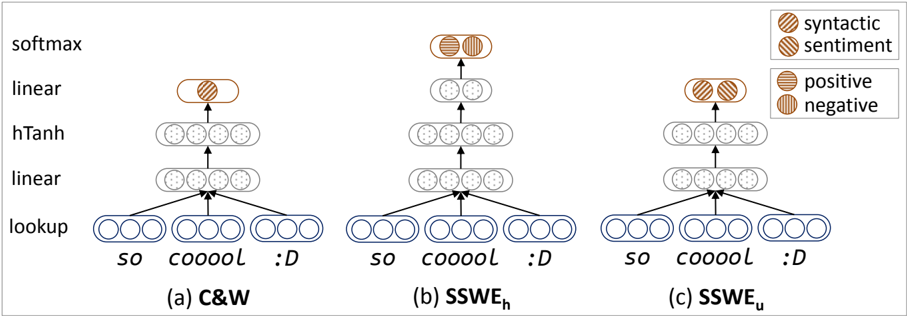
We present a method that learns word embedding for Twitter sentiment classification in this paper.Most existing algorithms for learning continuous word representations typically only model the syntactic context of words but ignore the sentiment of text.This is problematic for sentiment analysis as they usually map words with similar syntactic context but opposite sentiment polarity, such as good and bad, to neighboring word vectors.We address this issue by learning sentimentspecific word embedding (SSWE), which encodes sentiment information in the continuous representation of words.Specifically, we develop three neural networks to effectively incorporate the supervision from sentiment polarity of text (e.g.sentences or tweets) in their loss functions.To obtain large scale training corpora, we learn the sentiment-specific word embedding from massive distant-supervised tweets collected by positive and negative emoticons.Experiments on applying SS-WE to a benchmark Twitter sentiment classification dataset in SemEval 2013 show that (1) the SSWE feature performs comparably with hand-crafted features in the top-performed system; (2) the performance is further improved by concatenating SSWE with existing feature set.
Overview
The claims and statistics of this paper haven’t been checked yet.
Free: it reads the open-access text and checks the first 5 claims that cite a source we can check. Create a free account to check every claim.
Integrity signals
Registry
Cites
Statistics
Figures
Verification
Claims the paper makes
The claims and statistics of this paper haven’t been checked yet.
Free: it reads the open-access text and checks the first 5 claims that cite a source we can check. Create a free account to check every claim.
Claims other papers make about this one
Each is checked against this paper’s own text: does it say what the citing paper says it does?
The source backs part of the claim, not all of it — or backs it for a different population, condition or comparison.
In the citing paper
“Tang et al. [64] pioneered the Sentiment-Specific Word Embeddings (SSWE). Empirical results have shown its superior efficacy over other embeddings in integrating emotion labels at the word level for emotion-centric tasks.”
From A Survey of Deep Learning-Based Multimodal Emotion Recognition: Speech, Text, and Face (2023) · cites this paper as [64]
Experimental — accuracy not yet measured
Self-check
Percentages, sums and reported differences re-computed from the paper’s own numbers.
The self-check needs the paper’s full text.
Citations
Cites
(2003) · Journal of Machine Learning Research · doi:10.5555/944919.944937 · Cited by 32,337
Distributed Representations of Words and Phrases and their Compositionality
Mikolov, T., Sutskever, I., Chen, K., Corrado, G., & Dean, J. (2013) · arXiv · doi:10.48550/arxiv.1310.4546 · Cited by 24,533 · cited 2×
“Although existing word embedding learning algorithms (Collobert et al., 2011; Mikolov et al., 2013) are intuitive choices, they are not effective enough if directly used for sentiment classification.”
BackgroundRepresentation Learning: A Review and New Perspectives
Bengio, Y., Courville, A., & Vincent, P. (2013) · IEEE Transactions on Pattern Analysis and Machine Intelligence · doi:10.1109/tpami.2013.50 · Cited by 13,001
Blei, D. M., Ng, A. Y., & Jordan, M. I. (2002) · Advances in Neural Information Processing Systems 14 · doi:10.7551/mitpress/1120.003.0082 · Cited by 12,223
(2010) · Cited by 8,261
Mining and summarizing customer reviews
Hu, M., & Liu, B. (2004) · Proceedings of the tenth ACM SIGKDD international conference on Knowledge discovery and data mining · doi:10.1145/1014052.1014073 · Cited by 7,793
Thumbs up?: sentiment classification using machine learning techniques
Pang, B., Lee, L., & Vaithyanathan, S. (2002) · Proceedings of the ACL-02 conference on Empirical methods in natural language processing - EMNLP '02 · doi:10.3115/1118693.1118704 · Cited by 7,024
Learning Word Vectors for Sentiment Analysis
Maas, A. L., Daly, R. E., Pham, P. T., Huang, D., Ng, A. Y., & Potts, C. (2011) · Cited by 6,961
Recursive Deep Models for Semantic Compositionality Over a Sentiment Treebank
Socher, R., Perelygin, A., Wu, J., Chuang, J., Manning, C. D., Ng, A., & Potts, C. (2013) · Proceedings of the 2013 Conference on Empirical Methods in Natural Language Processing · doi:10.18653/v1/d13-1170 · Cited by 6,878
Opinion Mining and Sentiment Analysis
Pang, B., & Lee, L. (2008) · now publishers, Inc. eBooks · doi:10.1561/9781601981516 · Cited by 6,720
Research works printed but not linked: 5
- Alec Go, Richa Bhayani, and Lei Huang. 2009. Twit- ter sentiment classification using distant supervision. CS224N Project Report, Stanford, pages 1-12.
- Tomas Mikolov, Ilya Sutskever, Kai Chen, Greg Corra- do, and Jeffrey Dean. 2013. Distributed representa- tions of words and phrases and their compositionali- ty. The Conference on Neural Information Process- ing Systems.
- Preslav Nakov, Sara Rosenthal, Zornitsa Kozareva, Veselin Stoyanov, Alan Ritter, and Theresa Wilson. 2013. Semeval-2013 task 2: Sentiment analysis in twitter. In Proceedings of the International Work- shop on Semantic Evaluation, volume 13.
- Richard Socher, J. Pennington, E.H. Huang, A.Y. Ng, and C.D. Manning. 2011c. Semi-supervised recur- sive autoencoders for predicting sentiment distribu- tions. In Conference on Empirical Methods in Nat- ural Language Processing, pages 151-161.
- Richard Socher, Brody Huval, Christopher D. Man- ning, and Andrew Y. Ng. 2012. Semantic Com- positionality Through Recursive Matrix-Vector S- paces. In Proceedings of the Conference on Empiri- cal Methods in Natural Language Processing.
Cited by
Hierarchical Attention Networks for Document Classification
Yang, Z., Yang, D., Dyer, C., He, X., Smola, A., & Hovy, E. (2016) · Proceedings of the 2016 Conference of the North American Chapter of the Association for Computational Linguistics: Human Language Technologies · doi:10.18653/v1/n16-1174 · Cited by 4,712
Recent Trends in Deep Learning Based Natural Language Processing [Review Article]
Young, T., Hazarika, D., Poria, S., & Cambria, E. (2018) · IEEE Computational Intelligence Magazine · doi:10.1109/mci.2018.2840738 · Cited by 2,921
Deep learning for sentiment analysis: A survey
Zhang, L., Wang, S., & Liu, B. (2018) · WIREs Data Mining and Knowledge Discovery · doi:10.1002/widm.1253 · Cited by 1,928
Document Modeling with Gated Recurrent Neural Network for Sentiment Classification
Tang, D., Qin, B., & Liu, T. (2015) · Proceedings of the 2015 Conference on Empirical Methods in Natural Language Processing · doi:10.18653/v1/d15-1167 · Cited by 1,519
Self-citationEffective Use of Word Order for Text Categorization with Convolutional Neural Networks
Johnson, R., & Zhang, T. (2015) · Proceedings of the 2015 Conference of the North American Chapter of the Association for Computational Linguistics: Human Language Technologies · doi:10.3115/v1/n15-1011 · Cited by 864
Metadata
- Authors
- Tang, D., Wei, F., Yang, N., Zhou, M., Liu, T., & Qin, B.
- Affiliations
- Harbin Institute of Technology (CN)
- University of Science and Technology of China (CN)
- Venue
- Proceedings of the 52nd Annual Meeting of the Association for Computational Linguistics (Volume 1: Long Papers)
- Published
- 2014
- Pages
- 1555-1565
- ISSN
- 0736-587X (ISSN-L)
- OpenAlex
- W2250879510
- Cited by
- 1,181
- References
- 58
- Citations by year
- 2026: 6 · 2025: 17 · 2024: 45 · 2023: 80 · 2022: 88 · 2021: 107 · 2020: 163 · 2019: 155 · 2018: 177 · 2017: 144 · 2016: 110 · 2015: 80 · 2014: 9
- FWCI
- 67.34
- Type
- conference paper
- Language
- en
- Open access
- hybrid
- doi.org
- Licence
- cc-by
- Locations
- Proceedings of the conference - Association for Computational Linguistics. Meeting (publishedVersion, cc-by)
- Funders
- National Natural Science Foundation of China (61273321, 61300113, 61133012)
- Topics
- Physical Sciences › Computer Science › Artificial Intelligence › Sentiment Analysis and Opinion Mining
- Physical Sciences › Computer Science › Artificial Intelligence › Topic Modeling
- Physical Sciences › Computer Science › Artificial Intelligence › Hate Speech and Cyberbullying Detection
- Keywords
- sentiment polarity, distant supervision, emoticons, word representation learning, SemEval-2013
About these checks
Registry, retraction, Cites and statistics results are computed, not judged, with one exception: a printed reference that no index lists is read once by a model before it counts as a citation error. Claims are extracted by a model and kept only when their quote appears verbatim in the text; each cited source is then checked, with a model’s help, for whether it says what the claim relies on. Those verdicts can be wrong — read the claim’s quote and the cited source before relying on one.
Statistics and arithmetic are recomputed, not judged.
Confidence bands are shown only for fields calibrated on our annotated test set. None is calibrated yet, so no band is shown.
What counts as a claim ›How we measure confidence ›How we check this ›
Are you an author, or do you see a problem with this page? Request a review
How to cite
Cite CoChat for the checks on this page, and the paper for its own findings.
- This page
- CoChat. (2026). Citation check: Learning Sentiment-Specific Word Embedding for Twitter Sentiment Classification. https://app.cochat.ai/papers/10.3115/v1/p14-1146
- The paper
- Tang, D., Wei, F., Yang, N., Zhou, M., Liu, T., & Qin, B. (2014). Learning Sentiment-Specific Word Embedding for Twitter Sentiment Classification. Proceedings of the 52nd Annual Meeting of the Association for Computational Linguistics (Volume 1: Long Papers). https://doi.org/10.3115/v1/p14-1146
Data sources
Bibliographic data: Semantic Scholar, OpenAlex, Crossref.
Contains information from the Semantic Scholar Academic Graph Datasets, made available under the ODC Attribution License (ODC-BY 1.0).
Semantic Scholar’s data is described in: Kinney, R., et al. (2023). The Semantic Scholar Open Data Platform. arXiv:2301.10140.
