

Learning Sentiment-Specific Word Embedding for Twitter Sentiment Classification
Open accessThe DOI matches its Crossref record; 56 of the 58 references it cites were found in a registry or an index.
Abstract
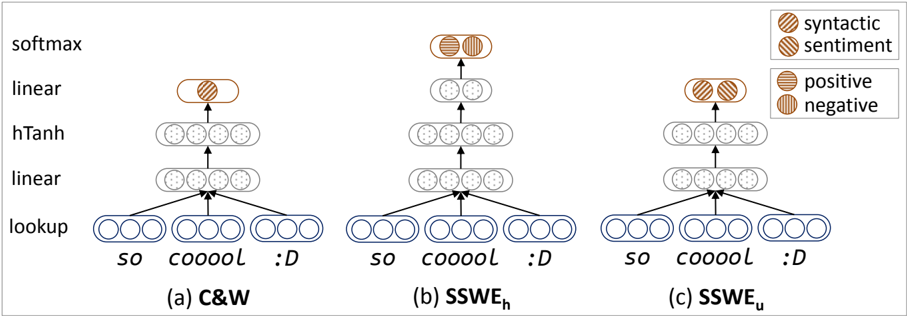
We present a method that learns word embedding for Twitter sentiment classification in this paper.Most existing algorithms for learning continuous word representations typically only model the syntactic context of words but ignore the sentiment of text.This is problematic for sentiment analysis as they usually map words with similar syntactic context but opposite sentiment polarity, such as good and bad, to neighboring word vectors.We address this issue by learning sentimentspecific word embedding (SSWE), which encodes sentiment information in the continuous representation of words.Specifically, we develop three neural networks to effectively incorporate the supervision from sentiment polarity of text (e.g.sentences or tweets) in their loss functions.To obtain large scale training corpora, we learn the sentiment-specific word embedding from massive distant-supervised tweets collected by positive and negative emoticons.Experiments on applying SS-WE to a benchmark Twitter sentiment classification dataset in SemEval 2013 show that (1) the SSWE feature performs comparably with hand-crafted features in the top-performed system; (2) the performance is further improved by concatenating SSWE with existing feature set.
Overview
The claims and statistics of this paper haven’t been checked yet.
Free: it reads the open-access text and checks the first 5 claims that cite a source we can check. Create a free account to check every claim.
Integrity signals
Registry
Cites
Statistics
Figures
Verification
Claims the paper makes
The claims and statistics of this paper haven’t been checked yet.
Free: it reads the open-access text and checks the first 5 claims that cite a source we can check. Create a free account to check every claim.
Claims other papers make about this one
Each is checked against this paper’s own text: does it say what the citing paper says it does?
The source backs part of the claim, not all of it — or backs it for a different population, condition or comparison.
In the citing paper
“Tang et al. [64] pioneered the Sentiment-Specific Word Embeddings (SSWE). Empirical results have shown its superior efficacy over other embeddings in integrating emotion labels at the word level for emotion-centric tasks.”
From A Survey of Deep Learning-Based Multimodal Emotion Recognition: Speech, Text, and Face (2023) · cites this paper as [64]
Experimental — accuracy not yet measured
Self-check
Percentages, sums and reported differences re-computed from the paper’s own numbers.
The self-check needs the paper’s full text.
Citations
Cites
(2003) · Journal of Machine Learning Research · doi:10.5555/944919.944937 · Cited by 32,337
Distributed Representations of Words and Phrases and their Compositionality
Mikolov, T., Sutskever, I., Chen, K., Corrado, G., & Dean, J. (2013) · arXiv · doi:10.48550/arxiv.1310.4546 · Cited by 24,533 · cited 2×
“Although existing word embedding learning algorithms (Collobert et al., 2011; Mikolov et al., 2013) are intuitive choices, they are not effective enough if directly used for sentiment classification.”
BackgroundRepresentation Learning: A Review and New Perspectives
Bengio, Y., Courville, A., & Vincent, P. (2013) · IEEE Transactions on Pattern Analysis and Machine Intelligence · doi:10.1109/tpami.2013.50 · Cited by 13,001
Blei, D. M., Ng, A. Y., & Jordan, M. I. (2002) · Advances in Neural Information Processing Systems 14 · doi:10.7551/mitpress/1120.003.0082 · Cited by 12,223
(2010) · Cited by 8,261
Mining and summarizing customer reviews
Hu, M., & Liu, B. (2004) · Proceedings of the tenth ACM SIGKDD international conference on Knowledge discovery and data mining · doi:10.1145/1014052.1014073 · Cited by 7,793
Thumbs up?: sentiment classification using machine learning techniques
Pang, B., Lee, L., & Vaithyanathan, S. (2002) · Proceedings of the ACL-02 conference on Empirical methods in natural language processing - EMNLP '02 · doi:10.3115/1118693.1118704 · Cited by 7,024
Learning Word Vectors for Sentiment Analysis
Maas, A. L., Daly, R. E., Pham, P. T., Huang, D., Ng, A. Y., & Potts, C. (2011) · Cited by 6,961
Recursive Deep Models for Semantic Compositionality Over a Sentiment Treebank
Socher, R., Perelygin, A., Wu, J., Chuang, J., Manning, C. D., Ng, A., & Potts, C. (2013) · Proceedings of the 2013 Conference on Empirical Methods in Natural Language Processing · doi:10.18653/v1/d13-1170 · Cited by 6,878
Opinion Mining and Sentiment Analysis
Pang, B., & Lee, L. (2008) · now publishers, Inc. eBooks · doi:10.1561/9781601981516 · Cited by 6,720
Research works printed but not linked: 5
- Alec Go, Richa Bhayani, and Lei Huang. 2009. Twit- ter sentiment classification using distant supervision. CS224N Project Report, Stanford, pages 1-12.
- Tomas Mikolov, Ilya Sutskever, Kai Chen, Greg Corra- do, and Jeffrey Dean. 2013. Distributed representa- tions of words and phrases and their compositionali- ty. The Conference on Neural Information Process- ing Systems.
- Preslav Nakov, Sara Rosenthal, Zornitsa Kozareva, Veselin Stoyanov, Alan Ritter, and Theresa Wilson. 2013. Semeval-2013 task 2: Sentiment analysis in twitter. In Proceedings of the International Work- shop on Semantic Evaluation, volume 13.
- Richard Socher, J. Pennington, E.H. Huang, A.Y. Ng, and C.D. Manning. 2011c. Semi-supervised recur- sive autoencoders for predicting sentiment distribu- tions. In Conference on Empirical Methods in Nat- ural Language Processing, pages 151-161.
- Richard Socher, Brody Huval, Christopher D. Man- ning, and Andrew Y. Ng. 2012. Semantic Com- positionality Through Recursive Matrix-Vector S- paces. In Proceedings of the Conference on Empiri- cal Methods in Natural Language Processing.
Cited by
Hierarchical Attention Networks for Document Classification
Yang, Z., Yang, D., Dyer, C., He, X., Smola, A., & Hovy, E. (2016) · Proceedings of the 2016 Conference of the North American Chapter of the Association for Computational Linguistics: Human Language Technologies · doi:10.18653/v1/n16-1174 · Cited by 4,712
Recent Trends in Deep Learning Based Natural Language Processing [Review Article]
Young, T., Hazarika, D., Poria, S., & Cambria, E. (2018) · IEEE Computational Intelligence Magazine · doi:10.1109/mci.2018.2840738 · Cited by 2,921
Deep learning for sentiment analysis: A survey
Zhang, L., Wang, S., & Liu, B. (2018) · WIREs Data Mining and Knowledge Discovery · doi:10.1002/widm.1253 · Cited by 1,928
Document Modeling with Gated Recurrent Neural Network for Sentiment Classification
Tang, D., Qin, B., & Liu, T. (2015) · Proceedings of the 2015 Conference on Empirical Methods in Natural Language Processing · doi:10.18653/v1/d15-1167 · Cited by 1,519
Self-citationEffective Use of Word Order for Text Categorization with Convolutional Neural Networks
Johnson, R., & Zhang, T. (2015) · Proceedings of the 2015 Conference of the North American Chapter of the Association for Computational Linguistics: Human Language Technologies · doi:10.3115/v1/n15-1011 · Cited by 864
ABCDM: An Attention-based Bidirectional CNN-RNN Deep Model for sentiment analysis
Basiri, M. E., Nemati, S., Abdar, M., Cambria, E., & Acharya, U. R. (2021) · Future Generation Computer Systems · doi:10.1016/j.future.2020.08.005 · Cited by 745
Sequence classification for credit-card fraud detection
Jurgovsky, J., Granitzer, M., Ziegler, K., Calabretto, S., Portier, P.-E., He-Guelton, L., & Caelen, O. (2018) · Expert Systems with Applications · doi:10.1016/j.eswa.2018.01.037 · Cited by 514
A survey of sentiment analysis in social media
Yue, L., Chen, W., Li, X., Zuo, W., & Yin, M. (2019) · Knowledge and Information Systems · doi:10.1007/s10115-018-1236-4 · Cited by 577
Sentiment Analysis: Mining Opinions, Sentiments, and Emotions
Liu, B. (2015) · Cited by 656
A survey of multimodal sentiment analysis
Soleymani, M., Garcia, D., Jou, B., Schuller, B., Chang, S.-F., & Pantic, M. (2017) · Image and Vision Computing · doi:10.1016/j.imavis.2017.08.003 · Cited by 601
Enhancing deep learning sentiment analysis with ensemble techniques in social applications
Araque, O., Corcuera-Platas, I., Sánchez-Rada, J. F., & Iglesias, C. A. (2017) · Expert Systems with Applications · doi:10.1016/j.eswa.2017.02.002 · Cited by 563
AraVec: A set of Arabic Word Embedding Models for use in Arabic NLP
Soliman, A. B., Eissa, K., & El-Beltagy, S. R. (2017) · Procedia Computer Science · doi:10.1016/j.procs.2017.10.117 · Cited by 509
Current State of Text Sentiment Analysis from Opinion to Emotion Mining
Yadollahi, A., Shahraki, A. G., & Zaiane, O. R. (2018) · ACM Computing Surveys · doi:10.1145/3057270 · Cited by 489
FNDNet – A deep convolutional neural network for fake news detection
Kaliyar, R. K., Goswami, A., Narang, P., & Sinha, S. (2020) · Cognitive Systems Research · doi:10.1016/j.cogsys.2019.12.005 · Cited by 453
Deep Convolution Neural Networks for Twitter Sentiment Analysis
Jianqiang, Z., Xiaolin, G., & Xuejun, Z. (2018) · IEEE Access · doi:10.1109/access.2017.2776930 · Cited by 482
SentiBench - a benchmark comparison of state-of-the-practice sentiment analysis methods
Ribeiro, F. N., Araújo, M., Gonçalves, P., André Gonçalves, M., & Benevenuto, F. (2016) · EPJ Data Science · doi:10.1140/epjds/s13688-016-0085-1 · Cited by 468
BioWordVec, improving biomedical word embeddings with subword information and MeSH
Zhang, Y., Chen, Q., Yang, Z., Lin, H., & Lu, Z. (2019) · Scientific Data · doi:10.1038/s41597-019-0055-0 · Cited by 455
Stance and Sentiment in Tweets
Mohammad, S. M., Sobhani, P., & Kiritchenko, S. (2017) · ACM Transactions on Internet Technology · doi:10.1145/3003433 · Cited by 449
Sentiment Analysis: Mining Opinions, Sentiments, and Emotions
Liu, B. (2020) · Cambridge University Press eBooks · doi:10.1017/9781108639286 · Cited by 362
Arming the public with artificial intelligence to counter social bots
Yang, K., Varol, O., Davis, C. A., Ferrara, E., Flammini, A., & Menczer, F. (2019) · Human Behavior and Emerging Technologies · doi:10.1002/hbe2.115 · Cited by 419
“Deep-learning approaches can also be used to detect sentiment online (Socher et al., 2013; Tang et al., 2014; Severyn and Moschitti, 2015), allowing the next generation of social bots to be more perceptive about human emotions.”
BackgroundSenticNet 5: Discovering Conceptual Primitives for Sentiment Analysis by Means of Context Embeddings
Cambria, E., Poria, S., Hazarika, D., & Kwok, K. (2018) · Proceedings of the AAAI Conference on Artificial Intelligence · doi:10.1609/aaai.v32i1.11559 · Cited by 411
EmoNet: Fine-Grained Emotion Detection with Gated Recurrent Neural Networks
Abdul-Mageed, M., & Ungar, L. (2017) · Proceedings of the 55th Annual Meeting of the Association for Computational Linguistics (Volume 1: Long Papers) · doi:10.18653/v1/p17-1067 · Cited by 378
Big Data: Deep Learning for financial sentiment analysis
Sohangir, S., Wang, D., Pomeranets, A., & Khoshgoftaar, T. M. (2018) · Journal of Big Data · doi:10.1186/s40537-017-0111-6 · Cited by 390
Deep Learning for Detecting Cyberbullying Across Multiple Social Media Platforms
Agrawal, S., & Awekar, A. (2018) · Lecture Notes in Computer Science · doi:10.1007/978-3-319-76941-7_11 · Cited by 387
Understanding Emotions in Text Using Deep Learning and Big Data
Chatterjee, A., Gupta, U., Chinnakotla, M. K., Srikanth, R., Galley, M., & Agrawal, P. (2019) · Computers in Human Behavior · doi:10.1016/j.chb.2018.12.029 · Cited by 384
Effective LSTMs for Target-Dependent Sentiment Classification
Tang, D., Qin, B., Feng, X., & Liu, T. (2016) · International Conference on Computational Linguistics · Cited by 720
Self-citationSuperAgent: A Customer Service Chatbot for E-commerce Websites
Cui, L., Huang, S., Wei, F., Tan, C., Duan, C., & Zhou, M. (2017) · Proceedings of ACL 2017, System Demonstrations · doi:10.18653/v1/p17-4017 · Cited by 347
Self-citationA comparison of word embeddings for the biomedical natural language processing
Wang, Y., Liu, S., Afzal, N., Rastegar-Mojarad, M., Wang, L., Shen, F., Kingsbury, P., & Liu, H. (2018) · Journal of Biomedical Informatics · doi:10.1016/j.jbi.2018.09.008 · Cited by 370
Learning Semantic Representations of Users and Products for Document Level Sentiment Classification
Tang, D., Qin, B., & Liu, T. (2015) · Proceedings of the 53rd Annual Meeting of the Association for Computational Linguistics and the 7th International Joint Conference on Natural Language Processing (Volume 1: Long Papers) · doi:10.3115/v1/p15-1098 · Cited by 365
Self-citationBeneath the Tip of the Iceberg: Current Challenges and New Directions in Sentiment Analysis Research
Poria, S., Hazarika, D., Majumder, N., & Mihalcea, R. (2023) · IEEE Transactions on Affective Computing · doi:10.1109/taffc.2020.3038167 · Cited by 321
emoji2vec: Learning Emoji Representations from their Description
Eisner, B., Rocktäschel, T., Augenstein, I., Bosnjak, M., & Riedel, S. (2016) · Proceedings of The Fourth International Workshop on Natural Language Processing for Social Media · doi:10.18653/v1/w16-6208 · Cited by 291
Sentiment Embeddings with Applications to Sentiment Analysis
Tang, D., Wei, F., Qin, B., Yang, N., Liu, T., & Zhou, M. (2016) · IEEE Transactions on Knowledge and Data Engineering · doi:10.1109/tkde.2015.2489653 · Cited by 335
Self-citationSemi-supervised Convolutional Neural Networks for Text Categorization via Region Embedding
Johnson, R., & Zhang, T. (2015) · arXiv (Cornell University) · doi:10.48550/arxiv.1504.01255 · Cited by 238
Co-LSTM: Convolutional LSTM model for sentiment analysis in social big data
Behera, R. K., Jena, M., Rath, S. K., & Misra, S. (2021) · Information Processing & Management · doi:10.1016/j.ipm.2020.102435 · Cited by 320
Neural Sentiment Classification with User and Product Attention
Chen, H., Sun, M., Tu, C., Lin, Y., & Liu, Z. (2016) · Proceedings of the 2016 Conference on Empirical Methods in Natural Language Processing · doi:10.18653/v1/d16-1171 · Cited by 339
Target-dependent twitter sentiment classification with rich automatic features
Vo, D.-T., & Zhang, Y. (2015) · International Conference on Artificial Intelligence · Cited by 439
Li, W., Qi, F., Tang, M., & Yu, Z. (2020) · Neurocomputing · doi:10.1016/j.neucom.2020.01.006 · Cited by 318
Sentiment analysis based on improved pre-trained word embeddings
Rezaeinia, S. M., Rahmani, R., Ghodsi, A., & Veisi, H. (2019) · Expert Systems with Applications · doi:10.1016/j.eswa.2018.08.044 · Cited by 325
SKEP: Sentiment Knowledge Enhanced Pre-training for Sentiment Analysis
Tian, H., Gao, C., Xiao, X., Liu, H., He, B., Wu, H., Wang, H., & wu, F. (2020) · Proceedings of the 58th Annual Meeting of the Association for Computational Linguistics · doi:10.18653/v1/2020.acl-main.374 · Cited by 272
Predicting Polarities of Tweets by Composing Word Embeddings with Long Short-Term Memory
Wang, X., Liu, Y., SUN, C., Wang, B., & Wang, X. (2015) · Proceedings of the 53rd Annual Meeting of the Association for Computational Linguistics and the 7th International Joint Conference on Natural Language Processing (Volume 1: Long Papers) · doi:10.3115/v1/p15-1130 · Cited by 297
Salcedo-Sanz, S., Ghamisi, P., Piles, M., Werner, M., Cuadra, L., Moreno-Martínez, A., Izquierdo-Verdiguier, E., Muñoz-Marí, J., Mosavi, A., & Camps-Valls, G. (2020) · Information Fusion · doi:10.1016/j.inffus.2020.07.004 · Cited by 244
Gated Neural Networks for Targeted Sentiment Analysis
Zhang, M., Zhang, Y., & Vo, D.-T. (2016) · Proceedings of the AAAI Conference on Artificial Intelligence · doi:10.1609/aaai.v30i1.10380 · Cited by 304
Systematic reviews in sentiment analysis: a tertiary study
Ligthart, A., Catal, C., & Tekinerdogan, B. (2021) · Artificial Intelligence Review · doi:10.1007/s10462-021-09973-3 · Cited by 303
Transformer-based deep learning models for the sentiment analysis of social media data
Tabinda Kokab, S., Asghar, S., & Naz, S. (2022) · Array · doi:10.1016/j.array.2022.100157 · Cited by 237
A survey of state-of-the-art approaches for emotion recognition in text
Alswaidan, N., & Menai, M. E. B. (2020) · Knowledge and Information Systems · doi:10.1007/s10115-020-01449-0 · Cited by 273
Distinguishing between facts and opinions for sentiment analysis: Survey and challenges
Chaturvedi, I., Cambria, E., Welsch, R. E., & Herrera, F. (2018) · Information Fusion · doi:10.1016/j.inffus.2017.12.006 · Cited by 292
A survey of Twitter research: Data model, graph structure, sentiment analysis and attacks
Antonakaki, D., Fragopoulou, P., & Ioannidis, S. (2021) · Expert Systems with Applications · doi:10.1016/j.eswa.2020.114006 · Cited by 265
Mao, R., Liu, Q., He, K., Li, W., & Cambria, E. (2023) · IEEE Transactions on Affective Computing · doi:10.1109/taffc.2022.3204972 · Cited by 241
Onan, A. (2019) · IEEE Access · doi:10.1109/access.2019.2945911 · Cited by 257
The State-of-the-Art in Twitter Sentiment Analysis: A Review and Benchmark Evaluation
Zimbra, D., Abbasi, A., Zeng, D., & Chen, H. (2018) · ACM Transactions on Management Information Systems · doi:10.1145/3185045 · Cited by 236
SenticNet 4: A Semantic Resource for Sentiment Analysis Based on Conceptual Primitives
Cambria, E., Poria, S., Bajpai, R., & Schuller, B. W. (2016) · OPUS (Augsburg University) · Cited by 347
An analysis of hierarchical text classification using word embeddings
Stein, R. A., Jaques, P. A., & Valiati, J. F. (2019) · Information Sciences · doi:10.1016/j.ins.2018.09.001 · Cited by 243
An Overview of Sentiment Analysis in Social Media and Its Applications in Disaster Relief
Beigi, G., Hu, X., Maciejewski, R., & Liu, H. (2016) · Studies in Computational Intelligence · doi:10.1007/978-3-319-30319-2_13 · Cited by 230
Neural networks for deceptive opinion spam detection: An empirical study
Ren, Y., & Ji, D. (2017) · Information Sciences · doi:10.1016/j.ins.2017.01.015 · Cited by 240
Symeonidis, S., Effrosynidis, D., & Arampatzis, A. (2018) · Expert Systems with Applications · doi:10.1016/j.eswa.2018.06.022 · Cited by 229
Enhancing Social Media Analysis with Visual Data Analytics: A Deep Learning Approach
Shin, D., He, S., Lee, G. M., Whinston, A. B., Cetintas, S., & Lee, K.-C. (2020) · MIS Quarterly · doi:10.25300/misq/2020/14870 · Cited by 230
Coooolll: A Deep Learning System for Twitter Sentiment Classification
Tang, D., Wei, F., Qin, B., Liu, T., & Zhou, M. (2014) · Proceedings of the 8th International Workshop on Semantic Evaluation (SemEval 2014) · doi:10.3115/v1/s14-2033 · Cited by 243
Self-citationAttention Modeling for Targeted Sentiment
Liu, J., & Zhang, Y. (2017) · Proceedings of the 15th Conference of the European Chapter of the Association for Computational Linguistics: Volume 2, Short Papers · doi:10.18653/v1/e17-2091 · Cited by 231
More than Bags of Words: Sentiment Analysis with Word Embeddings
Rudkowsky, E., Haselmayer, M., Wastian, M., Jenny, M., Emrich, Š., & Sedlmair, M. (2018) · Communication Methods and Measures · doi:10.1080/19312458.2018.1455817 · Cited by 219
Alharbi, A. S. M., & de Doncker, E. (2019) · Cognitive Systems Research · doi:10.1016/j.cogsys.2018.10.001 · Cited by 228
A Survey of Deep Learning-Based Multimodal Emotion Recognition: Speech, Text, and Face
Lian, H., Lu, C., Li, S., Zhao, Y., Tang, C., & Zong, Y. (2023) · Entropy · doi:10.3390/e25101440 · Cited by 224
Deep learning for sentiment analysis: successful approaches and future challenges
Tang, D., Qin, B., & Liu, T. (2015) · WIREs Data Mining and Knowledge Discovery · doi:10.1002/widm.1171 · Cited by 207
Self-citationA Survey of Textual Emotion Recognition and Its Challenges
Deng, J., & Ren, F. (2023) · IEEE Transactions on Affective Computing · doi:10.1109/taffc.2021.3053275 · Cited by 186
Movie Recommendation System Using Sentiment Analysis From Microblogging Data
Kumar, S., De, K., & Roy, P. P. (2020) · IEEE Transactions on Computational Social Systems · doi:10.1109/tcss.2020.2993585 · Cited by 200
Word2vec convolutional neural networks for classification of news articles and tweets
Jang, B., Kim, I., & Kim, J. W. (2019) · PLOS ONE · doi:10.1371/journal.pone.0220976 · Cited by 195
Semantic text classification: A survey of past and recent advances
Altınel, B., & Ganiz, M. C. (2018) · Information Processing & Management · doi:10.1016/j.ipm.2018.08.001 · Cited by 192
Content Attention Model for Aspect Based Sentiment Analysis
Liu, Q., Zhang, H., Zeng, Y., Huang, Z., & Wu, Z. (2018) · Proceedings of the 2018 World Wide Web Conference on World Wide Web - WWW '18 · doi:10.1145/3178876.3186001 · Cited by 191
Sentiment analysis using deep learning approaches: an overview
Habimana, O., Li, Y., Li, R., Gu, X., & Yu, G. (2020) · Science China Information Sciences · doi:10.1007/s11432-018-9941-6 · Cited by 186
State of the art: a review of sentiment analysis based on sequential transfer learning
Chan, J. Y.-L., Bea, K. T., Leow, S. M. H., Phoong, S. W., & Cheng, W. K. (2023) · Artificial Intelligence Review · doi:10.1007/s10462-022-10183-8 · Cited by 179
OpinionFlow: Visual Analysis of Opinion Diffusion on Social Media
Wu, Y., Liu, S., Yan, K., Liu, M., & Wu, F. (2014) · IEEE Transactions on Visualization and Computer Graphics · doi:10.1109/tvcg.2014.2346920 · Cited by 188
Naseem, U., Razzak, I., Khan, S. K., & Prasad, M. (2021) · ACM Transactions on Asian and Low-Resource Language Information Processing · doi:10.1145/3434237 · Cited by 194
Wang, L., Niu, J., & Yu, S. (2020) · IEEE Transactions on Knowledge and Data Engineering · doi:10.1109/tkde.2019.2913641 · Cited by 175
Phan, H. T., Tran, V. C., Nguyen, N. T., & Hwang, D. (2020) · IEEE Access · doi:10.1109/access.2019.2963702 · Cited by 167
Sentiment Analysis in Social Networks
(2017) · Elsevier eBooks · doi:10.1016/c2015-0-01864-0 · Cited by 182
Weakly-Supervised Deep Embedding for Product Review Sentiment Analysis
Zhao, W., Guan, Z., Chen, L., He, X., Cai, D., Wang, B., & Wang, Q. (2018) · IEEE Transactions on Knowledge and Data Engineering · doi:10.1109/tkde.2017.2756658 · Cited by 177
Context-Sensitive Lexicon Features for Neural Sentiment Analysis
Teng, Z., Vo, D. T., & Zhang, Y. (2016) · Proceedings of the 2016 Conference on Empirical Methods in Natural Language Processing · doi:10.18653/v1/d16-1169 · Cited by 176
Detection of Hate Speech using BERT and Hate Speech Word Embedding with Deep Model
Saleh, H., Alhothali, A., & Moria, K. M. (2023) · Applied Artificial Intelligence · doi:10.1080/08839514.2023.2166719 · Cited by 172
Monitoring the public opinion about the vaccination topic from tweets analysis
D'Andrea, E., Ducange, P., Bechini, A., Renda, A., & Marcelloni, F. (2019) · Expert Systems with Applications · doi:10.1016/j.eswa.2018.09.009 · Cited by 163
Fusion of EEG response and sentiment analysis of products review to predict customer satisfaction
Kumar, S., Yadava, M., & Roy, P. P. (2018) · Information Fusion · doi:10.1016/j.inffus.2018.11.001 · Cited by 186
Unsupervised method for sentiment analysis in online texts
Fernández-Gavilanes, M., Álvarez-López, T., Juncal-Martínez, J., Costa-Montenegro, E., & Javier González-Castaño, F. (2016) · Expert Systems with Applications · doi:10.1016/j.eswa.2016.03.031 · Cited by 161
A survey on sentiment analysis and opinion mining for social multimedia
Li, Z., Fan, Y., Jiang, B., Lei, T., & Liu, W. (2019) · Multimedia Tools and Applications · doi:10.1007/s11042-018-6445-z · Cited by 164
“[83] collected tweets using distant supervision and learned sentiment specific word embeddings (SSWE) from them.”
BackgroundA Reinforcement Learning Framework for Explainable Recommendation
Wang, X., Chen, Y., Yang, J., Wu, L., Wu, Z., & Xie, X. (2018) · 2018 IEEE International Conference on Data Mining (ICDM) · doi:10.1109/icdm.2018.00074 · Cited by 163
Building Large-Scale Twitter-Specific Sentiment Lexicon : A Representation Learning Approach
Tang, D., Wei, F., Qin, B., Zhou, M., & Liu, T. (2014) · International Conference on Computational Linguistics · Cited by 203
Self-citationA Deep Recurrent Neural Network with BiLSTM model for Sentiment Classification
Sharfuddin, A. A., Tihami, M. N., & Islam, M. S. (2018) · International Conference on Bangla Speech and Language Processing (ICBSLP) · doi:10.1109/icbslp.2018.8554396 · Cited by 162
Bayesian network based extreme learning machine for subjectivity detection
Chaturvedi, I., Ragusa, E., Gastaldo, P., Zunino, R., & Cambria, E. (2017) · Journal of the Franklin Institute · doi:10.1016/j.jfranklin.2017.06.007 · Cited by 168
Document representation and feature combination for deceptive spam review detection
Li, L., Qin, B., Ren, W., & Liu, T. (2017) · Neurocomputing · doi:10.1016/j.neucom.2016.10.080 · Cited by 161
Self-citationUsing word embeddings in Twitter election classification
Yang, X., Macdonald, C., & Ounis, I. (2017) · Information Retrieval · doi:10.1007/s10791-017-9319-5 · Cited by 154
Deep learning based emotion analysis of microblog texts
Xu, D., Tian, Z., Lai, R., Kong, X., Tan, Z., & Shi, W. (2020) · Information Fusion · doi:10.1016/j.inffus.2020.06.002 · Cited by 167
Detection of Hate Speech Text in Hindi-English Code-mixed Data
Sreelakshmi, K., Premjith, B., & Soman, K. P. (2020) · Procedia Computer Science · doi:10.1016/j.procs.2020.04.080 · Cited by 152
A Review of Text Corpus-Based Tourism Big Data Mining
Li, Q., Li, S., Zhang, S., Hu, J., & Hu, J. (2019) · Applied Sciences · doi:10.3390/app9163300 · Cited by 160
Context-Sensitive Twitter Sentiment Classification Using Neural Network
Ren, Y., Zhang, Y., Zhang, M., & Ji, D. (2016) · Proceedings of the AAAI Conference on Artificial Intelligence · doi:10.1609/aaai.v30i1.9974 · Cited by 158
Neural Network-based Detection of Self-Admitted Technical Debt: From Performance to Explainability
Ren, X., Xing, Z., Xia, X., Lo, D., Wang, X., & Grundy, J. (2019) · ACM Transactions on Software Engineering and Methodology · doi:10.1145/3324916 · Cited by 177
A Dual Embedding Space Model for Document RankingPreprint
Mitra, B., Nalisnick, E., Craswell, N., & Caruana, R. (2016) · arXiv (Cornell University) · doi:10.48550/arxiv.1602.01137 · Cited by 155
Social Collaborative Viewpoint Regression with Explainable Recommendations
Ren, Z., Liang, S., Li, P., Wang, S., & de Rijke, M. (2017) · ACM International Conference on Web Search and Data Mining (WSDM) · doi:10.1145/3018661.3018686 · Cited by 157
Deep learning for sentiment analysis
Rojas-Barahona, L. M. (2016) · Language and Linguistics Compass · doi:10.1111/lnc3.12228 · Cited by 156
User modeling with neural network for review rating prediction
Tang, D., Qin, B., Liu, T., & Yang, Y. (2015) · International Conference on Artificial Intelligence · Cited by 178
Self-citationBMT-Net: Broad Multitask Transformer Network for Sentiment Analysis
Zhang, T., Gong, X., & Chen, C. L. P. (2021) · IEEE Transactions on Cybernetics · doi:10.1109/tcyb.2021.3050508 · Cited by 145
Wan, W., Zhang, X., Liu, X., Chen, W., & Wang, T. (2016) · International Workshop on Semantic Evaluation (SemEval) · doi:10.18653/v1/s16-1062 · Cited by 169
Detecting Stance in Tweets And Analyzing its Interaction with Sentiment
Sobhani, P., Mohammad, S., & Kiritchenko, S. (2016) · Proceedings of the Fifth Joint Conference on Lexical and Computational Semantics · doi:10.18653/v1/s16-2021 · Cited by 130
“More recently, features drawn from word embeddings have been shown to be effective in various text classification tasks such as sentiment analysis (Tang et al., 2014) and named entity recognition (Turian et al., 2010).”
BackgroundMachine learning and deep learning for sentiment analysis across languages: A survey
Mercha, E. M., & Benbrahim, H. (2023) · Neurocomputing · doi:10.1016/j.neucom.2023.02.015 · Cited by 155
Metadata
- Authors
- Tang, D., Wei, F., Yang, N., Zhou, M., Liu, T., & Qin, B.
- Affiliations
- Harbin Institute of Technology (CN)
- University of Science and Technology of China (CN)
- Venue
- Proceedings of the 52nd Annual Meeting of the Association for Computational Linguistics (Volume 1: Long Papers)
- Published
- 2014
- Pages
- 1555-1565
- ISSN
- 0736-587X (ISSN-L)
- OpenAlex
- W2250879510
- Cited by
- 1,181
- References
- 58
- Citations by year
- 2026: 6 · 2025: 17 · 2024: 45 · 2023: 80 · 2022: 88 · 2021: 107 · 2020: 163 · 2019: 155 · 2018: 177 · 2017: 144 · 2016: 110 · 2015: 80 · 2014: 9
- FWCI
- 67.34
- Type
- conference paper
- Language
- en
- Open access
- hybrid
- doi.org
- Licence
- cc-by
- Locations
- Proceedings of the conference - Association for Computational Linguistics. Meeting (publishedVersion, cc-by)
- Funders
- National Natural Science Foundation of China (61273321, 61300113, 61133012)
- Topics
- Physical Sciences › Computer Science › Artificial Intelligence › Sentiment Analysis and Opinion Mining
- Physical Sciences › Computer Science › Artificial Intelligence › Topic Modeling
- Physical Sciences › Computer Science › Artificial Intelligence › Hate Speech and Cyberbullying Detection
- Keywords
- sentiment polarity, distant supervision, emoticons, word representation learning, SemEval-2013
About these checks
Registry, retraction, Cites and statistics results are computed, not judged, with one exception: a printed reference that no index lists is read once by a model before it counts as a citation error. Claims are extracted by a model and kept only when their quote appears verbatim in the text; each cited source is then checked, with a model’s help, for whether it says what the claim relies on. Those verdicts can be wrong — read the claim’s quote and the cited source before relying on one.
Statistics and arithmetic are recomputed, not judged.
Confidence bands are shown only for fields calibrated on our annotated test set. None is calibrated yet, so no band is shown.
What counts as a claim ›How we measure confidence ›How we check this ›
Are you an author, or do you see a problem with this page? Request a review
Data sources
Bibliographic data: Semantic Scholar, OpenAlex, Crossref.
Contains information from the Semantic Scholar Academic Graph Datasets, made available under the ODC Attribution License (ODC-BY 1.0).
Semantic Scholar’s data is described in: Kinney, R., et al. (2023). The Semantic Scholar Open Data Platform. arXiv:2301.10140.
