

Prominent Misinformation Interventions Reduce Misperceptions but Increase Skepticism
Open accessThe DOI matches its Crossref record; 40 of the 40 references it cites were found in a registry or an index.
Abstract
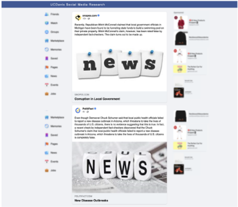
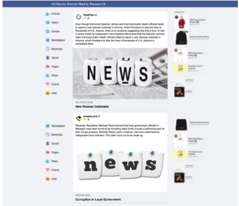
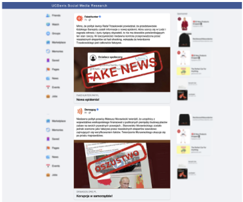
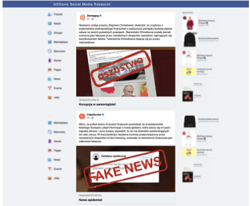
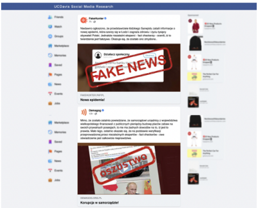
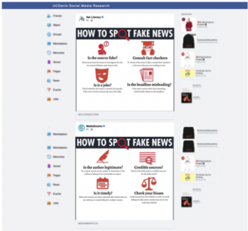
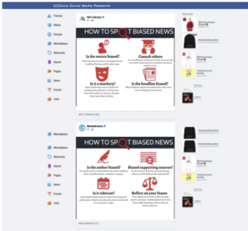
Current interventions to combat misinformation, including fact-checking, media literacy tips, and media coverage of misinformation, may have unintended democratic consequences. We propose that these interventions may increase skepticism toward all information, including accurate information. Across three online survey experiments in three diverse countries (the US, Poland, and Hong Kong, total N = 6127), we test the unintended consequences of existing strategies and compare them with three alternative interventions against misinformation. We examine how exposure to fact-checking, media literacy tips, and media coverage of misinformation affects individuals' perception of both factual and false information, as well as their trust in key democratic institutions. Our results show that while all interventions successfully reduce belief in false information, they also negatively impact the credibility of factual information. This highlights the need for further improved strategies that minimize the harms and maximize the benefits of interventions against misinformation.
Overview
The claims and statistics of this paper haven’t been checked yet.
Free: it reads the open-access text and checks the first 5 claims that cite a source we can check. Create a free account to check every claim.
Integrity signals
Registry
Cites
Statistics
Figures













Verification
Claims the paper makes
The claims and statistics of this paper haven’t been checked yet.
Free: it reads the open-access text and checks the first 5 claims that cite a source we can check. Create a free account to check every claim.
Claims other papers make about this one
Each is checked against this paper’s own text: does it say what the citing paper says it does?
In the citing paper
“recent research finds that this not only reduces belief in false information, but in all information (Hoes et al., 2023).”
From On manipulation by emotional AI: UK adults’ views and governance implications (2024) · cites this paper as Hoes et al., 2023
Self-check
Percentages, sums and reported differences re-computed from the paper’s own numbers.
The self-check needs the paper’s full text.
Citations
Cites
Attitudinal Effects of Mere Exposure
Zajonc, R. B. (1968) · Journal of Personality and Social Psychology · doi:10.1037/h0025848 · Cited by 6,745
(1999) · Cited by 6,104
Lazer, D. M. J., Baum, M. A., Benkler, Y., Berinsky, A. J., Greenhill, K. M., Menczer, F., Metzger, M. J., Nyhan, B., Pennycook, G., Rothschild, D., et al. (2018) · Science · doi:10.1126/science.aao2998 · Cited by 4,160
When Corrections Fail: The Persistence of Political Misperceptions
Nyhan, B., & Reifler, J. (2010) · Political Behavior · doi:10.1007/s11109-010-9112-2 · Cited by 3,173
Pennycook, G., & Rand, D. G. (2019) · Cognition · doi:10.1016/j.cognition.2018.06.011 · Cited by 2,022
Fake news on Twitter during the 2016 U.S. presidential election
Grinberg, N., Joseph, K., Friedland, L., Swire-Thompson, B., & Lazer, D. (2019) · Science · doi:10.1126/science.aau2706 · Cited by 1,803
Measuring the impact of COVID-19 vaccine misinformation on vaccination intent in the UK and USA
Loomba, S., de Figueiredo, A., Piatek, S. J., de Graaf, K., & Larson, H. J. (2021) · Nature Human Behaviour · doi:10.1038/s41562-021-01056-1 · Cited by 1,800
Less than you think: Prevalence and predictors of fake news dissemination on Facebook
Guess, A., Nagler, J., & Tucker, J. (2019) · Science Advances · doi:10.1126/sciadv.aau4586 · Cited by 1,652
Susceptibility to misinformation about COVID-19 around the world
Roozenbeek, J., Schneider, C. R., Dryhurst, S., Kerr, J., Freeman, A. L. J., Recchia, G., van der Bles, A. M., & van der Linden, S. (2020) · Royal Society Open Science · doi:10.1098/rsos.201199 · Cited by 1,447
Shifting attention to accuracy can reduce misinformation online
Pennycook, G., Epstein, Z., Mosleh, M., Arechar, A. A., Eckles, D., & Rand, D. G. (2021) · Nature · doi:10.1038/s41586-021-03344-2 · Cited by 1,155
Research works printed but not linked: 1
- Guess, A., Lockett, D., Lyons, B., Montgomery, J., Nyhan, B., & Reifler, J. (2020). "fake news" may have limited effects beyond increasing beliefs in false claims. Harvard Kennedy School Misinformation Review , 1 (1).
Cited by
Why misinformation must not be ignored.
Ecker, U. K. H., Tay, L. Q., Roozenbeek, J., van der Linden, S., Cook, J., Орескес, Н., & Lewandowsky, S. (2024) · American Psychologist · doi:10.1037/amp0001448 · Cited by 87
Exposure to Higher Rates of False News Erodes Media Trust and Fuels Overconfidence
Altay, S., Lyons, B. A., & Modirrousta-Galian, A. (2024) · Mass Communication & Society · doi:10.1080/15205436.2024.2382776 · Cited by 84
Labeling AI-Generated Content: Promises, Perils, and Future Directions
Wittenberg, C., Epstein, Z., Berinsky, A. J., & Rand, D. G. (2024) · An MIT Exploration of Generative AI · doi:10.21428/e4baedd9.0319e3a6 · Cited by 73
Altay, S., Angelis, A. D., & Hoes, E. (2024) · Communications Psychology · doi:10.1038/s44271-024-00121-5 · Cited by 66
Self-citationCountering misinformation through psychological inoculation
van der Linden, S. (2023) · Advances in experimental social psychology · doi:10.1016/bs.aesp.2023.11.001 · Cited by 70
Metadata
- Authors
- Hoes, E., Aitken, B., Zhang, J., Gackowski, T., & Wojcieszak, M.
- Affiliations
- University of Zurich (CH)
- University of California, Davis (US)
- University of Warsaw (PL)
- Publisher
- Center for Open Science
- Published
- 2023-05-10
- OpenAlex
- W4376143771
- Cited by
- 21
- References
- 39
- Citations by year
- 2026: 3 · 2025: 3 · 2024: 9 · 2023: 5
- Type
- posted content
- Language
- en
- Open access
- green
- doi.org
- Locations
- PsyArXiv (OSF Preprints) (submittedVersion)
- PsyArXiv (OSF Preprints) (submittedVersion, cc-by)
- Funders
- H2020 European Research Council (756301)
- Topics
- Social Sciences › Sociology and Political Science › Misinformation and Its Impacts
- Social Sciences › Communication › Communication and COVID-19 Impact
- Social Sciences › Sociology and Political Science › Media Influence and Politics
- Keywords
- misinformation interventions, fact-checking, media literacy, skepticism, misunderstanding, trust in democratic institutions, unintended consequences
About these checks
Registry, retraction, Cites and statistics results are computed, not judged, with one exception: a printed reference that no index lists is read once by a model before it counts as a citation error. Claims are extracted by a model and kept only when their quote appears verbatim in the text; each cited source is then checked, with a model’s help, for whether it says what the claim relies on. Those verdicts can be wrong — read the claim’s quote and the cited source before relying on one.
Statistics and arithmetic are recomputed, not judged.
Confidence bands are shown only for fields calibrated on our annotated test set. None is calibrated yet, so no band is shown.
What counts as a claim ›How we measure confidence ›How we check this ›
Are you an author, or do you see a problem with this page? Request a review
How to cite
Cite CoChat for the checks on this page, and the paper for its own findings.
- This page
- CoChat. (2026). Citation check: Prominent Misinformation Interventions Reduce Misperceptions but Increase Skepticism. https://app.cochat.ai/papers/10.31234/osf.io/zmpdu
- The paper
- Hoes, E., Aitken, B., Zhang, J., Gackowski, T., & Wojcieszak, M. (2023). Prominent Misinformation Interventions Reduce Misperceptions but Increase Skepticism. https://doi.org/10.31234/osf.io/zmpdu
Data sources
Bibliographic data: Semantic Scholar, OpenAlex, Crossref.
Contains information from the Semantic Scholar Academic Graph Datasets, made available under the ODC Attribution License (ODC-BY 1.0).
Semantic Scholar’s data is described in: Kinney, R., et al. (2023). The Semantic Scholar Open Data Platform. arXiv:2301.10140.
