

Prominent Misinformation Interventions Reduce Misperceptions but Increase Skepticism
Open accessThe DOI matches its Crossref record; 40 of the 40 references it cites were found in a registry or an index.
Abstract
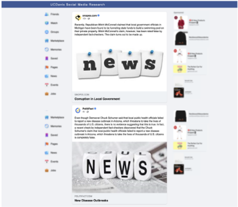
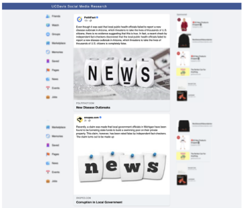
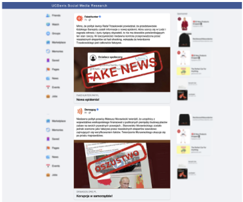
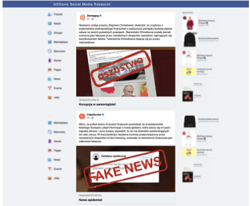
Current interventions to combat misinformation, including fact-checking, media literacy tips, and media coverage of misinformation, may have unintended democratic consequences. We propose that these interventions may increase skepticism toward all information, including accurate information. Across three online survey experiments in three diverse countries (the US, Poland, and Hong Kong, total N = 6127), we test the unintended consequences of existing strategies and compare them with three alternative interventions against misinformation. We examine how exposure to fact-checking, media literacy tips, and media coverage of misinformation affects individuals' perception of both factual and false information, as well as their trust in key democratic institutions. Our results show that while all interventions successfully reduce belief in false information, they also negatively impact the credibility of factual information. This highlights the need for further improved strategies that minimize the harms and maximize the benefits of interventions against misinformation.
Overview
The claims and statistics of this paper haven’t been checked yet.
Free: it reads the open-access text and checks the first 5 claims that cite a source we can check. Create a free account to check every claim.
Integrity signals
Registry
Cites
Statistics
Figures














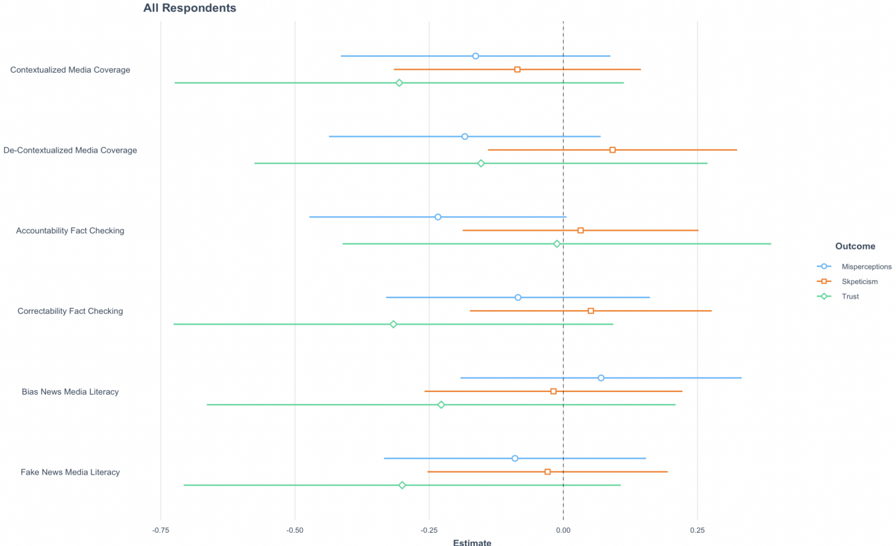
Verification
Claims the paper makes
The claims and statistics of this paper haven’t been checked yet.
Free: it reads the open-access text and checks the first 5 claims that cite a source we can check. Create a free account to check every claim.
Claims other papers make about this one
Each is checked against this paper’s own text: does it say what the citing paper says it does?
In the citing paper
“recent research finds that this not only reduces belief in false information, but in all information (Hoes et al., 2023).”
From On manipulation by emotional AI: UK adults’ views and governance implications (2024) · cites this paper as Hoes et al., 2023
Self-check
Percentages, sums and reported differences re-computed from the paper’s own numbers.
The self-check needs the paper’s full text.
Citations
Cites
Attitudinal Effects of Mere Exposure
Zajonc, R. B. (1968) · Journal of Personality and Social Psychology · doi:10.1037/h0025848 · Cited by 6,745
(1999) · Cited by 6,104
Lazer, D. M. J., Baum, M. A., Benkler, Y., Berinsky, A. J., Greenhill, K. M., Menczer, F., Metzger, M. J., Nyhan, B., Pennycook, G., Rothschild, D., et al. (2018) · Science · doi:10.1126/science.aao2998 · Cited by 4,160
When Corrections Fail: The Persistence of Political Misperceptions
Nyhan, B., & Reifler, J. (2010) · Political Behavior · doi:10.1007/s11109-010-9112-2 · Cited by 3,173
Pennycook, G., & Rand, D. G. (2019) · Cognition · doi:10.1016/j.cognition.2018.06.011 · Cited by 2,022
Fake news on Twitter during the 2016 U.S. presidential election
Grinberg, N., Joseph, K., Friedland, L., Swire-Thompson, B., & Lazer, D. (2019) · Science · doi:10.1126/science.aau2706 · Cited by 1,803
Measuring the impact of COVID-19 vaccine misinformation on vaccination intent in the UK and USA
Loomba, S., de Figueiredo, A., Piatek, S. J., de Graaf, K., & Larson, H. J. (2021) · Nature Human Behaviour · doi:10.1038/s41562-021-01056-1 · Cited by 1,800
Less than you think: Prevalence and predictors of fake news dissemination on Facebook
Guess, A., Nagler, J., & Tucker, J. (2019) · Science Advances · doi:10.1126/sciadv.aau4586 · Cited by 1,652
Susceptibility to misinformation about COVID-19 around the world
Roozenbeek, J., Schneider, C. R., Dryhurst, S., Kerr, J., Freeman, A. L. J., Recchia, G., van der Bles, A. M., & van der Linden, S. (2020) · Royal Society Open Science · doi:10.1098/rsos.201199 · Cited by 1,447
Shifting attention to accuracy can reduce misinformation online
Pennycook, G., Epstein, Z., Mosleh, M., Arechar, A. A., Eckles, D., & Rand, D. G. (2021) · Nature · doi:10.1038/s41586-021-03344-2 · Cited by 1,155
Research works printed but not linked: 1
- Guess, A., Lockett, D., Lyons, B., Montgomery, J., Nyhan, B., & Reifler, J. (2020). "fake news" may have limited effects beyond increasing beliefs in false claims. Harvard Kennedy School Misinformation Review , 1 (1).
Cited by
Items 101–193 of 193
Digital Education and Global Connectivity: Transforming International Relations in the 21st Century
Noor, S., Zarif, M., Ahmed, H. M., Khadim, E. U., Hasaan, S., Amir, M., Muskan, & Zafar, N. (2025) · Social science review archives. · doi:10.70670/sra.v3i4.1351 · Cited by 1
A Novel Responsible AI Model for Fusion Fake News Detection
Xia, H., Wang, Y., Zhang, Z., Liu, D. Y., & Sun, J. (2026) · Journal of Database Management · doi:10.4018/jdm.397913 · Cited by 1
Susceptibility to misinformation as a signal detection problem
Gawronski, B., Ng, N. L., Nahon, L. S., Hubeny, T. J., & Wurzinger, F. M. (2026) · European Review of Social Psychology · doi:10.1080/10463283.2026.2675803 · Cited by 1
Linnert, E., Hameleers, M., van der Meer, T. G. L. A., & Bos, L. (2026) · Journalism & Mass Communication Quarterly · doi:10.1177/10776990261451790 · Cited by 1
Wang, Y. (2026) · Humanities and Social Sciences Communications · doi:10.1057/s41599-026-08207-7 · Cited by 1
Sheppard, B., Durnell, L., & Haufler, A. J. (2026) · Frontiers in Medicine · doi:10.3389/fmed.2026.1814102 · Cited by 1
Yang, D., & Zhang, W. (2026) · Mathematics · doi:10.3390/math14162862 · Cited by 1
Brisola, A. C., Oliveira, F., Barcelos, J., & Shintaku, M. (2025) · Tendências da Pesquisa Brasileira em Ciência da Informação · doi:10.59289/5hgt0354 · Cited by 1
Who Changes Their Mind? Exploring Stance Shifts in LLM-Based Social Media Simulations
Gatta, V. L., Orlando, G. M., Perillo, M., Tammaro, F., & Moscato, V. (2026) · ACM Conference on Hypertext and Social Media (HT) · doi:10.1145/3800935.3830836 · Cited by 1
An accuracy self-nudge to reduce misinformation sharing online.
Stock, F., Hertwig, R., & Lorenz-Spreen, P. (2026) · Technology Mind and Behavior · doi:10.31234/osf.io/awj97 · Cited by 1
Digital diplomacy: Evolution of diplomatic and influence strategies in the digital age
Nocetti, J., Lyubareva, I., & Carey-Libbrecht, L. (2024) · Réseaux · doi:10.3917/res.245.0011 · Cited by 1
Wise blindness: reinterpreting false information engagement through a thematic analysis
Ding, W., & Ge, Y. H. (2025) · Social Influence · doi:10.1080/15534510.2025.2469704 · Cited by 1
Jamieson, K. H., Gibson, L., Jamieson, P. E., & Patterson, S. (2025) · Proceedings of the National Academy of Sciences · doi:10.1073/pnas.2517067122 · Cited by 1
Specific Media Literacy Tips Decrease Belief in AI-generated Visual MisinformationPreprint
Guo, S., Swire‐Thompson, B., & Hu, X. (2024) · PsyArXiv (OSF Preprints) · doi:10.31234/osf.io/phr79 · Cited by 1
Sun, X., Bai, X., Chen, B., Niu, G., & Mao, P. (2025) · Research Square · doi:10.21203/rs.3.rs-6660774/v1 · Cited by 1
Fischer, K. (2025) · PsyArXiv (OSF Preprints) · doi:10.31234/osf.io/jvxen_v1 · Cited by 1
An Inductive Learning Intervention to Improve News Veracity DiscernmentPreprint
Modirrousta-Galian, A., Seabrooke, T., Hanoch, Y., Kelley, N. J., & Higham, P. A. (2024) · PsyArXiv (OSF Preprints) · doi:10.31234/osf.io/6j7fr_v1 · Cited by 1
Disinformation: History, Drivers, and Countermeasures
Bruno, N., & Moriggi, S. (2025) · Encyclopedia · doi:10.3390/encyclopedia5040211 · Cited by 1
Knowing What We Don't Know: Targeting Overconfidence to Combat MisinformationPreprint
Taavila, S., Amara, M., Draginić, K., Jung, N. S., Li, X., & Sloksnath, P. R. (2024) · SSRN Electronic Journal · doi:10.2139/ssrn.4872927
Lu, M. H., Azevedo, R., Kiesow, D., Darici, D., Jiang, W., & Schneider, B. (2025) · Proceedings. · doi:10.22318/icls2025.631173
An Inductive Learning Intervention to Improve News Veracity DiscernmentPreprint
Modirrousta-Galian, A., Seabrooke, T., Hanoch, Y., Kelley, N. J., & Higham, P. A. (2025) · PsyArXiv (OSF Preprints) · doi:10.31234/osf.io/6j7fr_v2
An Inductive Learning Intervention to Improve News Veracity DiscernmentPreprint
Modirrousta-Galian, A., Seabrooke, T., Hanoch, Y., Kelley, N. J., & Higham, P. A. (2025) · PsyArXiv (OSF Preprints) · doi:10.31234/osf.io/6j7fr_v3
Rhyme or reason: medium-term effects of heuristic and traditional media literacy interventions
Dobber, T., Strikovic, E., & Tulin, M. (2025) · Information Communication & Society · doi:10.1080/1369118x.2025.2533315
Automated rhetorical move and step recognition in fact-checking articles with neural models
Liu, X., Song, N., Chen, K., Chen, Y., & Pei, L. (2025) · Information Processing & Management · doi:10.1016/j.ipm.2025.104293
Vooght, E. D., Duelen, A., Petasis, G., den Broeck, W. V., Desimpelaere, L., Picone, I., Giacobone, G. A., Pollini, A., Katsamori, D., Bådum, N. B., et al. (2025) · Advances in computational intelligence and robotics book series · doi:10.4018/979-8-3373-0872-2.ch012
News Informs and Boosts Discernment: A Replication in France and Germany
Altay, S., Hoes, E., & Wojcieszak, M. (2025) · The International Journal of Press/Politics · doi:10.1177/19401612251378969
Self-citationCultivating Media Critical Thinking with a Socratic AI Coach: A Methodology
Kapetanakis, P., Paparrigopoulos, I. E., Katsamori, D., Papachristou, E., & Petasis, G. (2025) · International Journal of Research and Innovation in Social Science · doi:10.47772/ijriss.2025.910000678
Modirrousta-Galian, A. (2025) · ePrints Soton (University of Southampton)
Desinformación y género: Audiencias, medios y verificación en sociedades contemporáneas
Montiel Torres, M. F. (2025) · Repositorio Institucional de la Universidad de Málaga (University of Málaga)
Aspernäs, J. (2025) · Linköping studies in behavioural science · doi:10.3384/9789181183009
Verbreitung und Auswirkungen von Desinformation im Kontext des DSA & Online-Plattformen
Steffen, N., Kroon, P., & Wiewiorra, L. (2025) · Econstor (Econstor)
Jones-Jang, S. M., Kim, D. H., & Kenski, K. M. (2026) · Information Communication & Society · doi:10.1080/1369118x.2026.2622332
A Design-Based Intervention to Develop Elementary Students’ Digital Literacy Skills
Muis, K. R., Pearson, H. A., Montazami, A., & Dubé, A. K. (2026) · The Journal of Experimental Education · doi:10.1080/00220973.2026.2634379
Why Young Adults Lose Trust in Journalism: Testing Familiarity and Quality Theses
Roy, S. K. (2025) · SHAREOK (University of Oklahoma; Oklahoma State University; Central Oklahoma University)
Barnett, H. K., Warmelink, L., Nightingale, S. J., Ahmed, F., & Crawford, T. J. (2026) · Technology Mind and Behavior · doi:10.1037/tmb0000183
Lee, J., Jung, L., & Hwang, J. L. (2026) · Science Communication · doi:10.1177/10755470261430253
Gehle, L., & Schemer, C. (2026) · Communication Research · doi:10.1177/00936502261442623
On explainable stance detection, distribution, and claim verification
Saha, R. R. (2026) · cIRcle (University of British Columbia) · doi:10.14288/1.0452456
Radičová, I., & Keklak, R. (2026) · Communication Today · doi:10.34135/communicationtoday.2026.vol.17.no.1.1
Misinformation, Disinformation and Hate Speech Response: What Works, Where, and Why?
Cheeseman, K. (2026) · OpenDocs (Institute of Development Studies) · doi:10.19088/k4dd.2026.049
Krzywosz‐Rynkiewicz, B., Wong, K. L., Ming, C. M., Keith, C. K., Eric, C. K. M., & Bhowmik, M. K. (2026) · International Journal of Adolescence and Youth · doi:10.1080/02673843.2026.2674314
Closing the Motivation Gap: Incentives Enhance Visual Misinformation Discernment and VerificationPreprint
Qian, S., Shen, C., Zhang, J., & Wojcieszak, M. (2026) · arXiv (Cornell University) · doi:10.48550/arxiv.2605.20438
Self-citationLevine, T. R. (2026) · Journal of Broadcasting & Electronic Media · doi:10.1080/08838151.2026.2674814
Vasiliadis, S. D., Cook, J., Nissan, K., Vidmar, S., Grobler, A. C., Cook, W., Hopkins, K., Lepage, C., Thomson, A., Danchin, M. H., et al. (2026) · Frontiers in Public Health · doi:10.3389/fpubh.2026.1768612
Community structure-regulation coupling reveals optimal information diffusion
Chen, X. Y., Xie, M., Meng, J., Fang, S., Chen, X. Y., Kurths, J. U., Nagler, J., & Fan, J. (2026) · Nature Communications · doi:10.1038/s41467-026-73665-1
de Carvalho, C. P., Ramos, J. P., Simas, C., Barbosa, P., Carthy, S., & Pinto, M. (2026) · Campbell Systematic Reviews · doi:10.1177/18911803261459099
Zaker, M., Navimipour, N. J., & Atalay, A. A. (2026) · International Biennial Conference on Advances in Artificial Intelligence and Data Science (IBAAIDS) · doi:10.1109/ibaaids66771.2026.11567394
Wertz, B., Babińska, M., Batorski, D., Louison-Lavoy, D., Blazer, N., Noble, N. S., & Wojcieszak, M. (2026) · PLoS ONE · doi:10.1371/journal.pone.0352588
Self-citationBoosting Media Literacy Using Lateral Reading and Online Search Interventions
Oswald, L., Kozyreva, A., Herzog, S. M., Nickl, P. L., & Hertwig, R. (2026) · Psychological Science · doi:10.1177/09567976261453813
van der Meer, T. G. L. A., & Hameleers, M. (2026) · Digital Journalism · doi:10.1080/21670811.2026.2700585
Immunization 2050: from eradication to precision. Looking ahead to the next 25 years
Lima, E. J. D. F. (2026) · Revista Brasileira de Saúde Materno Infantil · doi:10.1590/1806-930420260s100007
Visual Indicators to Increase the Detection of Linguistic Media BiasPreprint
Hinterreiter, S., Bahss, A., Gah, A.-C., Spinde, T., Echizen, I., & Latoschik, M. E. (2026) · arXiv (Cornell University) · doi:10.48550/arxiv.2607.20031
Identifying a Level-up Pathway for AI-assisted Counterspeech through ElaborationPreprint
Li, H., Bae, I., Bazarova, N. N., & Margolin, D. (2026) · arXiv (Cornell University) · doi:10.48550/arxiv.2607.28239
Hoes, E., & Altay, S. (2026) · Political Science Research and Methods · doi:10.1017/psrm.2026.10117
Self-citationConsumer Behavior and Digital Services: Competence, Rights and Protection
Fandrejewska, A., Eisenbardt, M., & Eisenbardt, T. (2026) · Routledge eBooks · doi:10.4324/9781003623274
AI-enabled health communication to address misinformation on social media: a mini review
Hu, Y. (2026) · Frontiers in Communication · doi:10.3389/fcomm.2026.1907956
Greenwashing training fosters a general skepticism toward advertisements
von Sicherer, P., & Pennycook, G. (2026) · Journal of Environmental Psychology · doi:10.1016/j.jenvp.2026.103190
Living with Misinformation: A Media Literacy Approach
Notley, T., Dezuanni, M., Park, S., Thomson, T. J., & Hourigan, A. (2026) · Routledge eBooks · doi:10.4324/9781003674290
FakeSpotter: A content and strategy agnostic Viral Misinformation Detection ToolPreprint
Spitale, G., & Germani, F. (2026) · arXiv (Cornell University) · doi:10.48550/arxiv.2609.19152
Audu, S. (2026) · British Journal of Contemporary Research · doi:10.67693/bjcr-r75mwtk5
O'Connor, P., Murphy, G., & Walsh, N. (2026) · International Journal of Social and Psychological Aspects of Healthcare · doi:10.51847/sbook0phhs
Defining Media Literacy: Audience Perspectives in Brazil and the United States
Ferreira, C. D. P. (2026) · University of Minnesota Digital Conservancy (University of Minnesota)
Disinformation, Ideology, and Public Opinion in Central Europe
Hlatky, R. (2026) · Cambridge University Press eBooks · doi:10.1017/9781009616935
Furdui, R., & Gavreliuc, A. (2026) · Romanian Journal of Applied Psychology · doi:10.2478/rjap-2026-0009
Domain-specific emotional effects of deepfakes on news-sharing behaviour
Ichikawa, K., Chen, J., & Sasahara, K. (2026) · Journal of Computational Social Science · doi:10.1007/s42001-026-00492-1
Post-Truth Politics in International Relations: The Impact of Disinformation on Global Diplomacy
Farid, A. S. (2026) · Synergisia. · doi:10.62872/p3bytd68
Trust in social media news sources during the war in Ukraine
Zadravec, J. (2025) · University of Maribor digital library (University of Maribor)
Strengthening Media and Information Literacy to Combat Digital Misinformation
Yusrijal, Y., Kurniasih, R., & Rizal, A. (2026) · Mahogany Journal De Social · doi:10.37899/mjds.v3i3.395
Manis, K. T., Cockrell, S., & Friske, W. (2026) · Journal of Macromarketing · doi:10.1177/02761467261490922
Strategije vladnega odzivanja na spletne govorice v času zdravstvene krize
Wu, J. (2026) · Repository of the University of Ljubljana (University of Ljubljana)
Moore, R. C., & Hancock, J. T. (2026) · Perspectives on Psychological Science · doi:10.1177/17456916261475589
Wack, M., & Warren, P. (2026) · arXiv (Cornell University) · doi:10.48550/arxiv.2610.17068
Mai, Đ. B. T., & Thị, T. T. A. N. (2026) · Journal of Science - Vietnam Women s Academy · doi:10.65607/9s32026
Mai, Đ. B. T., & Thị, T. T. A. N. (2026) · Journal of Science - Vietnam Women s Academy · doi:10.65607/6s32026
Competitive spreading dynamics under sentinel intervention in higher-order community networks
Peng, H., Wang, Z., Cheng, Y., Zhang, B., Zhong, M. J., Li, S., Zhao, D., & Wang, W. (2026) · Chaos An Interdisciplinary Journal of Nonlinear Science · doi:10.1063/5.0356660
Danal, P. H., & Sartika, N. (2026) · Borneo Nursing Journal (BNJ) · doi:10.61878/bnj.v8i2b.2237
A misinformation playbook sharpens judgement without breeding cynicismPreprint
Guo, T., Ye, T., Xie, Y., & Mei, Q. (2026) · arXiv (Cornell University) · doi:10.48550/arxiv.2610.22724
Rinenggo, A. (2026) · WASPADA (Jurnal Wawasan Pengembangan Pendidikan) · doi:10.61689/waspada.v14i2.1269
Judijanto, L. (2026) · International Journal of Applied and Advanced Multidisciplinary Research · doi:10.59890/ijaamr.v4i9.315
Balcarse, C. E. G. M. (2026) · Revista JRG de Estudos Acadêmicos · doi:10.55892/jrg.v9i21.3936
Algorithmic Intervention Decreases Polarization in Content ModerationPreprint
Bertani, A., Mohammadi, S., & Yasseri, T. (2026) · arXiv (Cornell University) · doi:10.48550/arxiv.2611.03072
Cao, N. T., Thanh, N. H., Sang, N. V., Hieu, L. T. T., Sang, N. V., Hudzenko, O., Legeza, S., Bezaltychna, O., & Sedov, V. (2026) · Journal of Management Practices Humanities and Social Sciences · doi:10.33152/jmphss-10.5.7
Ke, Q., Cao, Y., Zhu, H., & Qin, Q. (2026) · Health Communication · doi:10.1080/10410236.2026.2759128
Jiang, H., Lv, H., Wang, Y., Xu, G., & Li, H. (2026) · Research Square · doi:10.21203/rs.3.rs-11310134/v1
Psychological and Cognitive Roots of Misinformation Belief and Spread
Alcântara, L. B., & Miguel, D. (2026) · IGI Global eBooks · doi:10.4018/979-8-3373-7421-5.ch001
Saidi, F. S. A. (2026) · IGI Global eBooks · doi:10.4018/979-8-3373-7421-5.ch004
Más allá de la verificación de hechos: Democratic Literacy Amid Europe’s Populist Radical Right
Joaquim, A. F. V. L. (2026) · SOCIAL REVIEW International Social Sciences Review / Revista Internacional de Ciencias Sociales · doi:10.62701/revsocial.v14.5601
Digital Literacy and Critical Thinking as Defence: A Deepfake Literacy Framework for Schools
Charles, T., & Hattar, J. (2026) · Advances in computational intelligence and robotics book series · doi:10.4018/979-8-3373-8924-0.ch008
Metadata
- Authors
- Hoes, E., Aitken, B., Zhang, J., Gackowski, T., & Wojcieszak, M.
- Affiliations
- University of Zurich (CH)
- University of California, Davis (US)
- University of Warsaw (PL)
- Publisher
- Center for Open Science
- Published
- 2023-05-10
- OpenAlex
- W4376143771
- Cited by
- 21
- References
- 39
- Citations by year
- 2026: 3 · 2025: 3 · 2024: 9 · 2023: 5
- Type
- posted content
- Language
- en
- Open access
- green
- doi.org
- Locations
- PsyArXiv (OSF Preprints) (submittedVersion)
- PsyArXiv (OSF Preprints) (submittedVersion, cc-by)
- Funders
- H2020 European Research Council (756301)
- Topics
- Social Sciences › Sociology and Political Science › Misinformation and Its Impacts
- Social Sciences › Communication › Communication and COVID-19 Impact
- Social Sciences › Sociology and Political Science › Media Influence and Politics
- Keywords
- misinformation interventions, fact-checking, media literacy, skepticism, misunderstanding, trust in democratic institutions, unintended consequences
About these checks
Registry, retraction, Cites and statistics results are computed, not judged, with one exception: a printed reference that no index lists is read once by a model before it counts as a citation error. Claims are extracted by a model and kept only when their quote appears verbatim in the text; each cited source is then checked, with a model’s help, for whether it says what the claim relies on. Those verdicts can be wrong — read the claim’s quote and the cited source before relying on one.
Statistics and arithmetic are recomputed, not judged.
Confidence bands are shown only for fields calibrated on our annotated test set. None is calibrated yet, so no band is shown.
What counts as a claim ›How we measure confidence ›How we check this ›
Are you an author, or do you see a problem with this page? Request a review
Data sources
Bibliographic data: Semantic Scholar, OpenAlex, Crossref.
Contains information from the Semantic Scholar Academic Graph Datasets, made available under the ODC Attribution License (ODC-BY 1.0).
Semantic Scholar’s data is described in: Kinney, R., et al. (2023). The Semantic Scholar Open Data Platform. arXiv:2301.10140.
