

The DOI matches its Crossref record; 8 of the 8 references it cites were found in a registry or an index.
Characteristics of personal health records: findings of the Medical Library Association/National Library of Medicine Joint Electronic Personal Health Record Task Force
Open accessAbstract
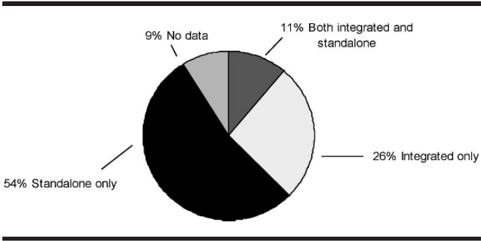
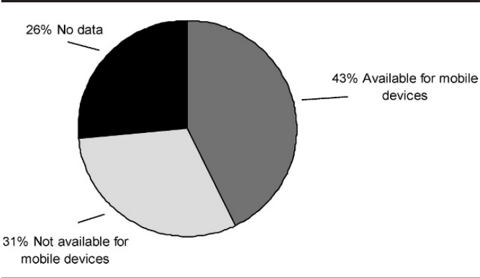
OBJECTIVES: The Medical Library Association (MLA)/National Library of Medicine (NLM) Joint Electronic Personal Health Record Task Force examined the current state of personal health records (PHRs). METHODS: A working definition of PHRs was formulated, and a database was built with fields for specified PHR characteristics. PHRs were identified and listed. Each task force member was assigned a portion of the list for data gathering. Findings were recorded in the database. RESULTS: Of the 117 PHRs identified, 91 were viable. Almost half were standalone products. A number used national standards for nomenclature and/or record structure. Less than half were mobile device enabled. Some were publicly available, and others were offered only to enrollees of particular health plans or employees at particular institutions. A few were targeted to special health conditions. CONCLUSIONS: The PHR field is very dynamic. While most PHR products have some common elements, their features can vary. PHRs can link their users with librarians and information resources. MLA and NLM have taken an active role in making this connection and in encouraging librarians to assume this assistance role with PHRs.
Overview
The claims and statistics of this paper haven’t been checked yet.
Run the check — free, no account needed. It reads the open-access text and checks the sources it cites.
Integrity signals
Registry
Cites
Statistics
Figures
Verification
Claims the paper makes
The claims and statistics of this paper haven’t been checked yet.
Run the check — free, no account needed. It reads the open-access text and checks the sources it cites.
Claims other papers make about this one
Each is checked against this paper’s own text: does it say what the citing paper says it does?
In the citing paper
“These existing studies in emergency access for PHR without blockchain are the traditional system, and also there are some studies based on blockchain but not access to PHR in an emergency condition.”
From EACMS: Emergency Access Control Management System for Personal Health Record Based on Blockchain (2019) · cites this paper as [39]
Self-check
Percentages, sums and reported differences re-computed from the paper’s own numbers.
The self-check needs the paper’s full text.
Citations
Cites
Personal Health Records: Definitions, Benefits, and Strategies for Overcoming Barriers to Adoption
Tang, P. C., Ash, J. S., Bates, D. W., Overhage, J. M., & Sands, D. Z. (2005) · Journal of the American Medical Informatics Association · doi:10.1197/jamia.m2025 · Cited by 1,424
A Research Agenda for Personal Health Records (PHRs)
Kaelber, D. C., Jha, A. K., Johnston, D., Middleton, B., & Bates, D. W. (2008) · Journal of the American Medical Informatics Association · doi:10.1197/jamia.m2547 · Cited by 415
Early Experiences with Personal Health Records
Halamka, J. D., Mandl, K. D., & Tang, P. C. (2007) · Journal of the American Medical Informatics Association · doi:10.1197/jamia.m2562 · Cited by 355
Weitzman, E. R., Kaci, L., & Mandl, K. D. (2009) · Journal of Medical Internet Research · doi:10.2196/jmir.1187 · Cited by 117
Exploring Technology Impacts of Healthcare 2.0 Initiatives
Randeree, E. (2009) · Telemedicine Journal and e-Health · doi:10.1089/tmj.2008.0093 · Cited by 68
Governance for Personal Health Records
Reti, S. R., Feldman, H. J., & Safran, C. (2008) · Journal of the American Medical Informatics Association · doi:10.1197/jamia.m2854 · Cited by 46
Future vision: is family medicine ready for patient-directed care?
Scherger, J. E. (2009) · PubMed · Cited by 31
Rise of the Personal Health Record: Panacea or Pitfall for Health Information
Coffield, R. L., & DeLoss, G. E. (2008) · Cited by 10
Research works printed but not linked: 6
- MLA/NLM Joint Electronic Personal Health Record Task Force update and survey-please participate! MLA-FOCUS [Internet]. 2008 Feb 14 (special edition) [cited 27 Aug 2009]. ,http://www.mlanet.org/members/mla-focus/2008/ mla-focus-20080214sf.html..
- Friends of the National Library of Medicine. 2009 conference: video, speakers, presentations, and program: personal electronic health records: from biomedical research to people's health [Internet] The Friends; 2009 [cited 28 Dec 2009]. ,http://www.fnlm.org/Events-2009-Conf.html..
- Mault JR. Experiences with connected care [Internet]. Presented at Friends of the National Library of Medicine 2009 Conference ''Personal Electronic Health Records: From Biomedical Research to People's Health.'' Microsoft Health Solutions Group; 20 May 2009 [cited 28 Aug 2009]. ,http:// www.fnlm.org/pdfs/May20/05_James_Mault.pdf..
- Spector A. Our search for great value in personal healthcare records [Internet]. Presented at Friends of the National Library of Medicine 2009 Conference ''Personal Electronic Health Records: From Biomedical Research to People's Health.'' Google; 20 May 2009 [cited 28 Aug 2009]. ,http://www.fnlm.org/pdfs/May20/06_Alfred_Spector .pdf..
- Department of Health and Human Services. Agency information collection request; 30-day public comment request. Fed Regist. 2009 May 22;74(98):24012-3.
- Moore J. Preface. In: iPHR Market Report. Cambridge, MA: Chilmark Research; 2008.
Cited by
Sorted by citations
Items 101–101 of 101
Research articles, labels, and prestige
Cooper, I. D. (2015) · Journal of the Medical Library Association JMLA · doi:10.3163/1536-5050.103.3.001
Metadata
- Authors
- Jones, D. A., Shipman, J. P., Plaut, D. A., & Selden, C. R.
- Affiliations
- Louisiana State University Health Sciences Center Shreveport (US)
- Kaiser Permanente (US)
- National Institutes of Health (US)
- ORCID
- Shipman, Jean P
- Venue
- Journal of the Medical Library Association : JMLA
- Published
- 2010-07
- Volume
- 98
- Issue
- 3
- Pages
- 243-249
- ISSN
- 1536-5050 (ISSN-L)
- 1558-9439
- PMC
- PMC2900995
- OpenAlex
- W1986298963
- Cited by
- 101
- References
- 8
- Citations by year
- 2025: 2 · 2024: 1 · 2023: 2 · 2022: 5 · 2021: 5 · 2020: 3 · 2019: 8 · 2018: 5 · 2017: 13 · 2016: 5 · 2015: 13 · 2014: 12 · 2013: 7 · 2012: 11
- FWCI
- 16.13
- Type
- journal article
- Language
- en
- Open access
- diamond
- doi.org
- Licence
- cc-by
- Locations
- Journal of the Medical Library Association JMLA (publishedVersion, cc-by)
- PubMed Central (publishedVersion)
- PubMed (publishedVersion)
- Funders
- Medical Library Association
- Vanderbilt University
- Vanderbilt University Medical Center
- U.S. National Library of Medicine
- Topics
- Health Sciences › Health Professions › Health Information Management › Electronic Health Records Systems
- Health Sciences › Health Professions › General Health Professions › Health Literacy and Information Accessibility
- Social Sciences › Library and Information Sciences › Web and Library Services
- Keywords
- personal health records, electronic health records, nomenclature standards, mobile health, health plan enrollees, Medical Library Association, National Library of Medicine
- MeSH terms
- Confidentiality, Humans, Libraries, Medical, Library Associations, National Library of Medicine (U.S.), United States, Medical Records Systems, Computerized, Program Development, Health Insurance Portability and Accountability Act, Professional Role, Consumer Health Information, Electronic Health Records
About these checks
Registry, retraction, Cites and statistics results are computed, not judged, with one exception: a printed reference that no index lists is read once by a model before it counts as a citation error. Claims are extracted by a model and kept only when their quote appears verbatim in the text; each cited source is then checked, with a model’s help, for whether it says what the claim relies on. Those verdicts can be wrong — read the claim’s quote and the cited source before relying on one.
Statistics and arithmetic are recomputed, not judged.
Confidence bands are shown only for fields calibrated on our annotated test set. None is calibrated yet, so no band is shown.
What counts as a claim ›How we measure confidence ›How we check this ›
Are you an author, or do you see a problem with this page? Request a review
