

The DOI matches its Crossref record; 3 of the 3 references it cites were found in a registry or an index.
Assessment of Automatic Thoughts in Patients with Depressive Illness at a Tertiary Hospital in Nepal
Abstract
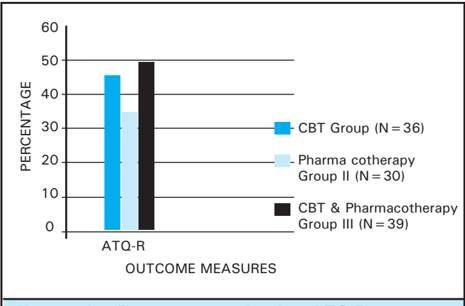
Introduction: Cognitive functions have significant influence on psycho-social and general wellbeing. The quality, content and processing of negative thoughts initiate depressive symptoms; i.e. low mood, decreased self-worth and diminished interest in pleasurable activities. The study assessed the automatic thoughts of patients having depressive illness and evaluated and compared the changes after therapy; i.e. Psychotherapy and pharmacotherapy.Methods: Diagnosed cases of depressive illness (n=135), according to ICD-10 and study criteria, attending the out-patient clinic of Department of Psychiatry and Mental Health, Tribhuvan University Teaching Hospital, were included. Beck Depression Inventory was used to screen level of depressive symptoms. Automatic thoughts were assessed by the Automatic Thought Questionnaire-Revised before initiating therapy and after completion of therapy for comparison. Depressive patients received either of the three treatment procedures after randomization of the study sample into three different treatment groups; i.e. Cognitive behavior therapy, pharmacotherapy or combined therapy receiving both cognitive behavior therapy and pharmacotherapy.Results: Among the total 135 patients, 53 (39.3%) had moderate, 47 (34.8%) had severe depressive and 35 (25.9%) had mild depressive symptoms before therapeutic interventions. Negative automatic thoughts were significantly present in depressed patients and reduced after all three interventions. Negative automatic thoughts of hopelessness, anxiety and inability coping were significantly reduced after therapy.Conclusions: Automatic negative thoughts were significantly correlated with depressive disorder. Combined therapy CBT with pharmacotherapy or CBT alone was found to be more effective in modifying automatic negative thoughts than pharmacotherapy alone, ultimately reducing depressive symptoms to a significant degree.Keywords: automatic thoughts; cognitive Behavior therapy; pharmacotherapy. [PubMed]
Overview
The claims and statistics of this paper haven’t been checked yet.
Run the check — free, no account needed. It reads the open-access text and checks the sources it cites.
Integrity signals
Registry
Cites
Statistics
Figures
Verification
Claims the paper makes
The claims and statistics of this paper haven’t been checked yet.
Run the check — free, no account needed. It reads the open-access text and checks the sources it cites.
Claims other papers make about this one
Each is checked against this paper’s own text: does it say what the citing paper says it does?
In the citing paper
“It has been suggested in various studies that CBT reduces negative thoughts (Furlong & Oei, 2002;Pan et al., 2017;Rana et al., 2017).”
In the citing paper
“The results of the study are compatible with the results of other studies indicating that CBT improves coping among students (Bernhardsdottir et al., 2013;Hamdan-Mansour et al., 2009;Rana et al., 2017).”
Self-check
Percentages, sums and reported differences re-computed from the paper’s own numbers.
The self-check needs the paper’s full text.
Citations
Cites
Frank, E. (1991) · Archives of General Psychiatry · doi:10.1001/archpsyc.1991.01810330075011 · Cited by 1,959
Treatment and prevention of depression
Hollon, S. D., Thase, M. E., & Markowitz, J. C. (2002) · Psychological Science in the Public Interest · doi:10.1111/1529-1006.00008 · Cited by 511
Cognitive Therapy and Pharmacotherapy for Depression: Singly and in Combination
Hollon, S. D. (1992) · Archives of General Psychiatry · doi:10.1001/archpsyc.1992.01820100018004 · Cited by 481
Research works printed but not linked: 18
- Gable SL, Nezlek JB. Level and instability of day-to-day psychological well-being and risk for depression. J Pers Soc Psychol. 1998 Jan;74(1):129-38. [PubMed]
- Thorsteinsson EB, Ryan S, Sveinbjornsdottir S. The mediating effects of social support and coping on the stress-depression relationship in rural and urban adolescents. Open Journal of Depression. 2013;2(1):1-6. [Full Text | DOI] · DOI
- Beck AT, Ward CH, Mendelson M, et al. An inventory for measuring depression. Archives of General Psychiatry. 1961 June;4:561-71. [Pub Med]
- Beck AT, Rush AJ, Shaw BF, Emery G. Cognitive therapy of depression. New York: Guilford Press. 1979 [Web link]
- Kohrt BA, Kunz RD, Koirala NR, Sharma VD, Nepal MK. Validation of the Nepali version of Beck Depression Inventory. The Nepalese Journal of Psychiatry. 2002; 2(4):123-30. [Web link]
- Ekeblad A, Falkenström F, Andersson G, Vestberg R, Holmqvist R. Randomized Trial of Interpersonal Psychotherapy and Cognitive Behavioral Therapy for Major Depressive Disorder in a Community-Based Psychiatric Outpatient Clinic. Depress Anxiety. 2016 Dec; 33(12):1090-1098. doi: 10.1002/da.22495. Epub 2016 Mar 31. [Pub Med] · DOI
- Hollon SD, Kendall PC. Cognitive self-statements in depression: Development of an automatic thoughts questionnaire. Cognitive Therapy and Research. 1980 December; 4(4): 383-395. [Web link | DOI] · DOI
- Kendall PC, Howard BL, Hays RC. Self-referent speech and psychopathology: The balance of positive and negative thinking. Cognitive Therapy and Research. 1989 December; 13(6): 583-598. [Web link | DOI] · DOI
- Hill CV, Oei TP, Hill MA. An empirical investigation of the specificity and sensitivity of the Automatic Thoughts Questionnaire and Dysfunctional Attitudes Scale. Journal of Psychopathology and Behavioral Assessment. 1989; 11(4): 291-311. [Web Link | DOI] · DOI
- Risal A, Manandhar K, Linde M, et al. Anxiety and depression in Nepal: prevalence, comorbidity and associations.BMC Psychiatry. 2016 April; 16:102. [Full Text | DOI] · DOI
- Patel V, Kirkwood BR, Pednekar S, Pereira B, Barros P, Fernandes J, Datta, J, et al. Gender disadvantage and reproductive health risk factors for common mental disorders in women: a community survey in India. Archives of General Psychiatry. 2006; 63(4):404-413. [ Full Text ]
- Bebbington PE. The origin of sex differences in depressive disorder: Bridging the gap. International Review of Psychiatry. 1996 July; 8(4):295-332. [DOI] · DOI
- Marco A, Piccinelli GW. Gender differences in depression, Critical review, The British Journal of Psychiatry. 2000 Dec; 177 (6): 486-492. [Full Text |DOI ] · DOI · Paper page
- Kendler KS, Kessler RC, Neale MC, Heath AC, Eaves LJ. The Prediction of Major Depression in Women: Toward an Integrated Etiologic Model. American Journal of Psychiatry. 1993 Aug; 150(8):1139-48. [ Full Text | DOI] · DOI · Paper page
- Dobson KS, Dozois DJA. Historical and philosophical bases of the cognitive-behavioral therapies. In: K.S. Dobson, ed. Handbook of cognitive-behavioral therapies. New York: Guilford Press. 2001; 3rd Ed:3-15 [Full Text]
- Szentagotai A, David D, Lupu V, Cosman D. Rational emotive behavior therapy versus cognitive therapy versus pharmacotherapy in the treatment of major depressive disorder: Mechanisms of change analysis. Psychotherapy: Theory, Research, Practice, Training. 2008 Dec; 45(4):523-538. [ PubMed | Full Text | DOI] · DOI
- Conte HR, Plutchik R, Wild KV, Karasu TB. Combined psychotherapy and pharmacotherapy for depression. A systematic analysis of the evidence.Arch Gen Psychiatry. 1986 May; 43(5):471-9. [PubMed | Full Text]
- Jonghe DF, Kool S, Aalst VG, Dekker J, Peen J. Combining psychotherapy and antidepressants in the treatment of depression. J Affect Disord. 2001 May; 64(2-3):217-29. [PubMed | Full Text]
Cited by
Sorted by citations
Demir, S., & Ercan, F. (2022) · Perspectives in Psychiatric Care · doi:10.1111/ppc.13073 · Cited by 43
Metadata
- Authors
- Rana, M., Sthapit, S., & Sharma, V. D.
- Venue
- Journal of Nepal Medical Association
- Published
- 2017-06-28
- Volume
- 56
- Issue
- 206
- ISSN
- 1815-672X
- 0028-2715
- Cited by
- 5
- References
- 3
About these checks
Registry, retraction, Cites and statistics results are computed, not judged, with one exception: a printed reference that no index lists is read once by a model before it counts as a citation error. Claims are extracted by a model and kept only when their quote appears verbatim in the text; each cited source is then checked, with a model’s help, for whether it says what the claim relies on. Those verdicts can be wrong — read the claim’s quote and the cited source before relying on one.
Statistics and arithmetic are recomputed, not judged.
Confidence bands are shown only for fields calibrated on our annotated test set. None is calibrated yet, so no band is shown.
What counts as a claim ›How we measure confidence ›How we check this ›
Are you an author, or do you see a problem with this page? Request a review
