

Effect of Selected Drying Methods on the Cannabinoid Profile of Cannabis sativa L. var. sativa Inflorescences and Leaves
Open accessThe DOI matches its Crossref record; 29 of the 29 references it cites were found in a registry or an index.
Abstract
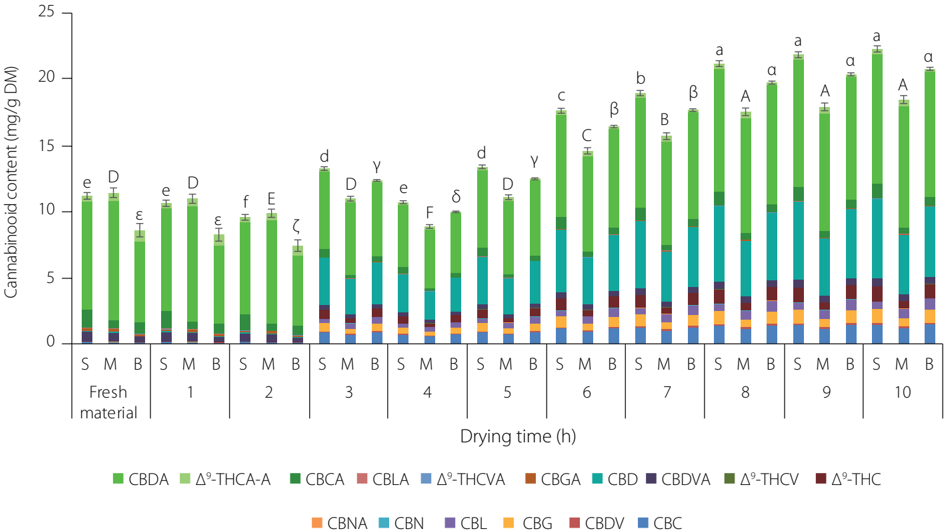
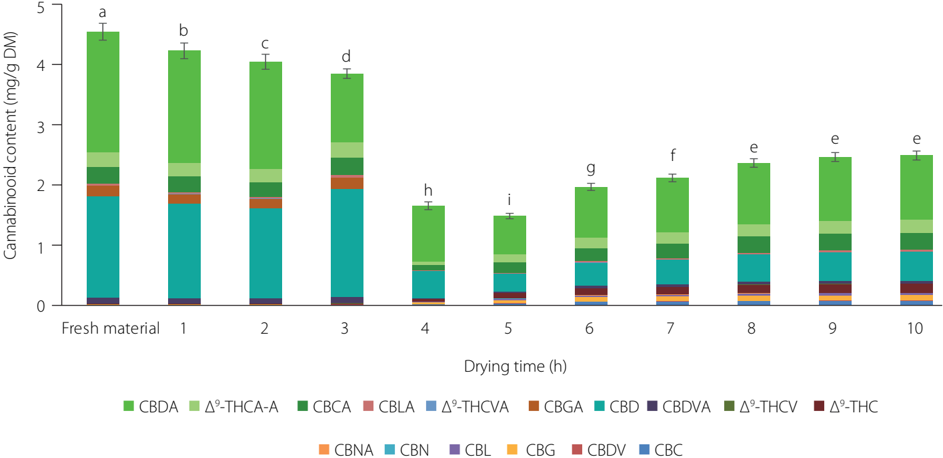
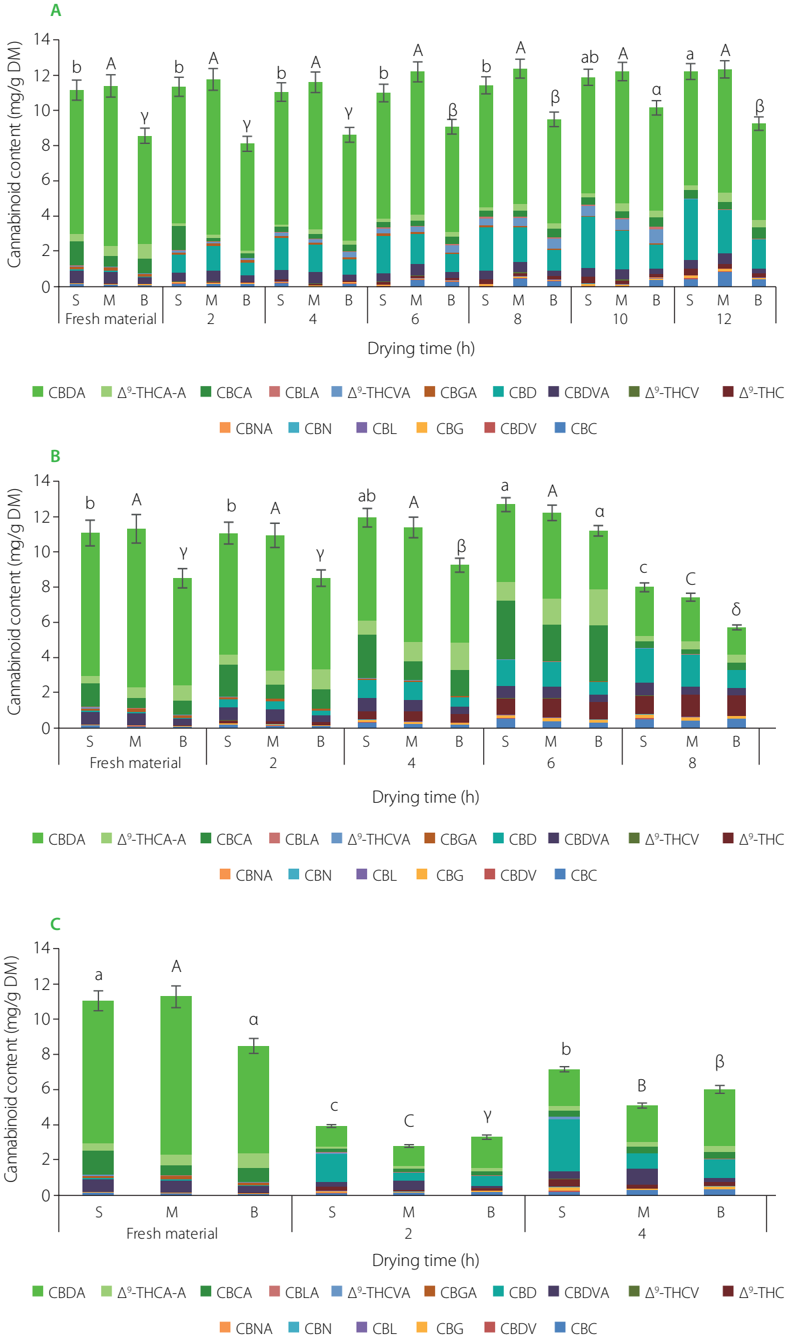
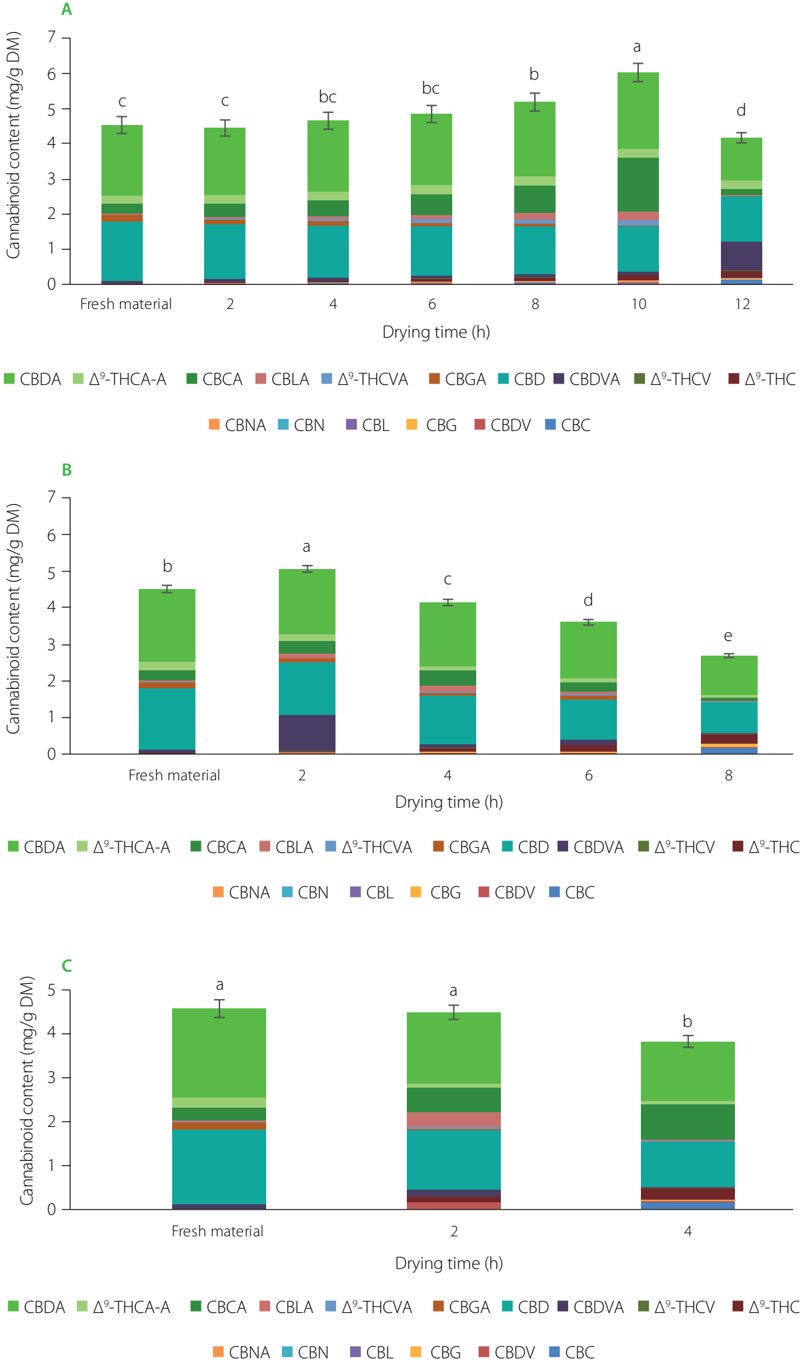
The hemp industry uses traditional drying methods based on ambient temperature.However, these methods do not guarantee a high-quality dried product due to the possibility of mold growth.The present study aimed to evaluate the effect of the drying method for parts of the Cannabis sativa L. var.sativa plant (ambient temperature drying without light, freeze-drying, and convective drying at 50, 60, and 70°C) on the content of 17 cannabinoids.The leaves were separated, and the inflorescences were subdivided according to size.Analyses were performed using UHPLC-HESI-MS.Traditional drying of the inflorescences increased the total cannabinoid content to 17.608-22.209mg/g DM relative to fresh material (8.562-11.386mg/g DM).Increasing the drying temperature by 10°C significantly enhanced cannabinoid degradation in the dried inflorescences.The most significant increase in cannabidiol and Δ 9 -tetrahydrocannabinol content in the inflorescences was observed during traditional drying (up to 10 times).The greatest decrease in the content of the main acid precursors of cannabinoids, i.e., cannabidiolic acid and Δ 9 -tetrahydrocannabinolic acid A, was observed during convective drying (up to 3 times).The present study is one of the first to compare the effects of drying methods on the profile of cannabinoids in selected parts of the Cannabis sativa L. plant.
Overview
The claims and statistics of this paper haven’t been checked yet.
Free: it reads the open-access text and checks the first 5 claims that cite a source we can check. Create a free account to check every claim.
Integrity signals
Registry
Cites
Statistics
Figures
Verification
Claims the paper makes
The claims and statistics of this paper haven’t been checked yet.
Free: it reads the open-access text and checks the first 5 claims that cite a source we can check. Create a free account to check every claim.
Claims other papers make about this one
Each is checked against this paper’s own text: does it say what the citing paper says it does?
The source backs part of the claim, not all of it — or backs it for a different population, condition or comparison.
In the citing paper
“This waste contains bioactive compounds such as cannabinoids, terpenes, and phenols, though in lower concentrations than inflorescences”
From Cannabis sativa L. biomass valorization as a strategic bioresource for South Africa’s circular bioeconomy: integrating biorefinery pathways and green extraction (2026) · cites this paper as [42]
Experimental — accuracy not yet measured
Self-check
Percentages, sums and reported differences re-computed from the paper’s own numbers.
The self-check needs the paper’s full text.
Citations
Cites
Farinon, B., Molinari, R., Costantini, L., & Merendino, N. (2020) · Nutrients · doi:10.3390/nu12071935 · Cited by 473
Aizpurua-Olaizola, O., Soydaner, U., Öztürk, E., Schibano, D., Simsir, Y., Navarro, P., Etxebarria, N., & Usobiaga, A. (2016) · Journal of Natural Products · doi:10.1021/acs.jnatprod.5b00949 · Cited by 467
A review of drying methods for improving the quality of dried herbs
Thamkaew, G., Sjöholm, I., & Galindo, F. G. (2021) · Critical Reviews in Food Science and Nutrition · doi:10.1080/10408398.2020.1765309 · Cited by 379
Pellati, F., Borgonetti, V., Brighenti, V., Biagi, M., Benvenuti, S., & Corsi, L. (2018) · BioMed Research International · doi:10.1155/2018/1691428 · Cited by 371
The therapeutic potential of cannabis
Baker, D., Pryce, G., Giovannoni, G., & Thompson, A. J. (2003) · The Lancet Neurology · doi:10.1016/s1474-4422(03)00381-8 · Cited by 343
Wang, M., Wang, Y.-H., Avula, B., Radwan, M. M., Wanas, A. S., van Antwerp, J., Parcher, J. F., ElSohly, M. A., & Khan, I. A. (2016) · Cannabis and Cannabinoid Research · doi:10.1089/can.2016.0020 · Cited by 265
Cannabidiolic‐acid synthase, the chemotype‐determining enzyme in the fiber‐type Cannabis sativa
Taura, F., Sirikantaramas, S., Shoyama, Y., Yoshikai, K., Shoyama, Y., & Morimoto, S. (2007) · FEBS Letters · doi:10.1016/j.febslet.2007.05.043 · Cited by 243
Aizpurua-Olaizola, O., Omar, J., Navarro, P., Olivares, M., Etxebarria, N., & Usobiaga, A. (2014) · Analytical and Bioanalytical Chemistry · doi:10.1007/s00216-014-8177-x · Cited by 167
Changes in the Chemical Composition of Basil Caused by Different Drying Procedures
Di Cesare, L. F., Forni, E., Viscardi, D., & Nani, R. C. (2003) · Journal of Agricultural and Food Chemistry · doi:10.1021/jf021080o · Cited by 149
Cannabis sativa : origin and history, glandular trichome development, and cannabinoid biosynthesis
Xie, Z., Mi, Y., Kong, L., Gao, M., Chen, S., Chen, W., Meng, X., Sun, W., Chen, S., & Xu, Z. (2023) · Horticulture Research · doi:10.1093/hr/uhad150 · Cited by 105
Park, S., Pauli, C. S., Gostin, E. L., Staples, S., Seifried, D., Kinney, C. A., & Heuvel, B. D. V. (2022) · Journal of Cannabis Research · doi:10.1186/s42238-021-00111-y · Cited by 99
Cannabinoids—Characteristics and Potential for Use in Food Production
Kanabus, J., Bryła, M., Roszko, M. Ł., Modrzewska, M., & Pierzgalski, A. (2021) · Molecules · doi:10.3390/molecules26216723 · Cited by 71
Self-citationKwaśnica, A., Pachura, N., Masztalerz, K., Figiel, A., Zimmer, A., Kupczyński, R., Wujcikowska, K., Carbonell-Barrachina, Á. A., Szumny, A., & Różański, H. (2020) · Foods · doi:10.3390/foods9081118 · Cited by 68
Chen, C., Wongso, I., Putnam, D. H., Khir, R., & Pan, Z. (2021) · Industrial Crops and Products · doi:10.1016/j.indcrop.2021.114051 · Cited by 63
Postharvest Operations of Cannabis and Their Effect on Cannabinoid Content: A Review
Das, P. C., Vista, A. R., Tabil, L. G., & Baik, O. (2022) · Bioengineering · doi:10.3390/bioengineering9080364 · Cited by 62
Kiani, S., Minaei, S., & Ghasemi-Varnamkhasti, M. (2018) · Measurement · doi:10.1016/j.measurement.2018.03.033 · Cited by 60
Thermal stability of cannabinoids in dried cannabis: a kinetic study
Meija, J., McRae, G., Miles, C. O., & Melanson, J. E. (2021) · Analytical and Bioanalytical Chemistry · doi:10.1007/s00216-020-03098-2 · Cited by 55
García-Valverde, M. T., Callado, C. S.-C., Díaz-Liñán, M. C., de Medina, V. S., Hidalgo-García, J., Nadal, X., Hanuš, L., & Ferreiro‐Vera, C. (2022) · Frontiers in Chemistry · doi:10.3389/fchem.2022.1038729 · Cited by 49
Drying of cannabis—state of the practices and future needs
Challa, S. K. R., Misra, N. N., & Martynenko, A. I. (2020) · Drying Technology · doi:10.1080/07373937.2020.1752230 · Cited by 47
Post-Harvest Operations to Generate High-Quality Medicinal Cannabis Products: A Systemic Review
Ubeed, H. M. S. A., Wills, R. B. H., & Chandrapala, J. (2022) · Molecules · doi:10.3390/molecules27051719 · Cited by 42
Effects of long term storage on secondary metabolite profiles of cannabis resin
Grafström, K., Andersson, K., Pettersson, N., Dalgaard, J., & Dunne, S. J. (2019) · Forensic Science International · doi:10.1016/j.forsciint.2019.05.035 · Cited by 38
Kim, A. L., Yun, Y. J., Choi, H. W., Hong, C.-H., Shim, H. J., Lee, J. H., & Kim, Y. (2022) · Plants · doi:10.3390/plants11223088 · Cited by 37
Das, P. C., Baik, O., & Tabil, L. G. (2024) · Industrial Crops and Products · doi:10.1016/j.indcrop.2024.118215 · Cited by 33
Residues of herbal hemp leaf teas – How much of the cannabinoids remain?
Knezevic, F., Nikolai, A., Marchart, R., Sosa, S., Tubaro, A., & Novak, J. (2021) · Food Control · doi:10.1016/j.foodcont.2021.108146 · Cited by 28
Addo, P. W., Chauvin-Bossé, T., Taylor, N., MacPherson, S., Paris, M., & Lefsrud, M. G. (2023) · Industrial Crops and Products · doi:10.1016/j.indcrop.2023.116754 · Cited by 25
Uziel, A., Milay, L., Procaccia, S., Cohen, R., Burstein, A., Sulimani, L., Shreiber‐Livne, I., Lewitus, D. Y., & Meiri, D. (2024) · Cannabis and Cannabinoid Research · doi:10.1089/can.2022.0051 · Cited by 21
Turner, J. C., & Mahlberg, P. G. (1984) · Journal of Chromatography A · doi:10.1016/s0021-9673(00)96251-4 · Cited by 17
Kanabus, J., Bryła, M., & Roszko, M. Ł. (2023) · Molecules · doi:10.3390/molecules28248008 · Cited by 15
Self-citationEffect of Drying Methods on Chemical and Sensory Properties of Cannabis sativa Leaves
Kwaśnica, A., Pachura, N., Carbonell-Barrachina, Á. A., Issa‐Issa, H., Szumny, D., Figiel, A., Masztalerz, K., Klemens, M., & Szumny, A. J. (2023) · Molecules · doi:10.3390/molecules28248089 · Cited by 14
Research works printed but not linked: 2
- Esfandi, A., Mehrafarin, A., Jari, S.K., Badi, H.N., Larijani, K. (2024). Variability in color and phytochemical properties of hemp (Cannabis sativa L.) upon drying techniques; an opportunity for industrial products. Journal of Medicinal Plants and By-products, 13(1), 79-86. https://doi.org/10.22034/JMPB.2023.128276 · doi:10.22034/jmpb.2023.128276
- 11. Farinon, B., Molinari, R., Costantini, L., Merendino, N. (2020). The seed of industrial hemp (Cannabis sativa L.): Nutritional quality and potential functionality for human health and nutrition. Nutrients, 12 · DOI · Paper page
Cited by
Kaminski, K. P., Hoeng, J., Lach-Falcone, K., Goffman, F. D., Schlage, W. K., & Latino, D. A. R. S. (2025) · Molecules · doi:10.3390/molecules30132784 · Cited by 15
“…such as solid-phase microextraction/gas chromatography/gas chromatography–mass spectrometry (GC-MS) and high-performance liquid chromatography (HPLC) confirm that freeze-drying maintains a more stable phytochemical composition, making it an optimal method for high-quality cannabis processing [106].”
Ahmadi, K. E., Haboubi, K., Allaoui, H. E., Nasr, F. A., Lamsiah, M., Hayoune, A., Hammoudani, Y. E., Bouhrim, M., Al-Zharani, M. M., & Qurtam, A. A. (2026) · Industrial Crops and Products · doi:10.1016/j.indcrop.2026.122940 · Cited by 2
Motsa, L., Seedat, N., Mekuto, L., & Sekoai, P. (2026) · Biomass Conversion and Biorefinery · doi:10.1007/s13399-026-07177-9
“This waste contains bioactive compounds such as cannabinoids, terpenes, and phenols, though in lower concentrations than inflorescences [ 42].”
Sequeira, A. F., Spotorno, R. Á., Pochettino, J. J., Delfino, M. R., & Morales, W. G. (2026) · Revista Científica de la UCSA · doi:10.18004/ucsa/2409-8752/2026.013.01.073
Cvetanov, A., Bogevski, K., Maksimova, V., & Janevik-Ivanovska, E. (2026) · Journal of Agriculture and Plant Sciences · doi:10.46763/japs2624123c · Cited by 1
Metadata
- Authors
- Kanabus, J., Bryła, M., & Roszko, M.
- Affiliations
- Institute of Agricultural and Food Biotechnology (PL)
- Corresponding author
- Kanabus, Joanna
- Venue
- Polish Journal of Food and Nutrition Sciences
- Publisher
- InLife Institute of Animal Reproduction and Food Research of the Polish Academy of Sciences
- Published
- 2024-12-02
- Pages
- 408-418
- ISSN
- 1230-0322 (ISSN-L)
- 2083-6007
- OpenAlex
- W4404925023
- Cited by
- 6
- References
- 29
- Citations by year
- 2026: 5 · 2025: 1
- FWCI
- 1.71
- Type
- journal article
- Language
- en
- Open access
- gold
- doi.org
- Licence
- cc-by-nc-nd
- creativecommons.org/licenses/by-nc-nd/4.0/ (vor)
- creativecommons.org/licenses/by-nc-nd/4.0/ (am)
- creativecommons.org/licenses/by-nc-nd/4.0/ (tdm)
- Locations
- Polish Journal of Food and Nutrition Sciences (publishedVersion, cc-by-nc-nd)
- DOAJ (DOAJ: Directory of Open Access Journals) (submittedVersion)
- Topics
- Health Sciences › Medicine › Pharmacology (medical) › Cannabis and Cannabinoid Research
- Life Sciences › Agricultural and Biological Sciences › Food Science › Food Drying and Modeling
- Life Sciences › Agricultural and Biological Sciences › Food Science › Hops Chemistry and Applications
- Keywords
- Cannabis sativa, cannabinoid profile, cannabidiol, tetrahydrocannabinol, cannabidiolic acid, tetrahydrocannabinolic acid, freeze-drying, convective drying, inflorescence, leaves
About these checks
Registry, retraction, Cites and statistics results are computed, not judged, with one exception: a printed reference that no index lists is read once by a model before it counts as a citation error. Claims are extracted by a model and kept only when their quote appears verbatim in the text; each cited source is then checked, with a model’s help, for whether it says what the claim relies on. Those verdicts can be wrong — read the claim’s quote and the cited source before relying on one.
Statistics and arithmetic are recomputed, not judged.
Confidence bands are shown only for fields calibrated on our annotated test set. None is calibrated yet, so no band is shown.
What counts as a claim ›How we measure confidence ›How we check this ›
Are you an author, or do you see a problem with this page? Request a review
Data sources
Bibliographic data: Semantic Scholar, OpenAlex, Crossref.
Contains information from the Semantic Scholar Academic Graph Datasets, made available under the ODC Attribution License (ODC-BY 1.0).
Semantic Scholar’s data is described in: Kinney, R., et al. (2023). The Semantic Scholar Open Data Platform. arXiv:2301.10140.
