

The DOI matches its Crossref record; 147 of the 147 references it cites were found in a registry or an index.
Epidemiology and treatment of depression in patients with chronic medical illness
Open accessAbstract
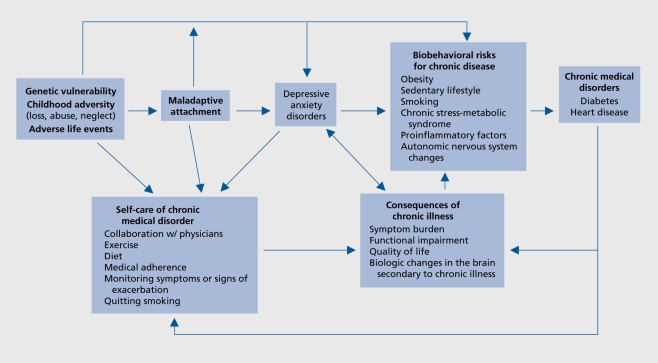
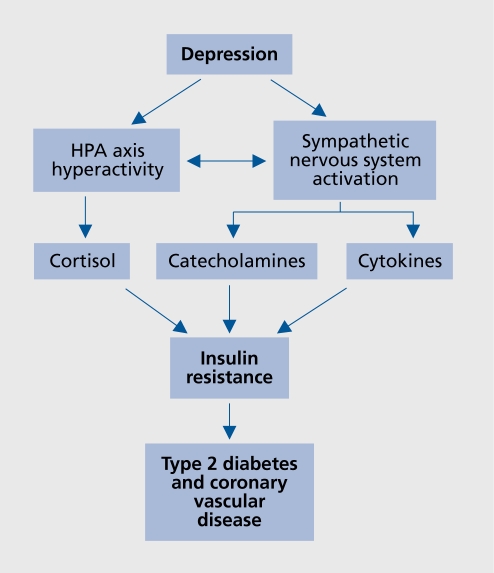
There is a bidirectional relationship between depression and chronic medical disorders. The adverse health risk behaviors and psychobiological changes associated with depression increase the risk for chronic medical disorders, and biological changes and complications associated with chronic medical disorders may precipitate depressive episodes. Comorbid depression is associated with increased medical symptom burden, functional impairment, medical costs, poor adherence to self-care regimens, and increased risk of morbidity and mortality in patients with chronic medical disorders. Depression may worsen the course of medical disorders because of its effect on proinflammatory factors, hypothalamic-pituitary axis, autonomic nervous system, and metabolic factors, in addition to being associated with a higher risk of obesity, sedentary lifestyle, smoking, and poor adherence to medical regimens. Both evidence-based psychotherapies and antidepressant medication are efficacious treatments for depression. Collaborative depression care has been shown to be an effective way to deliver these treatments to large primary care populations with depression and chronic medical illness.
Overview
The claims and statistics of this paper haven’t been checked yet.
Run the check — free, no account needed. It reads the open-access text and checks the sources it cites.
Integrity signals
Registry
Cites
Statistics
Figures
Verification
Claims the paper makes
The claims and statistics of this paper haven’t been checked yet.
Run the check — free, no account needed. It reads the open-access text and checks the sources it cites.
Claims other papers make about this one
Each is checked against this paper’s own text: does it say what the citing paper says it does?
The source backs part of the claim, not all of it — or backs it for a different population, condition or comparison.
In the citing paper
“are associated with greater disability, barriers to treatment, and poorer self-management of disease or disability (Katon, 2011).”
From Attachment insecurity predicts outcomes in an ACT-CBT group therapy for adults in a physical rehabilitation centre (2022) · cites this paper as Katon, 2011
Experimental — accuracy not yet measuredIn the citing paper
“Depressed individuals may be at risk for functional decline due to poor self-care, including poor nutritional intake and disengagement from daily activities. (Katon 2011)”
From Successful aging: Advancing the science of physical independence in older adults (2015) · cites this paper as Katon 2011
In the citing paper
“sterile inflammatory diseases such as these also have a high comorbidity with MDDs (Katon, 2011).”
From Danger Signals and Inflammasomes: Stress-Evoked Sterile Inflammation in Mood Disorders (2017) · cites this paper as Katon, 2011
Self-check
Percentages, sums and reported differences re-computed from the paper’s own numbers.
The self-check needs the paper’s full text.
Citations
Cites
Influence of life stress on depression: moderation by a polymorphism in the 5-HTT gene
Caspi, A., Sugden, K., Moffitt, T. E., Taylor, A., Craig, I. W., Harrington, H., McClay, J., Mill, J., Martin, J., Braithwaite, A., et al. (2003) · Science · doi:10.1126/science.1083968 · Cited by 8,120
A Meta-Analysis of Cytokines in Major Depression
Dowlati, Y., Herrmann, N., Swardfager, W., Liu, H., Sham, L., Reim, E. K., & Lanctôt, K. L. (2010) · Biological Psychiatry · doi:10.1016/j.biopsych.2009.09.033 · Cited by 4,729
DiMatteo, M. R., Lepper, H. S., & Croghan, T. W. (2000) · Archives of Internal Medicine · doi:10.1001/archinte.160.14.2101 · Cited by 4,177
Kleiger, R. E., Miller, J. P., Bigger, J. T., & Moss, A. J. (1987) · The American Journal of Cardiology · doi:10.1016/0002-9149(87)90795-8 · Cited by 3,995
The functioning and well-being of depressed patients. Results from the Medical Outcomes Study
Wells, K. B. (1989) · JAMA · doi:10.1001/jama.262.7.914 · Cited by 2,826
The Functioning and Well-being of Depressed Patients: Results From the Medical Outcomes Study
Wells, K. B. (1989) · JAMA · doi:10.1001/jama.1989.03430070062031 · Cited by 2,130 · cited 3×
“This large study showed that patients with depression were at least as functionally impaired as patients with chronic medical illnesses such as diabetes, CHD, and arthritis.(22) Moreover, when depression was comorbid with chronic physical illness, there was additive functional impairment.”
InfluentialGreen, C. P., Porter, C. B., Bresnahan, D. R., & Spertus, J. A. (2000) · Journal of the American College of Cardiology · doi:10.1016/s0735-1097(00)00531-3 · Cited by 1,827
Frequency domain measures of heart period variability and mortality after myocardial infarction
Bigger, J. T., Fleiss, J. L., Steinman, R. C., Rolnitzky, L. M., Kleiger, R. E., & Rottman, J. N. (1992) · Circulation · doi:10.1161/01.cir.85.1.164 · Cited by 1,712
Depression and Type 2 Diabetes Over the Lifespan
Mezuk, B., Eaton, W. W., Albrecht, S., & Golden, S. H. (2008) · Diabetes Care · doi:10.2337/dc08-0985 · Cited by 1,558
Research works printed but not linked: 2
- BurgM.Depression prior to CABG predicts 6-month and 2-year morbidity and mortality [abstract]. Psychosom Med. 200163103
- ConnerneyI.In-hospital depression after CABG surgery predicts 12-month outcome [abstract]. Psychosom Med. 200062106
Cited by
Sorted by citations
Items 801–817 of 817
Predictors of psychological distress among Afghan and Syrian refugee women in Houston, Texas
Zamil, J., Olumeko, I., Ofili, S. C., Cheruvu, S., Arefin, P., Atrooz, F., Ahmad, F., & Salim, S. (2026) · Frontiers in Global Women s Health · doi:10.3389/fgwh.2026.1830947 · Cited by 1
Mesfin, T. (2026) · Health Science Reports · doi:10.1002/hsr2.72811
Man, R., Wu, B., Tang, X., Liu, L., Shao, X., Peng, K., Zhong, Y., Wu, K., & Feng, Y. (2026) · Research Square · doi:10.21203/rs.3.rs-9965150/v1
Mayeli, M. (2026) · BMC Health Services Research · doi:10.1186/s12913-026-15165-y
Nguyen, V. V., Thimichai, P., Jin, J., Tsang, L., To, P. L., & Gramlich, L. M. (2026) · Nutrition in Clinical Practice · doi:10.1002/ncp.70156
Zhang, H., & Deng, L. (2026) · Archives of Medical Science · doi:10.5114/aoms/221240
Evaluation of Depression in Adults With and Without Type 2 Diabetes Mellitus: A Comparative Study
Hamza, M., Chan, S., Sharif, M. U., Ahmed, N., Sharif, A. R., Agha, S. A., & Khan, Z. (2026) · Cureus · doi:10.7759/cureus.113389
von Zimmermann, C., Weinland, C., Kornhuber, J., Lenz, B., & Mühle, C. (2026) · BMC Psychiatry · doi:10.1186/s12888-026-08419-w
Wu, F., Wang, N., & Yang, J. (2026) · The International Journal of Psychiatry in Medicine · doi:10.1177/00912174261475436
Mentale Erkrankungen und Multimorbidität
(2022) · Elsevier eBooks · doi:10.1016/b978-3-437-23685-3.00014-x
Plantard, A., Catrambone, V., Chouchou, F., & Valenza, G. (2026) · American Journal of Physiology-Regulatory, Integrative and Comparative Physiology · doi:10.1152/ajpregu.00303.2025
Karagodsky, G., Furuno, J. P., Herink, M. C., Viehmann, M. M., Duong, P. Y., & Stanislaw, J. J. (2026) · Journal of Primary Care & Community Health · doi:10.1177/21501319261481241
Kupferschmitt, A. A., Köllner, V., & Bachem, R. (2026) · PPmP - Psychotherapie · Psychosomatik · Medizinische Psychologie · doi:10.1055/a-2916-8193
Yu, Z., Zhang, A., Wang, K., An, Q., Chen, M., Wang, Y., & Wang, Z. (2026) · International Psychogeriatrics · doi:10.1016/j.inpsyc.2026.100270
Liu, J., Wu, J., & Zhang, X. (2026) · Journal of Affective Disorders · doi:10.1016/j.jad.2026.122574
Effect of Tai Chi Exercise on Fatigue in Renal Transplant Recipients: A Randomized Controlled Trial
Qiao, S., Liu, C., Lu, Y., Li, H., & Han, W. (2026) · Nursing Research and Practice · doi:10.1155/nrp/2584203
HIV and depression in a primary care clinic in Johannesburg, South Africa
Cholera, R. (2019) · Carolina Digital Repository (University of North Carolina at Chapel Hill) · doi:10.17615/wq6y-7270
Metadata
- Authors
- J. Katon, W.
- Affiliations
- Professor and Vice-Chair, Department of Psychiatry & Behavioral Sciences, University of Washington School of Medicine, Seattle, Washington, USA
- Venue
- Dialogues in Clinical Neuroscience
- Publisher
- Informa UK Limited
- Published
- 2011-03-31
- Volume
- 13
- Issue
- 1
- Pages
- 7-23
- ISSN
- 1294-8322 (ISSN-L)
- 1958-5969
- PMC
- PMC3181964
- OpenAlex
- W2121530613
- Cited by
- 820
- References
- 146
- Citations by year
- 2026: 38 · 2025: 60 · 2024: 58 · 2023: 63 · 2022: 72 · 2021: 75 · 2020: 57 · 2019: 62 · 2018: 55 · 2017: 64 · 2016: 56 · 2015: 43 · 2014: 46 · 2013: 35 · 2012: 26
- FWCI
- 26.71
- Type
- journal article
- Language
- en
- Open access
- diamond
- doi.org
- Licence
- Locations
- Dialogues in Clinical Neuroscience (publishedVersion, cc-by-nc-nd)
- Europe PMC (PubMed Central) (publishedVersion, cc-by-nc-nd)
- PubMed Central (publishedVersion, cc-by-nc-nd)
- PubMed (publishedVersion)
- Funders
- National Institute of Mental Health (K08MH069741, K-24 MH069741)
- Topics
- Health Sciences › Medicine › Pharmacology (medical) › Treatment of Major Depression
- Health Sciences › Medicine › Psychiatry and Mental health › Mental Health Treatment and Access
- Social Sciences › Psychology › Experimental and Cognitive Psychology › Anxiety, Depression, Psychometrics, Treatment, Cognitive Processes
- Keywords
- depression, chronic disease, comorbidities, bidirectional relationship, inflammation, hypothalamic-pituitary axis, autonomic nervous system, obesity, smoking, medication adherence, psychotherapy, antidepressants, collaborative care, primary care, functional disability, health care costs
- MeSH terms
- Chronic Disease, Depression, Diabetes Mellitus, Heart Diseases, Humans, Models, Biological, Physician-Patient Relations, Risk Factors, Self Care, Comorbidity
About these checks
Registry, retraction, Cites and statistics results are computed, not judged, with one exception: a printed reference that no index lists is read once by a model before it counts as a citation error. Claims are extracted by a model and kept only when their quote appears verbatim in the text; each cited source is then checked, with a model’s help, for whether it says what the claim relies on. Those verdicts can be wrong — read the claim’s quote and the cited source before relying on one.
Statistics and arithmetic are recomputed, not judged.
Confidence bands are shown only for fields calibrated on our annotated test set. None is calibrated yet, so no band is shown.
What counts as a claim ›How we measure confidence ›How we check this ›
Are you an author, or do you see a problem with this page? Request a review
