

The DOI matches its Crossref record.
An ISM Analysis of the Critical Success Factors in ERP Implementation
Open accessAbstract
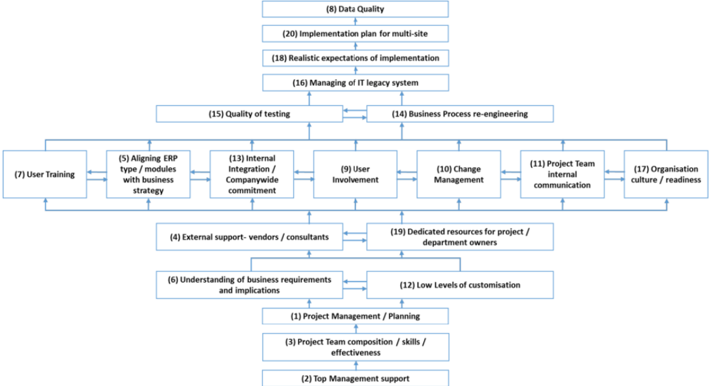
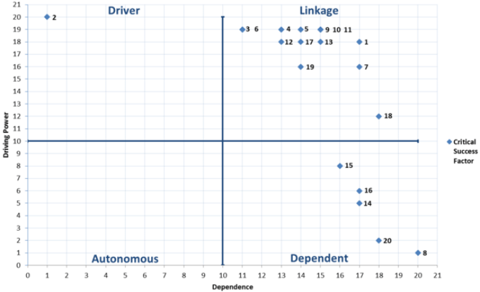
Enterprise Resource Planning (ERP) offers many benefits in aligning business operations. However, these implementations can be problematic and prone to failure. Critical success factors (CSF) which can improve the success rates of implementation have been researched and an interpretive structural modelling (ISM) was conducted to identify the interrelationships between factors. An ISM based model was created and this was achieved by completing the self-interaction matrix (SSIM), reachability matrix and level partitioning. This led to an ISM-based model being created followed by a cross-impact matrix multiplication (MICMAC) analysis to identify the factor’s relative driving power and level of dependence. The project revealed that top management support was the strongest CSF with a high driving power and low dependence. In addition, fourteen other factors displayed strong driving power with high dependence. The findings from the project were summarized into a recommended framework for manufacturing organizations to follow to increase the likelihood of a successful ERP implementation.
Overview
The claims and statistics of this paper haven’t been checked yet.
Run the check — free, no account needed. It reads the open-access text and checks the sources it cites.
Integrity signals
Registry
Cites
Statistics
Figures

Verification
Claims the paper makes
The claims and statistics of this paper haven’t been checked yet.
Run the check — free, no account needed. It reads the open-access text and checks the sources it cites.
Claims other papers make about this one
Each is checked against this paper’s own text: does it say what the citing paper says it does?
The cited source says what the claim attributes to it.
In the citing paper
“Furthermore, [25] identify top management support as the strongest critical success factor, demonstrating its high driving power in the implementation process.”
Self-check
Percentages, sums and reported differences re-computed from the paper’s own numbers.
The self-check needs the paper’s full text.
Citations
Cites
Still being checked.
Research works printed but not linked: 14
- H.M. Beheshti, What Managers Should Know About ERP/ERPII, Management Research News 29 (2006), 184-193
- I. Zouaghi, A. Laghouag, Aligning key success Factors to ERP Implementation Strategy: Learning from a case-study. International Journal of Business information systems 22 (1) (2012), 100-115.
- S. Jharkharia. Interrelations of Critical Failure Factors in ERP Implementation: An ISM based analysis. 3rd International Conference on Advanced Management Science 19 (2011), 170-174.
- K. Das, M. Kumar. Interpretive Structural Modelling based analysis for Critical Failure Factors in ERP Implementation. International Research Journal of Engineering and Technology 4 (2017),1223-1230.
- I. Zouaghi, A. Laghouag, Aligning key success Factors to ERP Implementation Strategy: Learning from a case-study. International Journal of Business Information Systems 22 (1) (2012), 100-115.
- S. Nagpal, A. Kumar, S. Khatri, Modelling interrelationships between CSF in ERP implementations: total ISM and MICMAC approach. International Journal of System Assurance Engineering and Management 8 (2017), 782-798.
- M.R.J. Qureshi, A. Abdulkhalaq, Increasing ERP Implementation Success Ratio by Focusing on Data Quality & User Participation. International Journal of Information Engineering and Electronic Business 7(3) (2015), 20-25
- Chaushi, BA.,Chaushi, A. and Dika, Z. (2016). Critical success factors in ERP implementation. Academic Journal of Business, Administration, Law and Social Sciences, [online] 2, pp.19-30.
- D. Maditinos, D. Chatzoudes D., C. Tsairidis. Factors affecting ERP system implementation effectiveness. Journal of Enterprise Information Management 25 (2011), 60-78
- C.P. Holland, Light B. A Critical Success Factors Model for ERP Implementation. IEEE Software 16 (3) (1999), 30-36
- J. N. Warfield, Developing interconnected matrices in structural modeling. IEEE Transcript on Systems. Men and Cybernetics 4 (1974), 51 -81
- G. Kannan, K. Devika, A. Noorul Haq. Analyzing supplier development criteria for an automobile industry. Industrial Management & Data Systems 110 (2010), 43 -62
- AlManei M., Salonitis K. Continuous improvement initiatives: an ISM analysis of critical success factors. Advances in Manufacturing Technology XXXIII: Proceedings of the 17th International Conference on Manufacturing Research (2019) 485 -491
- Sushil, Interpreting the interpretive structural model. Global Journal of Flexible Systems Management 13 (2) (2012), 87-106
Cited by
Sorted by citations
Sudarmo, S., Vandika, A. Y., & Fahrijal, R. (2024) · West Science Information System and Technology · doi:10.58812/wsist.v2i02.1209 · Cited by 4
“Furthermore, [25] identify top management support as the strongest critical success factor, demonstrating its high driving power in the implementation process.”
Background
Metadata
- Authors
- Hankin, P., Almanei, M., & Salonitis, K.
- Affiliations
- Cranfield University (GB)
- Corresponding author
- Salonitis, Konstantinos
- Venue
- Advances in Transdisciplinary Engineering
- Publisher
- IOS Press
- Published
- 2021-08-31
- ISSN
- 2352-751X (ISSN-L)
- 2352-7528
- OpenAlex
- W3196852389
- Cited by
- 8
- References
- 0
- Citations by year
- 2025: 1 · 2024: 3 · 2023: 3 · 2022: 1
- FWCI
- 7.96
- Type
- book chapter
- Language
- en
- Open access
- diamond
- doi.org
- Licence
- Locations
- Advances in transdisciplinary engineering (publishedVersion, cc-by-nc)
- CERES (Cranfield University) (submittedVersion, cc-by-nc)
- Topics
- Social Sciences › Business, Management and Accounting › Management Information Systems › ERP Systems Implementation and Impact
- Social Sciences › Business, Management and Accounting › Management Information Systems › Quality and Supply Management
- Social Sciences › Business, Management and Accounting › Strategy and Management › Corporate Governance and Management
- Keywords
- enterprise resource planning, ERP implementation, success factors, interpretive structural modeling, MICMAC analysis, top management support, manufacturing companies
About these checks
Registry, retraction, Cites and statistics results are computed, not judged, with one exception: a printed reference that no index lists is read once by a model before it counts as a citation error. Claims are extracted by a model and kept only when their quote appears verbatim in the text; each cited source is then checked, with a model’s help, for whether it says what the claim relies on. Those verdicts can be wrong — read the claim’s quote and the cited source before relying on one.
Statistics and arithmetic are recomputed, not judged.
Confidence bands are shown only for fields calibrated on our annotated test set. None is calibrated yet, so no band is shown.
What counts as a claim ›How we measure confidence ›How we check this ›
Are you an author, or do you see a problem with this page? Request a review
