

did2s: Two-Stage Difference-in-Differences
Open accessThe DOI matches its Crossref record; 17 of the 17 references it cites were found in a registry or an index; 10 of the 25 sources its claims cite were checked for support.
Abstract
Recent work has highlighted the difficulties of estimating difference-in-differences models when the treatment is adopted at different times for different units. This article introduces the R package did2s which implements the estimator introduced in @Gardner_2021. The article provides an approachable review of the underlying econometric theory and introduces the syntax for the function `did2s`. Further, the package introduces functions, event_study and plot_event_study, which uses a common syntax to implement all of the modern event-study estimators.
Overview
CoChat Summary
TL;DR
This article introduces the R package `did2s`, which implements Gardner’s (2022) two-stage difference-in-differences estimator for two-way fixed-effects models with staggered treatment timing and heterogeneous treatment effects. It also provides `event_study` and `plot_event_study` functions for estimating and plotting modern event-study estimators under a common syntax.
Key findings
- The two-stage estimator first estimates group and time fixed effects using untreated/not-yet-treated observations, then regresses adjusted outcomes on treatment; this avoids the negative weighting problem in static and event-study TWFE when treatment effects are heterogeneous across groups and time.
- In the simulated `df_het` static example, `did2s` estimates the overall treatment effect as 2.23048 (SE = 0.021408, t = 104.19, p < 2.2e-16) with 46,500 observations; the text says this is close to the true value.
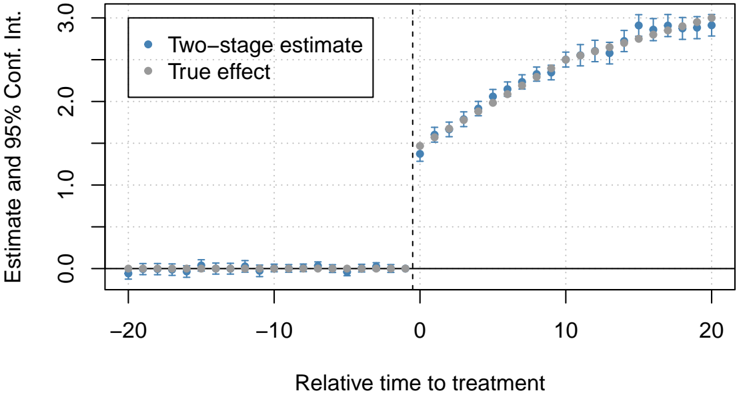
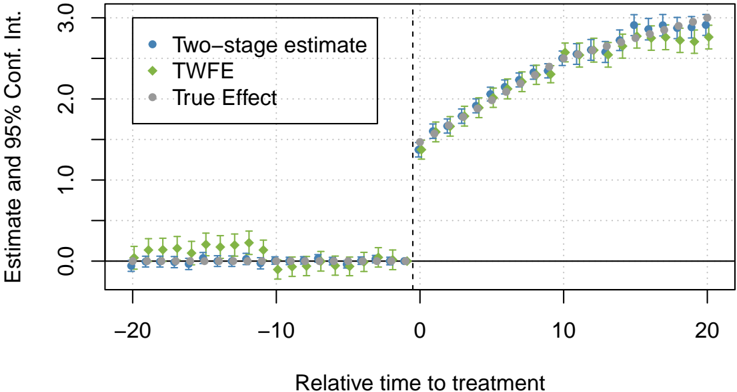
- Event-study estimates from `did2s` closely track the true effects: the true post-treatment effect starts at 1.5 and grows to 3 by post-period 20; OLS TWFE estimates show apparent pre-trend violations even though the data were simulated under parallel pre-trends.
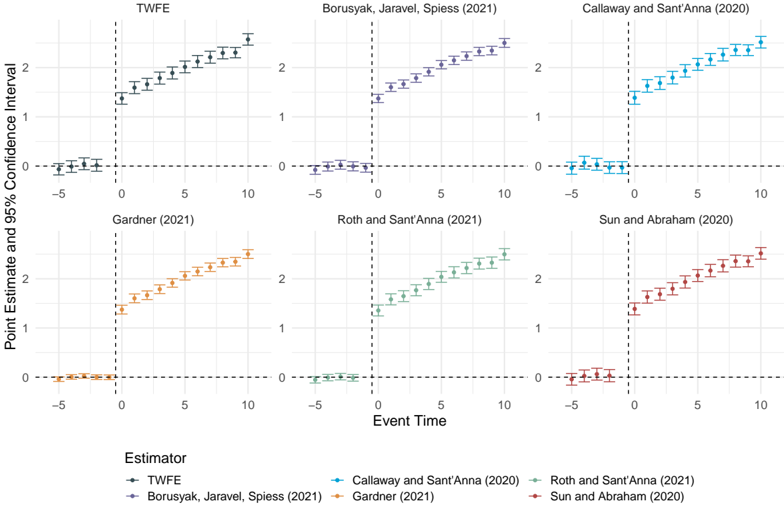
- `event_study` returns a tidy data frame of estimates and standard errors for multiple estimators, and `plot_event_study` produces ggplot comparisons; Table 2 summarizes assumptions including comparison group, parallel trends, limited anticipation, and correct specification of Y(0) for imputation estimators.
Methods
- Design: package/software article reviewing modern DiD theory and introducing `did2s`, which implements Gardner (2022); also `event_study` and `plot_event_study` for robust event-study estimators.
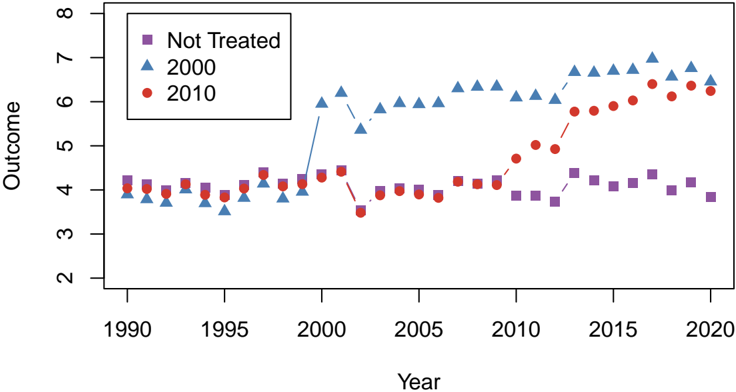
- Data: simulated dataset `df_het` with two treated groups and a never-treated group; the static example uses 46,500 observations, and event-study examples use the same simulated data.
- Analysis: first stage estimates group and time fixed effects on `Dgt = 0` observations; second stage regresses adjusted outcomes on treatment or event-study leads/lags; inference uses GMM asymptotic variance; `event_study` compares estimators via a common syntax.
Limitations
- The paper states further research is needed to determine which estimators work best in different settings, potentially via data-driven methods to assess assumption plausibility; more work is needed to formalize flexible covariate use, and no software yet exists for Caetano et al. (2022).
- Evident from the text: the empirical illustration is based on simulated data (`df_het`), not a real-world application, so performance evidence is simulation-based.
- Evident: the article notes the standard second-stage variance-covariance matrix would be incorrect without adjustment; it addresses this with GMM, but the text does not provide extensive finite-sample simulation evidence beyond the examples.
Model-written summary. Check it against the paper before relying on it.
Integrity signals
Registry
Cites
Statistics
Figures
Verification
Claims the paper makes
10 Valid · 4 Not valid · 9 Not checked · 50 Own results and interpretations
The cited sources support only part of this claim — read each source’s verdict below.
In the paper
“The natural question is, 'does the static TWFE model, (1), produce a consistent estimate for the overall average treatment effect?' Except for a few specific scenarios, the answer is no (Sun and Abraham 2020; Goodman-Bacon 2018; Borusyak, Jaravel, and Spiess 2021; Chaisemartin and D'Haultfoeuille 2019).”
What the sources say
- Not matchedcites Sun and Abraham 2020
An author–year citation the paper’s reference list doesn’t settle. We don’t search these by name.
- Supportedcites Goodman-Bacon 2018 matched to “Difference-in-Differences with Variation in Treatment Timing” (2018) source
In “Effects that vary across units but not over time” (page not provided), the paper says the TWFE estimand generally does not equal the sample average treatment effect because it weights groups by treatment variance rather than just sample shares. The same section explains that time-varying effects can bias comparisons between treatment-timing groups. These findings support the claim that static TWFE does not generally estimate the overall average treatment effect consistently. (LLM, conf=0.92)
- Not matchedcites Borusyak, Jaravel, and Spiess 2021
An author–year citation the paper’s reference list doesn’t settle. We don’t search these by name.
- Asserted: passes — The authors put it forward as true.
- Checkable: passes — It can be checked against evidence.
- Load-bearing: passes — The paper’s conclusions depend on it.
- Based: passes — The paper gives a reason why it holds.
- Not matched
The sources with a verdict support this claim; the rest weren’t checked yet, have no full text we could read, or their verdicts aren’t rated yet.
In the paper
“Results of Gardner (2022), Borusyak, Jaravel, and Spiess (2021), and Chaisemartin and D'Haultfoeuille (2019) all characterize the weights wgt from this regression.”
What the sources say
- Supportedcites Gardner (2022) matched to “Two-stage differences in differences” (2022) source
In “The regression DD estimand (3)” (page not provided), Gardner defines the weight on each group-by-period treatment effect as a coefficient from the regression with group and period fixed effects. Section 2.2 (page not provided) further explains how treatment duration, period-level treatment prevalence, and group size affect those weights. This supports the claim as it pertains to Gardner (2022). (LLM, conf=0.92)
- Not matchedcites Borusyak, Jaravel, and Spiess (2021)
An author–year citation the paper’s reference list doesn’t settle. We don’t search these by name.
- Not checked — no full text of the sourcecites Chaisemartin and D'Haultfoeuille (2019) matched to “Two-way Fixed Effects Estimators with Heterogeneous Treatment Effects” (2019) source
plain- Asserted: passes — The authors put it forward as true.
- Checkable: passes — It can be checked against evidence.
- Load-bearing: passes — The paper’s conclusions depend on it.
- Based: passes — The paper gives a reason why it holds.
- Supported
The cited sources support only part of this claim — read each source’s verdict below.
In the paper
“Arapidly growing econometric literature has identified difficulties in traditional difference-in-differences estimation when treatment turns on at different times for different groups and when the effects of treatment vary across groups and over time (Callaway and Sant'Anna 2020; Sun and Abraham 2020; Goodman-Bacon 2018; Borusyak, Jaravel, and Spiess 2021; Chaisemartin and D'Haultfoeuille 2019).”
What the sources say
- Not matchedcites Callaway and Sant'Anna 2020
An author–year citation the paper’s reference list doesn’t settle. We don’t search these by name.
- Not matchedcites Sun and Abraham 2020
An author–year citation the paper’s reference list doesn’t settle. We don’t search these by name.
- Supportedcites Goodman-Bacon 2018 matched to “Difference-in-Differences with Variation in Treatment Timing” (2018) source
The Abstract (page not specified) says that difference-in-differences applications commonly use groups treated at different times and that the resulting estimator averages heterogeneous treatment effects and is biased when effects change over time. The paper’s discussion of effects varying across units (page not specified) further explains how treatment-timing groups can act as controls for one another. These passages support the attributed methodological difficulty. (LLM, conf=0.92)
plainstates an association- Asserted: passes — The authors put it forward as true.
- Checkable: passes — It can be checked against evidence.
- Load-bearing: passes — The paper’s conclusions depend on it.
- Based: passes — The paper gives a reason why it holds.
- Not matched
A result the paper states — it cites no source for it, so there is none to check. The quote shows it is in the paper.
In the paper
“These two estimators return identical point estimates for post-treatment effects, but differ in their asymptotic regime and hence their standard errors.”
plainstates a cause- Asserted: passes — The authors put it forward as true.
- Checkable: passes — It can be checked against evidence.
- Load-bearing: unclear — It is unclear whether the paper’s conclusions depend on it.
- Based: passes — The paper gives a reason why it holds.
A result the paper states — it cites no source for it, so there is none to check. The quote shows it is in the paper.
In the paper
“These two estimators return identical point estimates for post-treatment effects, but differ in their asymptotic regime and hence their standard errors.”
plain- Asserted: passes — The authors put it forward as true.
- Checkable: passes — It can be checked against evidence.
- Load-bearing: unclear — It is unclear whether the paper’s conclusions depend on it.
- Based: passes — The paper gives a reason why it holds.
27 more claims
Create a free account to see all 73 claims and to verify the 2 references still open.
- Probably not a substantial claim. 32
- It may state two separate claims as one. 15
- The quote only partly states this claim. 1
Citations
Cites
ggplot2: Elegant Graphics for Data Analysis
Ginestet, C. (2011) · Journal of the Royal Statistical Society Series A: Statistics in Society · doi:10.1111/j.1467-985x.2010.00676_9.x · Cited by 13,726
Difference-in-Differences with multiple time periods
Callaway, B., & Sant’Anna, P. H. C. (2021) · Journal of Econometrics · doi:10.1016/j.jeconom.2020.12.001 · Cited by 9,126
Estimating dynamic treatment effects in event studies with heterogeneous treatment effects
Sun, L., & Abraham, S. (2021) · Journal of Econometrics · doi:10.1016/j.jeconom.2020.09.006 · Cited by 7,462
Chapter 36 Large sample estimation and hypothesis testing
Newey, W. K., & McFadden, D. (1994) · Handbook of Econometrics · doi:10.1016/s1573-4412(05)80005-4 · Cited by 1,743
Difference-in-Differences with Variation in Treatment Timing
Goodman-Bacon, A. (2018) · doi:10.3386/w25018 · Cited by 757
Partial Time Regressions as Compared with Individual Trends
Frisch, R., & Waugh, F. V. (1933) · Econometrica · doi:10.2307/1907330 · Cited by 629
Revisiting event study designs: robust and efficient estimation
(2022) · arXiv (preprint) · doi:10.47004/wp.cem.2022.1122 · Cited by 607
Two-way Fixed Effects Estimators with Heterogeneous Treatment Effects
de Chaisemartin, C., & D'Haultfoeuille, X. (2019) · doi:10.3386/w25904 · Cited by 350
Two-stage differences in differences
Gardner, J. (2022) · arXiv · doi:10.48550/arxiv.2207.05943 · Cited by 333
Self-citationbroom: Convert Statistical Objects into Tidy Tibbles
Robinson, D., Hayes, A., Couch, S., & Hvitfeldt, E. (2014) · CRAN: Contributed Packages · doi:10.32614/cran.package.broom · Cited by 244
Cited by
Difference-in-Differences for Policy Evaluation
Callaway, B. (2022) · Springer eBooks · doi:10.1007/978-3-319-57365-6_352-1 · Cited by 129
did2s: Two-Stage Difference-in-Differences Following Gardner (2021)
(2021) · doi:10.32614/cran.package.did2s · Cited by 32
Self-citationForeign bank entry and the outward foreign direct investment of companies: evidence from China
Liu, H., Yi, Z., Shang, H., & Liu, Z. (2024) · Journal of International Business Studies · doi:10.1057/s41267-024-00693-8 · Cited by 23
Unleashing Fintech’s potential: A catalyst for green bonds issuance
Huang, J., Liu, R., Wang, W., Wang, Z., Wang, C., & Jin, Y. J. (2024) · Journal of International Financial Markets Institutions and Money · doi:10.1016/j.intfin.2024.102009 · Cited by 31
“Recognizing the current discussion on heterogeneity in treatment effects within staggered DiD models, following Zhou et al. (2023) and Butts and Gardner (2021), we have incorporated a two-stage DiD model to verify the robustness of our findings and also assess the validity of the parallel trend…”
MethodLee, H., & Liu, Y. (2024) · Journal of Public Administration Research and Theory · doi:10.1093/jopart/muae006 · Cited by 26
Schaub, M. (2024) · Social Science & Medicine · doi:10.1016/j.socscimed.2024.117252 · Cited by 17
Smart, R., Powell, D., Pacula, R. L., Peet, E. D., Abouk, R., & Davis, C. S. (2024) · Journal of Health Economics · doi:10.1016/j.jhealeco.2024.102917 · Cited by 21
Responding to natural disasters: What do monthly remittance data tell us?
Bettin, G., Jallow, A., & Zazzaro, A. (2024) · Journal of Development Economics · doi:10.1016/j.jdeveco.2024.103413 · Cited by 23
Mafia doesn't live here anymore: Antimafia policies and housing prices
Calamunci, F. M., Ferrante, L., Scebba, R., & Torrisi, G. (2023) · Journal of Regional Science · doi:10.1111/jors.12647 · Cited by 12
Gao, H., Ouyang, Y., & Wang, Y. (2022) · Research in International Business and Finance · doi:10.1016/j.ribaf.2024.102252 · Cited by 19
Alternative Payment Models and Performance in Federally Qualified Health Centers
Markowski, J., Wallace, J., Schlesinger, M., & Ndumele, C. D. (2024) · JAMA Internal Medicine · doi:10.1001/jamainternmed.2024.2754 · Cited by 10
Wang, Y., & Yao, J. (2024) · Heliyon · doi:10.1016/j.heliyon.2024.e28745 · Cited by 14
Buttorff, C., Wang, G. S., Wilks, A., Tung, G. J., Kress, A., Schwam, D., & Pacula, R. L. (2023) · Journal of General Internal Medicine · doi:10.1007/s11606-023-08195-3 · Cited by 12
The Effect of Suspensions on Student Attendance in a High-Absenteeism Urban District
Singer, J. (2023) · Urban Education · doi:10.1177/00420859231192084 · Cited by 12
The Impact of Performance Funding Policy Design on College Access and Selectivity
Rosinger, K. O., Ortagus, J. C., Kelchen, R., & Choi, J. (2023) · Educational Evaluation and Policy Analysis · doi:10.3102/01623737221147905 · Cited by 15
“To address concerns that differential treatment timing and treatment effect heterogeneity can bias TWFE estimates, we also implemented the Sun and abraham (2020) event study approach using the eventstudyinteract command in Stata.”
The No-Hunger Games: How GLP-1 Medication Adoption is Changing Consumer Food PurchasesPreprint
Hristakeva, S., Liaukonytė, J., & Feler, L. (2024) · SSRN Electronic Journal · doi:10.2139/ssrn.5073929 · Cited by 8
Ward, J. D., & Corral, D. (2022) · Research in Higher Education · doi:10.1007/s11162-022-09723-6 · Cited by 17
“Second, we use the flexpaneldid command in Stata (Dettmann et al., 2019) to estimate a reweighted average treatment effect.”
MethodGeys, B., & Sørensen, R. J. (2023) · Kyklos · doi:10.1111/kykl.12358 · Cited by 10
Health benefits of reducing aircraft pollution: evidence from changes in flight paths
Beghelli, S., de Coulon, A., & O’Mahony, M. (2023) · Journal of Population Economics · doi:10.1007/s00148-023-00964-y · Cited by 9
“123 Fig.3 Event study regressions, 10 months correspond to 5 in the baseline period (11/2011–03/2012) and 5 in the trial period (11/2012–03/2013); see Butts and Gardner (2022) On average, a negative effect on central nervous and respiratory system conditions seem to dominate.”
BackgroundBehavioral Health Treatment and Police Officer Safety
Deza, M., Lu, T. T., Maclean, J. C., & Ortega, A. (2023) · The Journal of Human Resources · doi:10.3368/jhr.1223-13303r3 · Cited by 7
The impact of digitalization progress on carbon abatement costs: Cheaper or more expensive?
Xu, L., Cheng, J., & Hu, D. (2025) · Economic Analysis and Policy · doi:10.1016/j.eap.2025.06.015 · Cited by 10
Cooking or Clicking: The Impact of Online Food Delivery Platforms on Domestic Food Preparation
Babar, Y., Adeli, A. M., & Greenwood, B. N. (2021) · Management Science · doi:10.1287/mnsc.2023.02636 · Cited by 19
Transitory Income Windfalls and Charitable Giving: Evidence from Norwegian Register Data, 1993–2021
Geys, B., & Sørensen, R. J. (2024) · The Economic Journal · doi:10.1093/ej/ueae100 · Cited by 10
Do minimum wages crowd out union density?
Kozák, M., Picot, G., & Starke, P. (2024) · British Journal of Industrial Relations · doi:10.1111/bjir.12809 · Cited by 8
School-Based Health Care and Absenteeism: Evidence from Telemedicine
Komisarow, S., & Hemelt, S. W. (2024) · Education Finance and Policy · doi:10.1162/edfp_a_00398 · Cited by 8
“More details about the software can be found in Butts and Gardner (2022).”
MethodGrowing Platforms by Adding Complementors Without a Contract
Mayya, R., & Li, Z. (2025) · Information Systems Research · doi:10.1287/isre.2023.0237 · Cited by 13
Catalyzing entrepreneurship in county regions: Assessing the impact of high-speed rail connectivity
Yi, J., Xue-liang, Z., & Yang, Y. (2025) · Journal of Transport Geography · doi:10.1016/j.jtrangeo.2025.104138 · Cited by 6
The effect of Door-to-Door on separate collection of plastic packaging: evidence from Catalonia
Bel, G., & Bühler, J. (2024) · Environmental Economics and Policy Studies · doi:10.1007/s10018-024-00428-x · Cited by 3
“For our estimates to recover the ATT of the DtD collection policy on plastic selection, we need to make the following key assumption (de Chaisemartin and D’Haultfoeuille 2023): Parallel trends between all groups (groups of municipalities where DtD was implemented at the same time, including those where it was never im…”
Ke, Y., Wen, Y., & Teng, L. (2025) · Sustainability · doi:10.3390/su17198871 · Cited by 4
Xu, L. (2025) · Emerging Markets Finance and Trade · doi:10.1080/1540496x.2025.2556882 · Cited by 3
Does open government data policy mitigate institutional herding? Evidence from China
钟嘉琴, Ye, X., & Huang, C. (2026) · Economic Analysis and Policy · doi:10.1016/j.eap.2026.06.049 · Cited by 2
How do firms respond to state retirement plan mandates?
Bloomfield, A. C., Lee, K. M., Philbrick, J., et al. (2024) · Economic Inquiry · doi:10.1111/ecin.13259 · Cited by 2
Insurance: In or Out of the “Too Difficult” Box?Preprint
Grace, M. F., & Basu, S. (2022) · SSRN Electronic Journal · doi:10.2139/ssrn.4071072 · Cited by 2
Hänze, N. (2024) · Journal of Peace Research · doi:10.1177/00223433241265028 · Cited by 7
“Finally, these adjusted outcomes are regressed on the treatment indicator to obtain the unbiased average treatment effect, with the standard errors being adjusted to reflect that the dependent variable was estimated in the first stage (Butts and Gardner, 2022).”
Deng, F., Tan, Y., & Ni, M. (2025) · Finance research letters · doi:10.1016/j.frl.2025.107808 · Cited by 6
Vandenbroeck, A., & Markowski, J. H. (2025) · Health Affairs · doi:10.1377/hlthaff.2025.00266 · Cited by 5
The Effects of State Paid Sick Leave Mandates on Parental Childcare Time
Maclean, J. C., & Pabilonia, S. W. (2025) · Journal of Health Economics · doi:10.1016/j.jhealeco.2025.103033 · Cited by 9
Cao, Z., Yao, Y., Cui, B., Wang, J., & Jia, C. (2026) · Health Economics Review · doi:10.1186/s13561-026-00763-7 · Cited by 5
“To obtain a more interpretable average treatment effect under staggered implementation and potential effect heterogeneity, we applied the two-stage DID estimator [19].”
Xu, K., Yuan, P., Wang, G., & Yu, R. (2024) · Sustainability · doi:10.3390/su16188049 · Cited by 2
Guide to recent advances in difference-in-differences methodology for population health studies
Sutton, M., Francetic, I. N. ;., O’Neill, S., Hugh-Jones, S., & Munford, L. A. (2026) · Journal of Epidemiology & Community Health · doi:10.1136/jech-2025-225449 · Cited by 5
The growth consequences of socialism
Bergh, A., Bjørnskov, C., & Kouba, L. (2025) · Journal of Comparative Economics · doi:10.1016/j.jce.2025.04.003 · Cited by 3
Confounding, Spillovers and Interactions Influence Estimates of Social Distancing Policy EffectsPreprint
Enríquez, J. R., Larreguy, H., & Simpser, A. (2021) · SSRN Electronic Journal · doi:10.2139/ssrn.3980184 · Cited by 2
Beyond the big screen: secondary channel releases and their impact on the theatrical market
Brennan, D., Maclean, K. D. S., & Sanchez, M. (2024) · Journal of Cultural Economics · doi:10.1007/s10824-024-09522-0 · Cited by 2
“To implement the Gardner (2022) technique, we used the did2s R package designed by Butts and Gardner (2022).”
Markowski, J. H. (2025) · Milbank Quarterly · doi:10.1111/1468-0009.70031 · Cited by 1
Impact of alcohol exclusion law repeal on inpatient alcohol-related diagnoses
Azagba, S., Roy, B. K. D., & Ebling, T. (2026) · International Journal of Drug Policy · doi:10.1016/j.drugpo.2026.105435 · Cited by 1
Qiao, X., Cheng, S., Zhang, P., et al. (2026) · China & World Economy · doi:10.1111/cwe.70040 · Cited by 1
Henao, L., Berens, J., & Schneider, K. (2023) · SSRN Electronic Journal · doi:10.2139/ssrn.4663069 · Cited by 1
How digital credit platforms impact the ability of businesses to raise finance?
Xu, Y., Wang, Y., Wang, Y., Zeng, X., & Lu, F. (2025) · Applied Economics · doi:10.1080/00036846.2025.2536744 · Cited by 2
Crowdfunding and industrial diversification
Cortinovis, N. (2026) · Journal of Economic Geography · doi:10.1093/jeg/lbag032 · Cited by 1
The Councilwoman’s Tale. Countering Intimate Partner Homicides by Electing Women in Local CouncilsPreprint
Denti, D., & Faggian, A. (2022) · SSRN Electronic Journal · doi:10.2139/ssrn.4015134 · Cited by 2
Nguyen, P. V., Ngo, T., & Tiwari, A. K. (2026) · Environment and Development Economics · doi:10.1017/s1355770x26100503 · Cited by 1
Thomas, A. (2025) · Journal of Urban Mobility · doi:10.1016/j.urbmob.2025.100156 · Cited by 1
Growing Platforms by Adding Complementors without a ContractPreprint
Mayya, R., & Li, Z. (2021) · SSRN Electronic Journal · doi:10.2139/ssrn.3945088 · Cited by 1
Tram networks and urban mobility: Evidence from German cities
Kleinschmidt, V., Rösel, F., & Gaebler, S. (2026) · Transport Policy · doi:10.1016/j.tranpol.2026.104004 · Cited by 3
Impact of protected areas on deforestation in Madagascar from 2000 to 2023: A pre-analysis plan
Ramiandrisoa, D., Bédécarrats, F., Wong, M. H. L., & Razanakoto, T. (2026) · PLoS ONE · doi:10.1371/journal.pone.0342093 · Cited by 3
“Difference-in-differences with Two Way Fixed Effects: The DiD method is a research design used to evaluate the causal effects of a treatment when it has not been assigned randomly [23].”
Funahashi, H., & Cardazzi, A. (2026) · Regional Science and Urban Economics · doi:10.1016/j.regsciurbeco.2026.104244
International Sanctions and Constitutional CompliancePreprint
Gutmann, J., Langer, P., & Neuenkirch, M. (2026) · SSRN Electronic Journal · doi:10.2139/ssrn.6633098
China’s place-based e-commerce development policies reduced industrial solid waste generation
Dong, D., & Zheng, D. (2026) · Global Environmental Change · doi:10.1016/j.gloenvcha.2026.103168
The Impact of Spousal Social Security Claiming Decisions on the Financial Shock of WidowhoodPreprint
SLAVOV, S. N. (2026) · SSRN Electronic Journal · doi:10.2139/ssrn.6174463
Ossa, U. O. F., Díaz, C., Sylleros, M., & Osorio, V. (2026) · Journal of Experimental Criminology · doi:10.1007/s11292-026-09783-z
Does Public Participation in Constitution-Making Strengthen Property Rights and Rule of Law?Preprint
Pavlik, J. B., & Young, A. T. (2026) · SSRN Electronic Journal · doi:10.2139/ssrn.6138415
Liu, J., Zhang, K., & Wu, K. (2025) · British Journal of Industrial Relations · doi:10.1111/bjir.12882
Monitoring and delivering: Evidence from dropout rates in Brazil
Komel, B. H. C. (2026) · Journal of Development Economics · doi:10.1016/j.jdeveco.2026.103871
Opportunity in transit: bus stop crowding and crime
Díaz, C., Fernández, F., Fossati, S., & Trajtenberg, N. (2026) · Crime Science · doi:10.1186/s40163-026-00277-x · Cited by 1
“We implement the estimator following the procedure in Gardner et al. (2025) and Butts and Gardner (2022).”
Qin, Y., Yuan, K., Tao, W., et al. (2026) · International Conference on Cyber Security, Artificial Intelligence and Digital Economy (CSAIDE) · doi:10.1145/3819836.3819947
“…stacked difference-in-differences estimator of Sun and Abraham (2021)[16], the cohort-specific DID estimator of Callaway and Sant’Anna (2021)[17], and the two-stage DID estimator of Butts and Gardner (2022)[18]—we re-estimate the treatment effect under heterogeneous timing and treatment intensity.”
When ‘Eyes on the Street’ Are Not Enough: Insights from Itinerant Street Markets
Díaz, C., Fossati, S., & Trajtenberg, N. (2025) · Journal of Quantitative Criminology · doi:10.1007/s10940-025-09620-y · Cited by 2
Measuring incumbent ISP response to municipal broadband opt-out referenda in Colorado
Landgraf, S. W. (2023) · Telecommunications Policy · doi:10.1016/j.telpol.2023.102671 · Cited by 1
Literary networks: Agglomeration, peers, and productivity
Mitchell, S., & Kuld, L. (2026) · Journal of Cultural Economics · doi:10.1007/s10824-025-09574-w
“The event study uses the Gardner imputation estimator as implemented in R by Butts and Gardner (2022) to account for staggered treatment entry.”
Spousal social security claiming decisions and the financial shock of widowhood
Slavov, S. (2026) · Review of Economics of the Household · doi:10.1007/s11150-026-09885-7
Wang, Y., Xia, Y., Cai, C., Shi, Z., & He, P. (2026) · International Journal of Epidemiology · doi:10.1093/ije/dyag209
Strategic Goods and the Changing Geography of Geoeconomic PowerPreprint
Huynh, N., Demir, F., & Zaslavsky, Z. (2026) · SSRN Electronic Journal · doi:10.2139/ssrn.7444378
Temporary agency employment: A supplement to regular jobs – under certain circumstances
Neumann, U. (2023) · Competition & Change · doi:10.1177/10245294231221884 · Cited by 2
Tram Networks and Urban Mobility: Evidence from German CitiesPreprint
Kleinschmidt, V., Rösel, F., & Gaebler, S. (2025) · SSRN Electronic Journal · doi:10.2139/ssrn.5398315
King, G., & Palanki, S. (2025) · Economic Affairs · doi:10.1111/ecaf.12685
Qiu, L., Yuan, P., Wang, G., & Li, H. (2025) · Emerging Markets Finance and Trade · doi:10.1080/1540496x.2025.2599434 · Cited by 3
Words and roads: Policy narratives, firm expectations, and firm response to transport infrastructure
Liu, Y., Zhu, Y., Yang, Y., et al. (2026) · Research in Transportation Economics · doi:10.1016/j.retrec.2026.101839
The Impact of Central Bank Digital Currency on Capitalized R&D Expenditures: Evidence from ChinaPreprint
Wang, X., & Yue, Y. (2025) · SSRN Electronic Journal · doi:10.2139/ssrn.5396878
Sun, C., Zhao, B., & Zhai, X. (2026) · Regional Studies in Marine Science · doi:10.1016/j.rsma.2026.105087
Zhao, K., & Wang, X. (2026) · Technology in Society · doi:10.1016/j.techsoc.2026.103454
"Reward or Regulation?" - Carbon Emission Reduction Effects of Green Fiscal Policy
Zhang, S. (2023) · BCP Business & Management · doi:10.54691/bcpbm.v49i.5473
Workplace Anti-Discrimination and Corporate Organization CapitalPreprint
Zhang, K., & Wu, K. (2024) · SSRN Electronic Journal · doi:10.2139/ssrn.4858531
Bhattacharjee, S., Gupta, A., Kumar, R. J., & Chaudhuri, A. R. (2026) · Economics Letters · doi:10.1016/j.econlet.2026.113058 · Cited by 1
Recent minimum wage policy and its impacts on birth outcomes
Mizushima, Y., Powell, D., Weden, M. M., Strully, K. W., & Appleton, A. A. (2026) · Journal of Health Economics · doi:10.1016/j.jhealeco.2026.103184 · Cited by 1
Does the ‘Little Giant’ label improve corporate ESG performance?
Xu, Y., & Liu, R. (2026) · Applied Economics Letters · doi:10.1080/13504851.2026.2719632
The impact of central bank digital currency on firm innovation: Evidence from China
Wang, X., & Yue, Y. (2026) · International Review of Economics & Finance · doi:10.1016/j.iref.2026.105853
Zhang, H., Yang, X., & Wang, H. (2026) · Sustainable Cities and Society · doi:10.1016/j.scs.2026.107953
Evaluating the Effect of Enhanced LED Street Lighting on Nighttime Crime in Newark, New Jersey
Giménez-Santana, A., Tissandier, G., Zlaoui, K., Santos, A., Caplan, J. M., & Kennedy, L. W. (2026) · Journal of Quantitative Criminology · doi:10.1007/s10940-026-09690-6 · Cited by 1
Wang, J., Zhou, Z., Qu, H., et al. (2026) · Forests · doi:10.3390/f17091018
Metadata
- Authors
- Butts, K., & Gardner, J.
- Affiliations
- University of Colorado Boulder (US)
- University of Mississippi (US)
- Venue
- The R Journal
- Publisher
- The R Foundation
- Published
- 2022-12-20
- Volume
- 14
- Issue
- 3
- Pages
- 162-173
- ISSN
- 2073-4859 (ISSN-L)
- OpenAlex
- W3199325769
- Semantic Scholar
- 7d78231e9e2f7f3d8a0a9e731900436f61ff0f36
- Cited by
- 133
- References
- 7
- Citations by year
- 2026: 44 · 2025: 37 · 2024: 24 · 2023: 18 · 2022: 7
- FWCI
- 13.62
- Type
- journal article
- Language
- en
- Open access
- diamond
- doi.org
- Licence
- cc-by
- Locations
- The R Journal (publishedVersion, cc-by)
- RePEc: Research Papers in Economics (submittedVersion)
- arXiv (Cornell University) (submittedVersion)
- arXiv (Cornell University) (cc-by)
- Topics
- Physical Sciences › Mathematics › Statistics and Probability › Advanced Causal Inference Techniques
- Physical Sciences › Mathematics › Statistics and Probability › Data Analysis with R
- Social Sciences › Economics, Econometrics and Finance › Economics and Econometrics › Spatial and Panel Data Analysis
- Keywords
- staggered treatment adoption, treatment effect estimation
About these checks
Registry, retraction, Cites and statistics results are computed, not judged, with one exception: a printed reference that no index lists is read once by a model before it counts as a citation error. Claims are extracted by a model and kept only when their quote appears verbatim in the text; each cited source is then checked, with a model’s help, for whether it says what the claim relies on. Those verdicts can be wrong — read the claim’s quote and the cited source before relying on one.
The claim verdicts this report counts are experimental: their accuracy is not yet measured.
A language model drew the claims from the paper on 2026-09-30, under version 3 of the claim definition (model deepseek-v4.1-flash, prompt extract-v3).
A second model labelled each claim on 2026-09-30 (model jev-1.13-20260917, definition revision gold-guideline-v0.2).
Cited sources are checked with a language model’s help (gpt-6-sol).
Statistics and arithmetic are recomputed, not judged.
Confidence bands are shown only for fields calibrated on our annotated test set. None is calibrated yet, so no band is shown.
What counts as a claim ›How we measure confidence ›How we check this ›
Are you an author, or do you see a problem with this page? Request a review
Data sources
Bibliographic data: Semantic Scholar, OpenAlex, Crossref.
Contains information from the Semantic Scholar Academic Graph Datasets, made available under the ODC Attribution License (ODC-BY 1.0).
Semantic Scholar’s data is described in: Kinney, R., et al. (2023). The Semantic Scholar Open Data Platform. arXiv:2301.10140.
