

Conceptual Model for Financial Sustainability and Strategic Resource Allocation in Nonprofit Organizations
Open accessThe DOI matches its Crossref record; 107 of the 111 references it cites were found in a registry or an index; 30 of the 102 sources its claims cite were checked for support.
Abstract
Nonprofit organizations operate in environments marked by funding volatility, rising service demands, donor accountability pressures, and growing expectations for measurable social impact. These conditions have made financial sustainability and strategic resource allocation central to the long-term viability of mission-driven institutions. This study develops a conceptual model for understanding how nonprofit organizations can strengthen financial sustainability through deliberate, data-informed, and mission-aligned resource allocation practices. The paper argues that sustainability in the nonprofit sector extends beyond short-term revenue generation and depends on the organization’s capacity to balance financial stewardship, program effectiveness, operational efficiency, stakeholder trust, and adaptive strategic planning in complex and uncertain institutional contexts over time. The proposed conceptual model integrates key dimensions including revenue diversification, expenditure prioritization, reserve management, donor relationship development, performance measurement, governance quality, and leadership decision-making. It explains how these elements interact to support resilient financial structures and improve the allocation of scarce resources across programs, administration, innovation, and community impact initiatives. The model emphasizes that strategic resource allocation should not be viewed merely as a budgeting exercise, but as a dynamic governance process through which leadership actively reconciles social purpose with financial realities. Practical implications for nonprofit executives, boards, and resource managers are outlined, alongside directions for future empirical research.
Overview
CoChat Summary
TL;DR
This paper develops a conceptual model for nonprofit financial sustainability and strategic resource allocation, arguing that sustainability depends on mission-aligned, evidence-informed decisions rather than short-term fundraising alone. It synthesizes literature into an integrative framework linking revenue diversification, expenditure discipline, reserves, governance, planning, performance measurement, and stakeholder trust.
Key findings
- The proposed model identifies core sustainability variables as revenue capacity, expenditure discipline, strategic allocation capacity, governance quality, organizational capacity, mission alignment, and stakeholder trust.
- The paper says strategic resource allocation should distribute scarce resources across programs, administration, innovation, outreach, reserve building, and compliance needs, with prioritization based on mission relevance, expected impact, cost-effectiveness, beneficiary need, funding restrictions, organizational capacity, reputational considerations, and risk exposure.
- It argues that effective allocation can improve financial resilience, mission coherence, accountability, operational efficiency, stakeholder confidence, and institutional learning.
- The paper highlights major sustainability challenges in nonprofits: donor dependency, restricted funding, weak financial planning and forecasting, mission drift, and limited managerial and analytical capacity.
Methods
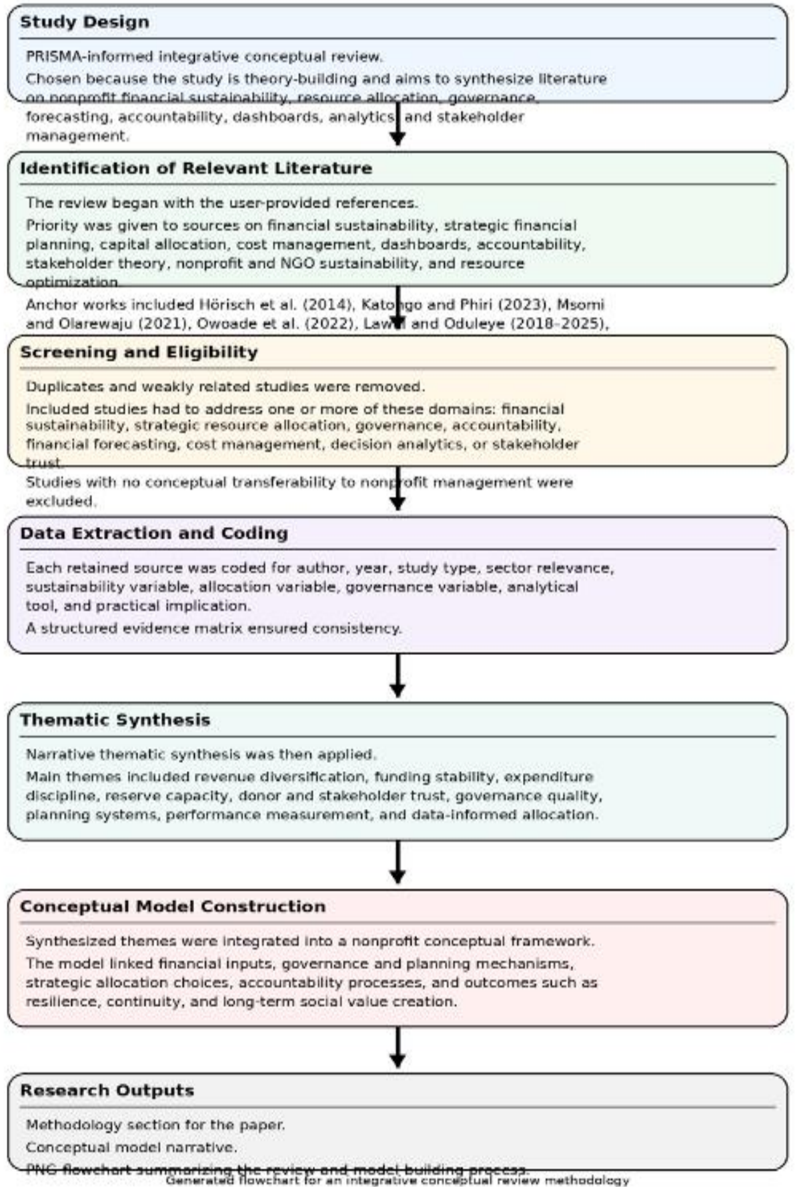
- The study uses an integrative conceptual review, described as PRISMA-informed and supported by narrative thematic synthesis.
- The authors used the paper’s reference base, retained studies relevant to nonprofit sustainability, governance, planning, stakeholder trust, forecasting, and decision-making, and excluded studies without a clear conceptual bridge to nonprofit financial sustainability.
- Analysis was interpretive and thematic, not statistical; the paper explicitly says a meta-analysis was not appropriate because the sources did not share standardized variables, common datasets, or comparable empirical designs.
Limitations
- The paper states that the review was conceptual and framework-oriented, not an empirical test of the model.
- It states that the literature was methodologically heterogeneous, which is why no statistical meta-analysis was done.
- Evident from the text: the model’s claims are theoretical and not validated with primary data or case studies in this paper.
Model-written summary. Check it against the paper before relying on it.
Integrity signals
Registry
Cites
Statistics
Figures
Verification
Claims the paper makes
12 Valid · 16 Not valid · 22 Not checked · 115 Own results and interpretations
The cited sources that could be checked couldn’t confirm or dispute this claim.
In the paper
“Diversification of revenue sources therefore becomes another dimension of sustainability, reducing dependency on a single donor, grant cycle, or public funding stream (Akomolafe, Agu & Bello, 2022, Bello, et al., 2022).”
§ Conceptual Model for Financial Sustainability and Strategic Resource Allocation in Nonprofit Organizations > Introduction
What the sources say
- Not matchedcites Akomolafe, Agu & Bello, 2022
An author–year citation the paper’s reference list doesn’t settle. We don’t search these by name.
- Could not verifycites Bello, et al., 2022 matched to “Factor Analysis of Poultry Birds De-Feathering Machines” (2022) sourceExperimental — accuracy not yet measured
The Introduction and Conclusion discuss the costs of poultry de-feathering machines, not diversification of revenue. Searches for donors, grants, public funding, and revenue diversification found no passage addressing the claim. (LLM, conf=0.76)
plainstates a cause- Asserted: passes — The authors put it forward as true.
- Checkable: passes — It can be checked against evidence.
- Load-bearing: passes — The paper’s conclusions depend on it.
- Based: passes — The paper gives a reason why it holds.
- Not matched
The cited sources support only part of this claim — read each source’s verdict below.
In the paper
“An organization that neglects these underlying capacities may struggle to sustain impact over time (Bello, et al. 2024, Omoegun & Oduro, 2024, Opara, et al., 2024, Tawose, Ekeocha & Oluwadele, 2024).”
§ Conceptual Model for Financial Sustainability and Strategic Resource Allocation in Nonprofit Organizations > Introduction
What the sources say
- Not matchedcites Bello, et al. 2024
An author–year citation the paper’s reference list doesn’t settle. We don’t search these by name.
- Partly supportedcites Omoegun & Oduro, 2024 matched to “Integrated Systems Framework for Commissioning Readiness Assessment in Offshore Processing Facilities Projects” (2024) sourceExperimental — accuracy not yet measured
Section 1.1 says that failure to ensure commissioning readiness can lead to cost overruns and safety incidents, supporting the general idea that neglecting a necessary capability can have adverse consequences. The paper addresses offshore-project readiness, however, not organizations’ underlying capacities or their ability to sustain impact over time. (LLM, conf=0.75)
- Partly supportedcites Opara, et al., 2024 matched to “A Theoretical Review of Synergizing Energy Efficiency with Transportation Logistics Optimization: Towards a Sustainable U.S. Infrastructure” (2024) sourceExperimental — accuracy not yet measured
Section 2.3 says organizations’ focus on short-term finances can lead to underinvestment in energy efficiency and logistics optimization, while Section 2.4 says lasting transportation-sector outcomes require sustained commitment and collaboration. This supports the general concern, but the paper does not establish the claim for organizations’ underlying capacities or impact broadly; its discussion is specific to sustainable transportation initiatives. The supplied passages give no page numbers. (LLM, conf=0.78)
hedgedstates a possible cause- Asserted: passes — The authors put it forward as true.
- Checkable: passes — It can be checked against evidence.
- Load-bearing: passes — The paper’s conclusions depend on it.
- Based: passes — The paper gives a reason why it holds.
- Not matched
The cited sources that could be checked couldn’t confirm or dispute this claim.
In the paper
“Resource allocation becomes increasingly fragmented as funds are directed toward activities that respond to external funding opportunities rather than to internally defined mission priorities (Akokodaripon, et al., 2023, Elebe, et al., 2023, Lawal & Oduleye, 2023, Ogunboye, et al., 2023).”
§ Conceptual Model for Financial Sustainability and Strategic Resource Allocation in Nonprofit Organizations > Strategic allocation depends on the organization's
What the sources say
- Not matchedcites Akokodaripon, et al., 2023
More than one paper fits this citation.
- Could not verifycites Elebe, et al., 2023 matched to “An Advanced Machine Learning Model for Detecting Synthetic Identity Fraud in E-Commerce Platforms” (2023) sourceExperimental — accuracy not yet measured
The paper’s section 2.5 discusses adapting fraud-detection models to changing attack patterns, not organizational funding decisions. Searches for fragmented resource allocation, external funding opportunities, and mission priorities returned only unrelated references; no passage in our copy addresses the claim. (LLM, conf=0.76)
- Not matchedcites Lawal & Oduleye, 2023
More than one paper fits this citation.
plainstates a cause- Asserted: passes — The authors put it forward as true.
- Checkable: passes — It can be checked against evidence.
- Load-bearing: passes — The paper’s conclusions depend on it.
- Based: passes — The paper gives a reason why it holds.
- Not matched
The cited sources that could be checked couldn’t confirm or dispute this claim.
In the paper
“At the same time, sustainability strengthens accountability by giving the organization the capacity to maintain robust reporting systems, internal controls, evaluation mechanisms, and governance processes (Akomolafe, etal., 2023, Bello, et al., 2023, Kevin 2023, Mayo, et al., 2023).”
§ Conceptual Model for Financial Sustainability and Strategic Resource Allocation in Nonprofit Organizations > Introduction
What the sources say
- Not matchedcites Akomolafe, etal., 2023
An author–year citation the paper’s reference list doesn’t settle. We don’t search these by name.
- Could not verifycites Bello, et al., 2023 matched to “Investigating the Influence of Rubber Seed Oil and Used Cooking Oil on Diesel” (2023) sourceExperimental — accuracy not yet measured
The Methods (§2.3) and Results (§4) concern biodiesel engine performance and emissions, not organizational accountability. Searches for reporting systems, internal controls, evaluation mechanisms, and governance found no passage addressing the claim. The indexed passages provide no page numbers. (LLM, conf=0.78)
- Not matchedcites Kevin 2023
An author–year citation the paper’s reference list doesn’t settle. We don’t search these by name.
plainstates a cause- Asserted: passes — The authors put it forward as true.
- Checkable: passes — It can be checked against evidence.
- Load-bearing: passes — The paper’s conclusions depend on it.
- Based: passes — The paper gives a reason why it holds.
- Not matched
The cited sources that could be checked couldn’t confirm or dispute this claim.
In the paper
“Another expected outcome is stronger mission coherence, because resources are more likely to flow toward activities that align with core purpose rather than being dispersed across disconnected or donor-driven initiatives (Agu & Akomolafe, 2020, Lawal & Oduleye, 2020).”
§ Conceptual Model for Financial Sustainability and Strategic Resource Allocation in Nonprofit Organizations > Strategic allocation depends on the organization's
What the sources say
- Could not verifycites Agu & Akomolafe, 2020 matched to “Advances in Corporate Governance and Performance Accountability in Global Energy Enterprises” (2020) sourceExperimental — accuracy not yet measured
The Discussion addresses aligning executive incentives with sustainability priorities, and the Conclusion discusses ESG planning and data-enabled performance monitoring in energy enterprises. Neither passage addresses whether data-informed resource allocation strengthens mission coherence or prevents resources from being dispersed across disconnected or donor-driven initiatives (searched: mission coherence, donor-driven initiatives, and strategic resource allocation). (LLM, conf=0.73)
- Not matchedcites Lawal & Oduleye, 2020
More than one paper fits this citation.
hedgedstates a cause- Asserted: passes — The authors put it forward as true.
- Checkable: passes — It can be checked against evidence.
- Load-bearing: passes — The paper’s conclusions depend on it.
- Based: passes — The paper gives a reason why it holds.
- Could not verify
61 more claims · 12 with their cited sources checked
Create a free account to see all 165 claims and every source verdict.
- Probably not a substantial claim. 69
- It may state two separate claims as one. 43
Citations
Cites
The publisher hasn’t deposited this paper’s reference list.
Research works printed but not linked: 26
- [1]1. Adamah, M., Mangelinck-Noël, N., Kan- Dapaah, K., Ottah, D. G., Salifu, A., Dozie- Nwachukwu, S. O., ... & Azoumah, Y. (2016). A maiden edition of AUSTECH 2015 International Conference Book of Abstracts.
- [2]2. Adeniji, I. O., Liadi, K. O., Opara, I. S., Elumilade, R. A., & Shittu, H. (2024). A comprehensive review of direct air capture technologies for carbon removal. International Journal of Advanced Multidisciplinary Research and Studies, 4(6), 2961-2967.
- [4]4. Adeniji, I. O., Shittu, H., Opara, I. S., Elumilade, R. A., & Liadi, K. O. (2019). Hydrogen as a secondary energy carrier: Modeling its integration in national grids. IRE Journal, 3(1), 16 pp.
- [5]5. Adeniji, O. I. (2019). Design And Construction Of Temperature Monitoring Device With Security FeatureS (Doctoral dissertation).
- [18]18. Akomolafe, O., Agu, M. U., & Bello, A. (2022). International Journal of Management and Organizational Research.
- [35]35. Anioke, S. C., & Atima, M. E. (2025). Gyanshauryam, International Scientific Refereed Research Journal.
- [37]37. Aye, P.A and Tawose, O.M. (2016): Physiological Responses of West African Dwarf Sheep fed Graded Levels of Gmelina arborea Leaf and Cassava Peel Concentrates under Different Management Systems. Agriculture and Biology Journal of North America, ISSN Print:2151-7517.Online:2151-7525, doi:10.5251/abjna.2016.7.4.185.195, http://www.scihub.org/ABJNA. · doi:10.5251/abjna.2016.7.4.185.195
- [53]53. Bello, K. A., Oyelaran, O. A., Tawose, O. M., Omoyi, C. O., Yussouff, A. A. (2024): Development of a Gum Production Machine from Manihot Esculenta Waste Peels: FUOYE Journal of Innovation Science and Technology, Volume 2(1) .https://www.jist.fuoye.edu.ng/index.php/jist/ar ticle/view/48
- [59]59. Eziama, E. U., Dan, A., Orifama, D. G., Enumah, I. N., Akingbule, G., Esiowu, U. F., Ibe, B. O., Folorunso, A., Ogbuagu, D. C., Shittu, M., Shittu, H., Opara, S. I., Erics, G., Ogunnaike, O., & Anyanacho, J. N. (2025, March). Controller area network flexible data attack detection using deep learning mechanism. In Proceedings of the 13th Annual and International Conference of the Renewable and Alternative Energy Society of Nigeria (RAESON 2025).
- [60]60. Eziama, E. U., Olumba, S. G., Okwe, G. I., Enumah, I. N., Ogbuaja, S. G., Agbaraji, C. E., Udeani, H. U., Folorunso, A., Oleka, C. V., Jacob, J. A., Nnamdi, H. I., Ogweda, H., Opara, S. I., Ogunnaike, O., Anyanacho, J. N., & Erics, G. (2025, March). AE-TCN: Autoencoder- driven temporal convolutional networks for secure and efficient cold chain monitoring. In Proceedings of the 13th Annual and International Conference of the Renewable and Alternative Energy Society of Nigeria (RAESON 2025).
- [68]68. Lawal, O. A., & Oduleye, T. E. (2018). A conceptual model for financial analytics-driven enterprise value creation in technology firms. IRE Journals, 2(2), 174.
- [69]69. Lawal, O. A., & Oduleye, T. E. (2018). A review and conceptual framework for tax governance and cross-border compliance analytics. IRE Journals, 2(5), 336.
- [70]70. Lawal, O. A., & Oduleye, T. E. (2019). A conceptual risk assessment model for transfer pricing in multinational corporations. IRE Journals, 2(12), 587.
- [71]71. Lawal, O. A., & Oduleye, T. E. (2019). Conceptualizing data-driven executive decision systems for strategic financial planning. IRE Journals, 3(3), 370.
- [76]76. Lawal, O. A., & Oduleye, T. E. (2021). Aligning financial planning analytics with corporate strategy: A conceptual integration model. Shodhshauryam, International Scientific Refereed Research Journal, 4(3), 319-346.
- [100]100. Msomi, T. S., & Olarewaju, O. M. (2021). Factors affecting small and medium enterprises' financial sustainability in South Africa. African Journal of Inter/Multidisciplinary Studies, 3(1), 103-117.
- [112]112. 111. Ogunboye, I., Adebayo, I. P. S., Anioke, S. C., Egwuatu, E. C., Ajala, C. F., & Awuah, S. B. (2023). Enhancing Nigeria's health surveillance system: A data-driven approach to epidemic preparedness and response'. World Journal of Advanced Research and Reviews, 20(1), 1352- 1369.
- [118]118. 117. Okoruwa, P. O., Fadayomi, O., Bello, A. D., Elebe, O., Hammed, N. I., & Omoegun, G. O. (2025). An artificial intelligence-driven financial crime investigation framework for analyst decision support. International Journal of Multidisciplinary Research and Growth Evaluation, 6(6), 1307-1314. https://doi.org/10.54660/IJMRGE.2025.6.6.1307 -1314 · doi:10.54660/ijmrge.2025.6.6.1307
- [121]121. Olamide, A. L., & Badmus, O. (2024). Innovative data integration method for enhancing GHG inventory reporting accuracy and reliability. Global Multidisciplinary Perspectives Journal, 1(6), 166-181. https://www.multiperspectivesjournal.com/sear ch?q=GMP-2024-1-007&search=search
- [132]132. Oluwadele, J. F., Tawose, O. M., Ekeocha, A. H., Akinlabi, E. Y., Adeitan, O. O., & Bello, K. A. (2023). Physiological indicators and stress index of scavenging chickens at Lafarge (Ewekoro) and Dangote (Ibese) cement factory areas of Ogun State, Nigeria. Journal of Austrian Society of Agricultural Economics, 19(4).
- [136]136. 140. Opara, I. S., Shittu, M. A., Adeniji, I. O., & Shittu, H. (2022). Blockchain-assisted secure data exchange architectures for SCADA- controlled power systems. IRE Journals, 6(3), 21 pp.
- [137]137. Opara, I. S., Shittu, M. A., Adeniji, I. O., Elumilade, R. A., Shittu, H., & Liadi, K. O. (2021). Selective coordination and arc-flash risk mitigation strategies in industrial power distribution systems. IRE Journal, 4(8), 19 pp.
- [139]139. 143. Owoade, O. A., Moneke, K. C., & Anioke, S. C. (2022). Leveraging business intelligence to optimize resource allocation in mental health and substance abuse centers. Journal of Scientific and Engineering Research, 9(12), 210- 235.
- [141]141. Shittu, M. A., Adeniji, I. O., Shittu, H., & Opara, I. S. (2020). Grounding system design optimization for medium-voltage distribution networks in emerging power markets. IRE Journal, 3(11), 19 pp.
- [145]145. 149. Tawose, O. M., Oluwadele, J.F., Ekeocha A. H., A.A Odumboni, O.S Egbeyemi (2023): Aflatoxin Detection and Quantification in Poultry Feeds Available in Selected Areas in Ekiti State, FUOYE Journal of Agriculture and Human Ecology (FUOJAHE), Vol 7, No 2. https://doi.org/10.62923/fuojahe.v7i2.302. · doi:10.62923/fuojahe.v7i2.302
- [146]146. 150. Tawose, O., & Oluwadele, J. (2025). Comparative analysis of the nutritional potentials of selected tuber peel meals as feed supplements for ruminant animals. Nigerian Journal of Agriculture and Agricultural Technology (NJAAT), 5(3A). https://njaat.com.ng/index.php/njaat/article/vie w/1169
Cited by
Tonoyan, A., Dada, O., & Ayivi-Donkor, S. S. (2026) · Gulf Journal of Advance Business Research · doi:10.51594/gjabr.v4i3.213 · Cited by 9
“…automation architectures, strengthens the feedback signal the protocol depends upon, while investment-risk monitoring practice from capital markets offers a template for the continuous divergence checks the protocol prescribes (Lawal & Oduleye, 2023; Sanni et al., 2026; Eboh & Aliliele, 2025).”
Metadata
- Authors
- Aliliele, C., Eboh, E. E., & Odihi, F.
- Affiliations
- Independent Researcher Dallas, TX
- Independent Researcher
- Joseph Sarwuan Tarka University Makurdi (NG)
- Venue
- International Journal of Scientific Research in Computer Science Engineering and Information Technology
- Publisher
- Technoscience Academy
- Published
- 2025-11-20
- Volume
- 11
- Issue
- 6
- Pages
- 612-651
- ISSN
- 2456-3307 (ISSN-L)
- OpenAlex
- W7162424069
- Cited by
- 0
- References
- 0
- FWCI
- 0.00
- Type
- journal article
- Language
- en
- Open access
- diamond
- doi.org
- Locations
- International Journal of Scientific Research in Computer Science Engineering and Information Technology (publishedVersion, cc-by)
- Topics
- Social Sciences › Sociology and Political Science › Nonprofit Sector and Volunteering
- Social Sciences › Economics, Econometrics and Finance › Finance › Community Development and Social Impact
- Social Sciences › Business, Management and Accounting › Accounting › Accounting and Organizational Management
- Keywords
- nonprofit financial sustainability, strategic resource allocation, nonprofit financial management, conceptual model, income diversification, reserve management, nonprofit governance, donor dependence, mission drift, financial forecasting, performance measurement, stakeholder trust, scenario analysis, mission alignment
About these checks
Registry, retraction, Cites and statistics results are computed, not judged, with one exception: a printed reference that no index lists is read once by a model before it counts as a citation error. Claims are extracted by a model and kept only when their quote appears verbatim in the text; each cited source is then checked, with a model’s help, for whether it says what the claim relies on. Those verdicts can be wrong — read the claim’s quote and the cited source before relying on one.
The claim verdicts this report counts are experimental: their accuracy is not yet measured.
A language model drew the claims from the paper on 2026-10-07, under version 3 of the claim definition (model deepseek-v4.1-flash, prompt extract-v3).
A second model labelled each claim on 2026-10-07 (model jev-1.13-20260917, definition revision gold-guideline-v0.2).
Cited sources are checked with a language model’s help (gpt-6-sol).
Statistics and arithmetic are recomputed, not judged.
Confidence bands are shown only for fields calibrated on our annotated test set. None is calibrated yet, so no band is shown.
What counts as a claim ›How we measure confidence ›How we check this ›
Are you an author, or do you see a problem with this page? Request a review
Data sources
Bibliographic data: Semantic Scholar, OpenAlex, Crossref.
Contains information from the Semantic Scholar Academic Graph Datasets, made available under the ODC Attribution License (ODC-BY 1.0).
Semantic Scholar’s data is described in: Kinney, R., et al. (2023). The Semantic Scholar Open Data Platform. arXiv:2301.10140.
