

The DOI matches its Crossref record; 121 of the 123 references it cites were found in a registry or an index.
Ferroportin disease: pathogenesis, diagnosis and treatment
Open accessAbstract
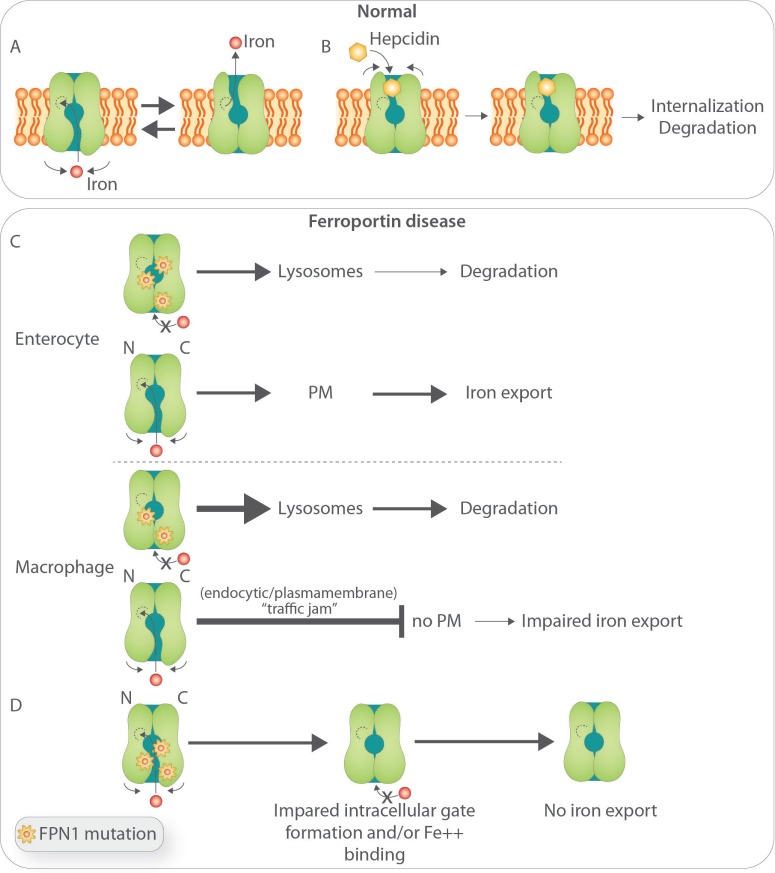
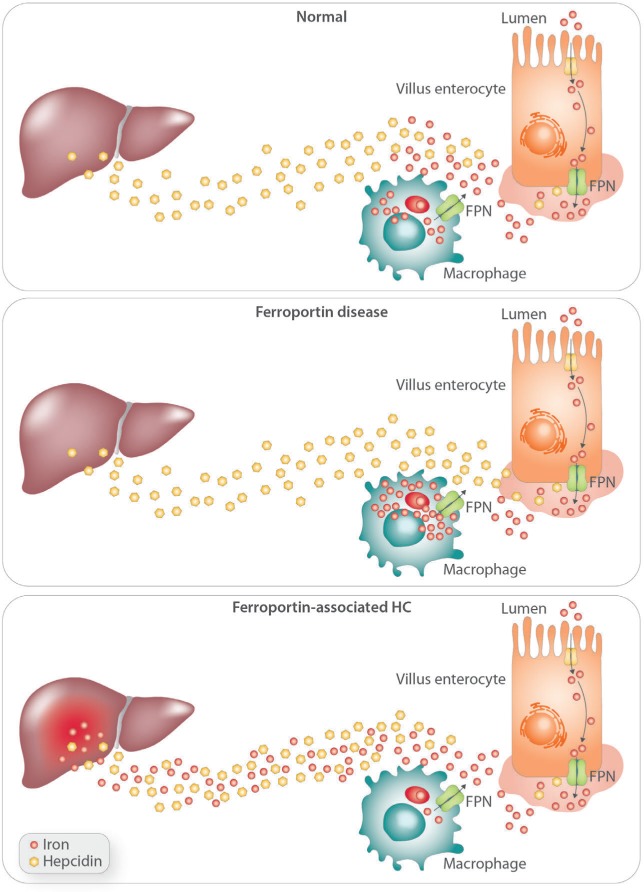
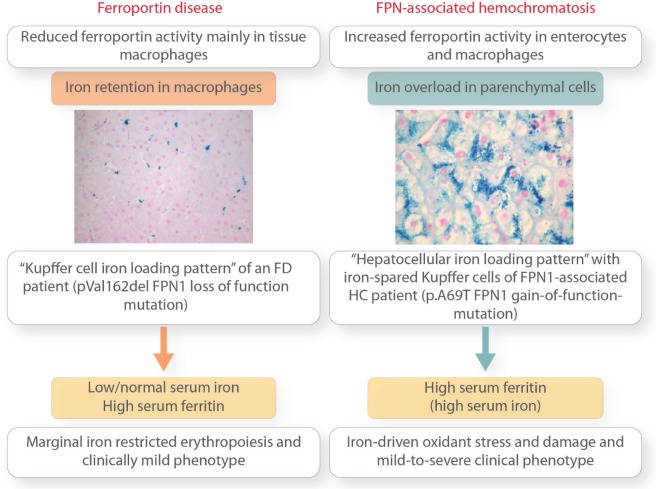
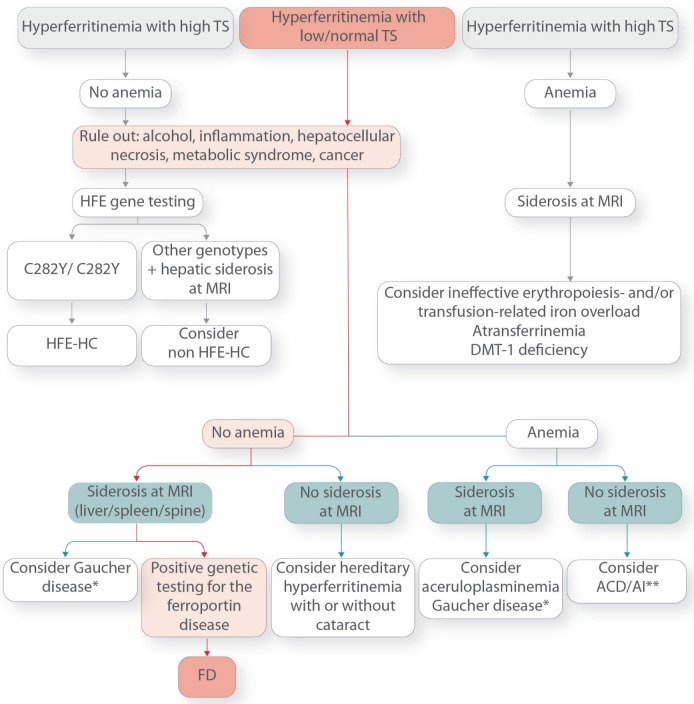
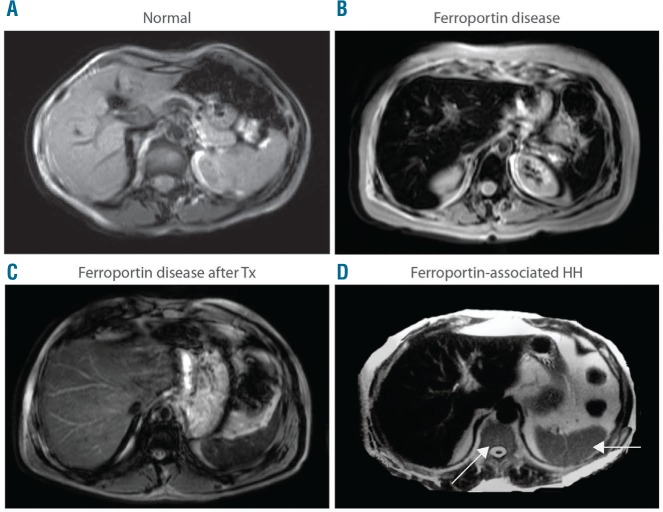
Ferroportin Disease (FD) is an autosomal dominant hereditary iron loading disorder associated with heterozygote mutations of the ferroportin-1 (FPN) gene. It represents one of the commonest causes of genetic hyperferritinemia, regardless of ethnicity. FPN1 transfers iron from the intestine, macrophages and placenta into the bloodstream. In FD, loss-of-function mutations of FPN1 limit but do not impair iron export in enterocytes, but they do severely affect iron transfer in macrophages. This leads to progressive and preferential iron trapping in tissue macrophages, reduced iron release to serum transferrin (i.e. inappropriately low transferrin saturation) and a tendency towards anemia at menarche or after intense bloodletting. The hallmark of FD is marked iron accumulation in hepatic Kupffer cells. Numerous FD-associated mutations have been reported worldwide, with a few occurring in different populations and some more commonly reported (e.g. Val192del, A77D, and G80S). FPN1 polymorphisms also represent the gene variants most commonly responsible for hyperferritinemia in Africans. Differential diagnosis includes mainly hereditary hemochromatosis, the syndrome commonly due to either HFE or TfR2, HJV, HAMP, and, in rare instances, FPN1 itself. Here, unlike FD, hyperferritinemia associates with high transferrin saturation, iron-spared macrophages, and progressive parenchymal cell iron load. Abdominal magnetic resonance imaging (MRI), the key non-invasive diagnostic tool for the diagnosis of FD, shows the characteristic iron loading SSL triad (spleen, spine and liver). A non-aggressive phlebotomy regimen is recommended, with careful monitoring of transferrin saturation and hemoglobin due to the risk of anemia. Family screening is mandatory since siblings and offspring have a 50% chance of carrying the pathogenic mutation.
Overview
The claims and statistics of this paper haven’t been checked yet.
Run the check — free, no account needed. It reads the open-access text and checks the sources it cites.
Integrity signals
Registry
Cites
Statistics
Figures
Verification
Claims the paper makes
The claims and statistics of this paper haven’t been checked yet.
Run the check — free, no account needed. It reads the open-access text and checks the sources it cites.
Claims other papers make about this one
Each is checked against this paper’s own text: does it say what the citing paper says it does?
In the citing paper
“Loss-of-function mutations impair iron export, are associated with iron accumulation in Küpffer cells and require no or reduced phlebotomy therapy, representing the true “ferroportin disease”.81”
From Iron metabolism and iron disorders revisited in the hepcidin era (2020) · cites this paper as [81]
Self-check
Percentages, sums and reported differences re-computed from the paper’s own numbers.
The self-check needs the paper’s full text.
Citations
Cites
Targeting Hypoxia-Inducible Factors for the Treatment of Anemia in Chronic Kidney Disease Patients
Locatelli, F., Fishbane, S. N., Block, G. A., & Macdougall, I. C. (2017) · American Journal of Nephrology · doi:10.1159/000455166 · Cited by 4,836
Hepcidin Regulates Cellular Iron Efflux by Binding to Ferroportin and Inducing Its Internalization
Nemeth, E., Tuttle, M. S., Powelson, J., Vaughn, M. B., Donovan, A., Ward, D. M., Ganz, T., & Kaplan, J. (2004) · Science · doi:10.1126/science.1104742 · Cited by 4,803
A novel MHC class I-like gene is mutated in patients with hereditary haemochromatosis
Feder, J. N., Gnirke, A., Thomas, W., Tsuchihashi, Z., Ruddy, D. A., Basava, A., Dormishian, F., Domingo, R., Ellis, M. C., Fullan, A., et al. (1996) · Nature Genetics · doi:10.1038/ng0896-399 · Cited by 3,664
Hepcidin, a urinary antimicrobial peptide synthesized in the liver
Park, C. H., Valore, E. V., Waring, A. J., & Ganz, T. (2001) · Journal of Biological Chemistry · doi:10.1074/jbc.m008922200 · Cited by 2,168
Pigeon, C., Ilyin, G., Courselaud, B., Leroyer, P., Turlin, B., Brissot, P., & Loréal, O. (2001) · Journal of Biological Chemistry · doi:10.1074/jbc.m008923200 · Cited by 1,697
Positional cloning of zebrafish ferroportin1 identifies a conserved vertebrate iron exporter
Donovan, A., Brownlie, A., Zhou, Y., Shepard, J., Pratt, S. J., Moynihan, J., Paw, B. H., Drejer, A., Barut, B., Zapata, A., et al. (2000) · Nature · doi:10.1038/35001596 · Cited by 1,667
McKie, A. T., Marciani, P., Rolfs, A., Brennan, K., Wehr, K., Barrow, D., Miret, S., Bomford, A., Peters, T. J., Farzaneh, F., et al. (2000) · Molecular Cell · doi:10.1016/s1097-2765(00)80425-6 · Cited by 1,422
Dysmetabolic Hyperferritinemia: All Iron Overload Is Not Hemochromatosis
Makker, J. S., Hanif, A., Bajantri, B., & Chilimuri, S. S. (2015) · Case Reports in Gastroenterology · doi:10.1159/000373883 · Cited by 1,353
LEAP-1, a novel highly disulfide-bonded human peptide, exhibits antimicrobial activity
Krause, A., Neitz, S., Mägert, H.-J., Schulz, A., Forssmann, W.-G., Schulz-Knappe, P., & Adermann, K. (2000) · FEBS Letters · doi:10.1016/s0014-5793(00)01920-7 · Cited by 1,324
The iron exporter ferroportin/Slc40a1 is essential for iron homeostasis
Donovan, A., Lima, C. A., Pinkus, J. L., Pinkus, G. S., Zon, L. I., Robine, S., & Andrews, N. C. (2005) · Cell Metabolism · doi:10.1016/j.cmet.2005.01.003 · Cited by 1,275
Cited by
Sorted by citations
Hayes, J. D., Dinkova-Kostova, A. T., & Tew, K. D. (2020) · Cancer Cell · doi:10.1016/j.ccell.2020.06.001 · Cited by 2,654
Iron metabolism and iron disorders revisited in the hepcidin era
Camaschella, C., Nai, A., & Silvestri, L. (2020) · Haematologica · doi:10.3324/haematol.2019.232124 · Cited by 734
“Loss-of-function mutations impair iron export, are associated with iron accumulation in Küpffer cells and require no or reduced phlebotomy therapy, representing the true “ferroportin disease”.(81) Gain-of-function mutations lead to hepcidin resistance and the release of too much iron, as occurs in hemochromatosis.”
Structures and General Transport Mechanisms by the Major Facilitator Superfamily (MFS)
Drew, D., North, R. A., Nagarathinam, K., & Tanabe, M. (2021) · Chemical Reviews · doi:10.1021/acs.chemrev.0c00983 · Cited by 488
Hepcidin and Iron in Health and Disease
Nemeth, E., & Ganz, T. (2023) · Annual Review of Medicine · doi:10.1146/annurev-med-043021-032816 · Cited by 457
Liver iron sensing and body iron homeostasis
Wang, C.-Y., & Babitt, J. L. (2019) · Blood · doi:10.1182/blood-2018-06-815894 · Cited by 360
Metadata
- Authors
- Pietrangelo, A.
- Affiliations
- University of Modena and Reggio Emilia (IT)
- Corresponding author
- Pietrangelo, Antonello
- Venue
- Haematologica
- Published
- 2017-11-03
- Volume
- 102
- Issue
- 12
- Pages
- 1972-1984
- ISSN
- 0390-6078 (ISSN-L)
- 1592-8721
- PMC
- PMC5709096
- OpenAlex
- W2766930181
- Cited by
- 151
- References
- 123
- Citations by year
- 2026: 12 · 2025: 22 · 2024: 14 · 2023: 17 · 2022: 10 · 2021: 28 · 2020: 23 · 2019: 7 · 2018: 16 · 2017: 1
- FWCI
- 9.91
- Type
- journal article
- Language
- en
- Open access
- gold
- doi.org
- Locations
- Haematologica (publishedVersion)
- Europe PMC (PubMed Central) (publishedVersion, cc-by-nc)
- PubMed Central (publishedVersion, cc-by-nc)
- PubMed (publishedVersion)
- IRIS UNIMORE (University of Modena and Reggio Emilia) (submittedVersion, cc-by)
- DOAJ (DOAJ: Directory of Open Access Journals) (submittedVersion)
- Topics
- Health Sciences › Medicine › Hematology › Iron Metabolism and Disorders
- Life Sciences › Neuroscience › Neurology › Neurological diseases and metabolism
- Health Sciences › Medicine › Genetics (clinical) › Hemoglobinopathies and Related Disorders
- Keywords
- ferroportin disease, ferroportin 1, hereditary iron overload, hyperferritinemia, transferrin saturation, Kupffer cells, phlebotomy, family screening
- MeSH terms
- Ferroportin, Humans, Kupffer Cells, Mutation, Phlebotomy, Iron Overload, Cation Transport Proteins
About these checks
Registry, retraction, Cites and statistics results are computed, not judged, with one exception: a printed reference that no index lists is read once by a model before it counts as a citation error. Claims are extracted by a model and kept only when their quote appears verbatim in the text; each cited source is then checked, with a model’s help, for whether it says what the claim relies on. Those verdicts can be wrong — read the claim’s quote and the cited source before relying on one.
Statistics and arithmetic are recomputed, not judged.
Confidence bands are shown only for fields calibrated on our annotated test set. None is calibrated yet, so no band is shown.
What counts as a claim ›How we measure confidence ›How we check this ›
Are you an author, or do you see a problem with this page? Request a review
