

The DOI matches its Crossref record; 5 of the 5 references it cites were found in a registry or an index.
Pollen-food allergy syndrome in children
Abstract
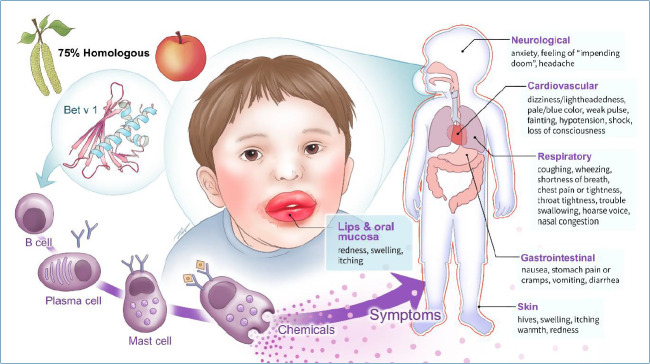
Pollen-food allergy syndrome (PFAS) is an immunoglobulin E-mediated immediate allergic reaction caused by cross-reactivity between pollen and the antigens of foods—such as fruits, vegetables, or nuts—in patients with pollen allergy. A 42.7% prevalence of PFAS in Korean pediatric patients with pollinosis was recently reported. PFAS is often called oral allergy syndrome because of mild symptoms such as itching, urticaria, and edema mainly in the lips, mouth, and pharynx that appear after food ingestion. However, reports of systemic reactions such as anaphylaxis have been increasing recently. This diversity in the degree of symptoms is related to the types of trigger foods and the characteristics of allergens, such as heat stability. When pediatric patients with pollen allergy are treated, attention should be paid to PFAS and an active effort should be made to diagnose it.
Overview
The claims and statistics of this paper haven’t been checked yet.
Run the check — free, no account needed. It reads the open-access text and checks the sources it cites.
Integrity signals
Registry
Cites
Statistics
Figures
Verification
Claims the paper makes
The claims and statistics of this paper haven’t been checked yet.
Run the check — free, no account needed. It reads the open-access text and checks the sources it cites.
Claims other papers make about this one
Each is checked against this paper’s own text: does it say what the citing paper says it does?
In the citing paper
“Class II allergens are proteins that typically do not cause primary sensitization through the gastrointestinal tract but instead trigger allergic reactions due to cross-reactivity with aeroallergens (such as pollen) that have already sensitized the immune system.”
From Pollen–Food Allergy Syndrome: Allergens, Clinical Insights, Diagnostic and Therapeutic Challenges (2024) · cites this paper as [43]
In the citing paper
“as this geographic correlation reflects the widespread sensitization to Bet v 1, which primes the immune system to recognize structurally similar proteins in fruits, vegetables, and nuts [43,57].”
From Pollen–Food Allergy Syndrome: Allergens, Clinical Insights, Diagnostic and Therapeutic Challenges (2024) · cites this paper as [43]
Self-check
Percentages, sums and reported differences re-computed from the paper’s own numbers.
The self-check needs the paper’s full text.
Citations
Cites
Common epitopes of birch pollen and apples—Studies by western and northern blot
Ebner, C., Birkner, T., Valenta, R., Rumpold, H., Breitenbach, M., Scheiner, O., & Kraft, D. (1991) · Journal of Allergy and Clinical Immunology · doi:10.1016/0091-6749(91)90152-e · Cited by 278
Mari, A., Iacovacci, P., Afferni, C., Barletta, B., Tinghino, R., Di Felice, G., & Pini, C. (1999) · Journal of Allergy and Clinical Immunology · doi:10.1016/s0091-6749(99)70171-5 · Cited by 217
Asero (1998) · Clinical & Experimental Allergy · doi:10.1046/j.1365-2222.1998.00399.x · Cited by 195
Kondo, Y., & Urisu, A. (2009) · Allergology International · doi:10.2332/allergolint.09-rai-0136 · Cited by 120
How long does the effect of birch pollen injection SIT on apple allergy last?
Asero, R. (2003) · Allergy · doi:10.1034/j.1398-9995.2003.00139.x · Cited by 94
Research works printed but not linked: 45
- 10.1097/DER.0000000000000087 · DOI
- 10.1016/j.anai.2009.11.007 · DOI
- 10.3346/jkms.2012.27.4.350 · DOI
- 10.1016/S0021-8707(42)90070-4 · DOI
- 10.1111/j.1365-2222.1987.tb02317.x · DOI
- 10.1111/j.1365-2222.1994.tb00248.x · DOI · Paper page
- 10.1111/j.1398-9995.2005.00674.x · DOI · Paper page
- 10.1046/j.1365-2222.2000.00868.x · DOI
- 10.1111/j.1398-9995.1982.tb02323.x · DOI
- Cho, 1998, Oral allergy syndrome in pollen - sensitized patients, 458
- 10.4168/aair.2018.10.6.648 · DOI
- 10.1111/pai.12136 · DOI
- 10.1111/jpc.12658 · DOI
- 10.1016/j.aller.2016.04.017 · DOI
- 10.3346/jkms.2019.34.e11 · DOI
- 10.1016/S0091-6749(03)02008-6 · DOI
- 10.1067/mai.2001.118515 · DOI
- 10.1007/s11882-016-0601-1 · DOI
- 10.1016/S0091-6749(96)80062-5 · DOI
- 10.1067/mai.2000.106929 · DOI
- 10.1067/mai.2002.126380 · DOI
- 10.1016/S0091-6749(00)90186-6 · DOI
- 10.1007/s11882-008-0080-0 · DOI
- Möller, 1989, Effect of pollen immunotherapy on food hypersensitivity in children with birch pollinosis, 343
- 10.1067/mai.2000.108711 · DOI
- 10.1067/mai.2000.107196 · DOI
- 10.1016/j.jaci.2003.09.030 · DOI
- 10.1111/j.1365-2222.2004.01837.x · DOI
- 10.4168/aard.2018.6.2.85 · DOI
- 10.1111/j.1398-9995.2006.00994.x · DOI
- 10.1067/mai.2000.107196 · DOI
- 10.1159/000024355 · DOI
- 10.1042/bst0300910 · DOI
- 10.1016/S1081-1206(10)62238-7 · DOI
- 10.1111/j.1365-2222.2012.04071.x · DOI
- 10.1016/0091-6749(89)90083-3 · DOI · Paper page
- 10.1034/j.1398-9995.2003.00272.x · DOI
- 10.1111/j.1365-2222.2009.03345.x · DOI
- Sloane, 2001, Oral allergy syndrome, 321
- 10.2174/187221308786241875 · DOI
- 10.1111/j.1365-2222.2010.03557.x · DOI
- 10.1016/0091-6749(89)90360-6 · DOI
- 10.1016/S1081-1206(10)62281-8 · DOI
- 10.1097/01.all.0000168793.27948.b0 · DOI
- Kelso, 1995, Oral allergy syndrome successfully treated with pollen immunotherapy, 391
Cited by
Sorted by citations
Pollen–Food Allergy Syndrome: Allergens, Clinical Insights, Diagnostic and Therapeutic Challenges
Haidar, L., Bănărescu, C. F., Uța, C., Moldovan, S. I., Zimbru, E.-L., Zimbru, R.-I., Ciurariu, E., Georgescu, M., & Panaitescu, C. (2024) · Applied Sciences · doi:10.3390/app15010066 · Cited by 21
Metadata
- Authors
- Jeon, Y. H.
- ORCID
- Jeon, You Hoon
- Venue
- Clinical and Experimental Pediatrics
- Publisher
- Korean Pediatric Society
- Published
- 2020-12-15
- Volume
- 63
- Issue
- 12
- Pages
- 463-468
- ISSN
- 2713-4148
- PMC
- PMC7738766
- Cited by
- 31
- References
- 5
- Language
- en
About these checks
Registry, retraction, Cites and statistics results are computed, not judged, with one exception: a printed reference that no index lists is read once by a model before it counts as a citation error. Claims are extracted by a model and kept only when their quote appears verbatim in the text; each cited source is then checked, with a model’s help, for whether it says what the claim relies on. Those verdicts can be wrong — read the claim’s quote and the cited source before relying on one.
Statistics and arithmetic are recomputed, not judged.
Confidence bands are shown only for fields calibrated on our annotated test set. None is calibrated yet, so no band is shown.
What counts as a claim ›How we measure confidence ›How we check this ›
Are you an author, or do you see a problem with this page? Request a review
