

The DOI matches its Crossref record; 68 of the 68 references it cites were found in a registry or an index; 16 of the 153 sources its claims cite were checked for support.
Two-Way Fixed Effects and Differences-in-Differences with Heterogeneous Treatment Effects: A Survey
Open accessAbstract
Linear regressions with period and group fixed effects are widely used to estimate policies' effects: 26 of the 100 most cited papers published by the American Economic Review from 2015 to 2019 estimate such regressions. It has recently been shown that those regressions may produce misleading estimates, if the policy's effect is heterogeneous between groups or over time, as is often the case. This survey reviews a fast-growing literature that documents this issue, and that proposes alternative estimators robust to heterogeneous effects. We use those alternative estimators to revisit Wolfers (2006a).
Overview
CoChat Summary
TL;DR
This survey explains why two-way fixed effects (TWFE) regressions can give misleading treatment effects when effects vary across groups or over time, and it reviews alternative difference-in-differences estimators that are robust to heterogeneity. It also re-analyzes Wolfers (2006a) on unilateral divorce laws and shows that several modern estimators give broadly similar conclusions, though precision and long-run estimates can differ.
Key findings
- In a survey of the 20 most cited AER papers from each of 2015–2019, 26 of 100 papers estimated at least one TWFE regression for a treatment effect.
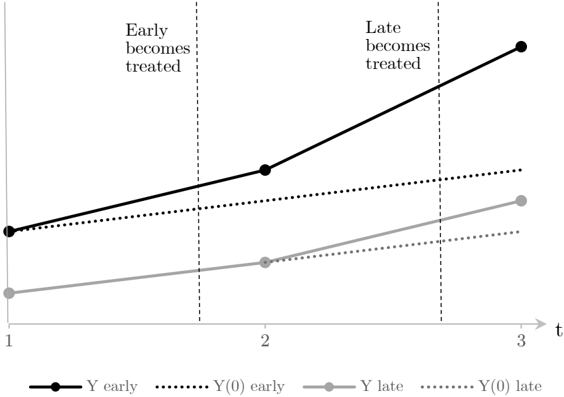
- TWFE coefficients can place negative weights on some group-time treatment effects; the paper gives a minimum-wage example where the coefficient could be positive even if the treatment effect is negative in every group-time cell.
- In the Gentzkow et al. (2011) newspaper-turnout example, the paper reports DID M = 0.0043 (s.e. = 0.0014), equivalent to a 0.43 percentage point increase in turnout from one more newspaper, and says this is 66% larger than the reported first-difference FE estimate.
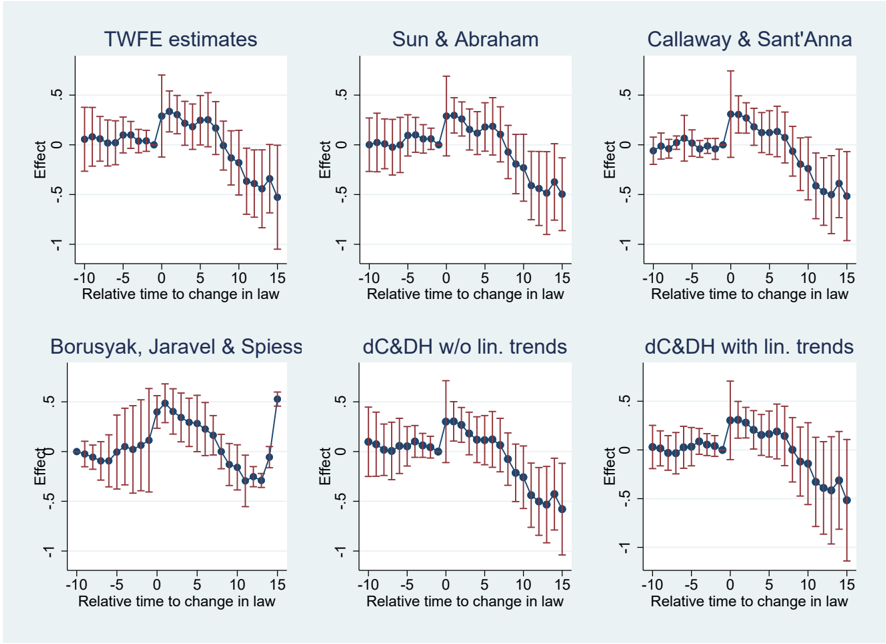
- In the Wolfers (2006a) application on unilateral divorce laws, the event-study estimates imply divorce rates rise in the year of adoption and for seven years thereafter, then become significantly negative 11 years after adoption; the survey reports placebo estimates are small and, in the main specifications, jointly insignificant (e.g. F-test p-value = 0.863 for the eventstudy regression, 0.120 for did_imputation, and 0.427 for did_multiplegt).
Methods
- The paper is a survey and methodological review of TWFE and DID estimators under heterogeneous treatment effects, focused on parallel-trends-based estimators and on when dynamic effects are or are not allowed.
- It reviews decomposition results for TWFE regressions, then summarizes alternative estimators including DID M, Callaway and Sant’Anna (2021), Sun and Abraham (2021), Borusyak et al. (2021), and de Chaisemartin and D'Haultfœuille (2021a, 2022).
- It reanalyzes Wolfers (2006a) using the authors’ own and related Stata/R commands, with estimates weighted by states’ populations and standard errors clustered at the state level.
Limitations
- The paper explicitly says the literature it reviews is very recent, and that several papers are still working papers, so some findings have not yet been peer reviewed.
- The authors state that whether researchers should systematically abandon TWFE estimators is still unclear; TWFE can sometimes estimate a convex combination of effects or have lower variance, depending on the setting.
- Evident from the text: the paper’s empirical reanalysis is only of one application (Wolfers 2006a), so its application-level comparison is illustrative rather than a broad systematic benchmark.
Model-written summary of a shortened version of the paper’s full text (it is longer than we read). Check it against the paper before relying on it.
Integrity signals
Registry
Cites
Statistics
Figures
Verification
Claims the paper makes
12 Valid · 6 Not valid · 98 Not checked · 118 Own results and interpretations
At least one cited source doesn’t support this claim or points to a different paper, and none confirmed it — see the verdicts below.
In the paper
“The estimators in de Chaisemartin et al. (2022) can be extended to the case where there are no stayers, provided there are quasi-stayers, meaning units whose treatment barely changes from period one to two.”
What the sources say
- Disputedcites de Chaisemartin et al. (2022) sourceExperimental — accuracy not yet measured
The Introduction (page unavailable) says the paper assumes stayers exist throughout and describes settings without stayers as cases where that assumption fails. Section 3.2 defines quasi-stayers as units with arbitrarily small treatment changes, but says the authors do not consider estimating the AS with quasi-stayers; it does not present the claimed extension to a no-stayers setting. (LLM, conf=0.88)
Checked by a reasoning model — may be wrong.
plain- Asserted: passes — The authors put it forward as true.
- Checkable: passes — It can be checked against evidence.
- Load-bearing: unclear — It is unclear whether the paper’s conclusions depend on it.
- Based: passes — The paper gives a reason why it holds.
- Disputed
At least one cited source doesn’t support this claim or points to a different paper, and none confirmed it — see the verdicts below.
In the paper
“In such instances, Roth (2021) notes that leveraging earlier pre-treatment periods increases the bias of a DID estimator, since one makes comparisons from earlier periods.”
What the sources say
- Disputedcites Roth (2021) sourceExperimental — accuracy not yet measured
The Introduction (p. 3) says that, under (quasi-)random treatment timing, adjusting with pre-treatment outcomes is unbiased for any weight; it discusses the choice of weight as affecting variance, not increasing bias. The paper therefore makes a contrary point in the setting it studies, rather than saying that comparisons with earlier periods increase DiD bias. (LLM, conf=0.88)
Checked by a reasoning model — may be wrong.
plainstates a cause- Asserted: passes — The authors put it forward as true.
- Checkable: passes — It can be checked against evidence.
- Load-bearing: unclear — It is unclear whether the paper’s conclusions depend on it.
- Based: passes — The paper gives a reason why it holds.
- Disputed
The cited sources support only part of this claim — read each source’s verdict below.
In the paper
“Goodman-Bacon (2021) shows that when the treatment is binary and the design is staggered, meaning that groups can switch in but not out of treatment, we have”
- Also stated in: § 2.2.1 Forbidden comparisons when the treatment is binary and the design is staggered · plain
“where DID g,g ′ ,t,t ′ is a DID comparing the outcome evolution of two groups g and g ′ from a pre period t to a post period t ′ , and where v g,g ′ ,t,t ′ are non-negative weights summing to one, with v g,g ′ ,t,t ′ > 0 if and only if g switches treatment between t and t ′ while g ′ does not.”
What the sources say
- Partly supportedcites Goodman-Bacon (2021) sourceExperimental — accuracy not yet measured
Split into 2 atoms — 1 confirmed, 1 partially supported, 0 disputed, 0 misattributed, 0 unverifiable. Expand the claim to see per-atom verdicts.
plain- Asserted: passes — The authors put it forward as true.
- Checkable: passes — It can be checked against evidence.
- Load-bearing: passes — The paper’s conclusions depend on it.
- Based: passes — The paper gives a reason why it holds.
- Also stated in: § 2.2.1 Forbidden comparisons when the treatment is binary and the design is staggered · plain
Every source the paper cites for this claim was checked and supports it.
In the paper
“Instead, with endpoint binning the regression assumes that that the treatment effect is constant after L periods, a more plausible assumption.”
What the sources say
- Supportedcites Schmidheiny and Siegloch (2020) source
Section 2.2, Remark 2, says that binning the endpoints of a finite effect window assumes dynamic treatment effects stay constant after the last lag. It describes this as often economically plausible. No page number is available in the supplied copy. (LLM, conf=0.94)
plain- Asserted: passes — The authors put it forward as true.
- Checkable: passes — It can be checked against evidence.
- Load-bearing: unclear — It is unclear whether the paper’s conclusions depend on it.
- Based: passes — The paper gives a reason why it holds.
- Supported
The cited sources support only part of this claim — read each source’s verdict below.
In the paper
“without it, the regression implicitly assumes that the treatment no longer has any effect after L periods.”
What the sources say
- Partly supportedcites Schmidheiny and Siegloch (2020) sourceExperimental — accuracy not yet measured
Section 2.2.2 says that a model without endpoint binning implicitly assumes effects drop to zero outside the effect window if observations outside that window are not dropped. The claim omits this condition: Section 2.2 describes dropping those observations as another way to restrict the window. (LLM, conf=0.87)
plain- Asserted: passes — The authors put it forward as true.
- Checkable: passes — It can be checked against evidence.
- Load-bearing: unclear — It is unclear whether the paper’s conclusions depend on it.
- Based: passes — The paper gives a reason why it holds.
- Partly supported
127 more claims · 5 with their cited sources checked
Create a free account to see all 234 claims and every source verdict.
- It may state two separate claims as one. 68
- Probably not a substantial claim. 46
Citations
Cites
Difference-in-Differences with multiple time periods
Callaway, B., & Sant’Anna, P. H. C. (2021) · Journal of Econometrics · doi:10.1016/j.jeconom.2020.12.001 · Cited by 9,126
Difference-in-differences with variation in treatment timing
Goodman-Bacon, A. (2021) · Journal of Econometrics · doi:10.1016/j.jeconom.2021.03.014 · Cited by 8,046
Estimating dynamic treatment effects in event studies with heterogeneous treatment effects
Sun, L., & Abraham, S. (2021) · Journal of Econometrics · doi:10.1016/j.jeconom.2020.09.006 · Cited by 5,518
Two-Way Fixed Effects Estimators with Heterogeneous Treatment Effects
de Chaisemartin, C., & D’Haultfœuille, X. (2020) · American Economic Review · doi:10.1257/aer.20181169 · Cited by 5,031
Self-citationEstimation and Inference of Impulse Responses by Local Projections
Jordà, Ò. (2005) · American Economic Review · doi:10.1257/0002828053828518 · Cited by 4,677
How Much Should We Trust Staggered Difference-in-Differences Estimates?
Baker, A. C., Larcker, D. F., & Wang, C. C. Y. (2022) · Journal of Financial Economics · doi:10.1016/j.jfineco.2022.01.004 · Cited by 3,149
Semiparametric Difference-in-Differences Estimators
Abadie, A. (2005) · The Review of Economic Studies · doi:10.1111/0034-6527.00321 · Cited by 2,286 · cited 1×
“It is a generalization of the standard common trends assumption in DID models (see, e.g., Abadie, 2005).”
What's Trending in Difference-in-Differences? A Synthesis of the Recent Econometrics Literature
Roth, J., Sant'Anna, P. H. C., Bilinski, A., & Poe, J. (2022) · arXiv · Cited by 2,036
What's trending in difference-in-differences? A synthesis of the recent econometrics literature
Roth, J., Sant’Anna, P. H. C., Bilinski, A., & Poe, J. (2023) · Journal of Econometrics · doi:10.1016/j.jeconom.2023.03.008 · Cited by 2,027
Did Unilateral Divorce Laws Raise Divorce Rates? A Reconciliation and New Results
Wolfers, J. (2006) · American Economic Review · doi:10.1257/aer.96.5.1802 · Cited by 950
Design-based analysis in Difference-In-Differences settings with staggered adoption
Athey, S., & Imbens, G. W. (2022) · Journal of Econometrics · doi:10.1016/j.jeconom.2020.10.012 · Cited by 917
Pretest with Caution: Event-Study Estimates after Testing for Parallel Trends
Roth, J. (2022) · American Economic Review: Insights · doi:10.1257/aeri.20210236 · Cited by 769
Difference-in-Differences Estimators of Intertemporal Treatment Effects
de Chaisemartin, C., & D’Haultfœuille, X. (2026) · Review of Economics and Statistics · doi:10.1162/rest_a_01414 · Cited by 740
Self-citationTwo-Way Fixed Effects, the Two-Way Mundlak Regression, and Difference-in-Differences Estimators
Wooldridge, J. M. (2021) · SSRN / The Econometrics Journal · doi:10.2139/ssrn.3906345 · Cited by 714
On the Use of Two-Way Fixed Effects Regression Models for Causal Inference with Panel Data
Imai, K., & Kim, I. S. (2021) · Political Analysis · doi:10.1017/pan.2020.33 · Cited by 623
Revisiting event study designs: robust and efficient estimation
(2022) · arXiv (preprint) · doi:10.47004/wp.cem.2022.1122 · Cited by 607
Bargaining in the Shadow of the Law: Divorce Laws and Family Distress
Stevenson, B., & Wolfers, J. (2006) · The Quarterly Journal of Economics · doi:10.1093/qje/121.1.267 · Cited by 601
Did Unilateral Divorce Raise Divorce Rates? Evidence from Panel Data
Friedberg, L. (1997) · doi:10.2139/ssrn.2207 · Cited by 522
Did Unilateral Divorce Raise Divorce Rates? Evidence from Panel Data
Friedberg, L. (1998) · doi:10.3386/w6398 · Cited by 514
The Effect of Newspaper Entry and Exit on Electoral Politics
Gentzkow, M., Shapiro, J. M., & Sinkinson, M. (2011) · American Economic Review · doi:10.1257/aer.101.7.2980 · Cited by 497
Revisiting Event Study Designs
Borusyak, K., & Jaravel, X. (2016) · SSRN Electronic Journal · doi:10.2139/ssrn.2826228 · Cited by 463
Grouped Patterns of Heterogeneity in Panel Data
Bonhomme, S., & Manresa, E. (2015) · Econometrica · doi:10.3982/ecta11319 · Cited by 451
Pre-Event Trends in the Panel Event-Study Design
Freyaldenhoven, S., Hansen, C., & Shapiro, J. M. (2019) · American Economic Review · doi:10.1257/aer.20180609 · Cited by 427
Regional policy evaluation: interactive fixed effects and synthetic controls.
Gobillon, L., & Magnac, T. (2016) · Review of Economics and Statistics · doi:10.1162/rest_a_00537 · Cited by 424
Liu, L., Wang, Y., & Xu, Y. (2024) · American Journal of Political Science · doi:10.1111/ajps.12723 · Cited by 390
Kahn-Lang, A., & Lang, K. (2020) · Journal of Business & Economic Statistics · doi:10.1080/07350015.2018.1546591 · Cited by 367
Two-way Fixed Effects Estimators with Heterogeneous Treatment Effects
de Chaisemartin, C., & D'Haultfoeuille, X. (2019) · doi:10.3386/w25904 · Cited by 350
Two-stage differences in differences
Gardner, J. (2022) · arXiv · doi:10.48550/arxiv.2207.05943 · Cited by 333
Fuzzy differences-in-differences
de Chaisemartin, C., & D’HaultfŒuille, X. (2018) · The Review of Economic Studies · doi:10.1093/restud/rdx049 · Cited by 324
Self-citationEfficiency Bounds for Semiparametric Regression
Chamberlain, G. (1992) · Econometrica · doi:10.2307/2951584 · Cited by 318
Schmidheiny, K., & Siegloch, S. (2020) · doi:10.2139/ssrn.3571164 · Cited by 295
Schmidheiny, K., & Siegloch, S. (2023) · Journal of Applied Econometrics · doi:10.1002/jae.2971 · Cited by 293
Difference-in-Differences with a Continuous Treatment
Callaway, B., Goodman-Bacon, A., & Sant'Anna, P. H. C. (2021) · arXiv · doi:10.48550/arxiv.2107.02637 · Cited by 243
Average and Quantile Effects in Nonseparable Panel ModelsPreprint
Fernández‐Val, I., Hahn, J., Chernozhukov, V., & Newey, W. K. (2013) · DSpace@MIT (Massachusetts Institute of Technology) · Cited by 234
Nothing to See Here? A Non‐Inferiority Approach to Parallel Trends
Bilinski, A., & Hatfield, L. A. (2026) · Statistics in Medicine · doi:10.1002/sim.70296 · Cited by 196
The Role of Parallel Trends in Event Study Settings: An Application to Environmental Economics
Marcus, M., & Sant’Anna, P. H. C. (2021) · Journal of the Association of Environmental and Resource Economists · doi:10.1086/711509 · Cited by 192
Average and quantile effects in nonseparable panel models
(2013) · Econometrica · doi:10.3982/ecta8405 · Cited by 170
Efficient Estimation for Staggered Rollout Designs
Roth, J., & Sant’Anna, P. H. C. (2023) · Journal of Political Economy Microeconomics · doi:10.1086/726581 · Cited by 164
Manski, C. F., & Pepper, J. V. (2018) · Review of Economics and Statistics · doi:10.1162/rest_a_00689 · Cited by 158
The Effect of Newspaper Entry and Exit on Electoral PoliticsPreprint
Gentzkow, M. A., Shapiro, J. M., & Sinkinson, M. (2009) · SSRN Electronic Journal · doi:10.2139/ssrn.1508431 · Cited by 152
Blandhol, C., Bonney, J., Mogstad, M., & Torgovitsky, A. (2022) · National Bureau of Economic Research · doi:10.3386/w29709 · Cited by 144
(2012) · Econometrica · doi:10.3982/ecta8220 · Cited by 131
Nothing to See Here? A non-inferiority approach to parallel trends
Bilinski, A., & Hatfield, L. A. (2018) · arXiv · doi:10.48550/arxiv.1805.03273 · Cited by 104
Efficient Estimation for Staggered Rollout Designs
Roth, J., & Sant'Anna, P. H. C. (2021) · arXiv · doi:10.48550/arxiv.2102.01291 · Cited by 96
Simple Diagnostics for Two-Way Fixed Effects
Jakiela, P. (2021) · doi:10.36934/wecon:2021-05 · Cited by 95
Did Unilateral Divorce Laws Raise Divorce Rates? A Reconciliation and New Results
Wolfers, J. J. (2003) · National Bureau of Economic Research · doi:10.3386/w10014 · Cited by 85
Kahn-Lang, A., & Lang, K. (2018) · National Bureau of Economic Research · doi:10.3386/w24857 · Cited by 83
Revisiting Event Study Designs: Robust and Efficient Estimation
(2021) · doi:10.48550/arxiv.2108.12419 · Cited by 76
Bargaining in the Shadow of the Law: Divorce Laws and Family Distress
Stevenson, B., & Wolfers, J. J. (2006) · The Quarterly Journal of Economics · doi:10.1162/003355306776083572 · Cited by 64
BACONDECOMP: Stata module to perform a Bacon decomposition of difference-in-differences estimation
Goodman-Bacon, A., Goldring, T., & Nichols, A. (2019) · RePEc: Research Papers in Economics · Cited by 62
Panel Experiments and Dynamic Causal Effects: A Finite Population Perspective
Bojinov, I., Rambachan, A., & Shephard, N. (2021) · Quantitative Economics · doi:10.3982/qe1744 · Cited by 60
Fuzzy differences-in-differences
de Chaisemartin, C., & D’Haultfœuille, X. (2017) · doi:10.1920/wp.cem.2015.6915 · Cited by 56
Self-citationPre-event Trends in the Panel Event-study Design
Freyaldenhoven, S., Hansen, C., & Shapiro, J. M. (2018) · National Bureau of Economic Research · doi:10.3386/w24565 · Cited by 52
Liu, L., Wang, Y., & Xu, Y. (2021) · arXiv · doi:10.48550/arxiv.2107.00856 · Cited by 52
Manski, C. F., & Pepper, J. V. (2015) · National Bureau of Economic Research · doi:10.3386/w21701 · Cited by 47
Константинович, Б. К. (2021) · RePEc: Research Papers in Economics · Cited by 37
CSDID: Stata module for the estimation of Difference-in-Difference models with multiple time periods
Ríos‐Avila, F., Sant’Anna, P. H. C., & Callaway, B. (2021) · RePEc: Research Papers in Economics · Cited by 25
When Should We (Not) Interpret Linear IV Estimands as Late?Preprint
Słoczyński, T. (2021) · SSRN Electronic Journal · doi:10.2139/ssrn.3842328 · Cited by 24
Sun, L. (2020) · RePEc: Research Papers in Economics · Cited by 20
EVENTSTUDYINTERACT: Stata module to implement the interaction weighted estimator for an event study
Sun, L. P. (2021) · RePEc: Research Papers in Economics · Cited by 14
Two-way Fixed Effects Regressions with Several Treatments
de Chaisemartin, C., & d'Haultfoeuille, X. (2020) · SSRN Electronic Journal · doi:10.2139/ssrn.3751060 · Cited by 10
Self-citationdidimputation: Imputation Estimator from Borusyak, Jaravel, and Spiess (2021)
Butts, K. (2021) · doi:10.32614/cran.package.didimputation · Cited by 8
Wolfers, J. J. (2006) · ICPSR Data Holdings · doi:10.3886/e116250v1 · Cited by 4
Difference-in-Differences Estimators for Treatments Continuously Distributed at Every Period
de Chaisemartin, C., D'Haultfœuille, X., Pasquier, F., Sow, D., & Vazquez-Bare, G. (2022) · arXiv · doi:10.48550/arxiv.2201.06898 · Cited by 4
Self-citationSimple Diagnostics for Two-Way Fixed EffectsPreprint
Jakiela, P. (2021) · RePEc: Research Papers in Economics · doi:10.48550/arxiv.2103.13229 · Cited by 4
bacondecomp: Goodman-Bacon Decomposition
Flack, E., & Jee, E. (2020) · CRAN: Contributed Packages · doi:10.32614/cran.package.bacondecomp · Cited by 3
Fuzzy Differences-in-Differences
De Chaisemartin, C., D'Haultfoeuille, X., De Chaisemartin, C., & D'Haultfoeuille, X. (2015) · Unknown · doi:10.22004/ag.econ.270218
Self-citationWhen Should We (Not) Interpret Linear IV Estimands as LATE?
Słoczyński, T. (2020) · arXiv · doi:10.48550/arxiv.2011.06695
Cited by
Persistent effect of El Niño on global economic growth
Callahan, C. W., & Mankin, J. (2023) · Science · doi:10.1126/science.adf2983 · Cited by 155
Political ideology and international capital allocation
Kempf, E., Luo, M., Schäfer, L., & Tsoutsoura, M. (2023) · Journal of Financial Economics · doi:10.1016/j.jfineco.2023.02.005 · Cited by 122
Liu, Y., Huang, H., Mbanyele, W., Wang, F., & Liu, H. (2024) · Financial Innovation · doi:10.1186/s40854-024-00620-8 · Cited by 65
The economic impact of UNESCO World Heritage: Evidence from Italy
Bertacchini, E., Revelli, F., & Zotti, R. (2024) · Regional Science and Urban Economics · doi:10.1016/j.regsciurbeco.2024.103996 · Cited by 41
Well-being Effects of Natural Disasters: Evidence from China’s Wenchuan Earthquake
Wang, Z., & Wang, F. (2022) · Journal of Happiness Studies · doi:10.1007/s10902-022-00609-z · Cited by 32
Metadata
- Authors
- de Chaisemartin, C., & D'Haultfoeuille, X.
- Venue
- National Bureau of Economic Research
- Publisher
- National Bureau of Economic Research
- Published
- 2022-02
- OpenAlex
- W4213318018
- Cited by
- 70
- References
- 57
- Citations by year
- 2026: 8 · 2025: 16 · 2024: 19 · 2023: 20 · 2022: 7
- Type
- report
- Language
- en
- Open access
- green
- doi.org
- Locations
- National Bureau of Economic Research (publishedVersion)
- Topics
- Physical Sciences › Mathematics › Statistics and Probability › Advanced Causal Inference Techniques
- Social Sciences › Economics, Econometrics and Finance › Economics and Econometrics › Spatial and Panel Data Analysis
- Social Sciences › Public Administration › Evaluation and Performance Assessment
- Keywords
- two-way fixed effects, difference-in-differences, treatment effect heterogeneity, policy evaluation, robust estimators, causal inference
About these checks
Registry, retraction, Cites and statistics results are computed, not judged, with one exception: a printed reference that no index lists is read once by a model before it counts as a citation error. Claims are extracted by a model and kept only when their quote appears verbatim in the text; each cited source is then checked, with a model’s help, for whether it says what the claim relies on. Those verdicts can be wrong — read the claim’s quote and the cited source before relying on one.
The claim verdicts this report counts are experimental: their accuracy is not yet measured.
A language model drew the claims from the paper on 2026-09-28, under version 3 of the claim definition (model deepseek-v4.1-flash, prompt extract-v3).
A second model labelled each claim on 2026-09-28 (model jev-1.13-20260917, definition revision gold-guideline-v0.2).
Cited sources are checked with a language model’s help (gpt-6-sol).
Statistics and arithmetic are recomputed, not judged.
Confidence bands are shown only for fields calibrated on our annotated test set. None is calibrated yet, so no band is shown.
What counts as a claim ›How we measure confidence ›How we check this ›
Are you an author, or do you see a problem with this page? Request a review
Data sources
Bibliographic data: Semantic Scholar, OpenAlex, Crossref.
Contains information from the Semantic Scholar Academic Graph Datasets, made available under the ODC Attribution License (ODC-BY 1.0).
Semantic Scholar’s data is described in: Kinney, R., et al. (2023). The Semantic Scholar Open Data Platform. arXiv:2301.10140.
