

The DOI matches its Crossref record; 50 of the 50 references it cites were found in a registry or an index.
Bioactive Cellulose Nanocrystal-Poly(ε-Caprolactone) Nanocomposites for Bone Tissue Engineering Applications
Open accessAbstract
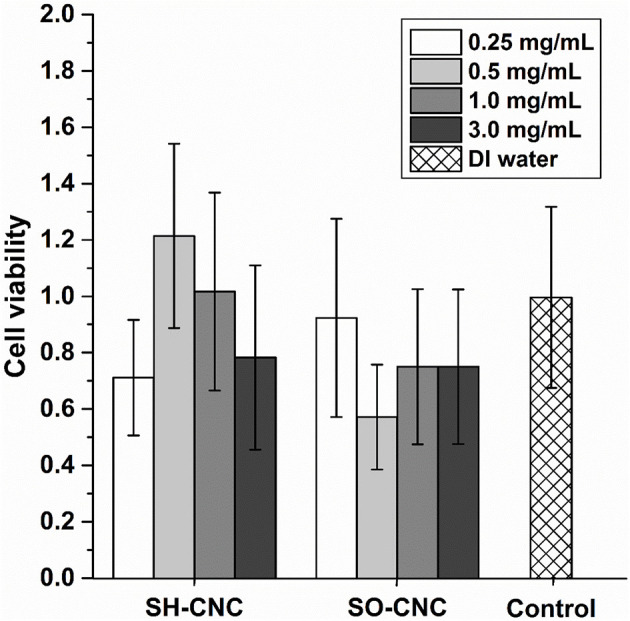
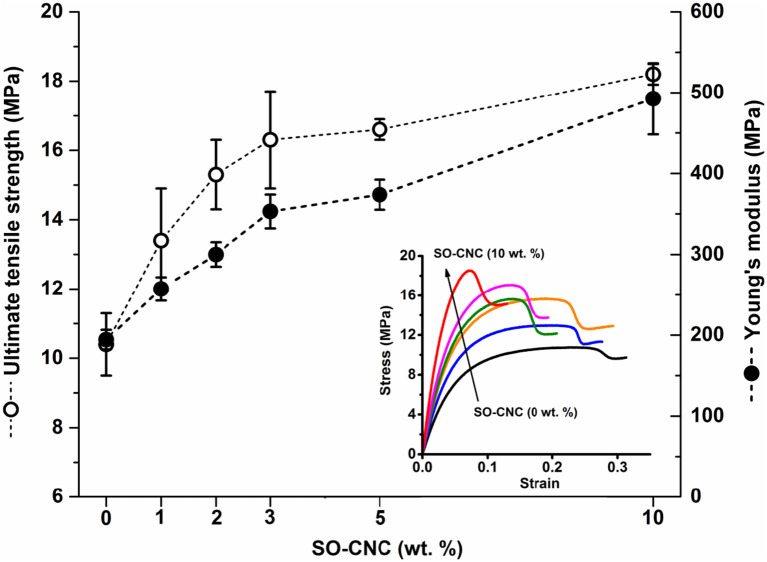
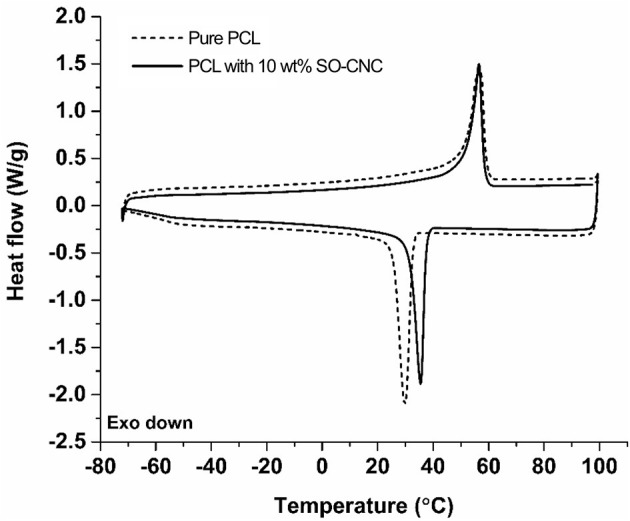
3D-printed bone scaffolds hold great promise for the individualized treatment of critical-size bone defects. Among the resorbable polymers available for use as 3D-printable scaffold materials, poly(ε-caprolactone) (PCL) has many benefits. However, its relatively low stiffness and lack of bioactivity limit its use in load-bearing bone scaffolds. This study tests the hypothesis that surface-oxidized cellulose nanocrystals (SO-CNCs), decorated with carboxyl groups, can act as multi-functional scaffold additives that (1) improve the mechanical properties of PCL and (2) induce biomineral formation upon PCL resorption. To this end, an in vitro biomineralization study was performed to assess the ability of SO-CNCs to induce the formation of calcium phosphate minerals. In addition, PCL nanocomposites containing different amounts of SO-CNCs (1, 2, 3, 5, and 10 wt%) were prepared using melt compounding extrusion and characterized in terms of Young's modulus, ultimate tensile strength, crystallinity, thermal transitions, and water contact angle. Neither sulfuric acid-hydrolyzed CNCs (SH-CNCs) nor SO-CNCs were toxic to MC3T3 preosteoblasts during a 24 h exposure at concentrations ranging from 0.25 to 3.0 mg/mL. SO-CNCs were more effective at inducing mineral formation than SH-CNCs in simulated body fluid (1x). An SO-CNC content of 10 wt% in the PCL matrix caused a more than 2-fold increase in Young's modulus (stiffness) and a more than 60% increase in ultimate tensile strength. The matrix glass transition and melting temperatures were not affected by the SO-CNCs but the crystallization temperature increased by about 5.5°C upon addition of 10 wt% SO-CNCs, the matrix crystallinity decreased from about 43 to about 40%, and the water contact angle decreased from 87 to 82.6°. The abilities of SO-CNCs to induce calcium phosphate mineral formation and increase the Young's modulus of PCL render them attractive for applications as multi-functional nanoscale additives in PCL-based bone scaffolds.
Overview
The claims and statistics of this paper haven’t been checked yet.
Run the check — free, no account needed. It reads the open-access text and checks the sources it cites.
Integrity signals
Registry
Cites
Statistics
Figures
Verification
Claims the paper makes
The claims and statistics of this paper haven’t been checked yet.
Run the check — free, no account needed. It reads the open-access text and checks the sources it cites.
Claims other papers make about this one
Each is checked against this paper’s own text: does it say what the citing paper says it does?
The check wasn’t confident either way, so it gives no verdict — never disputed.
In the citing paper
“If the addition of NC significantly increases the crystallinity of the composite, the biodegradation rate decreases since the crystalline domains are less accessible to microbes and water compared to amorphous regions [74,75]”
From Nanocellulose-Reinforced Poly(Lactic Acid) and Poly(ε-caprolactone) Bio-Nanocomposites: A Review and Future Outlook for Poly(Lactic Acid)/Poly(ε-caprolactone) Blend Systems (2025) · cites this paper as [75]
Experimental — accuracy not yet measured
Self-check
Percentages, sums and reported differences re-computed from the paper’s own numbers.
The self-check needs the paper’s full text.
Citations
Cites
How useful is SBF in predicting in vivo bone bioactivity?
Kokubo, T., & Takadama, H. (2006) · Biomaterials · doi:10.1016/j.biomaterials.2006.01.017 · Cited by 9,578
Cellulose nanomaterials review: structure, properties and nanocomposites
Moon, R. J., Martini, A., Nairn, J., Simonsen, J., & Youngblood, J. (2011) · Chemical Society Reviews · doi:10.1039/c0cs00108b · Cited by 6,756
Mediation of biomaterial-cell interactions by adsorbed proteins: a review
Wilson, C. J., Clegg, R. E., Leavesley, D. I., & Pearcy, M. J. (2005) · Tissue Engineering · doi:10.1089/ten.2005.11.1 · Cited by 1,696
Lin, N., Huang, J. T., & Dufresne, A. (2012) · Nanoscale · doi:10.1039/c2nr30260h · Cited by 904
Energy dissipation in tapping-mode atomic force microscopy
Cleveland, J. P., Anczykowski, B., Schmid, A. E., & Elings, V. B. (1998) · Applied Physics Letters · doi:10.1063/1.121434 · Cited by 881
The role of prenucleation clusters in surface-induced calcium phosphate crystallization
Dey, A., Bomans, P. H. H., Müller, F. A., Will, J., Frederik, P. M., de With, G., & Sommerdijk, N. A. J. M. (2010) · Nature Materials · doi:10.1038/nmat2900 · Cited by 786
Aliphatic polyesters. I. The degradation of poly(ϵ‐caprolactone) in vivo
Pitt, C. G., Chasalow, F. I., Hibionada, Y. M., Klimas, D. M., & Schindler, A. (1981) · Journal of Applied Polymer Science · doi:10.1002/app.1981.070261124 · Cited by 729
Steric stabilization of a cellulose microcrystal suspension by poly(ethylene glycol) grafting
Araki, J., Wada, M., & Kuga, S. (2001) · Langmuir · doi:10.1021/la001070m · Cited by 720
Habibi, Y., Goffin, A.-L., Schiltz, N., Duquesne, E., Dubois, P., & Dufresne, A. (2008) · Journal of Materials Chemistry · doi:10.1039/b809212e · Cited by 672
TEMPO-mediated surface oxidation of cellulose whiskers
Habibi, Y., Chanzy, H., & Vignon, M. R. (2006) · Cellulose · doi:10.1007/s10570-006-9075-y · Cited by 666
Biomaterials and bone mechanotransduction
Sikavitsas, V. I., Temenoff, J. S., & Mikos, A. G. (2001) · Biomaterials · doi:10.1016/s0142-9612(01)00002-3 · Cited by 531
The Potential of Cellulose Nanocrystals in Tissue Engineering Strategies
Domingues, R. M. A., Gomes, M. E., & Reis, R. L. (2014) · Biomacromolecules · doi:10.1021/bm500524s · Cited by 520
Nanocomposites of cellulose acetate butyrate reinforced with cellulose nanocrystals
Grunert, M., & Winter, W. T. (2002) · Journal of Polymers and the Environment · doi:10.1023/a:1021065905986 · Cited by 465
Highly Filled Bionanocomposites from Functionalized Polysaccharide Nanocrystals
Habibi, Y., & Dufresne, A. (2008) · Biomacromolecules · doi:10.1021/bm8001717 · Cited by 391
Kvien, I., Tanem, B. S., & Oksman, K. (2005) · Biomacromolecules · doi:10.1021/bm050479t · Cited by 362
Preparation of Cellulose Whiskers Reinforced Nanocomposites from an Organic Medium Suspension
Samir, M. A. S. A., Alloin, F., Sanchez, J., Kissi, N. E., & Dufresne, A. (2004) · Macromolecules · doi:10.1021/ma030532a · Cited by 339
Nanoscale compositional mapping with gentle forces
Garcia, R. A., Magerle, R., & Pérez, R. (2007) · Nature Materials · doi:10.1038/nmat1925 · Cited by 326
Polysaccharide nano crystal reinforced nanocomposites
Dufresne, A. (2008) · Canadian Journal of Chemistry · doi:10.1139/v07-152 · Cited by 325
Identification of Nanoscale Dissipation Processes by Dynamic Atomic Force Microscopy
Garcia, R. A., Gómez, C. J., Martínez, N., et al. (2006) · Physical Review Letters · doi:10.1103/physrevlett.97.016103 · Cited by 311
Roughness and hydrophobicity studies of nanofiltration membranes using different modes of AFM
Boussu, K., der Bruggen, B. V., Volodin, A., et al. (2005) · Journal of Colloid and Interface Science · doi:10.1016/j.jcis.2005.01.095 · Cited by 309
Cölfen, H. (2010) · Nature Materials · doi:10.1038/nmat2911 · Cited by 302
Fundamentals of Biomechanics in Tissue Engineering of Bone
Athanasiou, K. A., Zhu, C. F., Lanctot, D. R., Agrawal, C. M., & Wang, X. (2000) · Tissue Engineering · doi:10.1089/107632700418083 · Cited by 301
Surface silylation of cellulose microfibrils: preparation and rheological properties
Goussé, C., Chanzy, H., Cerrada, M. L., & Fleury, É. (2004) · Polymer · doi:10.1016/j.polymer.2003.12.028 · Cited by 291
Tamayo, J., & Garcia, R. A. (1997) · Applied Physics Letters · doi:10.1063/1.120039 · Cited by 291
Tensile and compressive properties of cancellous bone
Røhl, L., Larsen, E., Linde, F., Odgaard, A., & Jørgensen, J. B. (1991) · Journal of Biomechanics · doi:10.1016/0021-9290(91)90006-9 · Cited by 281
Preparation of homogeneous dispersions of tunicate cellulose whiskers in organic solvents
van den Berg, O., Capadona, J. R., & Weder, C. (2007) · Biomacromolecules · doi:10.1021/bm061104q · Cited by 278
An ecotoxicological characterization of nanocrystalline cellulose (NCC)
Kovacs, T., Naish, V., O'Connor, B., Blaise, C., Gagné, F., Hall, L., Trudeau, V., & Martel, P. (2010) · Nanotoxicology · doi:10.3109/17435391003628713 · Cited by 269
Acid-Catalyzed and Solvolytic Desulfation of H2SO4-Hydrolyzed Cellulose Nanocrystals
Jiang, F., Esker, A. R., & Roman, M. (2010) · Langmuir · doi:10.1021/la1028405 · Cited by 255
Self-citationWutticharoenmongkol, P., Sanchavanakit, N., Pavasant, P., & Supaphol, P. (2005) · Macromolecular Bioscience · doi:10.1002/mabi.200500150 · Cited by 254
Cellulose micro/nanocrystals reinforced polyurethane
Marcovich, N. E., Auad, M. L., Bellesi, N. E., Nutt, S., & Aranguren, M. I. (2006) · Journal of materials research/Pratt's guide to venture capital sources · doi:10.1557/jmr.2006.0105 · Cited by 231
Multiwall carbon nanotubes/polycaprolactone composites for bone tissue engineering application
Pan, L., Pei, X., He, R., Wan, Q., & Wang, J. (2012) · Colloids and Surfaces B Biointerfaces · doi:10.1016/j.colsurfb.2012.01.011 · Cited by 216
Dentin sialophosphoprotein in biomineralization
Prasad, M., Butler, W. T., & Qin, C. (2010) · Connective Tissue Research · doi:10.3109/03008200903329789 · Cited by 192
From Images to Interactions: High-Resolution Phase Imaging in Tapping-Mode Atomic Force Microscopy
Stärk, M., Möller, C., Müller, D. J., et al. (2001) · Biophysical Journal · doi:10.1016/s0006-3495(01)76266-2 · Cited by 184
1. An Overview of Biomineralization Processes and the Problem of the Vital Effect
Weiner, S., & Dove, P. M. (2003) · De Gruyter eBooks · doi:10.1515/9781501509346-006 · Cited by 176
Biodegradable poly(ɛ-caprolactone) nanowires for bone tissue engineering applications
Porter, J. R., Henson, A., & Popat, K. C. (2008) · Biomaterials · doi:10.1016/j.biomaterials.2008.10.022 · Cited by 176
Maio, E. D., Iannace, S., Sorrentino, L., & Nicolais, L. (2004) · Polymer · doi:10.1016/j.polymer.2004.10.037 · Cited by 155
Fleming, K., Gray, D. G., Prasannan, S., & Matthews, S. (2000) · Journal of the American Chemical Society · doi:10.1021/ja000764e · Cited by 154
Osteogenic differentiation of bone marrow stromal cells on poly(ε-caprolactone) nanofiber scaffolds
Ruckh, T. T., Kumar, K., Kipper, M. J., & Popat, K. C. (2010) · Acta Biomaterialia · doi:10.1016/j.actbio.2010.02.006 · Cited by 141
Liu, H. H., Slamovich, E. B., & Webster, T. J. (2006) · Journal of Biomedical Materials Research Part A · doi:10.1002/jbm.a.30734 · Cited by 115
A Novel Thermoformable Bionanocomposite Based on Cellulose Nanocrystal‐graft‐Poly(ε‐caprolactone)
Chen, G., Dufresne, A., Huang, J. T., & Chang, P. R. (2008) · Macromolecular Materials and Engineering · doi:10.1002/mame.200800261 · Cited by 103
Crystal Orientation of Hydroxyapatite Induced by Ordered Carboxyl Groups
Sato, K., Kogure, T., Kumagai, Y., & Tanaka, J. (2001) · Journal of Colloid and Interface Science · doi:10.1006/jcis.2001.7617 · Cited by 98
Zurick, K. M., Qin, C., & Bernards, M. T. (2012) · Journal of Biomedical Materials Research Part A · doi:10.1002/jbm.a.34462 · Cited by 87
In vitro mineralization and bone osteogenesis in poly(ε‐caprolactone)/gelatin nanofibers
Perez, M. A. A., Guarino, V., Cirillo, V., et al. (2012) · Journal of Biomedical Materials Research Part A · doi:10.1002/jbm.a.34233 · Cited by 66
Peluso, G., Petillo, O., Anderson, J. M., Ambrosio, L., Nicolais, L., Melone, M. A. B., Eschbach, F. O., & Huang, S. J. (1997) · Journal of Biomedical Materials Research · doi:10.1002/(sici)1097-4636(19970305)34:3 · Cited by 53
Direct visualization of surface charge in aqueous solution
Czajkowsky, D. M., Allen, M. J., Elings, V. B., et al. (1998) · Ultramicroscopy · doi:10.1016/s0304-3991(98)00024-2 · Cited by 52
Hikosaka, M. Y., Pulcinelli, S. H., Santilli, C. V., et al. (2006) · Journal of Non-Crystalline Solids · doi:10.1016/j.jnoncrysol.2006.02.124 · Cited by 48
Biodegradable Polymer-Based Scaffolds for Bone Tissue Engineering
Sultana, N. (2012) · SpringerBriefs in applied sciences and technology · doi:10.1007/978-3-642-34802-0 · Cited by 42
Wei, J., Heo, S. J., Liu, C., et al. (2008) · Journal of Biomedical Materials Research Part A · doi:10.1002/jbm.a.32139 · Cited by 25
Jing, X., Jin, E., Mi, H., et al. (2015) · Journal of Materials Science · doi:10.1007/s10853-015-8933-0 · Cited by 21
9. Thermal Analysis of Polymers
Runt, J. P., & Harrison, I. R. (1980) · Methods of experimental physics · doi:10.1016/s0076-695x(08)60760-7 · Cited by 11
Cited by
Sorted by citations
Cellulose-based composite scaffolds for bone tissue engineering and localized drug delivery
Janmohammadi, M., Nazemi, Z., Salehi, A. O. M., Seyfoori, A., John, J. V., Nourbakhsh, M. S., & Akbari, M. (2023) · Bioactive Materials · doi:10.1016/j.bioactmat.2022.05.018 · Cited by 323
Ngwenya, M., Gumede, T. P., Pérez Camargo, R. A., & Motloung, B. (2025) · Materials · doi:10.3390/ma18225172 · Cited by 9
Metadata
- Authors
- Hong, J. K., Cooke, S. L., Whittington, A. R., & Roman, M.
- Affiliations
- Virginia Tech (US)
- Corresponding author
- Roman, Maren
- Venue
- Frontiers in Bioengineering and Biotechnology
- Publisher
- Frontiers Media SA
- Published
- 2021-02-25
- Volume
- 9
- Pages
- 605924-605924
- ISSN
- 2296-4185 (ISSN-L)
- PMC
- PMC7947866
- OpenAlex
- W3133428517
- Cited by
- 39
- References
- 50
- Citations by year
- 2026: 7 · 2025: 4 · 2024: 6 · 2023: 9 · 2022: 9 · 2021: 4
- FWCI
- 2.13
- Type
- journal article
- Language
- en
- Open access
- gold
- doi.org
- Licence
- Locations
- Frontiers in Bioengineering and Biotechnology (publishedVersion, cc-by)
- PubMed Central (publishedVersion, cc-by)
- PubMed (publishedVersion)
- DOAJ (DOAJ: Directory of Open Access Journals) (submittedVersion, cc-by-sa)
- VTechWorks (Virginia Tech) (submittedVersion, cc-by)
- Funders
- National Science Foundation
- U.S. Department of Agriculture
- Virginia Agricultural Experiment Station, Virginia Polytechnic Institute and State University
- Institute for Critical Technology and Applied Science
- Topics
- Physical Sciences › Engineering › Biomedical Engineering › Bone Tissue Engineering Materials
- Physical Sciences › Materials Science › Biomaterials › Advanced Cellulose Research Studies
- Physical Sciences › Materials Science › Biomaterials › biodegradable polymer synthesis and properties
- Keywords
- cellulose nanocrystals, polycaprolactone, bone tissue engineering, 3D-printed bone scaffolds, biomineralization, mechanical properties, Young's modulus, tensile strength, crystallinity, water contact angle, biocompatibility, critical-size bone defect, resorbable polymers
About these checks
Registry, retraction, Cites and statistics results are computed, not judged, with one exception: a printed reference that no index lists is read once by a model before it counts as a citation error. Claims are extracted by a model and kept only when their quote appears verbatim in the text; each cited source is then checked, with a model’s help, for whether it says what the claim relies on. Those verdicts can be wrong — read the claim’s quote and the cited source before relying on one.
Statistics and arithmetic are recomputed, not judged.
Confidence bands are shown only for fields calibrated on our annotated test set. None is calibrated yet, so no band is shown.
What counts as a claim ›How we measure confidence ›How we check this ›
Are you an author, or do you see a problem with this page? Request a review
