

Glutathione-responsive and -exhausting metal nanomedicines for robust synergistic cancer therapy
Open accessThe DOI matches its Crossref record; 95 of the 95 references it cites were found in a registry or an index.
Abstract
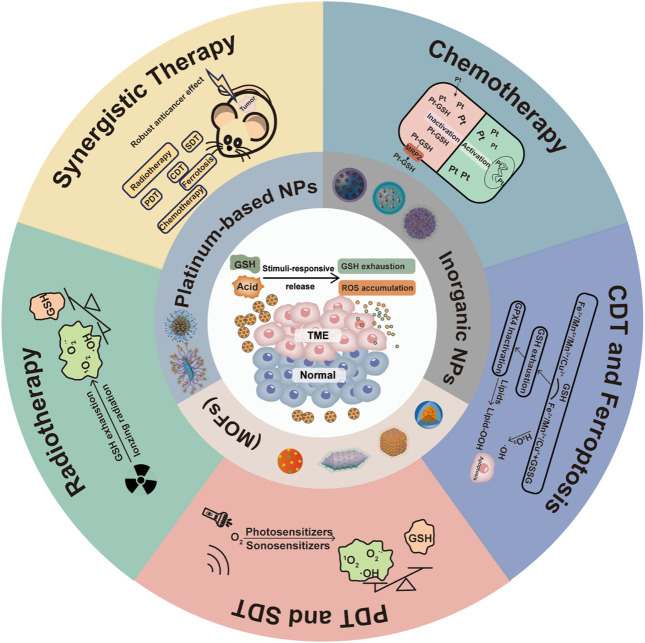
Due to their rapid and uncontrolled proliferation, cancer cells are characterized by overexpression of glutathione (GSH), which impairs reactive oxygen species (ROS)-based therapy and weakens the chemotherapeutic agent-induced toxification. Extensive efforts have been made in the past few years to improve therapeutic outcomes by depleting intracellular GSH. Special focus has been given to the anticancer applications of varieties of metal nanomedicines with GSH responsiveness and exhaustion capacity. In this review, we introduce several GSH-responsive and -exhausting metal nanomedicines that can specifically ablate tumors based on the high concentration of intracellular GSH in cancer cells. These include inorganic nanomaterials, metal-organic frameworks (MOFs), and platinum-based nanomaterials. We then discuss in detail the metal nanomedicines that have been extensively applied in synergistic cancer therapy, including chemotherapy, photodynamic therapy (PDT), sonodynamic therapy (SDT), chemodynamic therapy (CDT), ferroptotic therapy, and radiotherapy. Finally, we present the horizons and challenges in the field for future development.
Overview
The claims and statistics of this paper haven’t been checked yet.
Free: it reads the open-access text and checks the first 5 claims that cite a source we can check. Create a free account to check every claim.
Integrity signals
Registry
Cites
Statistics
Figures
Verification
Claims the paper makes
The claims and statistics of this paper haven’t been checked yet.
Free: it reads the open-access text and checks the first 5 claims that cite a source we can check. Create a free account to check every claim.
Self-check
Percentages, sums and reported differences re-computed from the paper’s own numbers.
The self-check needs the paper’s full text.
Citations
Cites
Ferroptosis: An Iron-Dependent Form of Nonapoptotic Cell Death
Dixon, S. J., Lemberg, K. M., Lamprecht, M. R., Skouta, R., Zaitsev, E. M., Gleason, C. E., Patel, D. N., Bauer, A. J., Cantley, A. M., Yang, W. S., et al. (2012) · Cell · doi:10.1016/j.cell.2012.03.042 · Cited by 18,691
Stimuli-responsive nanocarriers for drug delivery
Mura, S., Nicolas, J., & Couvreur, P. (2013) · Nature Materials · doi:10.1038/nmat3776 · Cited by 6,289
Ferroptosis turns 10: Emerging mechanisms, physiological functions, and therapeutic applications
Stockwell, B. R. (2022) · Cell · doi:10.1016/j.cell.2022.06.003 · Cited by 3,056 · cited 1×
“Concretely, GPX4 uses GSH as the substrate to reduce phospholipid hydroperoxides (PLOOHs) to hydroxyl derivatives (PLOHs), and oxidizes GSH to GSSH, therefore alleviating the damage of oxidative stress to tumor cells (Stockwell, 2022).”
BackgroundBroadening horizons: the role of ferroptosis in cancer
Chen, X., Kang, R., Kroemer, G., & Tang, D. (2021) · Nature Reviews Clinical Oncology · doi:10.1038/s41571-020-00462-0 · Cited by 2,897 · cited 1×
“Researchers have revealed that the morphological characteristics of ferroptosis are the diminishment of mitochondrial volume, the augmentation of membrane density, and the disappearance of mitochondria (Chen et al., 2021).”
BackgroundGlutathione: overview of its protective roles, measurement, and biosynthesis
Forman, H. J., Zhang, H., & Rinna, A. (2009) · Molecular Aspects of Medicine · doi:10.1016/j.mam.2008.08.006 · Cited by 2,636 · cited 1×
“For example, in order to maintain intracellular redox homeostasis and build a powerful antioxidant defense, cancer cells are typically characterized by high level of antioxidants, especially GSH with a high concentration of ~10 mM, which is approximately ten times higher than that in normal cells (Forman et al., 2009).”
BackgroundJohnstone, T. C., Suntharalingam, K., & Lippard, S. J. (2016) · Chemical Reviews · doi:10.1021/acs.chemrev.5b00597 · Cited by 2,485 · cited 1×
“However, their therapeutic outcomes are limited because of drug resistance due to the intracellular inactivation effect (Johnstone et al., 2016).”
BackgroundReactive Oxygen Species (ROS)-Based Nanomedicine
Yang, B., Chen, Y., & Shi, J. (2019) · Chemical Reviews · doi:10.1021/acs.chemrev.8b00626 · Cited by 2,443 · cited 1×
“Nanotechnology especially has a prominent position in the area of biomedicine, and nanomedicines are being widely explored for the detection, diagnosis, and treatment of cancer (Yang et al., 2019; Huo et al., 2020).”
BackgroundNanotechnology for Multimodal Synergistic Cancer Therapy
Fan, W., Yung, B., Huang, P., & Chen, X. (2017) · Chemical Reviews · doi:10.1021/acs.chemrev.7b00258 · Cited by 1,791 · cited 1×
“In the last few years, various GSH modulation-enhanced combinational therapy strategies have been extensively exploited, accompanied by the development of versatile metal-based nanosystems with different structures, functionalities, and treatment performances (Fan et al., 2017).”
BackgroundCisplatin: The first metal based anticancer drug
Ghosh, S. (2019) · Bioorganic Chemistry · doi:10.1016/j.bioorg.2019.102925 · Cited by 1,751 · cited 1×
“As a chemotherapeutic agent, platinum is one of the most widely used metal-based anticancer components (Ghosh, 2019).”
BackgroundMolecular mechanisms of resistance and toxicity associated with platinating agents
Rabik, C. A., & Dolan, M. E. (2007) · Cancer Treatment Reviews · doi:10.1016/j.ctrv.2006.09.006 · Cited by 1,564
Cited by
New-generation advanced PROTACs as potential therapeutic agents in cancer therapy
Wang, C., Zhang, Y., Chen, W., Wu, Y., & Xing, D. (2024) · Molecular Cancer · doi:10.1186/s12943-024-02024-9 · Cited by 188
“This strategy takes advantage of the unique characteristics of tumor cells, such as their increased levels of GSH [86–89].”
BackgroundTumor microenvironment responsive nanozymes for multimodal imaging of tumors
Wang, H., Ouyang, W., & Liu, H. (2024) · Nano TransMed · doi:10.1016/j.ntm.2024.100032 · Cited by 67
Roy, N., & Paira, P. (2024) · ACS Omega · doi:10.1021/acsomega.3c08890 · Cited by 63
“Two enzymatic steps are involved in the consumption of one molecule of ATP for each catalytic cycle, where ATP breaks down into adenosine monophosphate (ADP) and Pi, providing energy for the transportation of amino acids and the synthesis of GSH. 72 − 75 It can be highlighted that synthesis of GSH is governed by three…”
BackgroundInfluentialEmerging trends, and prospects in Nanozyme engineering to enhance dual-mode sensing applications
Singh, R., Sharma, A., Banik, O., Navyatha, B., Santhosh, C., Banoth, E., Balaji, R., Chandrasekar, N., Kumar, S., & Daima, H. K. (2025) · Coordination Chemistry Reviews · doi:10.1016/j.ccr.2025.216768 · Cited by 54
Nanosensitizer-assisted sonodynamic therapy for breast cancer
Yu, J., Hu, J.-R., Tian, Y., Lei, Y.-M., Hu, H.-M., Lei, B.-S., Zhang, G., Sun, Y., & Ye, H.-R. (2025) · Journal of Nanobiotechnology · doi:10.1186/s12951-025-03311-3 · Cited by 43
“Hypoxia and high GSH concentrations in the TME make tumors resistant to SDT therapy [61–63].”
Halder, S., Das, T., Kushwaha, R., Misra, A. K., Jana, K., & Das, D. (2024) · Materials Horizons · doi:10.1039/d4mh00981a · Cited by 40
Translational Advances in Oncogene and Tumor-Suppressor Gene Research
Stojchevski, R., Sutanto, E. A., Sutanto, R., Hadzi‐Petrushev, N., Mladenov, M. I., Singh, S. P., Sinha, J. K., Ghosh, S., Yarlagadda, B., Singh, K. K., et al. (2025) · Cancers · doi:10.3390/cancers17061008 · Cited by 38
“Cancers have also been found to have an increased expression of glutathione, a powerful antioxidant that aids in cancer’s resistance to chemotherapeutic drugs designed to induce cytotoxicity via reactive oxygen species (ROS) [174].”
Peptide-Based Inorganic Nanoparticles as Efficient Intracellular Delivery Systems
Shirazi, A. N., Vadlapatla, R., Koomer, A., Nguyen, A., Khoury, V., & Parang, K. (2025) · Pharmaceutics · doi:10.3390/pharmaceutics17091123 · Cited by 28
“For example, peptide-modified AgNPs incorporating disulfide bonds demonstrated GSH-triggered release of paclitaxel within tumor cells [126,127].”
Mansur, A. A. P., & Mansur, H. S. (2025) · Journal of Nanotheranostics · doi:10.3390/jnt6010004 · Cited by 18
Han, T., Huan, M., Cai, Z., He, W., Zhou, S., & Zhang, B. (2023) · Advanced Healthcare Materials · doi:10.1002/adhm.202302094 · Cited by 15
Wang, J., Wang, H., Zou, F., Gu, J., Deng, S., Cao, Y., & Cai, K. (2025) · Pharmaceutics · doi:10.3390/pharmaceutics17040409 · Cited by 17
“Furthermore, tumor tissues are often rich in reducing agents such as glutathione (GSH), which can be leveraged to enable controlled drug release and targeted therapy [299].”
Kaplan, H. M., & Pazarcı, P. (2024) · ACS Omega · doi:10.1021/acsomega.3c07624 · Cited by 13
Dangi, K., Kumar, V., Mittal, D., Yadav, P., Malik, M., & Verma, A. K. (2025) · Nanomedicine · doi:10.1080/17435889.2025.2489918 · Cited by 15
Rathi, P., Chowdhury, S., & Siril, P. F. (2025) · Small · doi:10.1002/smll.202505835 · Cited by 17
Reactive oxygen species driven prodrug-based nanoscale carriers for transformative therapies
Vasvani, S., Vasukutty, A., Bardhan, R., Park, I., & Uthaman, S. (2024) · Biomaterials Science · doi:10.1039/d4bm00647j · Cited by 16
Liu, G., Wang, Z., Sun, W., Gao, W., Zhang, X., Lin, H. L., Tian, M., Ma, L., Li, Z., Wang, R., et al. (2025) · Optical Materials · doi:10.1016/j.optmat.2025.117401 · Cited by 10
Huang, B., Nie, G., Dai, X., Cui, T., Pu, W., & Zhang, C. (2024) · Environmental Toxicology · doi:10.1002/tox.24302 · Cited by 9
“13 Different from other cell death modes, intra-cellular redox signals imbalance and iron-dependent lipid peroxide accumulation are its main causes.”
Heterojunction semiconductor nanocatalysts as cancer theranostics
Sabu, A., Kandel, M., Sarma, R. R., Ramesan, L., Roy, E., Sharmila, R., & Chiu, H. (2024) · APL Bioengineering · doi:10.1063/5.0223718 · Cited by 8
Wen, Y., Qiu, Q., Feng, F., Zhu, Y., Zhang, J., Sun, Z., Zhang, T., Shi, W. M., & Shi, J. (2025) · Materials Today Bio · doi:10.1016/j.mtbio.2025.101447 · Cited by 12
An, X., Bai, J., & Li, Y. D. (2025) · Macromolecular Materials and Engineering · doi:10.1002/mame.202400442 · Cited by 8
Nanotechnology-based platforms for effective and versatile sonodynamic therapy in cancer treatment
McHale, A. P., & Nomikou, N. (2024) · Nanomedicine · doi:10.1080/17435889.2024.2396274 · Cited by 6
Liu, H., Long, Z., Xu, F., Xie, J., Shen, H., Xie, H. J., Yang, K., & Tao, Y. (2025) · ACS Applied Materials & Interfaces · doi:10.1021/acsami.5c13893 · Cited by 8
Yang, J., Chu, M., Zhang, Y., Qian, J., Liu, J., Wang, M., Qiang, Z., & Ren, J. (2024) · ACS Applied Materials & Interfaces · doi:10.1021/acsami.4c04952 · Cited by 6
Application of Redox-Responsive Cysteine-Based Organogels as a Drug Delivery System for Doxorubicin
Zare, D., Yılmaz, G., & Özçubukçu, S. (2024) · ACS Omega · doi:10.1021/acsomega.4c02620 · Cited by 6
Guo, S., Yan, Z., Huang, Y., Hu, X., Zhang, H., Wang, Y., Zhang, T., Qiang, H., Xue, M., Gao, J., et al. (2025) · Materials Today Bio · doi:10.1016/j.mtbio.2025.102258 · Cited by 7
“…the metabolic processes of tumor cells, such as inhibiting the utilization of glucose or glutamine by tumor cells, thereby cutting off the energy supply and material synthesis pathways of tumor cells and producing toxic substances, and restraining tumor growth from metabolic pathways [10 – 12].”
Ebbert, L., von Montfort, C., Wenzel, C.-K., Reichert, A. S., Stahl, W., & Brenneisen, P. (2024) · Antioxidants · doi:10.3390/antiox13070864 · Cited by 8
“GSH is an essential intracellular antioxidant and is often overexpressed in cancer cells [71].”
BackgroundUltrasound-activatable nanovaccines amplify dual-modal ROS for cancer sono-immunotherapy
Liu, Y., Li, G., Wang, G., Wang, Y., Su, J., Wu, Z., Wang, R., Zhang, X., Li, J., Zhang, G., et al. (2025) · Journal of Controlled Release · doi:10.1016/j.jconrel.2025.114285 · Cited by 4
Engineered Lipid Coronas for Gold Nanoparticle-Based Bioorthogonal Catalysis
Gupta, A., Maity, A., Ndugire, W., Chakraborty, S., Ghorpade, M., Hirschbiegel, C., Ribbe, A. E., Chakraborty, A., & Rotello, V. M. (2025) · Nano Letters · doi:10.1021/acs.nanolett.5c02523 · Cited by 4
Li, X., Li, Z., Su, Y., Zhou, J., Li, Y., Zhao, Q., Yang, X., Shi, L., & Shen, L. (2024) · Pharmaceutics · doi:10.3390/pharmaceutics16091130 · Cited by 4
Wang, Q., Yang, Y., Lin, Y., Zhong, H., & Hu, F. (2025) · Journal of Photochemistry and Photobiology C Photochemistry Reviews · doi:10.1016/j.jphotochemrev.2025.100723 · Cited by 5
The preparation of shikonin-based nanomedicine with robust GSH-responsiveness
Liu, Z., Sun, R., Huang, Y., Xu, F., Li, N., Zhang, W., Ge, P., & Zhang, W. (2024) · Colloids and Surfaces A Physicochemical and Engineering Aspects · doi:10.1016/j.colsurfa.2024.135557 · Cited by 3
Yi, M., Lin, Y.-Y., Li, Y., Xiong, B., Huang, Y., Guo, W., & Lü, B. (2024) · Current Drug Delivery · doi:10.2174/0115672018286563240223072702 · Cited by 3
Saravanakumar, K., Park, S., Li, Z., Yao, L., Kim, Y., Kim, Y. W., Choi, Y. J., Song, H. Y., Choi, K., Karthick, K., et al. (2024) · Journal of Drug Delivery Science and Technology · doi:10.1016/j.jddst.2024.106084 · Cited by 4
Rasekh, M., & Hafizi, S. (2026) · International Journal of Molecular Sciences · doi:10.3390/ijms27135930 · Cited by 3
“In addition, redox-manipulating nanomedicines can modulate intracellular oxidative balance, enhancing drug sensitivity and improving therapeutic outcomes in resistant tumours [86].”
Zhang, W., Li, X., Zeng, J., Wen, X., Zhang, C., Zhang, Y., He, J., & Yang, L. (2023) · Materials Today Bio · doi:10.1016/j.mtbio.2023.100828 · Cited by 4
“These results demonstrated that A@P–P-AS/Fe3+ mitigated hypoxia and attenuated the antioxidant capability of the SK-N-BE (2) cells, which would enhance ROS production and amplify the antitumor effect of LDRT [35].”
BackgroundRai, N., Marwaha, D., Gautam, S., Shukla, R. P., Sharma, M., Singh, N., Tiwari, P., Urandur, S., Banala, V. T., Sanap, S. N., et al. (2025) · International Journal of Biological Macromolecules · doi:10.1016/j.ijbiomac.2025.140306 · Cited by 2
RetractedKadry, M. O., & Megeed, R. M. A. (2025) · Cancer Nanotechnology · doi:10.1186/s12645-025-00331-4 · Cited by 2
“G 3: Post 3-MCA lung cancer induction, Glutathione (5 mg/kg BW) was administered IP for 1 month as treatment (Liu et al. 2023).”
Reduction-Responsive Polyprodrug Nanoplatform Based on Curcumin for Tumor-Targeted Therapy
Zhang, Z., Tian, J., Xu, X., Shi, W., Qi, Y., & Liu, Z. (2024) · Current Drug Delivery · doi:10.2174/0115672018314506240723080113 · Cited by 1
From Cold to Hot: Nanozyme‐Based Strategies for Reprogramming the Tumour Immunoenvironment
Wang, Y., Xu, M., Wang, Y., Lin, X., Zhang, Q., Lin, X., Wu, X., Zhang, C., Huang, W., & Shen, J. (2026) · Cell Proliferation · doi:10.1111/cpr.70235 · Cited by 2
“…nanozymes can utilise endogenous H 2 O 2 to drive Fenton or Fenton-like reactions and generate cytotoxic hydroxyl radicals, whereas glutathione (GSH)- responsive systems can consume GSH, inhibit its regeneration, or undergo tumour-triggered biodegradation to enhance redox disruption [52–54].”
Nanoparticle Drug Delivery Systems: The Future Direction for the Treatment of Tumors
Zhao, Y., Nie, X., Yan, H., Ren, J., Zhao, J., Tong, L., Zhao, L., Zhang, G., & Liu, H. (2026) · International Journal of Nanomedicine · doi:10.2147/ijn.s598126 · Cited by 6
Zhang, C., Shu, B., Wang, X., Shen, X., Du, Y., Yang, J., & Miao, Z. (2026) · Frontiers in Immunology · doi:10.3389/fimmu.2026.1845672 · Cited by 1
“S – under the ROS triggering generated by SDT, releasing the BRD4 inhibitor JQ1 to downregulate PD-L1, while MnFe2O4 consumes GSH to amplify the 1O2 yield, and in conjunction with ICB, increases the tumor inhibition rate from 45% to 92% (28).”
Li, Y., Chanda, D., Jeon, S.-W., Jeon, J., & Kim, M.-J. (2026) · Cancers · doi:10.3390/cancers18111786 · Cited by 2
“Collectively, these adaptations help cells cope with therapy-induced oxidative stress and limit apoptosis [60].”
Jiang, Y., Guo, R., Cui, Z., Hu, H., Yuan, L., Xu, X., Lin, L., Wang, X., & Cheng, W. (2026) · Journal of Materials Chemistry B · doi:10.1039/d6tb00399k · Cited by 1
Review of Copper-Based Nanozymes for Remodeling the Tumor Immune Microenvironment
ZHANG, Y., Yu, W., Zhang, N., Zhao, X., Wang, J., Yang, J., Yang, H., & Zhao, L. (2026) · ACS Applied Nano Materials · doi:10.1021/acsanm.6c01491 · Cited by 1
Metal‐Based Materials for Redox Modulation in Biomedicine
Fan, Y., Zhang, J., Sun, N., Chen, M., Sun, L., Lin, J., Chen, K., & Zhang, H. (2026) · Rare Metals · doi:10.1002/rar2.70536 · Cited by 1
Yang, J., Wang, T., Wu, H., Shao, B., Gao, C., & Yang, J. (2025) · Biosensors and Bioelectronics · doi:10.1016/j.bios.2025.117943
Advances in Nanomedicine-Mediated Photodynamic Therapy for Lung Cancer: Challenges and Perspectives
Liao, Y., Zhang, S., Liu, Y., Li, F., Zhang, G., & Liu, H. (2026) · International Journal of Nanomedicine · doi:10.2147/ijn.s567599
“105 This has prompted the rational design of responsive nanoparticles that can remodel the TME to enhance the efficacy of PDT.”
Therapeutic potential of glutathione in cancer management: a meta-analysis
Suliman, O., Abutwaimah, J., Abutwaimah, A., Alharbi, R., Niazy, E. T., Taher, F. M., Alhoivi, Y., Alnuwbi, A., Altuwaylie, R., Altom, S. M., et al. (2026) · International Journal of Community Medicine and Public Health · doi:10.18203/2394-6040.ijcmph20260359
Redox-modulation of regulated cell death: implications for synergistic anticancer therapies
Singh, P., Sridhar, S., Balasubramanian, D., Maigandan, D., Chandramoorthy, H. C. K., Ganesan, T. T., & Gandhirajan, R. K. (2026) · Naunyn-Schmiedeberg s Archives of Pharmacology · doi:10.1007/s00210-026-05320-x
“This is achieved by upregulating glutathione (GSH) through metabolic reprogramming (Liu et al. 2023) and increasing the production of NADPH, either directly (Hong et al. 2019) or by rerouting glucose flux toward the PPP which results in NADPH (Patra and Hay 2014).”
Rani, P., Kapoor, B., & Gulati, M. (2026) · Advanced Therapeutics · doi:10.1002/adtp.202500568
“The high metabolic activity of cancer cells also leads to increased production of reactive oxygen species (ROS), which in turn stimulates the synthesis of glutathione (GSH), a key component of the cell’s intrinsic antioxidant defense system[114–116].”
Peptide‐directed nanovehicles enabling tumor‐selective ROS amplification and antitumor immunity
Călin, M., Bila, G., Mânduțeanu, I., & Bilyy, R. (2026) · Open Research (University of Surrey) · doi:10.1002/viw.20260015
The glutathione metabolism in cancer
Grusac, E., Sardari, V., Cebotari, D., Railean, N., Garbuz, O., Tagadiuc, O., & Gulea, A. (2026) · Advanced Materials in Biopharmaceuticals and Technics · doi:10.59295/mabt2026.23
High-fidelity nanoflares: design strategies, response mechanisms, and biomedical applications
Zhou, Y., Xu, A., Quan, K., Lei, Y., Zhang, X., Liu, J., & Qing, Z. (2026) · Chemical Science · doi:10.1039/d6sc04006c
Functionalization of Nanozymes: A Precision Approach to Targeted Cancer Therapy
Poojary, N., Colaco, V., Jadhav, S. R., Datta, D., Srinivasan, V., Kudarha, R. R., & Dhas, N. L. (2026) · ACS Biomaterials Science & Engineering · doi:10.1021/acsbiomaterials.6c00386
Recent Advances in Conjugation Chemistry Expanding the Applications of the DNA Tetrahedron
Rutherford, T. J., & Wilds, C. J. (2026) · Chemical Biology & Drug Design · doi:10.1111/cbdd.70369
“Furthermore, to combat the immense oxidative stress of rapid proliferation, cancer cells often sustain GSH concentrations upwards of 10 mM, allowing for the differentiation of these cells by redox-responsive elements (Liu et al. 2023).”
Oxygen-deficient molybdenum oxide for photodynamic therapy and multimodal cancer treatment
Zhang, T., Li, Y., Gong, S., Wang, J., Wen, L., Chen, S., Yang, H., & Qiao, Q. (2026) · Frontiers of Materials Science · doi:10.1007/s11706-026-0779-7
Cysteine/GSH-Responsive Lipid Switch Development for Liposome Triggered Cargo Release
Ullah, M., Shahriar, K. R., Mustafa, M. B., & Best, M. D. (2026) · Bioconjugate Chemistry · doi:10.1021/acs.bioconjchem.6c00392
Tumor Microenvironment-Responsive Smart Nanodrug Delivery Systems for Cancer Theranostics
Wen, X., Jiang, Y., Yang, H., & Sun, Q. (2026) · Journal of Nanotheranostics · doi:10.3390/jnt7040023
Metadata
- Authors
- Liu, P., Hao, L., Liu, M., & Hu, S.
- Affiliations
- Central South University (CN)
- Corresponding author
- Liu, Min
- Hu, Shuo
- Venue
- Frontiers in Bioengineering and Biotechnology
- Publisher
- Frontiers Media SA
- Published
- 2023-03-10
- Volume
- 11
- Pages
- 1161472-1161472
- ISSN
- 2296-4185 (ISSN-L)
- PMC
- PMC10036587
- OpenAlex
- W4323857505
- Cited by
- 58
- References
- 95
- Citations by year
- 2026: 20 · 2025: 19 · 2024: 17 · 2023: 2
- FWCI
- 1.30
- Type
- journal article
- Language
- en
- Open access
- gold
- doi.org
- Licence
- Locations
- Frontiers in Bioengineering and Biotechnology (publishedVersion, cc-by)
- PubMed Central (publishedVersion, cc-by)
- PubMed (publishedVersion)
- DOAJ (DOAJ: Directory of Open Access Journals) (submittedVersion, cc-by-sa)
- Funders
- National Natural Science Foundation of China
- Natural Science Foundation of Hunan Province
- Science and Technology Program of Hunan Province
- Topics
- Physical Sciences › Engineering › Biomedical Engineering › Nanoplatforms for cancer theranostics
- Physical Sciences › Materials Science › Biomaterials › Nanoparticle-Based Drug Delivery
- Physical Sciences › Materials Science › Materials Chemistry › Advanced Nanomaterials in Catalysis
- Keywords
- glutathione depletion, synergistic cancer therapy, metal-organic frameworks, photodynamic therapy, sonodynamic therapy, chemodynamic therapy, ferroptosis, radiotherapy, reactive oxygen species, chemotherapy
About these checks
Registry, retraction, Cites and statistics results are computed, not judged, with one exception: a printed reference that no index lists is read once by a model before it counts as a citation error. Claims are extracted by a model and kept only when their quote appears verbatim in the text; each cited source is then checked, with a model’s help, for whether it says what the claim relies on. Those verdicts can be wrong — read the claim’s quote and the cited source before relying on one.
Statistics and arithmetic are recomputed, not judged.
Confidence bands are shown only for fields calibrated on our annotated test set. None is calibrated yet, so no band is shown.
What counts as a claim ›How we measure confidence ›How we check this ›
Are you an author, or do you see a problem with this page? Request a review
Data sources
Bibliographic data: Semantic Scholar, OpenAlex, Crossref.
Contains information from the Semantic Scholar Academic Graph Datasets, made available under the ODC Attribution License (ODC-BY 1.0).
Semantic Scholar’s data is described in: Kinney, R., et al. (2023). The Semantic Scholar Open Data Platform. arXiv:2301.10140.
