

Estimating vertical ground reaction forces during gait from lower limb kinematics and vertical acceleration using wearable inertial sensors
Open accessThe DOI matches its Crossref record; 37 of the 37 references it cites were found in a registry or an index.
Abstract
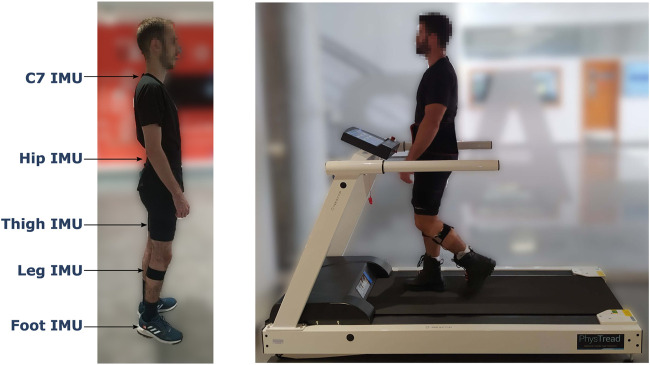
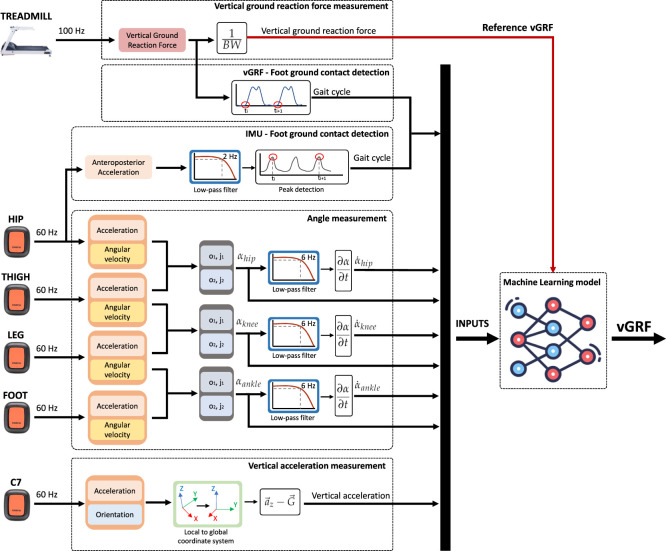
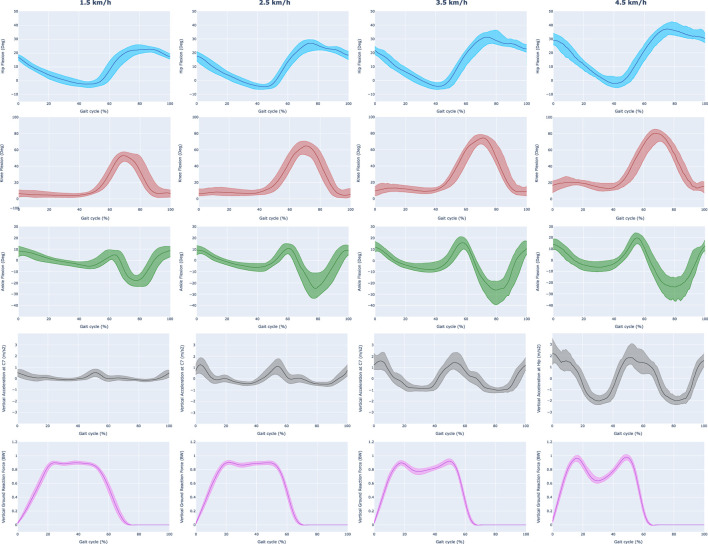
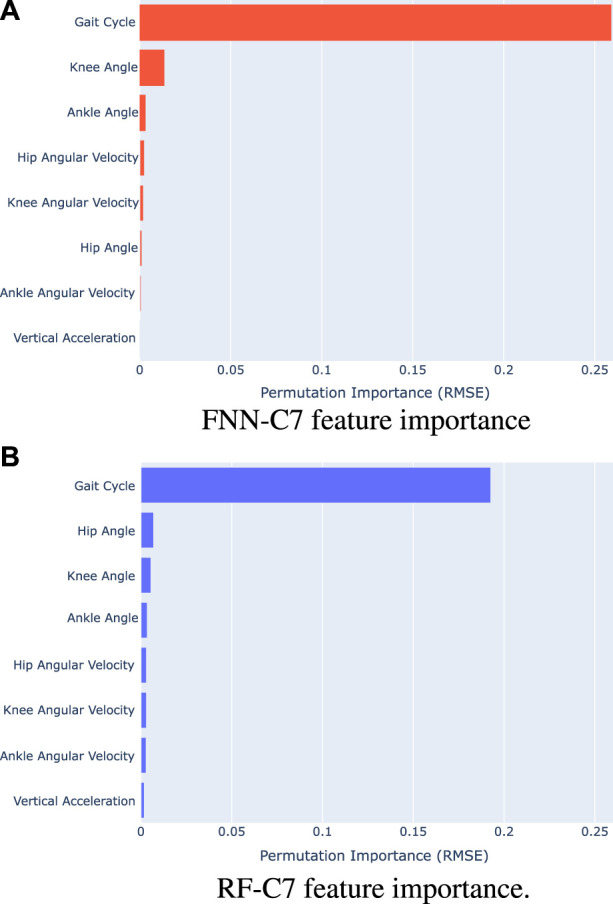
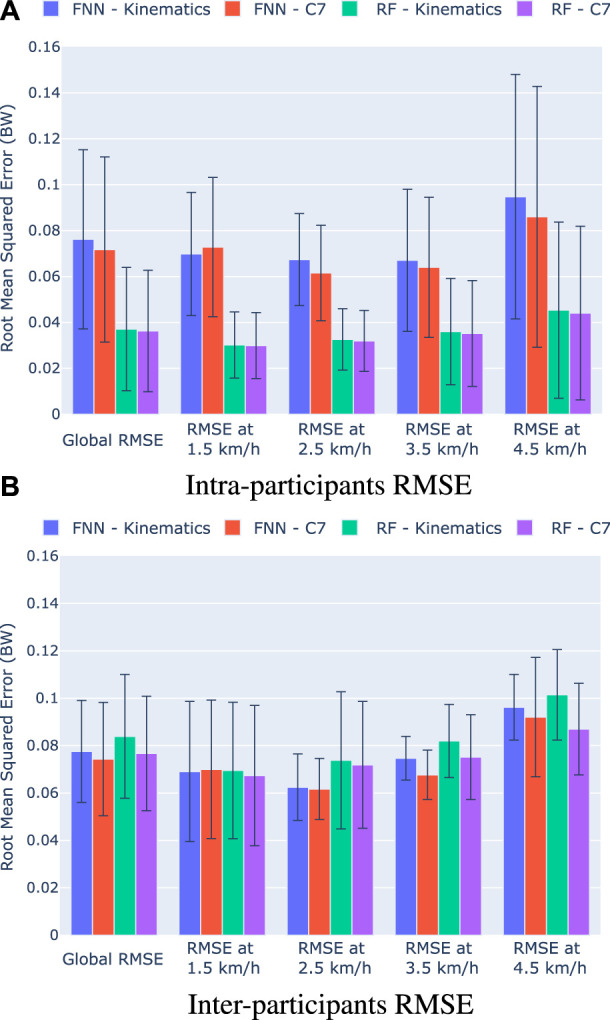
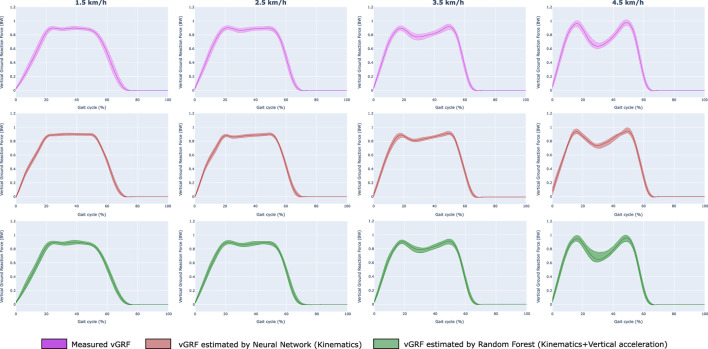
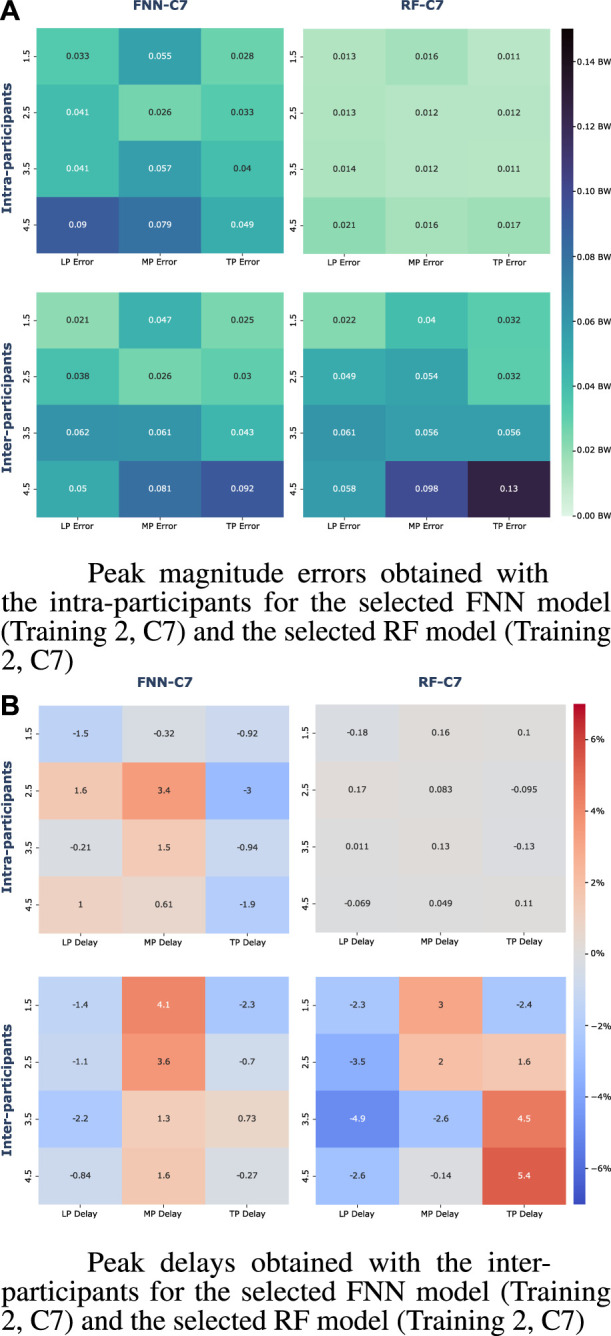
One of the most important forces generated during gait is the vertical ground reaction force (vGRF). This force can be measured using force plates, but these can limit the scope of gait analysis. This paper presents a method to estimate the vGRF using inertial measurement units (IMU) and machine learning techniques. Four wearable IMUs were used to obtain flexion/extension angles of the hip, knee, and ankle joints, and an IMU placed over the C7 vertebra to measure vertical acceleration. We trained and compared the performance of two machine learning algorithms: feedforward neural networks (FNN) and random forest (RF). We investigated the importance of the inputs introduced into the models and analyzed in detail the contribution of lower limb kinematics and vertical acceleration to model performance. The results suggest that the inclusion of vertical acceleration increases the root mean square error in the FNN, while the RF appears to decrease it. We also analyzed the ability of the models to construct the force signal, with particular emphasis on the magnitude and timing of the vGRF peaks. Using the proposed method, we concluded that FNN and RF models can estimate the vGRF with high accuracy.
Overview
The claims and statistics of this paper haven’t been checked yet.
Free: it reads the open-access text and checks the first 5 claims that cite a source we can check. Create a free account to check every claim.
Integrity signals
Registry
Cites
Statistics
Figures
Verification
Claims the paper makes
The claims and statistics of this paper haven’t been checked yet.
Free: it reads the open-access text and checks the first 5 claims that cite a source we can check. Create a free account to check every claim.
Claims other papers make about this one
Each is checked against this paper’s own text: does it say what the citing paper says it does?
The source backs part of the claim, not all of it — or backs it for a different population, condition or comparison.
In the citing paper
“Moreover, the strong correlation between vertical acceleration peaks and ground reaction force (GRF) reflects the energy output efficiency of lower limb muscles 67 , which can be used to quantify motor ability and assist rehabilitation training (Fig. 3a) 68 .”
From Recent advances in intelligent wearable systems: from multiscale biomechanical features towards human motion intent prediction (2026) · cites this paper as [67]
Experimental — accuracy not yet measured
Self-check
Percentages, sums and reported differences re-computed from the paper’s own numbers.
The self-check needs the paper’s full text.
Citations
Cites
Adam: A Method for Stochastic Optimization
Kingma, D. P., & Ba, J. (2014) · arXiv · doi:10.48550/arxiv.1412.6980 · Cited by 98,946 · cited 1×
“We have used the Recti fi ed Linear Unit (ReLu) as the activation function of the neurons, the Adam algorithm (Kingma and Ba, 2014) as the optimizer to adjust the network weights, and the RMSE as the loss function.”
MethodScikit-learn: Machine Learning in Python
Pedregosa, F., Varoquaux, G., Gramfort, A., Michel, V., Thirion, B., Grisel, O., Blondel, M., Müller, A., Nothman, J., Louppe, G., et al. (2012) · arXiv · doi:10.48550/arxiv.1201.0490 · Cited by 71,016 · cited 1×
“The RF models have been trained with SciKit Learn Python Library (Pedregosa et al., 2011).”
Method(2014) · Cited by 33,419
Permutation importance: a corrected feature importance measure
Altmann, A., Toloşi, L., Sander, O., & Lengauer, T. (2010) · Bioinformatics · doi:10.1093/bioinformatics/btq134 · Cited by 2,843 · cited 1×
“To understand the influence of the angles, the angular velocities, the vertical acceleration, and the cycle gait in the training of the FNN and RFmodels, we have calculated the feature importance by feature permutation (Altmann et al., 2010).”
MethodIntroduction to multi-layer feed-forward neural networks
Svozil, D., Kvasnicka, V., & Pospichal, J. (1997) · Chemometrics and Intelligent Laboratory Systems · doi:10.1016/s0169-7439(97)00061-0 · Cited by 1,600 · cited 2×
“The FNN models are a kind of arti fi cial neural networks based on neurons that receive an input signal and process them by the activation function to an output signal (Svozil et al., 1997; Sharma et al., 2017).”
BackgroundLearning to learn by gradient descent by gradient descent
Andrychowicz, M., Denil, M., Gomez, S., Hoffman, M. W., Pfau, D., Schaul, T., Shillingford, B., & de Freitas, N. (2016) · arXiv · doi:10.48550/arxiv.1606.04474 · Cited by 1,486 · cited 1×
“The adjustment of the weights of the neural network is usually performed by back-propagation, employing a non-linear optimization method such as the gradient descent algorithm (Andrychowicz et al., 2016).”
MethodACTIVATION FUNCTIONS IN NEURAL NETWORKS
Sharma, S., Sharma, S., & Athaiya, A. (2020) · International Journal of Engineering Applied Sciences and Technology · doi:10.33564/ijeast.2020.v04i12.054 · Cited by 1,197 · cited 1×
“The FNN models are a kind of arti fi cial neural networks based on neurons that receive an input signal and process them by the activation function to an output signal (Svozil et al., 1997; Sharma et al., 2017).”
Assessment of spatio-temporal gait parameters from trunk accelerations during human walking
Zijlstra, W., & Hof, A. L. (2003) · Gait & Posture · doi:10.1016/s0966-6362(02)00190-x · Cited by 870 · cited 1×
“To identify the foot contact in the IMU data (inputs of the model) we have made use of the hip acceleration (Zijlstra and Hof, 2003).”
MethodIMU-Based Joint Angle Measurement for Gait Analysis
Seel, T., Raisch, J., & Schauer, T. (2014) · Sensors · doi:10.3390/s140406891 · Cited by 867 · cited 2×
“was used to estimate the joint angles by means of the accelerometer and gyroscope data provided by the sensors (Seel et al., 2014).”
MethodOverfitting and undercomputing in machine learning
Dietterich, T. (1995) · ACM Computing Surveys · doi:10.1145/212094.212114 · Cited by 757 · cited 2×
“It is usual to obtain an increase in the error with inter-participant data, but the behavior of the RF models might indicate that they tend to overfit more than the FNN models, which is a known problem on algorithms based on decision trees (Dietterich, 1995).”
Method
Research works printed but not linked: 1
- Gulli A. Pal S. (2017). Deep learning with Keras. Birmingham: Packt Publishing Ltd.
Cited by
Multibody dynamics-based musculoskeletal modeling for gait analysis: a systematic review
Abdullah, M., Hulleck, A. A., Katmah, R., Khalaf, K. A., & Rich, M. E. (2024) · Journal of NeuroEngineering and Rehabilitation · doi:10.1186/s12984-024-01458-y · Cited by 66
Yamaguchi, T., Takahashi, Y., & Sasaki, Y. (2023) · Sensors · doi:10.3390/s23218985 · Cited by 21
Martínez-Pascual, D., Catalan, J. M., Blanco, A., Sanchís, M., Arán‐Aís, F., & García-Aracil, N. (2024) · IEEE Sensors Journal · doi:10.1109/jsen.2024.3400296 · Cited by 19
“2, which is based on previous studies [38], [39].”
BackgroundSelf-citationChen, S., Peng, C., Yang, B., Lin, J., Zhou, L., Jiang, Z., Liu, Z., Liu, Y., & Tang, L. (2026) · npj Artificial Intelligence · doi:10.1038/s44387-026-00083-5 · Cited by 9
Liu, Y., Liu, R., Wan, X., Chen, C., Wang, Y., Yu, W., Ouyang, J., Qian, L., & Liu, G. (2024) · IEEE Transactions on Neural Systems and Rehabilitation Engineering · doi:10.1109/tnsre.2024.3451651 · Cited by 7
“Key indicators comprised the first (GRF-F) during the loading response (LR) phase and the second peak of GRF (GRF-S) during the terminal stance (Tst) phase [40].”
BackgroundBedon, C., Sciomenta, M., & Mazelli, A. (2025) · Sensors · doi:10.3390/s25051387 · Cited by 5
Chen, T., Xu, D., Wang, M., Zhou, Z., Jie, T., Zhou, H., Yuan, Y., Baker, J. S., Gao, Z., & Gu, Y. (2025) · Clinical Biomechanics · doi:10.1016/j.clinbiomech.2025.106663 · Cited by 5
Junior, A. G. L., Silveira, M., Nedoma, J., & Martínek, R. (2025) · Biosensors · doi:10.3390/bios15090623 · Cited by 6
“As a result, the GRF is a useful tool for distinguishing between normal and pathological gait [21] and can also help predict the risk of ulceration in certain conditions [22].”
Tang, B., Zhu, M., Hu, Z., Ding, Y., Chen, S., & Li, Y. (2024) · Frontiers in Bioengineering and Biotechnology · doi:10.3389/fbioe.2024.1433861 · Cited by 5
Hulleck, A. A., Abdullah, M., Rich, M. E., Katmah, R., Khalaf, K. A., & Shehhi, A. A. (2024) · doi:10.36227/techrxiv.172954093.39157600/v1 · Cited by 2
Meng, Q., Yang, Z., Xue, Y., Zhou, L.-X., Zhang, N., Xiao, M., Feng, X., & Bao, C. (2026) · Frontiers in Bioengineering and Biotechnology · doi:10.3389/fbioe.2026.1871692 · Cited by 1
Zhang, L. Y., Yao, H., Fu, S., & Chien, J. H. (2026) · Experimental Physiology · doi:10.1113/ep093186 · Cited by 1
Batey, L., Jackson, E., Zeng, C., & Pillay, S. B. (2026) · Bioengineering · doi:10.3390/bioengineering13050530 · Cited by 1
“Clinicians and researchers focus heavily on the vertical component (vGRF), as it serves as the primary force during gait and a metric for characterizing biomechanical patterns and observing material influence [10–12].”
Lee, C. J., & Lee, J. (2025) · Journal of the Korean Society for Precision Engineering · doi:10.7736/jkspe.025.022
Aramaki, Y. (2025) · Journal of Physical Therapy Science · doi:10.1589/jpts.37.474
“Recently, the use of small wearable sensors has attracted attention as simple and low-cost devices for measuring posture and gait 4–6 ) .”
Hernandez, J. B., Gu, O., Elassa, A., Sharobim, M., Santana, S., & Son, J. (2025) · medRxiv · doi:10.1101/2025.10.14.25337892
Xu, L., Shen, J., Zhang, Y., Kang, Y., Gao, Q. Y., Huo, Z., Shi, H., An, J., Zhang, P., Zeng, P., et al. (2026) · European journal of medical research · doi:10.1186/s40001-026-04654-9
“Since kinetic gait parameters derive directly from the force-generating processes [18–20].”
Haymanot, T. B., Ali, A. N., Rao, D. N., & Getnet, T. G. (2026) · Journal of Engineering · doi:10.1155/je/4002846
Symmetry index-based gait improvement prediction using a CNN-LSTM-attention framework
Pushpalatha, O., & Ramesh, P. (2026) · IAES International Journal of Artificial Intelligence · doi:10.11591/ijai.v15.i4.pp3625-3636
Riaz, H., & Jiang, H. (2026) · Journal of Bodywork and Movement Therapies · doi:10.1016/j.jbmt.2026.08.015
Rodríguez-Granados, E. J., Urriolagoitia-Sosa, G., Romero-Ángeles, B., Gomez-Niebla, J. A., Guereca-Ibarra, J. R., Suarez-Hernandez, M. D. L. L., Rocha-Martinez, M. N., Carmona-Hernández, E. E., Lugo-Chacon, L. I., & Ramirez-Sanchez, G. (2026) · Diagnostics · doi:10.3390/diagnostics16162588
“First, the Move AI/Blender deployment should be repeated with synchronized force plates or another kinetic reference system, allowing direct quantitative validation of the estimated GRF and CoP [13,18,38–40].”
Fernández, G., Iglesias-Pordomingo, Á., Magdaleno, Á., & Lorenzana, A. (2026) · Results in Engineering · doi:10.1016/j.rineng.2026.112722
Jiao, Y., Huang, G., Huang, X., Bian, Y., & Wu, B. (2026) · Sensors · doi:10.3390/s26196307
Metadata
- Authors
- Martínez-Pascual, D., Catalán, J. M., Blanco-Ivorra, A., Sanchís, M., Arán-Ais, F., & García-Aracil, N.
- Affiliations
- Universitat de Miguel Hernández d'Elx (ES)
- Instituto Tecnológico del Calzado y Conexas (ES)
- Corresponding author
- Martínez-Pascual, David
- Venue
- Frontiers in Bioengineering and Biotechnology
- Publisher
- Frontiers Media SA
- Published
- 2023-09-29
- Volume
- 11
- Pages
- 1199459-1199459
- ISSN
- 2296-4185 (ISSN-L)
- PMC
- PMC10570513
- OpenAlex
- W4387166321
- Cited by
- 21
- References
- 37
- Citations by year
- 2026: 10 · 2025: 6 · 2024: 4 · 2023: 1
- FWCI
- 1.66
- Type
- journal article
- Language
- en
- Open access
- gold
- doi.org
- Licence
- Locations
- Frontiers in Bioengineering and Biotechnology (publishedVersion, cc-by)
- PubMed Central (publishedVersion, cc-by)
- PubMed (publishedVersion)
- DOAJ (DOAJ: Directory of Open Access Journals) (submittedVersion, cc-by-sa)
- Funders
- European Commission
- Ministerio de Ciencia e Innovación
- Ministerio de Universidades
- NextGenerationEU
- Topics
- Physical Sciences › Engineering › Biomedical Engineering › Lower Extremity Biomechanics and Pathologies
- Physical Sciences › Engineering › Biomedical Engineering › Gait Recognition and Analysis
- Physical Sciences › Computer Science › Computer Vision and Pattern Recognition › Context-Aware Activity Recognition Systems
- Keywords
- vertical ground reaction force, gait analysis, wearable inertial sensors, inertial measurement unit, lower limb kinematics, vertical acceleration, force estimation, feedforward neural networks, random forest, feature importance
About these checks
Registry, retraction, Cites and statistics results are computed, not judged, with one exception: a printed reference that no index lists is read once by a model before it counts as a citation error. Claims are extracted by a model and kept only when their quote appears verbatim in the text; each cited source is then checked, with a model’s help, for whether it says what the claim relies on. Those verdicts can be wrong — read the claim’s quote and the cited source before relying on one.
Statistics and arithmetic are recomputed, not judged.
Confidence bands are shown only for fields calibrated on our annotated test set. None is calibrated yet, so no band is shown.
What counts as a claim ›How we measure confidence ›How we check this ›
Are you an author, or do you see a problem with this page? Request a review
Data sources
Bibliographic data: Semantic Scholar, OpenAlex, Crossref.
Contains information from the Semantic Scholar Academic Graph Datasets, made available under the ODC Attribution License (ODC-BY 1.0).
Semantic Scholar’s data is described in: Kinney, R., et al. (2023). The Semantic Scholar Open Data Platform. arXiv:2301.10140.
