

Hashtags and resistance on TikTok: cultural, discursive, and algorithmic dimensions
Open accessThe DOI matches its Crossref record; 34 of the 34 references it cites were found in a registry or an index; none of the 36 sources its claims cite is checked for support yet.
Abstract
TikTok’s algorithmic curation and short-form, remixable features create a fertile ground for everyday forms of resistance and civic expression. This study examines how AI-related conversations on TikTok convey resistance through the strategic utilization of platform affordances. We compiled a corpus of 1,497 videos and conducted a three-stage analysis: (1) hashtag co-occurrence to identify thematic clusters; (2) examination of engagement metrics (views, likes, comments, shares) about the number and type of hashtags; and (3) multimodal narrative analysis of selected high-impact videos using Transana. Results reveal three thematic clusters, narrative creativity, algorithmic optimization, and critical commentary, that intersect with three specific forms of resistance identified in the narrative analysis: algorithmic resistance (tactics to subvert visibility rules), cultural resistance (re-appropriation of popular codes and shared aesthetics), and discursive resistance (alternative framings and counter-narratives). Engagement patterns suggest that reach is not solely determined by the number of hashtags but by their relevance and the combination strategy. Qualitative analysis reveals how creators use editing, sound, captions, and visual devices to embed critical messages within algorithmically governed circuits. The study presents an integrative framework that connects large-scale metrics and metadata with micro-narrative analysis. It demonstrates how affect, visibility, and multimodal creativity converge in digital resistance. These findings advance our understanding of how memes and short-form narratives evolve into situated acts of civic expression, suggesting implications for the design of recommendation systems, the study of algorithmic affordances, and the support of civic imagination in digital ecologies.
Overview
CoChat Summary
TL;DR
This study examines how AI-related conversations on TikTok convey resistance through hashtags and multimodal narratives, combining large-scale hashtag co-occurrence and engagement metrics with qualitative video analysis. It proposes an integrative framework linking algorithmic, cultural, and discursive forms of resistance.
Key findings
- Hashtag co-occurrence revealed three thematic clusters: narrative creativity, algorithmic optimization, and critical commentary, which intersect with three resistance forms: algorithmic, cultural, and discursive.
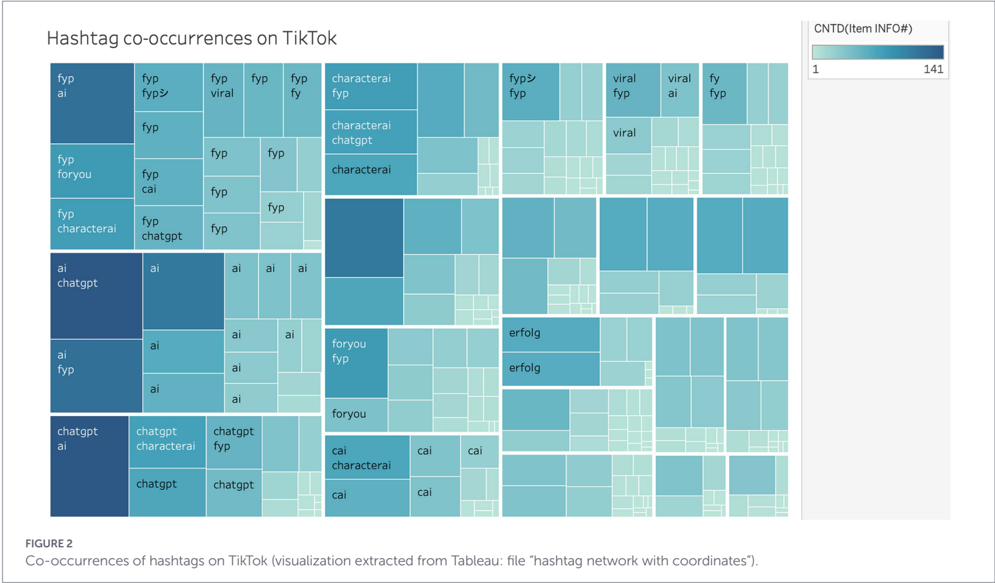
- Frequent co-occurrences included #chatgpt + #story (20), #chatgpt + #storytelling (13), #fyp + #viral (15), and #motivation + #mindset (12).
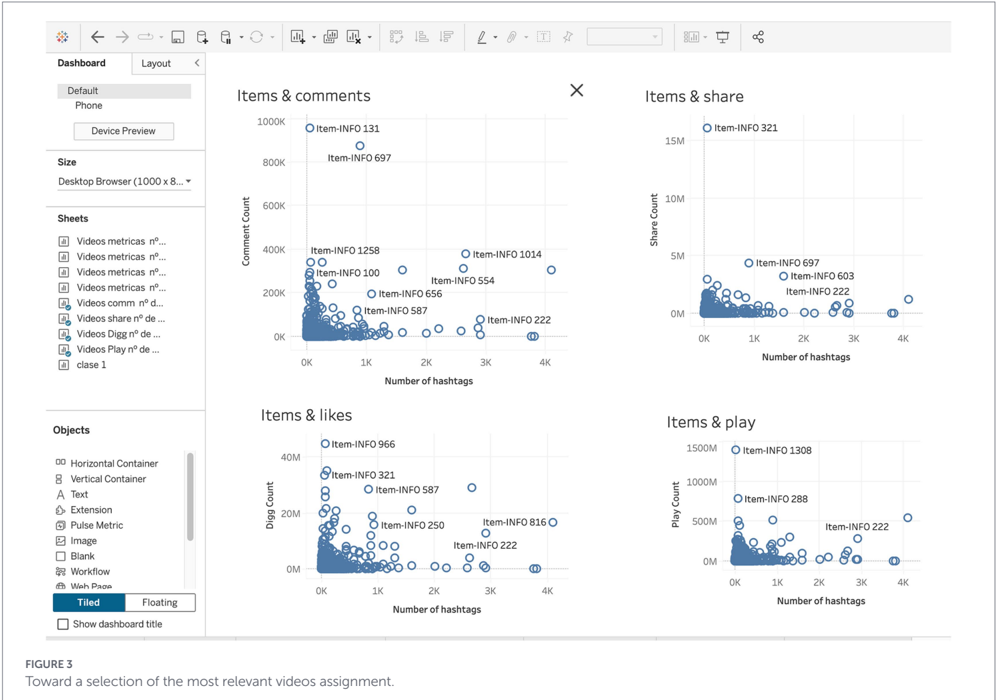
- Engagement was nonlinear: reach was not determined solely by the number of hashtags but by their relevance and combination strategy. Selected high-impact videos included Item-INFO 966 (62.4 million views, 5.6 million likes) and Item-INFO 288 (97.6 million views, 1 million likes).
- Qualitative analysis showed creators used editing, sound, captions, and visual devices to embed critical messages within algorithmically governed circuits, with resistance tactics often hybridizing algorithmic, cultural, and discursive dimensions.
Methods
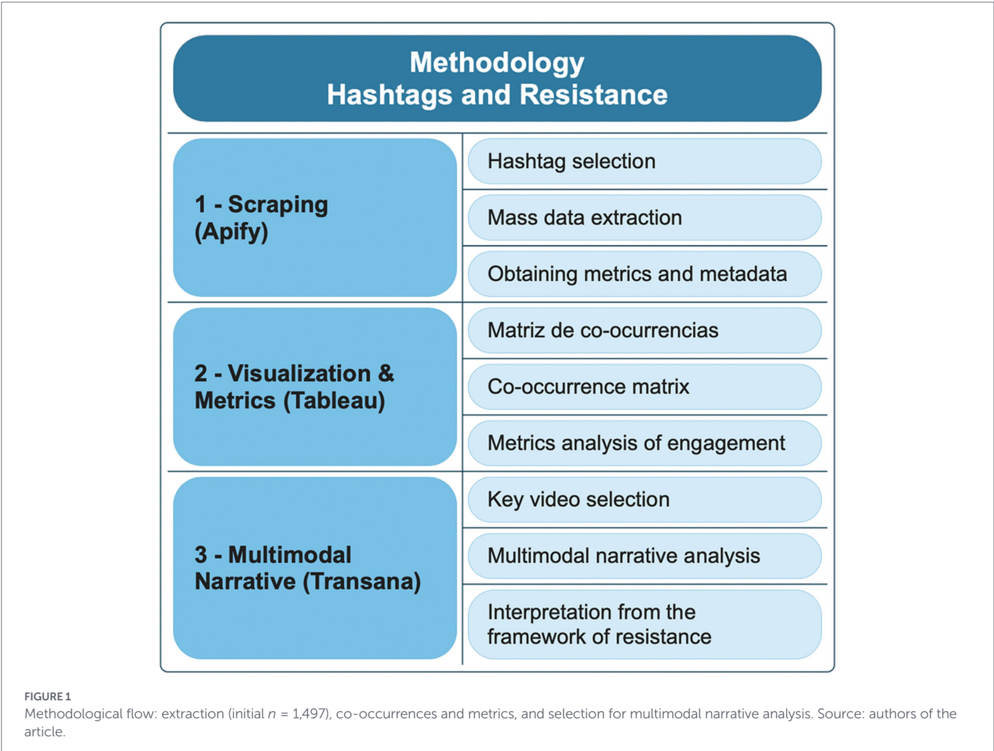
- Mixed-methods, deductive–inductive design. An initial corpus of 1,497 TikTok videos was scraped with Apify using selected hashtags, including #aiandmedia (199), #AiandSociety (173), #aichatbots (193), #aiinformation (190), #aiinjournalism (196), #Ainews (141), #aistorytelling (200), #aistorytelling24 (185), and #no (20).
- Phase 1 used a hashtag co-occurrence matrix in Tableau to identify thematic clusters. Phase 2 examined engagement metrics (views, likes, comments, shares) in relation to the number and type of hashtags. Phase 3 conducted multimodal narrative analysis of selected high-impact videos using Transana, coding clips by narrative format, sequence type, visual/audio resources, production/staging, and tone/style.
- The qualitative phase focused on the videos in Table 1 (nine cases); the paper notes that one video could not be downloaded because the account hosting it had been deleted.
Limitations
- The paper states the corpus is exploratory and non-representative, focuses mainly on videos in English, and lacks longitudinal analysis to assess the persistence of the tactics.
- Evident from the text: the hashtag selection was exploratory rather than statistically representative, and the qualitative sample is small (nine videos in Table 1), with one video unavailable because its account was deleted.
Model-written summary. Check it against the paper before relying on it.
Integrity signals
Registry
Cites
Statistics
Figures
Verification
Claims the paper makes
0 Valid · 1 Not valid · 24 Not checked · 75 Own results and interpretations
A result the paper reports from its own data — it cites no other source for it, so there is none to check. The quote shows it is in the paper.
In the paper
“The analysis of hashtag co-occurrences identified three discursive nuclei, narrative creativity, algorithmic optimization, and critical commentary, that articulate digital conversation.”
§ Hashtags and resistance on TikTok: cultural, discursive, and algorithmic dimensions > 5 Discussion
plainstates an association- Asserted: passes — The authors put it forward as true.
- Checkable: passes — It can be checked against evidence.
- Load-bearing: passes — The paper’s conclusions depend on it.
- Based: passes — The paper gives a reason why it holds.
A result the paper reports from its own data — it cites no other source for it, so there is none to check. The quote shows it is in the paper.
In the paper
“The co-occurrence matrix shows how affect circulates along semantic routes that, although conditioned by algorithmic mediation, manage to articulate counter-narratives to dominant narratives.”
§ Hashtags and resistance on TikTok: cultural, discursive, and algorithmic dimensions > 5 Discussion
plainstates a cause- Asserted: passes — The authors put it forward as true.
- Checkable: passes — It can be checked against evidence.
- Load-bearing: passes — The paper’s conclusions depend on it.
- Based: passes — The paper gives a reason why it holds.
A result the paper reports from its own data — it cites no other source for it, so there is none to check. The quote shows it is in the paper.
In the paper
“The first core group of hashtags includes those in which AI, especially ChatGPT, is associated with storytelling and creative experimentation.”
§ Hashtags and resistance on TikTok: cultural, discursive, and algorithmic dimensions > 4.1.1 AI as a narrative and creative resource
plainstates an association- Asserted: passes — The authors put it forward as true.
- Checkable: passes — It can be checked against evidence.
- Load-bearing: passes — The paper’s conclusions depend on it.
- Based: passes — The paper gives a reason why it holds.
A result the paper reports from its own data — it cites no other source for it, so there is none to check. The quote shows it is in the paper.
In the paper
“It documents how resistance tactics rely greatly on cultural and affective reappropriation as well as on the manipulation of algorithmic logics.”
§ Hashtags and resistance on TikTok: cultural, discursive, and algorithmic dimensions > 6 Conclusion
boostedstates a cause- Asserted: passes — The authors put it forward as true.
- Checkable: passes — It can be checked against evidence.
- Load-bearing: passes — The paper’s conclusions depend on it.
- Based: passes — The paper gives a reason why it holds.
A result the paper reports from its own data — it cites no other source for it, so there is none to check. The quote shows it is in the paper.
In the paper
“The third core combines hashtags that introduce dimensions of interpretation, dissemination, and criticism.”
§ Hashtags and resistance on TikTok: cultural, discursive, and algorithmic dimensions > 4.1.3 Reflection and critical commentary on AI
plainstates an association- Asserted: passes — The authors put it forward as true.
- Checkable: passes — It can be checked against evidence.
- Load-bearing: passes — The paper’s conclusions depend on it.
- Based: passes — The paper gives a reason why it holds.
29 more claims
Create a free account to see all 100 claims and to verify the 13 references still open.
- It may state two separate claims as one. 43
- Probably not a substantial claim. 43
Self-check
Percentages, sums and reported differences re-computed from the paper’s own numbers.
Each contradiction between two passages listed here was confirmed by an independent check.
Rated major: it would touch a result — a value a result rests on, reported and recomputed p-values on opposite sides of the significance level, two passages that conflict with no sign which is right, or a cited work retracted before this paper was published.
In the paper
§ Hashtags and resistance on TikTok: cultural, discursive, and algorithmic dimensions > 4.2 Metrics as a selection tool
“Item-INFO 1308 (more than 1.4 billion views)”
§ Hashtags and resistance on TikTok: cultural, discursive, and algorithmic dimensions > 6 Conclusion
“| Item-INFO 1308 | A -Narrative creativity and AI tools | Cultural resistance | 279.000.000 | 588.500 | 8.719 | 1.875 | akunbelajarid, merdekabelajar, canvaforeducation, canvauntukpendidikan, canva |”
Rated major: it would touch a result — a value a result rests on, reported and recomputed p-values on opposite sides of the significance level, two passages that conflict with no sign which is right, or a cited work retracted before this paper was published.
In the paper
§ Hashtags and resistance on TikTok: cultural, discursive, and algorithmic dimensions > 4.3.2.3 Discursive resistance -(video 966)
“## 4.3.2.3 Discursive resistance -(video 966)”
§ Hashtags and resistance on TikTok: cultural, discursive, and algorithmic dimensions > 6 Conclusion
“| Item-INFO 966 | A -Narrative creativity and AI tools | Cultural resistance | 62.400.000 | 5.600.000 | 0 | 29.300 | sensoryplay, attentionautism, specialeducation, autismacceptance, autismtoys |”
Rated major: it would touch a result — a value a result rests on, reported and recomputed p-values on opposite sides of the significance level, two passages that conflict with no sign which is right, or a cited work retracted before this paper was published.
In the paper
§ Hashtags and resistance on TikTok: cultural, discursive, and algorithmic dimensions > 4.3.2.2 Cultural resistance -(video 1,014)
“qualitative analysis reassigned it to the cultural resistance dimension.”
§ Hashtags and resistance on TikTok: cultural, discursive, and algorithmic dimensions > 6 Conclusion
“| Item-INFO 1014 | A -Narrative creativity and AI tools | Discursive resistance | 3.000.000 | 709.500 | 9.195 | 16.700 | sydneynovak, itsalwayssunnyinphiladelphia, ferrisbuellersdayoff, neilperry, troyandabed |”
Rated major: it would touch a result — a value a result rests on, reported and recomputed p-values on opposite sides of the significance level, two passages that conflict with no sign which is right, or a cited work retracted before this paper was published.
In the paper
§ Hashtags and resistance on TikTok: cultural, discursive, and algorithmic dimensions > 4.2 Metrics as a selection tool
“Item-INFO 697 (850 K)”
§ Hashtags and resistance on TikTok: cultural, discursive, and algorithmic dimensions > 6 Conclusion
“| Item-INFO 697 | B -Algorithmic optimization and virality | Algorithmic resistance | 17.200.000 | 629.300 | 29.100 | 145.400 | aiart, ganart, neuralart, nightcafestudio, abstract |”
Rated major: it would touch a result — a value a result rests on, reported and recomputed p-values on opposite sides of the significance level, two passages that conflict with no sign which is right, or a cited work retracted before this paper was published.
In the paper
§ Hashtags and resistance on TikTok: cultural, discursive, and algorithmic dimensions > 4.2 Metrics as a selection tool
“Item-INFO 966 (45 million)”
§ Hashtags and resistance on TikTok: cultural, discursive, and algorithmic dimensions > 6 Conclusion
“| Item-INFO 966 | A -Narrative creativity and AI tools | Cultural resistance | 62.400.000 | 5.600.000 | 0 | 29.300 | sensoryplay, attentionautism, specialeducation, autismacceptance, autismtoys |”
1 more finding
Create a free account to see every finding of this check.
Citations
Cites
(2014) · Cited by 15,747
de Certeau, M. (1984) · Cited by 15,090
An Introduction to Qualitative Research
Flick, U. (2023) · SAGE Publications Ltd eBooks · doi:10.4135/9781036231712 · Cited by 8,198
The Cultural Politics of Emotion
Ahmed, S. (2014) · Edinburgh University Press eBooks · doi:10.1515/9780748691142 · Cited by 8,060
(1997) · Cited by 7,801
Braun, V., & Clarke, V. (2022) · Encyclopedia of Quality of Life and Well-Being Research · doi:10.1007/978-3-319-69909-7_3470-2 · Cited by 5,890
Data colonialism: rethinking big data’s relation to the contemporary subject
Couldry, N., & Mejias, U. A. (2019) · Television & New Media · doi:10.1177/1527476418796632 · Cited by 1,617
The pursuit of quality in grounded theory
Charmaz, K., & Thornberg, R. (2021) · Qualitative Research in Psychology · doi:10.1080/14780887.2020.1780357 · Cited by 1,221
Playing the visibility game: How digital influencers and algorithms negotiate influence on Instagram
Cotter, K. (2019) · New Media & Society · doi:10.1177/1461444818815684 · Cited by 1,025
Gillespie, T. (2014) · Media Technologies · doi:10.7551/mitpress/9042.003.0013 · Cited by 1,016
Research works printed but not linked: 15
- Boym, S. (2008). The Future of Nostalgia. New York: Basic Books.
- Braun, V., and Clarke, V. (2024). "Thematic analysis, " in The SAGE Handbook of Qualitative Research, eds. N. K. Denzin, Y. S. Lincoln, M. D. Giardina and G. S. U. Cannella. Sixth ed (Los Angeles: Sage), 901-940.
- Bucher, T. (2018). "If… Then: algorithmic power and politics, " in Oxford studies in digital politics, (New York: Oxford University Press).
- Chouliaraki, L. (2013). The Ironic Spectator: Solidarity in the Age of Post-Humanitarianism. Cambridge: Polity Press.
- Clark, T., Foster, L., Sloan, L., and Bryman, A. (2021). Bryman's social Research Methods. Oxford: Oxford University Press.
- Creswell, J. W., and Creswell, J. D. (2023). Research design: Qualitative, Quantitative, and Mixed Methods Approaches. Thousand Oaks: SAGE Publications.
- Fiske, J. (1989). Understanding popular culture. Boston: Unwin Hyman.
- Foucault, M. (1978). The History of Sexuality. Volume I: An Introduction. New York: Pantheon Books.
- Garcia-Canclini, N. (2005). Hybrid Cultures Strategies for Entering and Leaving Modernity. Minneapolis: University of Minnesota Press.
- Leaver, T., Highfield, T., and Abidin, C. (2020). Instagram: visual social media cultures. Cambridge: Polity Press.
- Lorde (2013). Ribs. Pure Heroine [Album]. Auckland: Universal Music New Zealand.
- Manovich, L., and Arielli, E. (2024). Artificial aesthetics. Availbale at: https://manovich. net/index.php/projects/artificial-aesthetics.
- Peters-Lazaro, G., Shresthova, S., and Jenkins, H. (2020). Popular Culture and the civic Imagination: case Studies of Creative social change. New York: New York University Press.
- Scott, J. C. (1985). Weapons of the Weak: Everyday Forms of Peasant Resistance. New Haven: Yale University Press.
- Scott, J. C. (1990). Domination and the arts of Resistance: hidden Transcripts. New Haven: Yale University Press.
Cited by
ChatGPT on TikTok: Multimodal Representations of Artificial Intelligence and Engagement Patterns
Liu, X., & Schäfer, M. S. (2026) · Emerging Media · doi:10.1177/27523543261475005 · Cited by 1
Cano, C. A. G., & Castillo, V. S. (2026) · SAP Netnography · doi:10.62486/net2026244
Narti, S., Indasari, F., Ibrahim, R. A. B., Agung, R. D., & Desty, H. (2026) · Journal Transnational Universal Studies · doi:10.58631/jtus.v1i11.274
Marriage in digital space: A social network analysis of marriage is scary discourse on TikTok
Anggraini, M., arianto, I. D., & Kusuma, A. (2026) · SIMULACRA JURNAL SOSIOLOGI · doi:10.21107/sml.v9i2.36172
Metadata
- Authors
- Martínez-Borda, R., Rubio-López, N., Infante-Pineda, S., & Lacasa, P.
- Affiliations
- Department of Philology, Communication and Documentation, The University of Alcalá
- Universidad Internacional de La Rioja (ES)
- Universidad de Alcalá (ES)
- Corresponding author
- Lacasa, Pilar
- Venue
- Frontiers in Communication
- Publisher
- Frontiers Media SA
- Published
- 2026-05-06
- Volume
- 11
- Pages
- 1687271
- ISSN
- 2297-900X (ISSN-L)
- OpenAlex
- W7160425216
- Cited by
- 4
- References
- 34
- Citations by year
- 2026: 4
- FWCI
- 14.89
- Type
- journal article
- Language
- en
- Open access
- gold
- doi.org
- Licence
- Locations
- Frontiers in Communication (publishedVersion, cc-by)
- e_Buah (publishedVersion, cc-by-nc-nd)
- DOAJ (DOAJ: Directory of Open Access Journals) (submittedVersion)
- Funders
- Universidad Internacional de La Rioja
- European Commission
- Universidad de Alcalá
- Ministerio de Asuntos Económicos y Transformación Digital, Gobierno de España (MINECO, RTI2018-098916-B-I00)
- Topics
- Social Sciences › Communication › Social Media and Politics
- Social Sciences › Communication › Media and Digital Communication
- Social Sciences › Gender Studies › Gender, Feminism, and Media
- Keywords
- TikTok, hashtags, resistance, algorithmic curation, algorithmic resistance, cultural resistance, discursive resistance, platform affordances, engagement metrics, multimodal narratives, counter-narratives, memes, short-form video, recommender systems
About these checks
Registry, retraction, Cites and statistics results are computed, not judged, with one exception: a printed reference that no index lists is read once by a model before it counts as a citation error. Claims are extracted by a model and kept only when their quote appears verbatim in the text; each cited source is then checked, with a model’s help, for whether it says what the claim relies on. Those verdicts can be wrong — read the claim’s quote and the cited source before relying on one.
A language model drew the claims from the paper on 2026-11-24, under version 3 of the claim definition (model deepseek-v4.1-flash, prompt extract-v3).
A second model labelled each claim on 2026-11-24 (model jev-1.13-20260917, definition revision gold-guideline-v0.2).
Statistics and arithmetic are recomputed, not judged.
Confidence bands are shown only for fields calibrated on our annotated test set. None is calibrated yet, so no band is shown.
What counts as a claim ›How we measure confidence ›How we check this ›
Are you an author, or do you see a problem with this page? Request a review
Data sources
Bibliographic data: Semantic Scholar, OpenAlex, Crossref.
Contains information from the Semantic Scholar Academic Graph Datasets, made available under the ODC Attribution License (ODC-BY 1.0).
Semantic Scholar’s data is described in: Kinney, R., et al. (2023). The Semantic Scholar Open Data Platform. arXiv:2301.10140.
